
JEE Main PYQ Plan for Beginners — Your First Real Roadmap
Starting with previous year questions (PYQs) can feel like stepping into someone else’s exam day — and that’s the exact advantage. PYQs are not a mysterious shortcut; they are a mirror. They show the style, the traps, the recurring concepts, and the timing pressure you will face in a full-length, three-hour session. This guide gently converts that mirror into a plan: simple, actionable, and beginner-friendly.
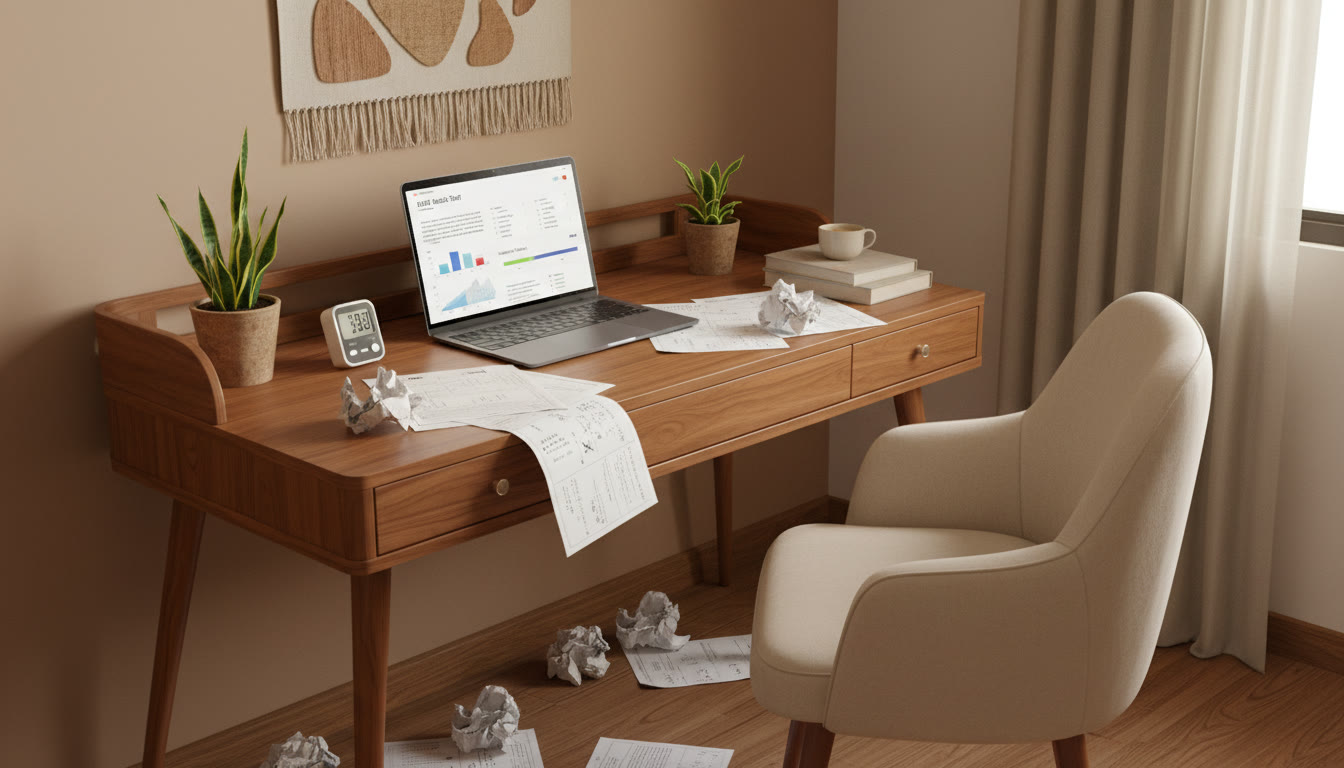
If you are at the beginning of your JEE Main journey, the goal is to build a repeatable routine: pick a chapter, solve its PYQs with intent, analyze mistakes, and then simulate exam conditions. Done consistently, this practice produces two outcomes: solid concept recall and reliable exam instincts. Below you’ll find why PYQs matter, how to structure practice around the actual exam format, a week-by-week plan you can adapt, and practical analysis templates that make every attempt teach you something concrete.
Why PYQs Are the Fastest Route to Clarity
They reveal what the exam setters value
Textbook problems teach mechanics; PYQs teach emphasis. After a few PYQs you’ll notice which derivations reappear, which trick substitutions are common, and how marks are distributed. That insight helps you prioritize topics instead of guessing.
They train test-ready timing and accuracy
Many beginners can solve a concept in isolation but slow down under timed pressure. PYQs practiced in timed blocks bridge that gap quickly and safely — especially when you pair them with a full-length, three-hour mock that mimics the test-day rhythm.
They expose the exact weak spots
Practice without analysis is practice without direction. PYQs highlight the same conceptual blind spots that cost marks in mocks — weak vector intuition in physics, stoichiometry speed in chemistry, or careless algebra slips in mathematics.
Understand the Exam Context (so your PYQ practice matches reality)
Format and question types
Keep these principles in mind as you practice: the exam emphasizes objective questions (multiple-choice and numerical-answer types), timing is tight, and negative marking exists for incorrect multiple-choice answers. Because objective formats don’t award partial credit for descriptive steps, treat derivations and diagrams as learning tools to secure conceptual clarity rather than sources of partial exam marks.
Three-hour full-length practice
Simulate the full three-hour rhythm regularly. When you practice end-to-end, you learn pacing, stamina, and question-selection strategy. Reserve at least one simulated three-hour mock every week when you are in the intense phase of your PYQ plan.
CBT realities and OMR-style discipline
Modern practice platforms are computer-based (CBT), but the discipline you adopt should mirror classic OMR habits: read carefully, mark answers deliberately, avoid impulsive erasures, and manage flagged questions systematically. That habit reduces careless mistakes and helps with error control under time pressure.
How to Begin: A 6-Step Beginner Routine for PYQs
Step 1 — Gather and categorize
- Collect PYQs topic-wise for Physics, Chemistry, and Mathematics (PCM). Note: JEE focuses on PCM; Biology is not part of JEE Main/Advanced examination syllabi, so do not mix preparation streams.
- Label each question by topic, subtopic, and perceived difficulty (easy/medium/hard).
Step 2 — Solve in small, focused batches
Start with 10–15 PYQs from one topic. Use a timer (25–40 minutes depending on complexity). Solve on paper, then check answers. If you get it right, mark how long it took; if wrong, flag a cause: conceptual gap, algebraic mistake, reading error, or time pressure.
Step 3 — Build an error log
Every mistake goes into a two-column error log: ‘What happened?’ and ‘Action plan’. Make the action plan tiny and testable: e.g., “Re-derive Maxwell’s equation set weekend” or “20 algebra drills: sign/expansion practice.”
Step 4 — Mix topic-wise drills with weekly full-length mocks
Alternate focused practice days with a weekly three-hour mock. Focused days sharpen concepts; mocks train selection, speed, and endurance.
Step 5 — Deep analysis after every mock
Don’t move on to more practice until you have analyzed each mock thoroughly. Find the root causes, not just symptoms. Convert recurring mistakes into micro-tasks in your study plan.
Step 6 — Retest and measure improvement
Re-attempt the same set of PYQs after 10–14 days to check retention and speed improvements. If time per question drops and accuracy rises, your approach is working; otherwise, tighten the feedback loop.
A Practical 10-Week PYQ Plan (Beginner-Friendly Timeline)
This adaptable plan assumes steady daily study; you can compress or expand weeks depending on how early you start. Treat the table as a template you personalize.
| Week | Core Focus | PYQ Target (topic-wise) | Mock Frequency | Key Action Items |
|---|---|---|---|---|
| 1 | Foundation: Mechanics (Physics), Basic Algebra (Math), Physical Chemistry | 30–50 questions | 1 short timed set + 1 diagnostic mini-mock | Categorize questions; start error log; time each attempt |
| 2 | Electrostatics & Circuits; Coordinate Geometry; Inorganic Chemistry | 30–50 questions | 1 full-length mock | Analyze weak subtopics; schedule micro-drills |
| 3 | Thermodynamics & Waves; Calculus basics; Organic foundations | 30–50 questions | 1 short timed set + 1 full mock | Practice multi-concept PYQs; resolve common traps |
| 4 | Optics & Modern Physics; Integrals & Applications; Reaction mechanisms | 40–60 questions | 1 full-length mock | Focus on speed and selective question choices |
| 5 | Vectors & 3D; Differential Equations; Chemical Bonding | 40–60 questions | 1 full mock | Deep analysis of recurring mistakes |
| 6 | Revision blocks of hardest topics (rotate) | Mixed revision: 60+ questions | 2 mocks (one timed, one diagnostic) | Retest earlier PYQs; check retention |
| 7 | Mixed practice and alternating full mocks | 80+ mixed PYQs | 1 full mock | Fine-tune test-day pacing; avoid overtraining |
| 8 | Problem clusters: high-yield chapters | 80–100 questions | 1 full mock | Polish accuracy on high-frequency concepts |
| 9 | Final consolidation: mixed sets and weak-topic repair | 100+ revision PYQs | 2 full mocks | Reduce careless errors; sharpen time decisions |
| 10 | Simulate exam week: full tests, careful analysis | Mixed revision only | 2 full mocks spaced by recovery days | Focus on calm execution and review error log |
How to Analyze Every PYQ: A Clean, Repeatable Template
Analysis turns practice into progress. Use this six-point checklist after each set or mock:
- Record raw score and time taken for the set.
- Classify each wrong answer as Conceptual / Calculation / Careless / Strategy (wrong approach).
- Estimate time lost per error (so you can judge whether it’s a pacing or understanding issue).
- Write a one-line root cause and a one-step corrective action (example: “Missed sign in vector addition — 10 algebra sign drills”).
- Choose one similar PYQ to re-attempt within 48 hours (spaced repetition).
- Mark topics that now move from ‘weak’ to ‘retest’ after corrective action.
Example breakdown (short)
Suppose you missed a physics PYQ on circular motion. Classify: Conceptual (centripetal vs centrifugal), Time lost: 4 minutes, Action: Re-derive equations from first principles and practice 5 related PYQs. Re-attempt a similar PYQ within two days to check retention.
Time Management and Exam Discipline
Start with comfort, then build speed
Don’t sprint on day one. Begin by solving for accuracy, then trim time per question by 10% every week. Use two clocks: one for overall three-hour pacing and a small timer for section blocks (e.g., 40–50 minutes per 30–35 question block) so you learn to switch gears quickly.
Selection strategy under negative marking
Because MCQs carry negative marks, avoid blind guessing. If you can eliminate one or more options confidently, your probabilistic edge improves. Train this elimination habit within every PYQ session: write down eliminated options and why.
Flagging and review discipline
In a real test, flagging helps you prioritize review time. In practice, emulate that: flag only when you can return within the allotted timeline. Excessive flagging invites panic; disciplined flagging creates focus.
Common Beginner Mistakes — And How to Fix Them
- Random guessing without elimination: Fix by practicing option-elimination drills.
- Skipping analysis: Fix by allocating 30–45 minutes after each mock solely to analysis.
- Over-reliance on shortcuts without understanding: Fix by re-deriving key formulas from basics weekly.
- Ignoring numerical-answer-type questions: Fix by scheduling mixed sets that contain both MCQs and numerical types.
- Studying too many topics at once: Fix by chunking study into topic blocks (two or three at a time) and rotating weekly.
Smart Techniques to Extract Maximum from PYQs
Cluster by concept, not by year
Group PYQs that test the same core idea, even if they come from different years. This accelerates pattern recognition and helps you see small variations on a theme.
Reverse-engineer repeated traps
When a concept appears repeatedly with similar traps (common algebra slip, sign error, trick in reading the question), write down the trap and practice three variations of that trap until it stops surprising you.
Active recall and spaced re-testing
After you solve and analyze a PYQ, schedule one short retest of the same concept within 48 hours and another after 10–14 days. Spaced re-testing cements long-term recall and reduces last-minute panic.

How Focused Tutoring Accelerates PYQ Mastery
When you’re starting out, guided feedback shortens the learning loop. A tutor who watches your error log and prescribes focused drills saves you weeks of trial-and-error. If you prefer a guided route, Sparkl’s one-on-one guidance can help you convert common mistakes into immediate micro-tasks. Well-structured personalized tutoring combines human insight with data-driven targeting to accelerate weak-topic repair.
Here’s what targeted support typically offers in the context of PYQs:
- Tailored study plans that prioritize your weakest topics while preserving revision cycles for stronger ones.
- Direct feedback on approach and test-style decision-making (what to attempt first, how long to spend on a question, when to move on).
- Expert-led micro-sessions focused on the exact types of PYQs that trouble you.
- AI-driven insights that spot patterns in your mistakes and suggest efficient drill sets.
Sample Daily Schedule for a PYQ-Focused Day
This is a balanced day for an intermediate beginner during a focused PYQ week. Adjust total hours according to your overall schedule.
- Morning (60–90 min): Topic warm-up + 10 focused PYQs (timed).
- Late morning (45 min): Targeted concept review of errors from the morning set.
- Afternoon (90–120 min): Topic 2 PYQ cluster + practice problems.
- Evening (180 min once or twice a week): Full-length mock (three-hour simulation) or sectional mock with full analysis afterward.
- Night (30–45 min): Light revision of the day’s error log and one re-attempt question.
Using an Error Log Like a Coach
Make your error log action-oriented. Each entry should have: question reference, error type, short correction steps, and a re-test date. Treat the log as a dynamic contract with yourself: you should be able to look at it and immediately know the next micro-task to remove that error from future attempts.
Measuring Progress — Practical Benchmarks
Rather than chasing absolute cutoffs, measure relative progress: faster time per correct question, fewer careless errors per mock, and a shrinking list of repeated conceptual mistakes. When a topic moves from ‘frequent mistakes’ to ‘occasional review’, you’ve made real progress.
Final Checklist Before Any Full-Length Mock
- Calibrate a three-hour, uninterrupted space and switch off distractions.
- Prepare materials: rough paper, timer, water, and a quiet environment.
- Decide your question-selection approach in advance (which sections to attempt first and what constitutes a ‘pass’ strategy).
- After the mock, allocate at least 45–90 minutes strictly for analysis; do not skip this.
Conclusion
PYQs are a diagnostic and corrective cycle: attempt, analyze, repair, retest. For beginners, the key is to keep the cycle short and focused — small, frequent practice sets nested inside regular full-length mock simulations, complemented by a tight error-log discipline. Follow a clear week-by-week template, analyze each failure for root causes, and convert those causes into tiny actionable tasks. That cycle is the academic engine that converts past questions into future confidence.















No Comments
Leave a comment Cancel