

Why Class 11 Matters: Build Habits That Last
If you’re in Class 11 and aiming for an IIT seat, think of this year as the engine room of your preparation. It’s the period where concepts are introduced, the muscle memory for problem solving is built, and — most importantly — your study habits are formed. Good time management in Class 11 doesn’t mean studying more hours than your friends; it means organizing those hours so each minute compounds into stronger understanding, faster problem solving, and higher accuracy on test day.

Understand the JEE ‘Game’ — Format, Pressure, and What Actually Counts
Before you design any plan, get the exam’s reality straight: modern JEE-style exams emphasize objective testing (multiple-choice and numerical type questions), disciplined full-length practice sessions that mimic a three-hour test, and penalties for careless guessing through negative marking. The test rewards correct selection and speed with accuracy — there are no partial marks for a half-baked written derivation in the main objective sections. So your time management must be wired around mastering ideas, speed, and precision.
Key exam realities every Class 11 student should keep front of mind
- MCQ and objective-style focus: practice fast recognition of concepts and methods.
- 3-hour full-length mock practice is essential to simulate exam endurance and pacing.
- Negative marking changes how you attempt questions — accuracy-first beats blind attempts.
- OMR discipline where applicable (in many practice or offline tests) — learn to mark answers carefully and review them under timed conditions.
- Syllabus alignment: prioritize topics from Physics, Chemistry, and Mathematics and treat school classes as core content-coverage opportunities.
- Diagrams and derivations are study tools; they help you understand and remember, but the exam often asks for quick application rather than long-form answers.
Time Management Philosophy: Quality Over Quantity
Effective time management for JEE is less about a rigid hourly target and more about consistent, focused practice pockets that respect attention span and recovery. You want to transform passive hours (reading or re-reading notes) into active hours (solving problems, explaining concepts aloud, testing yourself). That’s how a 2-hour focused slot can beat a scattered 4-hour session.
Core principles to guide daily planning
- Block your day: create fixed windows for deep work, school tasks, revision, and rest.
- Active practice first: problem solving, active recall, and test-style drills should be frontloaded.
- Short revision loops: regular short reviews of recently learned topics prevent forgetting.
- Mock tests as benchmarks: schedule and protect full three-hour mocks to check pacing and stamina.
- Reflect and adapt weekly: small adjustments beat big, infrequent overhauls.
Crafting a Weekly Study Template That Actually Works
Here’s a realistic weekly template that balances school, JEE prep, and rest. Tailor the hours to your daily school load — this is a model, not a rule. The idea: consistent coverage of three subjects, a dedicated slot for weak-topic repair, and a weekly focused problem session.
| Subject / Slot | Weekly Hours (sample) | Primary Focus | Example Tasks |
|---|---|---|---|
| Physics | 8–10 | Concept clarity + problem-solving | Derivation practice, 2 topic tests, 10 mixed problems |
| Chemistry | 7–9 | Reactions, mechanisms, numerical practice | Mechanism mapping, numerical sets, periodic revision |
| Mathematics | 8–10 | Problem-types, speed, accuracy | Graded problem sets, timed practice, topic list |
| Weak-topic repair / Tests | 4–6 | Targeted corrections | Error-log work, remedial problems, short revisions |
| Full-length / Mock | 3 (per mock) | Pacing & analysis | One full mock every 10–14 days in initial phases |
How to read and use this template
You’ll notice the weekly plan splits time by subject rather than stuffing one subject per day. That maintains continuity and prevents long gaps that cause forgetting. If school exams force a tweak, reduce mock frequency for that week but keep the daily micro-habits intact (15–30 minutes of active recall per subject).
Monthly Goals and Checkpoints: Small Targets, Big Gains
Working backward from the exam, set monthly milestones. Each milestone should have three parts: concept completion, problem mastery, and a timed check (a mini-test or a section of a full mock). That way you measure not just how much you studied but how well you can apply it under pressure.
| Month | Primary Focus | Mock/Test Frequency | Key Metric |
|---|---|---|---|
| Month 1 | Strong base in foundational chapters | 1 sectional test | Topic-wise accuracy |
| Month 2 | Problem pattern recognition | 1 full mock | Speed & net score trend |
| Month 3 | Weak-topic repair + mixed sets | 1 full mock | Error-type reduction |
Daily Routine: Micro-Habits That Build Momentum
Precision beats intensity. A typical productive day blends school responsibilities with targeted JEE practice. Here’s a flexible template for a busy Class 11 student:
- Morning (20–40 min): Quick revision of what you learned the previous day — flashcards, key formulae, 3 recall questions.
- During school: Convert class examples into JEE-style problems mentally; flag topics to practice later.
- Afternoon/Evening (1.5–3.5 hours): Deep study slot — solve graded problems, focus on one subject per day for depth.
- Night (30–45 min): Light revision — error log, summary notes, or an easy conceptual read before sleep.
Mock Tests: Treat Them Like Experiments, Not Punishments
Mock tests are the single-most powerful tool for time management. They teach you pacing, question selection, and how to protect marks against negative marking. Start with fortnightly full-length mocks and increase frequency as you get closer to the exam window. Always follow a strict mock routine: pre-test sleep, test-conditions (3-hour uninterrupted block), and a calm post-test analysis session.
A simple three-hour pacing strategy
- First pass (45–60 minutes): Scan and solve the easiest questions across sections quickly — build a safety net of solved marks.
- Second pass (90 minutes): Tackle medium-difficulty problems and the ones that require calculated thought.
- Final pass (30–45 minutes): Attempt high-value remaining questions and re-check the marked answers for careless errors.
What to track in your mock analysis
- Time spent per question type and per topic.
- Accuracy versus attempted questions — are you losing marks to negative marking?
- Careless errors vs conceptual gaps — treat them differently in repair strategy.
- Net score trend over six to eight mocks — look for steady improvement, not one-off spikes.
Designing a Repair Plan: From Errors to Strengths
An error log is non-negotiable. After a test, identify the cause of each incorrect answer: was it a concept gap, a misread, a calculation slip, or a time shortage? Categorize errors and assign corrective tasks — a short revision, ten targeted problems, and a micro-test after two days to confirm the fix.
Study Techniques That Multiply Return on Time Spent
Use active learning techniques that compress forgetting and accelerate retrieval. Passive re-reading is the least efficient use of your hours.
- Active recall: Close the book and reconstruct an idea or solve a problem from memory.
- Spaced repetition: Revisit topics at increasing intervals.
- Interleaved practice: Mix problem types to train selection skills under pressure.
- Teach back: Explain a concept to a peer or an imaginary student — teaching reveals gaps instantly.
- Timed problem sets: Do shorter sets under time pressure to build speed without sacrificing accuracy.
Using Personalized Help without Losing Autonomy
One-on-one guidance can accelerate the journey by focusing on your specific weaknesses and building a tailored study plan. Personalized tutors can help restructure your weekly schedule when school load spikes or when you reach a plateau in a subject. AI-driven insights and diagnostic reports can make analysis faster and more precise.
If you consider guided support, Sparkl offers tailored study plans, expert tutors, and adaptive feedback that many students find useful for closing narrow gaps in speed or concept clarity. For example, pairing a focused weekly plan with one-on-one troubleshooting sessions reduces wasted hours on ineffective repetition.
Sample 6-Month Map for a Class 11 Student
Use this as a roadmap: concept build-up, mixed practice, mock acceleration, and targeted repair.
| Phase | Focus | Key Activity | Checkpoint |
|---|---|---|---|
| Months 1–2 | Strong basics | School + concept notebooks + weekly problem sets | Sectional test |
| Months 3–4 | Mixed practice | Interleaved problems + fortnightly full mocks | Net score improvement |
| Months 5–6 | Consolidation & speed | Daily timed sets + targeted error repair | Stable mock scores and narrowing weakness list |
Common Time-Management Pitfalls — And How to Fix Them
- Pitfall: Marathon sessions with poor focus. Fix: Break into 45–90 minute deep sessions with short active breaks.
- Pitfall: Neglecting error analysis. Fix: Spend a fixed portion of study time reviewing mistakes, not just collecting them.
- Pitfall: Overdoing long mocks early. Fix: Start with sectional practice and build to full three-hour mocks gradually.
- Pitfall: Too many resources. Fix: One good textbook per subject and a set of graded problem books is usually sufficient.
Balance, Burnout Prevention, and the Long Game
Preparation for competitive exams is a long-distance run. Sleep, nutrition, short daily exercise, and time off for hobbies are not luxuries — they are performance investments. Use weekly recovery slots: a social hour, a hobby session, or a light outdoor activity. These help sustain motivation and sharpen cognitive function when you return to study.
Tracking Progress: Simple Tools That Don’t Eat Your Time
Keep tracking lightweight but consistent. A basic spreadsheet or notebook that logs:
- Topic practiced, duration, and error-type
- Mock scores and net trends
- Top three weekly goals and whether they were achieved
This record becomes fuel for weekly adjustments. If a topic repeats in the error log more than twice, promote it to a focused repair slot.
Real Example: What an Ideal Study Day Looks Like
Here’s a practical, realistic sample for a school-going Class 11 student:
- 06:30–07:00 — Quick revision (formulas and 3 recall questions)
- 08:30–15:00 — School (use breaks for 10-minute flashcard reviews)
- 16:00–17:30 — Deep study: Mathematics focused problem set
- 17:45–18:15 — Short break and light exercise
- 18:30–20:00 — Physics concept work and numerical practice
- 20:15–21:00 — Chemistry: theory review and short questions
- 21:10–21:30 — Night review: error log and one-minute summary
Small Tools, Big Differences
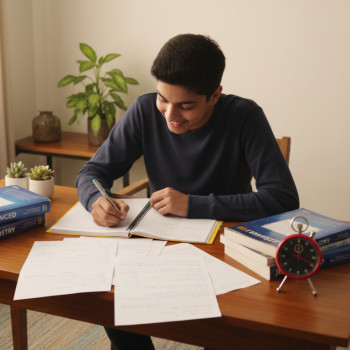
Invest in a few small study tools: a physical notebook for an error log, a timer for timed sets, and a simple calendar for blocking study sessions. If you use personalized tutoring any time, look for programs that provide tailored schedules and diagnostic feedback so each hour spent is efficient. For students seeking adaptive feedback, Sparkl‘s tutors and AI insights can help convert error patterns into targeted practice tasks without wasting time on irrelevant repetition.

Final Practical Checklist: A Week-by-Week To-Do List
- Week start: set 3 specific learning goals (one per subject).
- Mid-week: complete a short timed problem set and review mistakes immediately.
- Weekend: one full-length timed mock or two sectional mocks, followed by a detailed analysis session.
- Every fourth week: a longer review of all topics covered that month and adjust the next month’s schedule accordingly.
Conclusion
Effective JEE preparation in Class 11 is a steady accumulation of focused practice: clear concepts, scheduled active problem-solving, regular three-hour mock simulations, disciplined handling of negative marking and answer selection, and a compact repair routine driven by an honest error log. When your weekly plan balances school commitments, targeted practice, and recovery, you build the speed, accuracy, and endurance that competitive exams reward.






















No Comments
Leave a comment Cancel