

Mock Test Mastery: Turn Practice into Performance
Mock tests are not just practice—they are the bridge between what you know and what you can deliver under pressure. If you’ve been studying for months, the mock test is the moment your preparation shows up in exam clothes: timed, scanned, judged. Done right, a single three-hour full-length mock can deliver weeks of improvement; done casually, it can be a confidence-killer. This guide walks you through how to treat each mock as a focused experiment: simulate the exam, execute your plan, analyze with surgical precision, and iterate.
Keep in mind the exam format you are preparing for: it’s a multiple-choice, time-bound test conducted under strict OMR or computer-based discipline, with negative marking in place and no partial credit for partially worked-out answers. The core subjects you’ll focus on are Physics, Chemistry and Mathematics (PCM) — plan practice accordingly and avoid assuming any descriptive partial-marking will save a lost mark. Everything here is written to be evergreen: use these approaches across the current cycle and adapt small details as official instructions evolve.

Start Like It’s the Real Exam: Simulate Exam Conditions
To get honest feedback, you must recreate exam conditions. That means a full, uninterrupted three-hour block, identical order of sections, the same breaks (or lack of them), and the same rules about calculators or rough work. Treat every full mock as an assessment, not as additional study time. The purpose is to practice decision-making under pressure as much as to test content.
How to set up your simulation
- Choose a quiet room and a fixed start time; begin exactly when the clock reads the start minute.
- Use the same materials you will use on exam day—same pen type for OMR, same allowed stationery, and the same device setup if the test is computer-based.
- Turn off phones and notifications. Remove all study material from your desk—this is a performance test, not a study session.
- Keep an analogue watch or timer visible; rely on the same time-checking method you will use in the exam hall.
- Follow OMR discipline: no stray marks, fill bubbles fully, and avoid folding or smudging the sheet.
Before the test: a short checklist
- Warm up with 10–15 minutes of light revision—formula review or a single concept map, not solving new problems.
- Prepare stationery, water, and any permitted ID documents the night before.
- Plan your first and second target: a realistic target score and a fallback plan if you fall behind on time.
- Set up an honest timing rule for yourself: for example, aim for a minimum number of questions by midpoint, and adjust pacing if you lag.
Time Allocation and Practical Table
Three hours can feel both long and short; the difference is how you spend the minutes. Rather than rigidly clocking each question, use a section-based plan that reflects your strengths and the nature of each subject. Below is a practical allocation for a single 180-minute mock—tweak it to suit your personal speed and accuracy profile.
| Section | Suggested time (minutes) | Primary focus |
|---|---|---|
| Physics | 55–65 | Application of concepts, numerical set-ups, and careful use of units |
| Chemistry | 50–60 | Quick recall for inorganic, steady problem-solving in physical chemistry, and cautious reasoning in organics |
| Mathematics | 55–70 | Selection of solvable problems, accuracy, and efficient algebra/calculus steps |
| Total | 180 | One full exam simulation; includes short switching time between sections |
MCQ Tactics: Work the Question, Not the Clock
Multiple-choice questions reward clear thinking and ruthless selection. Your goal is correctly answered questions, not complex but unfinished work. Smart test-takers treat the paper like a set of opportunities to maximize net marks under negative marking.
On each question, follow this sequence
- Read actively: identify what is being asked before you look at the choices.
- Try to form a quick mental answer or the first step of the solution—this prevents being baited by tempting but wrong options.
- Scan the options: if your answer matches one, commit; if not, look for clear eliminations (physically cross out options on rough paper if allowed in CBT tools).
- If elimination leaves you with two options, use time-budget rules: if the expected gain outweighs the risk given the penalty, make a calculated guess; otherwise, mark and move on.
Speed vs accuracy: a balancing act
Speed alone without accuracy costs marks because of negative marking. Accuracy without speed leaves many easy marks on the table. The practical compromise is to have staged goals: reach a baseline number of attempted questions by the halfway mark, then switch to targeted attempts where you maximize confidence and value-per-minute. Use sectional pacing as a guide—if a section is consistently slow for you, practice specific timed drills on that subject, not more untimed study.
Managing Negative Marking
Negative marking changes the math of guessing. You should never assume a blind guess is safe. Instead, treat guessing as a probabilistic decision: the more options you can confidently eliminate, the higher the expected value of a guess. If you can reduce four options to two, a guess becomes much more attractive; if you can only eliminate one option, it often isn’t worth the risk.
- Never waste time on a question where you can’t eliminate at least one or two options quickly.
- Keep a mental rule for late-game guessing: if time is nearly up and you can eliminate a pair, guess; otherwise preserve your current score.
- Practice simulated guessing under timed conditions so your instincts are calibrated to the penalty structure.
Post-Mock Review: Turn Mistakes into Gains
A mock is only as valuable as the learning you extract afterward. Spend at least as much time analyzing as you did taking the test. The quality of your review—how honestly you categorize mistakes and how specifically you fix them—determines your improvement rate.
How to review: a focused routine
- Wait briefly: give yourself a short break (20–30 minutes) after the mock, then review with a fresh mind.
- Re-solve every incorrect or skipped question without the timer and write the full correct solution in your error log. If you got it right for the wrong reason, log that too.
- Classify each error by type (see table below) and record the root cause and targeted remedy.
- Schedule a short corrective session within 48 hours—re-solve similar questions and track whether the error reappears.
| Error Type | What it looks like | How to fix it |
|---|---|---|
| Silly/attention slip | Sign error, arithmetic mistake, misread units | Slow down for key steps, use checklist for units, practice error-free arithmetic drills |
| Conceptual gap | Unable to set up the equation or pick the right principle | Return to core theory, watch concise concept summaries, solve base-level problems repeatedly |
| Strategy/timing error | Spent too long on a hard problem; left easy ones | Practice selection strategy drills; learn to triage questions quickly |
Use an error log like a coach
Your error notebook is a living document. For each logged item include the question number, topic tag, error type, a short note on the fix, and one or two follow-up problems to practice. Over weeks you’ll begin to see clusters—once you notice a recurring concept or calculation that trips you, design a micro-plan to patch that hole.
Integrating Mocks into a Smart Study Plan
Mocks aren’t just tests; they are data points that guide your study choices. Early in the preparation cycle, use them to identify weak topics; later, use them for stamina, pacing, and stress management. The frequency should increase as the exam approaches: start with a few full mocks per month, increase to weekly cycles, and in the final phase use more focused mocks and daily mini-simulations for specific topics.
If you want targeted help turning mock analytics into a day-by-day plan, consider tailored coaching options. For example, Sparkl’s personalized tutoring can provide 1-on-1 guidance, tailored study plans, expert tutors and AI-driven insights that map mistakes to micro-lessons. Use such support only to accelerate your own disciplined practice, not to shortcut the essential loop: simulate, analyze, correct, repeat.
Psychology, Stamina, and the Exam-Day Routine
Mental readiness is as trainable as problem-solving. Mocks are your psychological rehearsals: every time you simulate the test environment you reduce novelty and stress. Build rituals that cue focus—simple things like a fixed warm-up routine, a 5-minute breathing exercise before you begin, and a post-test cooldown that prevents you from second-guessing your answers.
Practical daily habits
- Sleep and nutrition: in the final weeks, prioritize sleep cycles; cognitive function drops sharply on sleep deprivation.
- Micro-recovery: short breaks with light movement between study blocks preserve attention for longer sessions.
- Exposure therapy: do at least a few full mocks with room noise and minor interruptions so you learn to maintain focus.
OMR and Online Interface Discipline
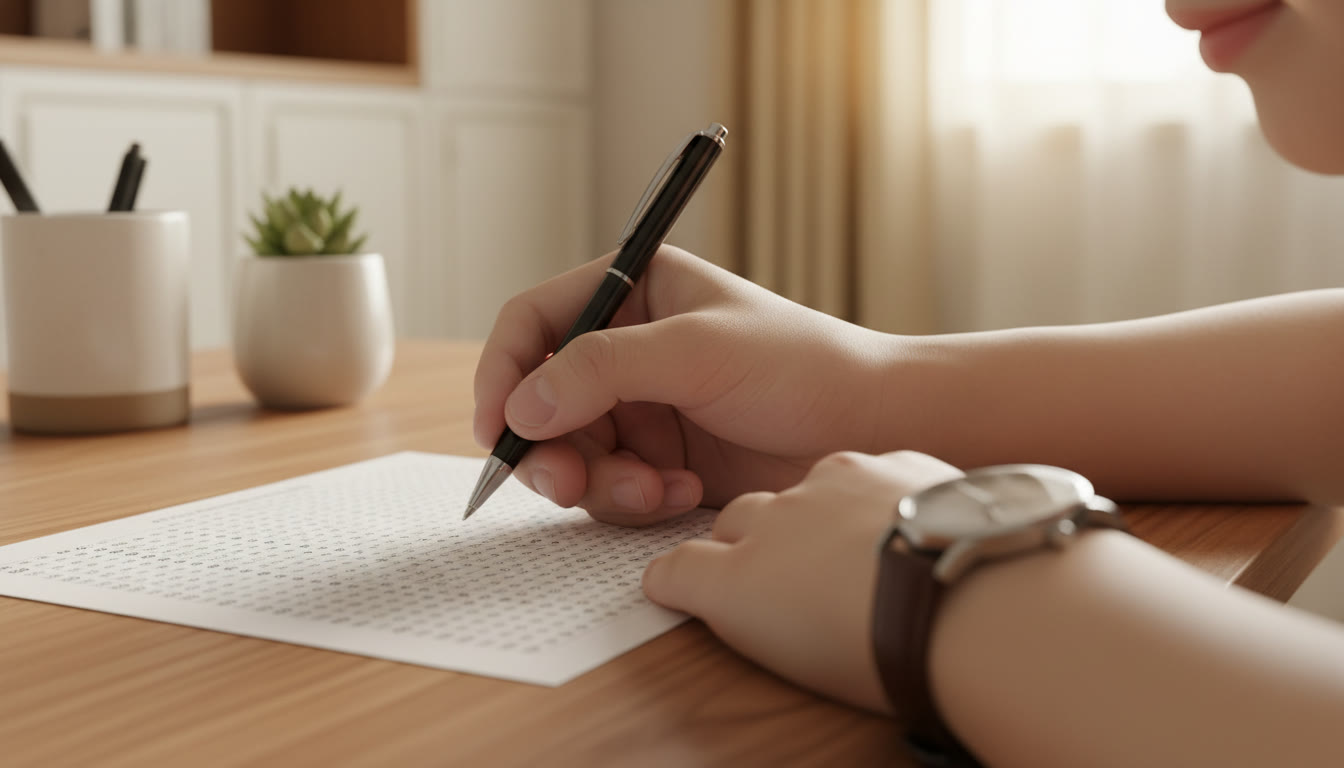
Small mistakes with the answer sheet or computer interface can lose precious marks. OMR discipline is a non-negotiable habit: accurate bubbling, matching question numbers, and clean pages are as important as solving the problem right.
OMR checklist
- Always confirm your roll number and test booklet code (if applicable) before you start.
- Fill bubbles fully and darkly; avoid stray marks near answer zones.
- If you change an answer, erase or correct carefully as per instructions—don’t make messy corrections.
- Keep rough work confined to allowed areas; avoid writing on the OMR bubble grid itself.
Computer-based test (CBT) tips
- Familiarize yourself with the navigation: how to mark for review, how to move between sections, and how to flag questions.
- Use the interface’s timer and question-status features to manage pacing; don’t rely on them exclusively—have your own time checkpoints.
- Before final submission, use any built-in review summary to ensure no questions were left unattempted accidentally.
Sample Weekly Mock Plan (Practical and Flexible)
Here’s a sample micro-cycle to make mocks meaningful while keeping room for focused study.
| Day | Activity | Purpose |
|---|---|---|
| Monday | Topic drills (Physics: Mechanics) | Strengthen core concepts |
| Wednesday | Timed sectional test (Chemistry) | Improve sectional speed and accuracy |
| Saturday | Full 3-hour mock + immediate light review | Performance and pacing rehearsal |
| Sunday | Deep review of mock errors + corrective practice | Close the feedback loop |
Common Pitfalls and How to Avoid Them
- Doing mocks as extra study time: treat them as assessments and keep focused study separate.
- Blaming low scores on test difficulty instead of actionable weaknesses—use the result to identify patterns, not excuses.
- Revisiting errors passively: redoing a question mentally is weaker than writing a full corrected solution, then solving variants.
- Over-practicing once-corrected mistakes: aim for spaced repetition; revisit after a few days to ensure retention.
- Ignoring physical readiness: long tests demand endurance—practice long sessions and recovery strategies.
Quick Revision Tools to Pair with Mocks
When time is limited, targeted tools yield big returns. Keep concise aids that help you before a mock or right after a weak exam.
- One-page formula sheets for each subject; make them yourself—writing aids memory.
- Concept flashcards for quick spot checks; review these during short breaks.
- Short error-spaced lists: your most frequent mistakes pasted on a page for a two-minute glance before a mock.
- Mini problem banks: 10-minute question sets focused on a single tricky topic so you can isolate weaknesses efficiently.
Final Preparation Rhythm
In the closing weeks before the exam, shift the emphasis: less new learning, more consolidation and mock-based calibration. Keep the following rhythm: one or two full mocks per week, daily micro-revisions of your error log, and stress-management routines that protect sleep and clarity. Each mock should refine an action plan: two things to stop doing, two things to start, and one measurable time-based goal to hit in the next mock.
Closing Thought
Mock tests are your laboratory: set up honest experiments, record precise results, correct the variables that fail, and repeat. When practice is structured and review is disciplined, mock tests stop being random trials and become the engine of steady improvement that converts preparation into reliable performance.














No Comments
Leave a comment Cancel