

Nail Your JEE Main Mock Test Accuracy: Why precision beats panic
Mocks are not just practice tests — they are mirrors. They show where your understanding is solid, where careless habits live, and where time pressure steals marks. If you treat a mock as a dress rehearsal for the exact conditions of the current cycle, you turn each test into the most productive study session possible: a diagnostic lab that refines your problem selection, pacing, and accuracy.

What we mean by accuracy (and why it matters more than raw attempts)
Accuracy = (Correct answers) / (Attempted questions). In MCQ-based, three-hour full-length mock practice — with negative marking and no partial-credit for objective problems — accuracy directly controls net score. Attempting every question without a plan invites avoidable negative marks. A steady rise in accuracy, even at the cost of fewer random attempts, reliably produces higher net scores over multiple mocks.
Understand the test frame: rules that shape smart choices
Key exam realities to internalize
- Format: MCQ-driven testing across Physics, Chemistry, and Mathematics; focus on concept clarity and swift application.
- Time: typical full-length mock mimics the three-hour window of the actual test; pacing matters more than rushed speed.
- Marking: negative marks are applied for incorrect options in many MCQs — avoid blind guessing; use elimination and educated guesses.
- OMR vs CBT: while the actual exam today is computerized in many cycles, some mock formats use OMR sheets; treat both seriously — accurate marking (OMR bubble discipline) or careful answer-clicking (CBT navigation) is essential.
- No partial credit: objective questions rarely give partial marks. A neat derivation helps learning but does not earn marks unless the selection is correct in the test interface.
Before the mock: a focused preparation checklist
Practical things to do in the 48–72 hours before
- Consolidate a single-page formula & concept sheet per subject — quick glanceability beats last-minute re-reading.
- Sleep, hydration, and a steady routine: the brain that’s rested reduces careless errors dramatically.
- Confirm test logistics: device charged if CBT; stationery and permitted ID ready if any offline component exists; know mock platform login details.
- Light review only: in the last 24 hours do low-stress active recall — flashcards, one-page derivations, 10–15 minute problem-solving bursts.
- Simulate conditions: practice once under full-time conditions for the current cycle (3 hours) at least weekly during serious preparation phases.
10-minute warm-up before the clock starts
- Do 5 quick mental math drills to warm numeric fluency.
- Skim your formula sheet; visualize two important derivations (one electrostatics/one calculus trick).
- Set a simple goal: target accuracy percentage and number of safe guesses allowed, not an attempted-question quota.
During the mock: tactics that protect your accuracy
Two rules to live by while the timer runs
- Rule 1 — No blind attempts: if elimination gives you a >50% chance of success, attempt; otherwise mark and move on.
- Rule 2 — Time-slice and rotate: keep moving between subjects if you’re stuck more than a set threshold (e.g., 3–4 minutes on a single problem).
Sample time-allocation table (180-minute mock)
| Segment | Duration | Goal | Actions |
|---|---|---|---|
| First pass (easy + medium) | 90 minutes | Secure all straightforward, high-return questions | Scan whole paper, solve quick MCQs, mark uncertain ones for review |
| Second pass (targeted medium + eliminations) | 60 minutes | Attempt questions with partial elimination or approachable calculation | Use elimination, plug options, short approximations |
| Final pass (tough questions + review) | 20–25 minutes | Attempt high-probability tough items and finalize answers | Choose only those you can solve confidently under time; resolve marking errors |
MCQ tactics that raise your hit-rate
- Elimination first: cross out impossible options. Two-option elimination raises success odds dramatically.
- Sanity checks: dimension/unit checks in physics and chemistry reduce silly mistakes.
- Plug-and-play: for algebraic or functional MCQs, substitute simple numbers to test choices faster than full derivation.
- Mark and move: if a question consumes more than your local threshold, mark it for review and continue; time lost chasing one question costs multiple guaranteed marks.
- Safe-guess budget: decide beforehand how many educated guesses you will risk given negative marking; stick to that budget.
OMR/CBT discipline (practical tips)
- If OMR is being used in a mock: fill one bubble firmly and fully, avoid stray marks, and re-check roll/ID entries before submission.
- For CBT: use the platform’s “mark for review” feature correctly and confirm that your final saved answers match what you intended to submit.
- Final five minutes: re-check the marked-for-review list and clear any accidental blank responses.
Subject-wise micro-tactics: small habits, big score gains
Physics
- Read the question fully: many students miss qualifiers like “net,” “instantaneous,” or boundary conditions.
- Sketch quickly: a diagram reduces misreading errors and often suggests the correct method immediately.
- Approximate before solving: rough magnitude checks identify wrong options fast.
Chemistry
- Separate the subject mentally: physical, organic, inorganic — each has its own quick-check tactics.
- Physical chem: units and limiting-case checks catch algebra mistakes.
- Organic: apply reaction logic over rote memorization; if mechanism seems off, options often reveal the right path.
Mathematics
- Start with simpler methods: substitution or inspection beats heavy algebra when time is limited.
- Keep a small set of standard transformations (trig identities, inequalities) in front of you while solving.
- Don’t chase algebraic manipulations without checking if an option can be tested directly.
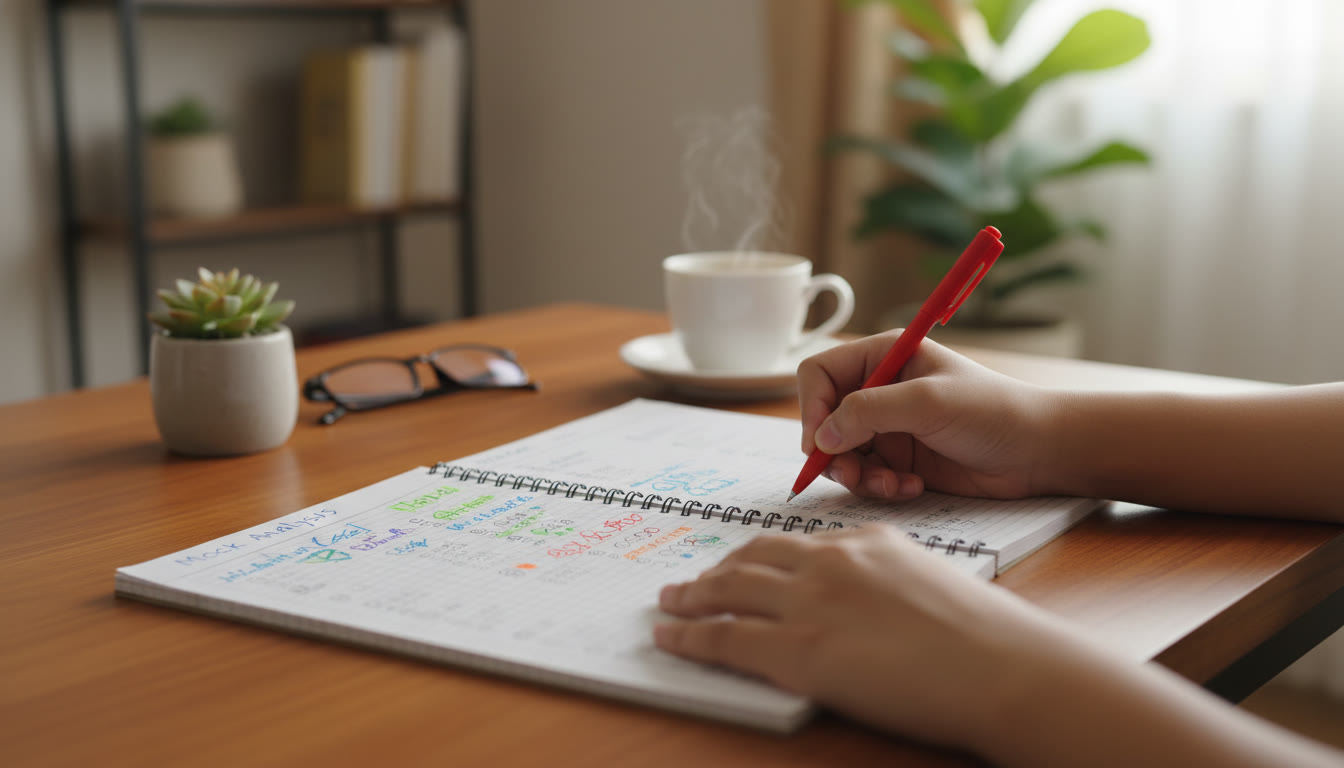
After the mock: analysis that actually changes outcomes
A simple four-step post-test routine
- Step 1 — Cool down: don’t immediately re-solve the test; take a short break to avoid emotional bias when you return to errors.
- Step 2 — Categorize every error: concept gap, careless mistake, calculation slip, time-pressure skip, or misread question.
- Step 3 — Fix one habit per week: pick the most frequent error type and drill targeted practice only for that habit.
- Step 4 — Re-attempt similar questions: once you correct a conceptual gap, immediately practice 10–15 similar problems to lock learning.
Common error types and corrective actions
| Error Type | Typical Symptom | Fast Fix |
|---|---|---|
| Careless reading | Right method, wrong final because a key phrase was missed | Underline qualifiers; paraphrase the question in one line before solving |
| Calculation slips | Small arithmetic mistakes that flip sign or magnitude | Use quick sanity checks (units, limits) and write intermediate steps clearly |
| Concept gaps | Repeated wrong answers on similar topics | Revisit fundamentals, watch a focused short lesson, then do 10–15 curated problems |
| Time mismanagement | Unfinished sections and rash attempts in last minutes | Practice shorter timed sets and train the ‘first-pass’ sweep habit |
Building a feedback loop: sample weekly & monthly cycles
Weekly rhythm for steady accuracy gains
- Day 1: Topic revision + 30–45 focused problems (concept strengthening).
- Day 2: Timed sectional test (60–90 minutes) focusing on weakest subject.
- Day 3: Review errors from Day 2; practice corrected approaches.
- Day 4: Full-length mock (if weekly mocks are scheduled) or mixed problem set.
- Day 5: Deep analysis of the mock; tag mistakes and create a micro-plan.
- Days 6–7: Recovery, light revision, and deliberate practice on one high-yield weakness.
Monthly checkpoints
- End of month: compare accuracy across mocks; expect small steady gains (e.g., 3–7 percentage points) rather than dramatic overnight jumps.
- Adjust practice: increase timed practice if time errors persist; increase careful reading drills if careless mistakes remain common.
Tools, guidance, and when to seek personalized help
What to automate and what to keep human
- Automate timing, question selection, and progress charts with any reliable mock platform.
- Keep human review for conceptual gaps — an expert can pinpoint the misconception faster than trial and error.
For students who need structured corrective loops, Sparkl‘s personalized tutoring often fits naturally into the practice cycle: 1-on-1 guidance to identify recurring mistakes, tailored study plans that focus your mock corrections, expert tutors to explain tricky concepts, and AI-driven insights that highlight error patterns so you can work efficiently.
Sample micro-plan: turning a weak topic into a strength in four weeks
Week-by-week blueprint
- Week 1 — Diagnose: do a 60-minute topic-only timed set and categorize every mistake.
- Week 2 — Repair: study focused lessons, resolve conceptual gaps, and solve 30 new problems with explanations.
- Week 3 — Consolidate: timed mixed sets, practice elimination techniques, record accuracy improvement.
- Week 4 — Stress-test: take two timed mocks (one full-length, one sectional) and compare error types; adjust next cycle.
Mindset, energy, and small daily habits that protect accuracy
Daily micro-habits
- Start each day with a 10-minute mental math or concept-quickfire session to sharpen focus.
- Use a single corrections notebook: write the mistake, the right approach, and one sentence takeaway for each error.
- Practice the “read-paraphrase-solve” routine: read the question, paraphrase it in one line, then begin solving.
Nutrition & rest tips for test-days
- Light, protein-rich breakfast; avoid heavy fried foods that induce lethargy.
- Hydrate but avoid excessive caffeine; it amplifies jittery errors under time pressure.
- Stretch once midway through the mock during permitted breaks to reset concentration.
Common myths about mocks (and the truth)
- Myth: “Attempting more always helps.” Truth: Random attempts increase negative marks; strategic attempts with elimination are superior.
- Myth: “I must solve every question fully to learn.” Truth: For learning, attempt a subset deeply and repeat similar problems; deep practice beats superficial coverage.
- Myth: “Scoring fluctuates because mocks are unfair.” Truth: Fluctuations happen; systematic error categorization reduces variance over time.
Final checklist before you close the mock cycle
- Have you categorized each error and assigned a corrective action?
- Is there a weekly plan that focuses on your top two error types?
- Are you protecting accuracy with pre-set guessing and time thresholds?
- Do you practice under realistic conditions at least once a week when in peak preparation?
How personalized guidance complements practice
Targeted one-on-one help can speed up the feedback loop: an experienced tutor quickly spots pattern errors in reasoning or persistent misreads that you might miss in self-analysis. If you pair that human insight with deliberate, data-driven practice cycles, the path from mistake to mastery gets much shorter.
For example, a tutor can help you rewrite your mock-review routine so each error yields a specific drill — not just notes. Combining that with AI-driven error clustering helps prioritize the most impactful drills over busy topics.
Concluding academic point
Accuracy in JEE Main mock tests is a trainable skill: a disciplined pre-test routine, a consistent on-test approach that emphasizes elimination and time-slicing, and a rigorous post-test error-correction loop convert random practice into predictable score gains. When each mock becomes an opportunity to diagnose, drill, and re-test a specific weakness, your net score improves not by luck but by design.



















No Comments
Leave a comment Cancel