

Rank Booster Strategy Using Mock Test Analysis
Mock tests are not a scoreboard — they are a feedback engine. If you treat each full-length practice as a ritual to only check your score, you will miss the real value: a precise, repeatable map of what to fix. This guide walks you through a humane, tactical mock-analysis workflow that converts effort into measurable rank gains. It mixes practical templates, action checklists, and realistic scheduling so you can begin today and keep improving through the current cycle.

Why mock tests are the engine of rank improvement
Mocks do three things better than any other single activity: they identify weak spots under pressure, habituate you to exam rhythm, and reveal time-management leaks. Beyond raw marks, a careful mock analysis lets you separate two kinds of stalls: conceptual gaps (which need study) and execution problems (which need strategy and practice). When you target the correct cause, every hour you study multiplies in effectiveness.
- Simulate exam pressure and sharpen decision-making under time constraints.
- Quantify recurring mistakes so you stop repeating them.
- Train your exam intuition: when to attempt, when to skip, when to secure marks.
- Build a compact, prioritized revision plan from noisy practice data.
Understand the exam format, timing, and rules
Accurate mock practice begins with accurate simulation. For typical JEE-style testing this means: MCQ-based testing, a three-hour full-length mock window, negative marking that penalizes incorrect choices, and strict answer-entry discipline in the test interface or OMR sheet you are simulating. A mock that mirrors the format forces you to practice not just problems, but the exact skills the exam demands: speed, precision, and strategic skipping.
Note on subjects: standard JEE preparation targets Physics, Chemistry, and Mathematics. If you are preparing for other entrance exams in parallel that require life-science content, build separate mock cycles for Biology. Keep your JEE mock-analysis data focused on PCM so your interventions stay sharply relevant.
| Exam Feature | Practice Focus | Why it matters |
|---|---|---|
| MCQ Format | Elimination tactics, option-based traps | Reduces time wasted on algebra you don’t need; trains smart guessing |
| 3-hour duration | Full-length stamina + sectional pacing | Conditions concentration across the entire session |
| Negative marking | Selective attempts, risk assessment | Improves net score by balancing attempts and accuracy |
| OMR/Interface discipline | Precise answer entry, verification routines | Prevents avoidable technical losses on exam day |
Design a smart mock schedule that grows with you
Mocks are most useful when their frequency matches the phase of preparation. Early on, a lower frequency with deep review works best; as you approach the exam window, increase full-length mocks to sharpen exam rhythm. Balance topic-wise tests and targeted short practices between full-length mocks to fix specific weaknesses uncovered by analysis.
- Early phase: 1 full-length mock every 10–14 days + topic tests.
- Build phase: 1 full-length mock per week + focused reattempt drills.
- Peak phase: 2 full-length mocks per week (with lighter revision days in between).
| Week | Mock Type | Focus | Follow-up |
|---|---|---|---|
| 1–2 | Full-length (baseline) | Identify top 6 weak topics | Detailed error log + 2 topic tests |
| 3–4 | Full-length + sectional | Time allocation & weak-topic drills | Redo flagged questions; concept sessions |
| 5–6 | Full-length (higher frequency) | Exam stamina & guess strategy | Timed reattempts + mixed-topic quizzes |
How to analyze a mock test: a step-by-step framework
Think of analysis as a short, repeatable ritual that you perform within 24–48 hours after a mock. The goal is not to wallow in a bad score or celebrate a good one — it is to get a clean dataset that tells you exactly what to practice next.
- Initial scan (0–30 minutes after mock): Record raw score, emotional state, and two immediate impressions — one positive (what clicked) and one negative (what stalled). This calms emotions and captures fresh memory before you check solutions.
- Question triage: Mark each attempted question as Correct / Wrong / Unattempted, and tag its difficulty (Easy / Medium / Hard). Note time spent if your platform records it.
- Root-cause classification: For each wrong answer, pick one cause: Conceptual gap, Calculation slip, Careless error, Time pressure, or Interface/OMR mistake.
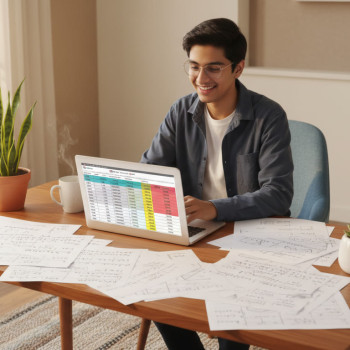
- Error logging: Use a compact table (see template below). Keep it in a single spreadsheet so you can sort by topic and mistake type.
- Action assignment: For each logged error, write a 1-line remedy: “derive formula + 5 solved examples” or “10 targeted MCQs + timed reattempt”.
- Follow-up schedule: Block 2–5 study sessions to address the top 3 recurring causes from the mock.
| Question ID | Topic | Mistake Type | Time Spent | Fix (1-line) |
|---|---|---|---|---|
| Q12 | Electrostatics | Conceptual | 12 min | Re-derive formula + 8 practice problems |
| Q27 | Limits | Careless | 2 min | Slow down; step-check algebra |
Classify mistakes so corrective work is surgical
Not all wrong answers are equal. Use these buckets and the specific repair for each:
- Conceptual: Re-teach the topic from first principles, do guided examples, then 10 mixed MCQs.
- Calculation: Practice structured steps and estimation checks; use solved examples that highlight shortcuts.
- Careless: Slow down for the first 10 problems; train micro-routines like underlining key data and writing units.
- Time-pressure: Do sectional speed drills and timed mini-mocks to retrain pacing.
- Interface/OMR: Simulate the exact exam interface or practice OMR filling under timed conditions.
Quantify progress with the right metrics
Score alone hides actionable detail. Track these metrics consistently and set realistic targets for each subject:
- Attempt Rate: Questions you try vs total.
- Accuracy: Correct answers as a percentage of attempts.
- Net Score: Accounts for negative marking — the central performance metric.
- Average Time per Question: Use it to spot slow topics.
- Negative Mark Ratio: Wrong attempts per attempted question.
| Mock | Total (%) | Accuracy (%) | Avg Time/Q (min) |
|---|---|---|---|
| Mock 1 | 48 | 54 | 2.1 |
| Mock 2 | 61 | 66 | 1.8 |
| Mock 3 | 72 | 78 | 1.5 |
Seeing a steady rise in accuracy and a drop in average time per question usually signals real improvement — not just luck.
Actionable repair plan after analysis
Turn your mock insights into a compact plan you can follow within a week.
- Pick the top 3 recurring topics across subjects and allocate focused sessions: 2 concept reviews + 4 mixed MCQs per topic.
- Schedule mini-mocks: 30–45 minute sectional tests that isolate weak areas.
- Reattempt logged wrong questions in a timed setting until you clear them twice in a row.
- Create a short cheat-sheet for each topic — one page of formulas and traps — and revise it daily for two weeks.
- Use a spaced-repetition check: revisit the same weak topic after 3 days and 10 days.
- If persistent gaps remain, seek targeted help: a short one-on-one intervention often converts weeks of slow progress into days of clarity. For personalized, data-driven guidance consider Sparkl’s approach — 1-on-1 guidance, tailored study plans, expert tutors, and AI-driven insights that translate mock findings into an efficient study path.
Time-management tactics and question selection strategy
Managing time in JEE-style tests is about patterns and priorities. Your goal is to maximise net marks, not raw attempts. Here are reproducible strategies:
- First pass: solve all clear and low-cost questions (your ‘easy 40–60’) within a fixed initial window (for example, first 60–70 minutes). This secures marks and builds confidence.
- Second pass: attempt medium problems where you have a solid method but need time; use the timer to allocate strict per-question limits.
- Third pass: reserve remaining time for high-value hard problems only if you can finish them correctly in a single sitting. Avoid repeatedly revisiting the same hard problem.
- Use intelligent skipping: when stuck for more than 4–6 minutes, mark and move on. A later, fresher look often works better.
- Practice elimination: in MCQs, ruling out one or two options raises your expected value of guessing; combine elimination with risk-budgeting given negative marking.
Mental resilience and test-day habits
Mental habits are the invisible engine of consistent mock performance. Build routines so that your brain associates the mock session with a repeatable state.
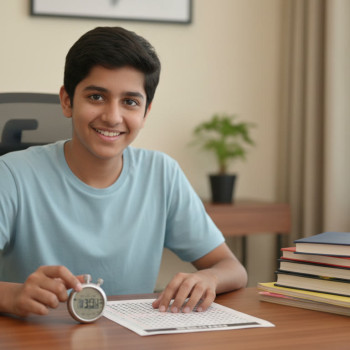
- Simulate the exam environment: quiet room, timed 3-hour window, minimal distractions.
- Pre-mock checklist: water, light snack, stationery (or login checks for CBT), and a 5-minute breathing routine.
- Post-mock cooldown: walk for 10 minutes, then start your analysis. Avoid re-reading solutions immediately while emotions are high.
- Sleep and nutrition matter: prioritize a stable sleep window before major mock cycles to maintain concentration.
Common pitfalls and how to avoid them
- Chasing score spikes instead of patterns — focus on repeatable improvements in accuracy and time per question.
- Blaming the test — assume the mock revealed something about your preparation you can act on.
- Copying solutions without understanding — always re-solve a corrected question from scratch.
- Over-scheduling mocks without review — a mock without analysis is a test of patience, not progress.
- Mixing formats carelessly — practice the exact interface (CBT or OMR simulation) you will face in the real exam.
Sample 6-week micro-cycle plan with mock-analysis checkpoints
This template balances full-length tests, sectional focus, and analysis windows. Adapt it based on your baseline performance and calendar constraints.
| Week | Key Activities | Mock(s) | Post-mock Action |
|---|---|---|---|
| 1 | Baseline full-length; identify 6 weak topics | 1 full-length | Error log + 2 topic drills |
| 2 | Concept repair on top 3 topics; sectional speed drills | 1 sectional mock (60–90 min) | Timed reattempts of logged Qs |
| 3 | Integration practice; mixed-topic quizzes | 1 full-length | Classify mistakes; set micro-goals |
| 4 | High-intensity time drills; OMR/interface simulation | 2 mini-mocks (short) | Fix execution and OMR routines |
| 5 | Targeted problem sets; formula sheets | 1 full-length | Deep concept rework on remaining gaps |
| 6 | Polish: speed, accuracy, and mental readiness | 1 full-length + 1 light mock | Final review of error log; stabilize routines |

Tools and simple templates that save hours
You don’t need complicated analytics to improve — consistent, simple tracking beats flashy dashboards that you never open. Keep a single spreadsheet with these tabs: Raw Scores, Error Log, Topic Checklists, and Weekly Targets. Use conditional formatting to highlight repeated topics and pivot tables to find where most time is spent.
If you prefer guided insights, combine personal analysis with occasional expert review. A short, targeted tutoring session that reviews your error log can cut down your revision time because it focuses on the exact mistakes you make — not on generic advice. For students who choose this route, Sparkl’s model pairs 1-on-1 guidance with AI-driven insights so your mock analytics feed directly into a tailored study plan.
Final academic note
Consistent mock analysis is a habit: practice under realistic conditions, log errors carefully, and convert those errors into a time-boxed corrective plan. Measure progress with accuracy, net score, and average time per question rather than single-score fluctuations. Over weeks, this disciplined loop—test, analyze, fix, repeat—shifts preparation from luck to system. Build the habit, guard the routine, and let data drive your revision choices.























No Comments
Leave a comment Cancel