
Should You Study NCERT for JEE Main Maths?
Every year students ask the same question with slightly different urgency: “Is NCERT enough for JEE Main Maths?” The short, honest reply is: NCERT is indispensable — it builds the conceptual scaffolding — but by itself it won’t always deliver the speed and variety of problem exposure needed for top ranks. This article walks you through precisely what NCERT gives you for Maths, what it doesn’t, and how to stitch it into an efficient, exam-aware preparation plan that respects the MCQ, negative-marking, and timed-mock realities of the current JEE Main-style context.

Quick orientation: What the exam demands
JEE Main Maths is tested in an MCQ-focused, time-bound environment where accuracy, speed, and selection strategy matter. Expect full-length timed sessions (three-hour mock simulations are the standard way to train), negative marking on incorrect attempts, and the need to convert conceptual clarity into fast problem-solving. That means your study stack needs two layers: rock-solid fundamentals and a large, varied problem bank practiced under timed conditions.
What NCERT gives you (and why it matters)
- Crystal-clear basics: Definitions, notation, and core theorems are presented in a straightforward way — exactly what you must master to avoid silly mistakes.
- Logical derivations: The step-by-step proofs and derivations build intuition so you can reconstruct methods under exam pressure.
- Representative examples: Worked examples show standard techniques — treat them as templates to remix when you see variations in MCQs.
- Systematic exercises: Problems grow in difficulty; finishing them trains conceptual completeness before you chase harder problem sets.
- Exam discipline foundation: Doing NCERT thoroughly helps you recognize standard traps, algebraic simplifications, and the clean ways to check answers quickly during a three-hour session.
What NCERT often doesn’t provide (so don’t get complacent)
- Sheer volume and variety: Many JEE Main questions are creative twists or require combining topics; NCERT alone may not give enough diverse practice.
- High-end problem depth: For top-percentile aspirants, you need problems that demand multiple-step strategy and speed, which typically come from curated practice material beyond NCERT.
- Timed-strategy drills: NCERT exercises are excellent for concept-building but not always set up to train strong time management under negative-marking pressure.
Topic-wise mapping: How NCERT aligns with JEE Main Maths
Below is a compact way to think about each major topic: where NCERT helps most, and what to do next to be exam-ready.
| Topic | NCERT Strength | How to use NCERT | Next step for JEE-level practice |
|---|---|---|---|
| Algebra (Quadratics, Polynomials, Sequences) | High | Master derivations, examples, and all exercise problems. | Attempt graded mixed-problem sets and time-bound quizzes on root manipulation and identity spotting. |
| Coordinate Geometry & Conics | Moderate | Use NCERT for standard forms, directrices, focal properties, and worked examples. | Practice transformation-based and trickier locus problems; solve many past-MCQs and mixed sets. |
| Trigonometry | High | Internalize identities, graphs, and methodical solutions shown in examples. | Drill identity transformations, inverse-trig pitfalls, and speed-based simplification tasks. |
| Calculus (Limits, Diff, Int) | High for basics, Moderate for advanced tricks | Follow proofs and typical derivatives/integrals — learn the standard approaches. | Solve application-style MCQs and complex integrals/optimization problems under time limits. |
| Vectors & 3D Geometry | Moderate | Understand vector algebra and coordinate methods from NCERT exercises. | Expose yourself to orientation+distance combos and spatial-visualization tasks often seen in exams. |
| Probability & Statistics | Moderate to Low | Use NCERT for definitions, small examples, and approach to basic problems. | Work many combinatorics-probability cross problems and quick-calculation drills. |
| Matrices & Determinants, Complex Numbers | Moderate | Grasp properties, simple applications, and standard manipulations. | Train on algebraic trick questions that combine matrices with linear systems or complex-plane geometry. |
How to study NCERT effectively — a step-by-step routine
Reading NCERT passively won’t cut it. Here’s a practical routine that turns NCERT pages into exam-winning skills.
- Step 1 — Read, don’t skim: Read a section actively: underline theorems, re-derive proofs on paper, and write short one-line interpretations of why a result matters.
- Step 2 — Work every example: Cover the worked examples by hand before looking at the solution. Try to predict the next step; the examples are templates you will remix in MCQs.
- Step 3 — Do all exercises: Treat each exercise problem as mandatory. If you can’t finish one, mark it, study its method, and reattempt after practice from other resources.
- Step 4 — Convert to variations: After solving a problem, ask yourself: how could this be tweaked? Change constants, combine topics, or add a condition. This builds adaptability for creative MCQs.
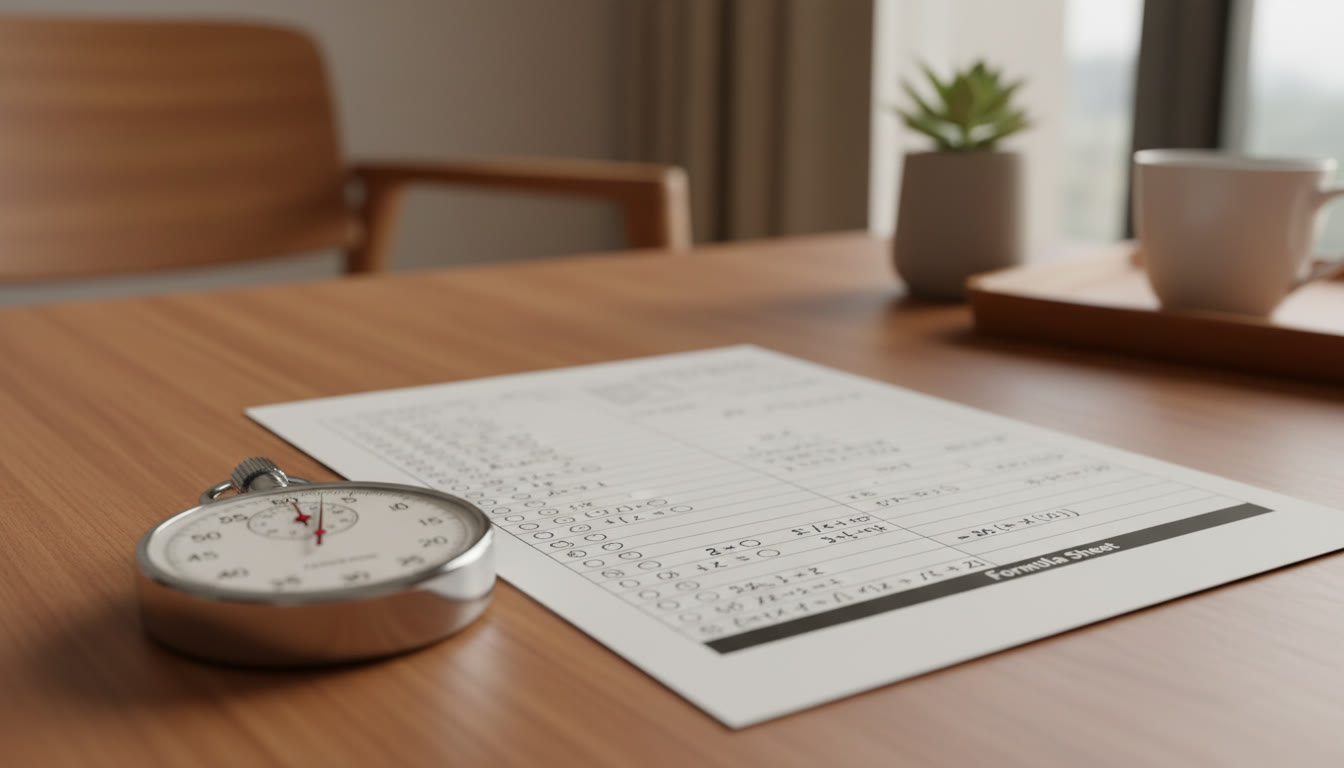
- Step 5 — Create a one-page formula sheet per topic: Condense key identities, boundary conditions, and standard substitutions you can quickly scan before a mock.
- Step 6 — Build speed with timed drills: Take topic-wise 30–60 minute timed sets to accelerate calculation and selection skills while keeping accuracy high.
Sample focused plan (8-week sketch for a topic-by-topic boost)
| Week | Focus | NCERT Tasks | Practice/Mock Tasks |
|---|---|---|---|
| 1 | Algebra fundamentals | Finish examples + all exercises; make formula sheet | Timed sets on quadratics, sequences; 1 short mock (90 mins) |
| 2 | Trigonometry & Identities | Master identities and transformations | Identity manipulation drills; mixed MCQs; error-check practice |
| 3 | Calculus (limits & derivatives) | Do every example and exercise; annotate methods | Application problems; 3-hour timed full-length mock |
| 4 | Coordinate Geometry & Conics | Sketch, annotate standard forms, solve exercises | Mixed locus problems; 60–90 min timed drills |
| 5 | Vectors, 3D, Matrices | Finish NCERT exercises; consolidate techniques | Mixed-topic test; error analysis |
| 6 | Probability & Combinatorics | Work examples + exercises; make short notes | Problem sets emphasizing counting tricks |
| 7 | Revision & Gap-filling | Re-solve previously marked problems; refine sheets | Two full-length timed mocks; detailed review |
| 8 | Polish speed & exam discipline | Flash revision of NCERT points; last-pass checks | Two full-length mocks (3-hour), simulate exam day timing and negative marking |
How to convert NCERT knowledge into MCQ-winning tactics
NCERT trains accuracy. To convert that into higher scores you must practice selection and elimination under time pressure:
- Rapid elimination: Use NCERT clarity to spot impossible options quickly — check boundary conditions, parity, asymptotic behavior, or sign checks before doing heavy algebra.
- Smart skipping: If a problem spills beyond a quick NCERT-based shortcut, mark and move on — maximize attempts you can answer confidently in the first pass.
- Sanity checks: Keep a quick habit adapted from NCERT — dimensional check, limit cases, or substituting simple values to eliminate options fast.
- Balance accuracy & speed: Train with negative marking active, so you learn when to risk an educated guess and when to conserve attempts.
When NCERT alone is enough — and when it isn’t
If your immediate goal is to build a strong base and clear the conceptual hurdles, NCERT is an excellent primary resource. For many students aiming for a safe score that crosses typical cutoffs, a disciplined, complete NCERT study plus steady timed practice can be sufficient.
However, if you’re targeting the highest percentiles, NCERT must be paired with a larger volume of diverse, tougher problems and a systematic mock schedule. The difference is not that NCERT is wrong — it’s that top scores demand speed and novelty-handling that come from heavy practice on varied problem types.
When to bring in expert, personalized help
There are moments in preparation when self-study yields diminishing returns: if you’ve plateaued despite deliberate practice, if time-management under mocks consistently fails you, or if you’re making repeated conceptual errors that resist correction. That’s the time to get focused help that identifies weak links and prescribes targeted drills.
For many students, one-to-one guidance that tailors a study plan, corrects method mistakes, and provides data-driven feedback shortens the path to desired scores. For instance, Sparkl‘s personalized tutoring often emphasizes exactly this: 1-on-1 sessions to fix weak spots, tailored study plans that respect your schedule, expert tutors who show alternate solution paths, and AI-driven insights that prioritize what to practice next.
Common mistakes students make with NCERT (and how to avoid them)
- Only reading, never solving: Passive reading builds familiarity but not recall. Solve — then solve a variation.
- Skipping examples as “easy”: Examples are templates; recreate them from scratch to internalize methods.
- Ignoring small-scale timed practice: If you don’t simulate negative-marking pressure in small drills, you won’t learn selection instincts.
- Not revising formula sheets: Without quick review notes, formula recall freezes under timed stress. Keep and use short sheets.
- Delaying difficult topics: Avoid postponing topics like 3D-geometry or probability; build up with small daily targets.
Mini example: turning an NCERT idea into a JEE trick
NCERT might show a standard way to integrate a rational function. In an MCQ you may face the same integrand packaged inside a definite-integral with symmetry that lets you avoid full integration. If you habitually look for symmetry, substitution, or limiting cases (all practiced in NCERT examples), you can often collapse long work into a fast shortcut. Practice spotting those shortcuts by creating a habit: after solving an NCERT problem, ask “Is there an alternate faster route for the same result?”
Revision tactics with NCERT during the final cycles
- Active re-solve: Instead of rereading, re-solve a selection of NCERT problems aloud or on white paper within time limits.
- Targeted flash sessions: Spend short bursts revising key manipulations for algebra, identities, and common integration tricks.
- Mock-analysis loop: After each full-length mock (3 hours), list the NCERT concepts you relied on and the ones you missed; then rework only those NCERT exercises.
- Error tagging: Maintain three columns for errors — conceptual, calculation, and selection — and map them back to NCERT topics to close gaps efficiently.
Final checklist: How to use NCERT as part of a winning JEE Main Maths strategy
- Finish all NCERT examples and exercises in each topic before moving to higher-difficulty practice.
- Create condensed formula/technique sheets for quick pre-mock revision.
- Use NCERT to build shortcuts and sanity checks that speed up MCQ elimination.
- Pair NCERT study with timed, negative-marked mock tests — ideally several 3-hour full-length simulations.
- Consider focused, personalized help if you plateau; targeted guidance accelerates correction of persistent weak points.
NCERT is the foundation; hard, varied practice built on that foundation makes the house stand under exam pressure. Prioritize clarity first, speed second, and strategy third — and let your practice reflect all three.
Conclusion
NCERT is essential for JEE Main Maths because it secures conceptual clarity and standard methods; however, to convert that clarity into high scores you must augment NCERT with disciplined, timed practice, deliberate variation drills, and strategic mock tests that simulate the MCQ and negative-marking environment. Use NCERT as your daily reference and training manual for fundamentals, then layer targeted problem practice and exam-simulation to develop the speed, selection skills, and mental stamina required for success.























No Comments
Leave a comment Cancel