

Why previous-year questions are the smartest way to sharpen your mock-test practice
If you treat past papers like relics, you’re missing the exam’s best mirror. Previous-year questions are distilled exam intent: the topics that matter, the phrasing that confuses, and the patterns that repeat across cycles. When you fold those questions into full-length mock tests, you don’t just practice problem solving—you rehearse decision-making under pressure. That twin rehearsal is what converts a “score increase” into a meaningful rank improvement.

Remember the exam context: tests are MCQ-based, taken in a continuous, timed block that is best simulated by a full-length, three-hour mock. There’s negative marking for incorrect MCQ choices, so blind guessing has a cost. And whether the test interface is paper-based, OMR, or computer-based, the discipline of deliberate marking, careful reviewing, and avoiding frantic last-minute changes is the same. Crucially, exam scoring is about final answers: thorough derivations and neat diagrams help you learn, but they don’t earn partial marks unless the final required format is correct. Treat diagrams and derivations as study tools, not exam answer padding.
Simulate the real thing: environment, timing and marking rules
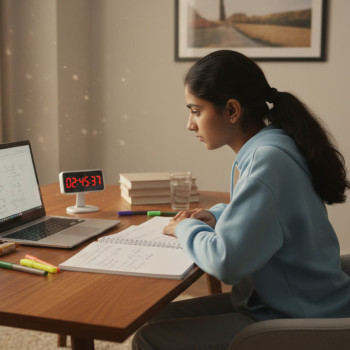
Simulation is not optional. A timed three-hour mock under quiet, exam-like conditions trains your brain to manage cognitive fatigue, attention shifts between subjects, and the emotional rhythm of test-day pressure. You should mimic all the constraints you will face: exact duration, scheduled short breaks (if any), allowed materials, and the same answering interface (paper/OMR or computer).
- Set aside the full test window and remove distractions: phone off, notifications silenced, and a quiet room.
- Follow exam answering discipline: deliberate selection, single marking (no stray marks), and planned skipping for hard questions.
- Respect negative marking: train to use educated elimination, not random guessing.
- Time-box sections or blocks to build pacing: e.g., aim for a tentative sectional time split, but be flexible to adapt during the test.
Six-step framework to convert previous-year questions into measurable rank gains
Past-paper practice becomes a high-ROI activity when it’s structured. Here’s a repeatable framework that turns every mock into actionable learning:
- Curate: Collect previous-year questions and tag them by topic, difficulty, and year. A small, well-organized bank beats an unfiltered stack.
- Construct hybrid mocks: Build mocks that mix genuine past questions with fresh, similarly-styled problems. Early on, weight mocks more toward past questions to learn patterns; later, use mixed or unseen questions to test transfer.
- Simulate strictly: Take the mock in a single timed block with exam rules—no aids, no interruptions.
- Immediate triage: Right after the mock, spend 20–30 minutes on a quick read-through: mark easy mistakes, highlight surprising question types, and note any persistent time drains.
- Deep analysis: Within 24–48 hours, classify every incorrect or slow question into categories: silly error, conceptual gap, incomplete technique, time misallocation, or misread question. Also tag topics that repeat across tests.
- Action plan and retest: Convert your analysis into concrete micro-tasks (targeted drills, flashcards, concept rework), schedule them, and retest the exact set or a near-equivalent mock two weeks later to measure change.
That last step—retesting—is the single most powerful habit. Without retest, insights remain interesting notes; with retest, insights become proof of learning or flags for deeper intervention.
A sample 8-week mock-driven plan (how to spread previous-year practice)
Use previous-year questions as a moving target: heavier early on for pattern recognition, progressively mixed and timed later for transfer and speed. Below is a compact sample plan you can adapt to your schedule.
| Week | Focus | % past Qs in mock | Mock frequency | Key action |
|---|---|---|---|---|
| 1 | Baseline & diagnosis | 70% | 1 full | Identify strengths, weak topics; start error log |
| 2 | Concept patching (big gaps) | 60% | 1 full + 2 mini | Targeted study sessions on core weaknesses |
| 3 | Speed & accuracy drills | 50% | 1 full + 3 timed sets | Time-per-question practice and elimination drills |
| 4 | Mixed difficulty practice | 40% | 1 full | Simulate section-switching and endurance |
| 5 | Advanced problem solving | 30% | 1 full + 2 challenging sets | Work on application and multi-concept questions |
| 6 | Consolidation | 30% | 2 full | Focus on consistent timing and fewer silly errors |
| 7 | Peak simulations | 20% | 2 full | Test under strict test-day conditions |
| 8 | Polish & review | 20% | 1 full + focused revision | Flashcards, formula checks, and calm review |
Subject-wise tactics: using previous-year questions to fix weak links
Previous-year questions reveal the flavour of each subject. Use that intelligence to create subject-specific micro-practices.
Physics
Physics questions reward precise models and clean assumptions. Past papers show which topics get conceptual questions and which are calculation-heavy. Practice by recreating the scenario aloud before solving: write down assumptions, relevant laws, and the minimal set of formulas you need. If a topic like mechanics or electricity repeatedly appears in past papers, build a two-part routine: quick concept checks (30 minutes of focused notes and a few warm-up problems) and a second session of timed numericals.
- Do reverse engineering: take a solved past question and try to write the question from the final answer—this builds sensitivity to phrasing.
- Keep a short formula sheet and a “failure log” for recurring conceptual slips.
Chemistry
Chemistry splits into three mental muscles: factual recall (inorganic), mechanistic thinking (organic), and calculation/derivation (physical). Use past questions to map which subtopics are repeat targets. For inorganic, make compact recall cards that link properties to reasons; for organic, practice mechanism templates and synthesis steps; for physical, speed up numerical set-up and unit-checking. In mocks, time your inorganic section separately to avoid getting stuck on recall while the clock runs out.
Mathematics
Mathematics in past papers often hides standard patterns under fresh covers. Your job is pattern recognition and error-free execution. Train with time-boxed practice: pick topic clusters (calculus, algebra, vectors) and do focused mini-tests from previous years, then a mixed timed block. For long solutions, write only the essential steps you need to reach the final answer quickly—practice writing concise, test-ready solutions during mocks.
Metrics that matter: what to track and how to act on the numbers
Tracking is how you convert raw effort into measurable rank improvement. Don’t track everything—track the metrics that tell a story and guide action:
- Accuracy per topic: Correct attempts divided by total attempts on that topic. Shows concept mastery.
- Time per question: Average time taken by difficulty band. Reveals pacing gaps.
- Negative-mark loss: Marks lost to incorrect attempts. Identifies blind-guessing habits.
- Repeat error rate: Questions or concepts you failed to fix after a retest cycle.
- Sectional balance: Attempts and accuracy across Physics, Chemistry, Mathematics in each mock.
Use a simple spreadsheet to log these after each mock. A weekly chart of progress on 2–3 core metrics will tell you which micro-tasks to prioritize for the next week.
| Metric | Why it matters | How to improve |
|---|---|---|
| Accuracy (%) | Directly links to score stability | Targeted concept revision + slow re-solve of errors |
| Avg time/question | Pacing determines how many questions you can attempt | Speed drills + timed micro-sets |
| Negative-mark loss | Shows cost of guessing | Practice elimination and skip strategy |

Common pitfalls students fall into—and quick fixes
Many high-effort students still plateau because of predictable habits. Catch these early and replace them with corrective drills.
- Pitfall: Reading solutions instead of re-solving. Fix: Re-solve the question without looking; use the official solution only after two independent attempts.
- Pitfall: One-off correction. Fix: Use spaced repetition—revisit corrected problems after one week and after two weeks.
- Pitfall: All mocks, no micro-work. Fix: For every mock, create a 4-item to-do list of focused drills to execute in the next 48 hours.
- Pitfall: Ignoring time analysis. Fix: Log time per question and practice “speed laps” of 15–30 minutes on the slowest topics.
- Pitfall: Over-emphasis on unfamiliar high-difficulty problems. Fix: Reinforce 80% accuracy on medium-level repeated topics before chasing the rare, very hard problems.
Micro-drills and daily rhythms that compound
Apply the 80/20 idea to practice: 80% of your gains come from fixing 20% of recurring weaknesses. Build small, focused drills that slot into daily life.
- 10-minute error-fix: pick one mistake from the previous mock and rework it until it’s clean.
- 30-minute concept sprint: read the short notes and solve two related previous-year questions back-to-back.
- 45-minute speed set: 10 mixed MCQs against the clock, immediate correction, repeat weekly.
Where personalized tutoring helps—and how to use it wisely
Targeted coaching accelerates the feedback loop. If you’re stuck repeating the same mistakes despite practice, one-on-one guidance can help you identify subtle habits—like inefficient problem setup, recurring conceptual blind spots, or pacing blind spots—that generic study alone misses. Personalized tutors can also help design mock blends that match your specific weak areas, and monitor retest cycles to confirm actual learning, not just short-term fixes.
For students who choose guided help, look for offerings that combine expert tutoring, tailored study plans, and data-driven insights so each mock and each retest becomes more efficient. Sparkl’s personalized tutoring model, for example, pairs one-on-one guidance with targeted study plans and AI-informed review prompts so you focus on the highest-impact corrections for your profile.
Test-day runbook: a calm, practical checklist
On the day of a full-length mock or the actual exam, follow a short routine that minimizes error and preserves energy:
- Sleep schedule: normal sleep the night before; avoid late-night cramming.
- Morning warm-up: 20–30 minutes of light revision—formula sheet, quick flashcards—no new topics.
- Pre-test checklist: stationery (if needed), permitted ID, water, comfortable clothing, and a quiet space.
- During the test: mark easy wins first, use elimination for MCQs, flag and skip ambiguous items, and watch the clock at regular intervals.
- After the test: quick triage in 20–30 minutes, then detailed analysis within 48 hours.
Conclusion
Previous-year questions are not relics; they are diagnostic tools that—when embedded into strict, timed mock tests and followed by honest analysis—become one of the fastest paths to rank improvement. Simulate the real exam, classify errors systematically, apply subject-specific micro-drills, track a few powerful metrics, retest deliberately, and use targeted tutoring where a trained observer can shorten your learning loop. That steady cycle—test, analyze, act, retest—builds reliable performance under pressure and moves your mock scores into the rank band you want.






















No Comments
Leave a comment Cancel