

Why a daily routine is your single most reliable ally in the final year
The last stretch of NEET preparation is less about frantic hours and more about focused, repeatable habits. The exam is MCQ-based, taken under strict OMR discipline, and runs for three hours. Negative marking applies, and answers are evaluated as discrete choices—there are no partial marks for descriptive attempts. With those facts in mind, the goal of a daily routine is simple: build repeatable competence in Physics, Chemistry, and Biology; sharpen exam temperament; and convert stress into steady momentum.
Think of your routine as the scaffolding that holds your learning together. It tells your brain what to expect each day, where to spend prime mental energy, and how to change gears between learning, practice, and recovery. When timed well, a routine removes the daily decision fatigue of “what should I study now?” and replaces it with a sequence that moves you forward reliably.

Core principles for designing a last-year NEET routine
- Consistency beats intensity: Short, repeated, high-quality study windows every day beat occasional marathon sessions.
- Mock-led preparation: Regular full-length, three-hour mock tests under OMR-like conditions are non-negotiable—this trains stamina, time management, and negative-marking discipline.
- Active recall & spaced repetition: Replace passive reading with practice questions, flash reviews, and timed recall sessions.
- Subject balance: Rotate Physics, Chemistry, and Biology so no subject stagnates; tailor the rotation to your weak areas.
- Feedback loop: Test → analyze mistakes → targeted revision → retest. Mistake analysis is where scores move up fastest.
- Health as a performance metric: Sleep, hydration, movement, and short breaks directly affect cognitive output. Don’t treat them as negotiable.
How to structure your day: a realistic sample routine
This is a template you can adapt to your personal clock and academic needs. The emphasis is on two deep study blocks, targeted practice, and a daily dose of test simulation or timed MCQs.
| Time | Activity | Focus | Why it works |
|---|---|---|---|
| 5:30–6:00 | Wake up & light exercise | Energy alignment | Short movement wakes the brain and improves focus. |
| 6:00–8:00 | Deep study block (Subject A) | Concept building | Use fresh morning attention for concept-heavy material. |
| 8:00–8:30 | Breakfast & break | Recovery | Nutrition and a mental reset improve retention. |
| 8:30–10:30 | Practice & problem solving (Subject B) | Application | Switching contexts helps consolidation. |
| 10:30–11:00 | Short break / light revision (flashcards) | Spaced recall | Short, frequent recall beats long rereads. |
| 11:00–1:00 | Third study block or doubt clearing | Problem areas | Use this slot for teacher interaction, doubts, or guided sessions. |
| 1:00–2:00 | Lunch & rest | Recharge | Allow digestion time; mental downtime is productive. |
| 2:00–4:00 | Mock mini-test / timed MCQs | Exam skills | Practice under time pressure and OMR discipline. |
| 4:00–5:00 | Analysis of practice & error log | Reflection | Active error analysis turns mistakes into learning gains. |
| 5:00–7:00 | Light study / revision (Biology diagrams, rapid Chemistry reactions) | Retention | Evening repetition locks what you practiced earlier. |
| 7:00–8:00 | Dinner & family time | Balance | Social recovery reduces burnout risk. |
| 8:00–9:30 | Low-intensity review / flash quizzes | Light recall | End the day with low cognitive load, revisiting key facts. |
| 9:30–10:30 | Wind down & sleep preparation | Sleep hygiene | Consistent sleep schedule is a multiplier for learning. |
How to personalize the template
Swap the subject order to match your personal alertness curve. If you are sharper in the evening, reverse the blocks—what matters is protected deep-focus time for concept-heavy material and a separate time for application and timed practice. Keep at least one longer (90–180 minute) block per day strictly for active problem solving—this is where conceptual understanding meets exam pressure.
Weekly and mock-test rhythm: the 7-day framework
Daily routine needs a weekly scaffold. A simple, effective week might look like:
- 5 days of focused study with rotating subject emphasis (e.g., Physics-heavy Monday, Biology-heavy Tuesday, etc.).
- 1 day for a full-length mock test under exam-like conditions (3 hours), followed immediately by a detailed analysis session.
- 1 lighter day for consolidation, doubt clearing, and recovery—use it for targeted revision of weak topics and restful activities.
Full-length mock tests are not mere score-checks; they are workouts that train time allocation, OMR bubble discipline, and negative-marking management. After every mock, spend at least as much time analyzing errors as you did in attempting the test. Your gain from a mock comes mainly from the quality of that analysis.
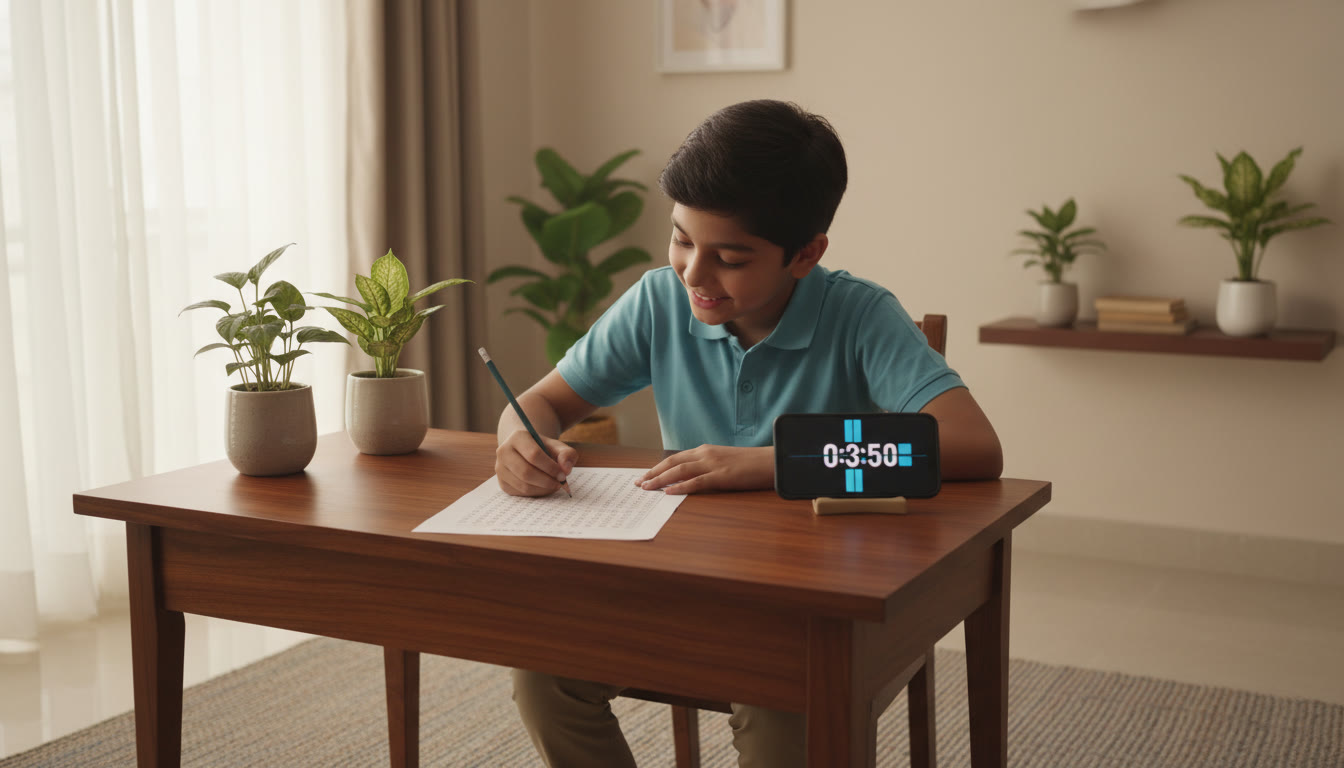
Mock tests: how to simulate the real day
To get the maximum transfer from practice to performance, make your mock as close to the actual exam as possible:
- Three hours of continuous MCQ answering with the same number of questions as your practice set.
- Strict negative-marking discipline—do not guess wildly. Practice smart elimination strategies.
- Use an answer sheet format that mimics OMR filling and practice neat, efficient bubble-filling under time pressure.
- Recreate small logistics: exam-center timing, breaks (if any), and the exact order you will tackle sections.
Post-mock analysis should include a categorized error log: careless mistakes, concept gaps, calculation errors, and time-management errors. Convert that log into a micro-plan: two focused sessions next day addressing the top two repeat errors.
Subject-specific tactics (quick, actionable)
Physics
Physics rewards precision: strong conceptual clarity plus practice with varied numerical problems. Establish a routine where mornings are for deriving formulae, understanding derivations, and visualizing physical meanings. Use the second block for solving application questions under time limits. Maintain a ‘formula sheet’ with context notes—don’t just memorize formulae; note when and why they apply. For numericals, cultivate the habit of quick estimation and unit-checking to avoid careless loss of marks.
Chemistry
Chemistry splits into physical, organic, and inorganic. Treat each differently: physical chemistry needs stepwise problem practice; organic chemistry needs reaction mechanisms practiced with pattern recognition; inorganic needs memorization but with layered understanding—group similar reactions together, use timelines for reaction conditions, and convert memorized facts into mental flashcards. Regular short quizzes on reaction pathways pay big dividends.
Biology
Biology is heavy on facts and diagrams but also on conceptual linking. Convert long passages into mind maps and habitually redraw diagrams from memory. Use active recall—cover the diagram and try to reproduce it accurately. For anatomy, physiology, and ecology, practice MCQs that force you to apply facts to scenarios rather than just recall isolated lines.
Daily micro-practices that add up
- Nightly 20-minute flash recall: before bed, close notes and write the top 10 points you learned that day.
- End-of-block summary: after each deep block write a 3-line summary of the core idea and one question you couldn’t answer—this drives tomorrow’s priority.
- Error log habit: one page per week with repeat errors highlighted—if a mistake recurs twice, it becomes mandatory study item.
Managing stress, fatigue, and motivation
Psychology matters. Short, scheduled breaks and a weekly lighter day prevent burnout. Use breathing or brief meditation in transition moments (two to five minutes) to reset focus. Sleep is non-negotiable—cognitive consolidation happens during sleep, so prioritize consistent sleep timing. If motivation wanes, shift from “I must study” to “I will practice one small, high-impact task”—success in tiny tasks rebuilds momentum.
How to use external help without losing ownership
Personalized tutoring and guided plans help when self-study hits a plateau. If you opt for one-on-one guidance, look for clear deliverables: tailored study plans, focused doubt resolution, weekly performance reviews, and AI-driven insights that highlight weak-concept patterns. For example, a tailored tutor can identify that you repeatedly miss questions in electrostatics and then help you close that gap with targeted drills and conceptual analogies. If you choose Sparkl‘s personalized tutoring, expect benefits like 1-on-1 guidance, tailored study plans, expert tutors, and AI-driven insights that accelerate the feedback loop—use those advantages to inform your daily routine, not to replace the habit of regular, focused practice.
Sample 30-day focus plan (rotate and refine)
Use 30-day windows to zone in on weak areas while preserving breadth. A balanced approach could be:
- Days 1–10: Concept consolidation in weakest subject + daily timed practice for all three subjects.
- Days 11–20: Increase mock frequency to twice weekly, continue targeted corrections, and practice OMR discipline.
- Days 21–30: Transition to high-revision density—short, spaced recall bursts, formula sheets, diagram redraws, and two timed full-length mocks with detailed analysis.
Each 30-day cycle should end with a checkpoint where you compare error logs from Day 1 and Day 30. If specific mistakes persist, make them the first item on the next cycle’s daily routine.
Common pitfalls and how to avoid them
- Marathon study without strategy: Swap a single 8-hour passive day for four 2-hour active blocks with targeted goals.
- Ignoring past mistakes: If an error category repeats, reduce variety and drill that category exclusively until performance stabilizes.
- Over-reliance on notes: Notes are for review; practice questions are the engine of score improvement.
- Poor OMR practice: Practice bubble-filling speed and accuracy; one careless fill can cost several marks.
Example comparison: two students, two approaches
Student A spends 6–8 scattered hours cramming different topics; Student B spends 4 focused sessions with daily mock passage and error analysis. Over a month, Student B’s error rate declines faster because deliberate practice creates a tighter feedback loop. The lesson: time alone doesn’t translate to performance—how you use the time does.
Final checklist for each study day
- Begin with a clear goal for each deep block.
- Include at least one timed-practice mini-session daily.
- Log and categorize errors immediately after practice.
- Spend 20–30 minutes on light, spaced recall before bed.
- Protect 7–8 hours of sleep and short movement breaks.
Closing academic note
As you shape your last-year routine, prioritize consistency, mock-test realism, and focused error analysis. Build days that alternate concept-first deep work with application-focused practice, and include regular full-length, three-hour mocks under strict OMR-like discipline to adapt to negative marking and time pressure. Regularly audit your error log to convert repeat mistakes into targeted micro-tasks. Over time, the steady application of these principles will align your preparation with the demands of MCQ-based testing across Physics, Chemistry, and Biology and sharpen the exam temperament required on the actual day.





















No Comments
Leave a comment Cancel