

Smart Study Plan for NEET Self-Study
Self-study for NEET can feel like steering a long journey by the stars: alone at times, uncertain at others, but deeply rewarding when the route is clear. A “smart” plan doesn’t mean packing more hours into your day — it means choosing the right hours, the right methods, and the right habits so your study time converts reliably into scores.
This guide is written for students who want structure without rigidity. It blends practical routines, subject-specific tactics, mock-test discipline, and revision architecture you can adapt to your pace. Wherever you are in the preparation cycle, the advice here is evergreen: it respects the NEET testing format (MCQs, OMR discipline, a full-length 3-hour rhythm, and negative marking) and focuses on building habits that survive pressure.

Understand the Exam Blueprint
What the paper expects (keep this at the front of your plan)
NEET-style exams test clarity, recall, and quick reasoning. Questions are multiple-choice, answer-sheet based (OMR), and scored so that correct answers add marks and incorrect answers reduce them. Because the paper rewards accuracy and speed together, your study plan must train both deep understanding and fast selection — not just memorization.
Three practical rules to build into every session
- Practice as if it’s OMR: mark answers decisively and simulate the pressure of a timed sheet.
- Train with full-length 3-hour mock tests regularly — they build stamina and time management instincts.
- Treat negative marking seriously: cultivate an answering strategy that balances attempts and caution.
Syllabus alignment: Physics, Chemistry, Biology
The syllabus is organized by the three pillars of science. Your study plan should divide time across these areas while allowing flexibility for your personal strengths and weaknesses. Think in terms of units and question formats: factual recall (Biology), conceptual application (Physics), and a mix of memory + problem solving (Chemistry).
Start with a Realistic Self-Assessment
Where to begin
Before you build or tweak a schedule, do a two-step assessment: (1) a timed diagnostic mock of one full-length paper to check endurance, raw speed, and sectional weak spots; (2) an honest log of how many hours you can sustainably study each day without burning out. The diagnostic tells you what to prioritize; the time audit tells you the realistic volume you can convert into learning.
How to interpret results
- If endurance fails (drops in score in last hour), increase full-length mock frequency and add timed endurance drills.
- If accuracy suffers (many wrongs despite taking time), slow down: strengthen conceptual clarity and error analysis instead of just speed drills.
- If one subject lags, reallocate weekly hours temporarily but avoid fully abandoning stronger subjects — maintain balance so you don’t lose easy marks.
Designing the Weekly & Daily Rhythm
The weekly skeleton
A consistent week is the backbone of success. Build a repeatable weekly template that you can sustain for months: focused study blocks, mixed-practice sessions, and scheduled revision. Keep weekends flexible for longer mocks and deeper revision passes.
| Day | Physics | Chemistry | Biology | Revision / Mock |
|---|---|---|---|---|
| Monday | 2.0 hrs (concepts + problems) | 1.5 hrs (inorganic/facts) | 1.5 hrs (botany) | 30–45 min quick revision |
| Tuesday | 1.5 hrs (numericals) | 2.0 hrs (organic mechanisms) | 1.5 hrs (zoology) | 30–45 min flashcards |
| Wednesday | 2.0 hrs (mixed practice) | 1.5 hrs (physical chemistry) | 1.5 hrs (diagrams & classification) | 45 min topic review |
| Thursday | 1.5 hrs (theory) | 2.0 hrs (problem sets) | 1.5 hrs (life cycles & processes) | 45 min error-log work |
| Friday | 2.0 hrs (application) | 1.5 hrs (revisions) | 1.5 hrs (high-yield facts) | 30–45 min flash recall |
| Saturday | 3.0 hrs (mock practice / past paper) | 3.0 hrs (mock practice / past paper) | 3.0 hrs (mock practice / past paper) | 1 hr test review & error log |
| Sunday | Rest lightly / Active revision: summary notes, flashcards, gentle catch-up (3–4 hrs total) | |||
Daily focus blocks and energy mapping
Break study time into focused blocks of 50–90 minutes with 10–20 minute breaks. Map heavy problem-solving (Physics numericals, Chemistry calculations) to your high-energy windows, and schedule memorization or lighter reading in your lower-energy slots. That leverages natural attention rhythms and reduces wasted time.
Micro-goals that keep momentum
- End each session with a 5-minute summary: what you learned and one practice question you must remember.
- Set weekly mini-milestones (complete a chapter, reach 80% accuracy on a topic) and reward completion with a small break.
- Maintain an error log — every mistake converted into a 1-line remedy and a date to revisit it.
Subject-by-subject Strategies
Biology: Make it story-based and visual
Biology rewards clear, structured notes. Turn long descriptions into short narratives and diagrams. For example, convert metabolic pathways or ecological cycles into flow charts you can redraw — the act of drawing cements memory far more effectively than passive reading. Use question banks to practise the exact MCQ style: often the trick is spotting a detail or rewording that tests the same concept.
Physics: Build concepts, then speed
Physics is about ideas applied quickly. Start with a clean conceptual map of each topic: core principles, typical equations, and conditions where those equations apply. Practice derivations to the point you can reproduce the logical steps in under two minutes, then switch to problem sets where speed and unit-checking are enforced. Keep a formula sheet you update weekly — the act of organizing formulas helps retention.
Chemistry: Balance memory and practice
Chemistry spans memorization and calculation. Organize study into three pillars: inorganic (facts & periodic trends), organic (mechanisms, named reactions, reaction flow), and physical (numerical techniques). For organic, practice reaction pathways in the form of short chains; for physical, do timed numerical drills until you hit both accuracy and speed. Maintain a short cheat-sheet of reagents and conditions you revise daily.
Mock Tests, Timing & Error Analysis
Why 3-hour full-length mocks are non-negotiable
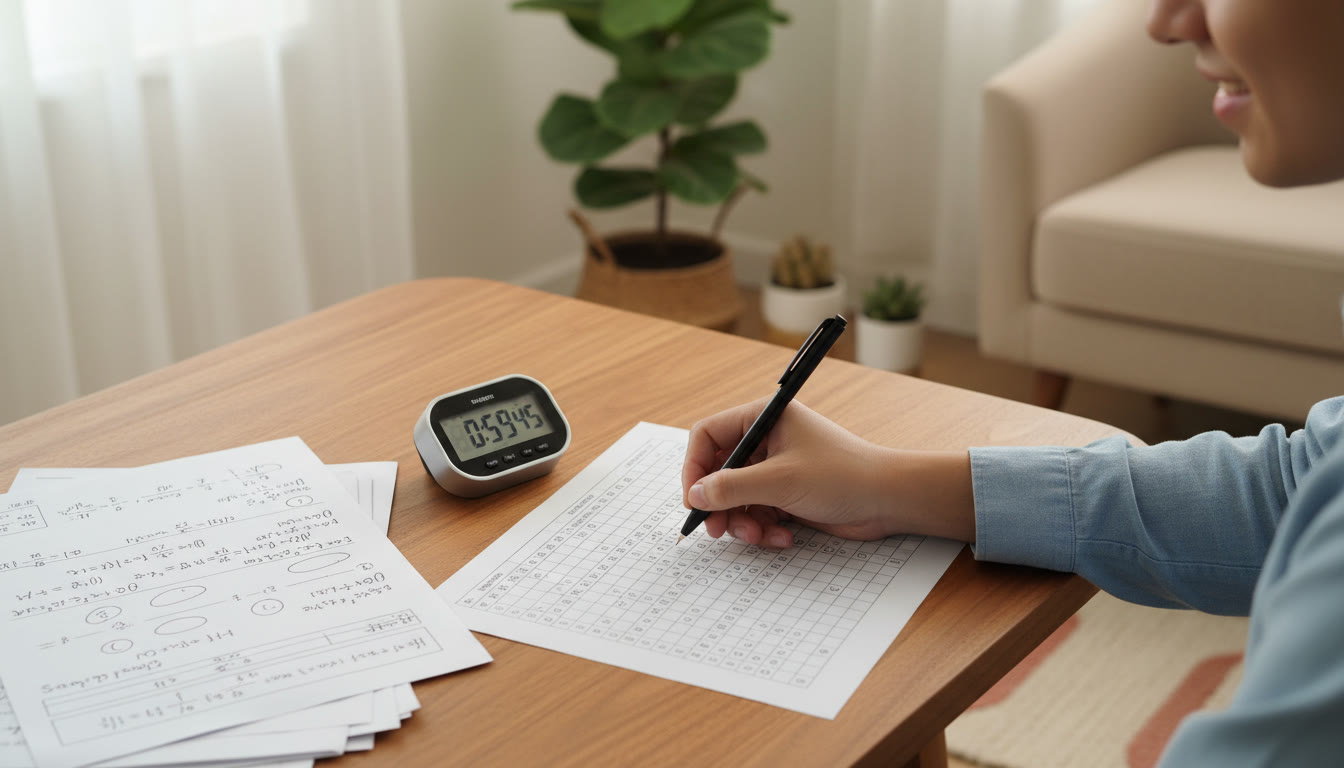
The actual exam is a single intense 3-hour testing session. Nothing builds the stamina and pacing instincts like regular full-length mocks. Beyond endurance, mocks teach you question selection strategy under time pressure — when to attempt slowly, when to guess conservatively, and when to skip and return.
How often and how to review them
Begin with one mock every two weeks, then increase frequency as your exam window approaches: weekly, then twice-weekly in peak revision. But the real work is in review:
- Score the paper honestly and log time spent per section.
- Use an error log that records question, mistake type (conceptual/reading/time-pressure/careless), and a corrective action.
- Re-attempt similar question types until the error pattern is gone.
| Week Range | Mock Cadence | Primary Focus |
|---|---|---|
| Initial months | One mock every 2 weeks | Baseline & diagnosis |
| Mid-course | One mock per week | Time management & targeted practice |
| Final stretch | Two mocks per week | Stamina, pacing, and polishing errors |
OMR etiquette during mocks
- Practice filling OMR bubbles accurately; a mis-fill can waste time and cause avoidable errors.
- Simulate exam conditions: strict timing, no phone, single sitting. That conditions your focus to the real environment.
- Adopt a consistent strategy: attempt high-confidence questions first, mark medium-confidence questions for review, and avoid random guessing unless you have an informed reason.
Revision Architecture: Notes, Spaced Repetition & The Error Log
Build compact notes that you can revise fast
Long notes are comforting but impractical. Use a layered approach: one-page chapter summaries, a pocket list of high-yield points, and a flashcard deck for active recall. Short, repeated exposures beat single long rereads.
Spaced repetition and scheduling revision passes
Design revision passes around increasing intervals: a day later, a week later, three weeks later. Each pass should be active — test yourself rather than re-reading. Use your error log to set priority: items that produce repeated mistakes should appear in every revision cycle until they’re stable.
How Personalized Help Fits into Self-Study
Targeted tutoring without losing independence
Self-study is powerful, but targeted guidance can shorten the learning curve. For many students, occasional one-on-one help accelerates recovery from persistent weak spots. Sparkl‘s approach to personalized tutoring focuses on short, high-impact interventions — 1-on-1 guidance for a stubborn topic, a tailored study plan when you feel stuck, or AI-driven insights that highlight weak question types from your mock tests. Think of personalized help as a compass, not a crutch: it corrects your path and helps you steer faster.
When to bring in a tutor or mentor
- If you have repeated errors in the same topic despite practice.
- If you lose more marks to strategy and pacing than content gaps.
- When you need a tailored plan because you have limited time and need surgical prioritization.
Practical Study Habits & Mental Fitness
Small habits that compound
- Daily planning: spend 5–10 minutes outlining the day’s goals each morning.
- End-of-day reflection: a 5-minute note about what worked and what needs adjustment.
- Sleep and recovery: aim for consistent sleep blocks — your memory consolidates during sleep, and cramming at the expense of rest is rarely efficient.
Stress management and exam-day calm
Practice the mechanics of the exam day: waking time, travel plan, and a short pre-exam warm-up. In the test hall, use breathing techniques in stressful moments and re-establish the basics: steady pace, scan the paper, pick low-effort wins first, then tackle the heavy ones. Confidence in the exam comes from repeated, realistic practice — the more mocks you take, the less novelty the real day feels.
Putting It Together: Sample Milestones and an 8-Week Focus Block
Break larger preparation windows into 8-week focus blocks that combine content, practice, and revision. Each block has a primary aim: content consolidation, speed improvement, error elimination, or final polishing. Rotate these aims so every block builds on the last.
| Weeks | Primary Aim | Daily Focus | Outcome |
|---|---|---|---|
| Weeks 1–2 | Patch major conceptual gaps | Targeted chapters, concept maps, basic problem sets | Reduced blind spots in each subject |
| Weeks 3–4 | Increase speed on standard problems | Timed practice sets, formula consolidation | Faster, more accurate problem-solving |
| Weeks 5–6 | Mock-driven learning | Full-length mocks and focused reviews | Improved endurance and pacing |
| Weeks 7–8 | Polish and recall | Flashcards, one-line notes, light revision | Stable recall under timed conditions |
Examples and Small Comparisons That Clarify Choices
Two students with equal study hours can end very different ways depending on how they spend those hours. One spends hours passively re-reading chapters; the other invests time in active recall, solves representative question sets, and reviews errors. The second student will reliably convert study time into score increases. The lesson: quality of study beats quantity when you use structured, test-focused methods.
Final Notes on Consistency and Adaptation
A smart NEET self-study plan is not a rigid timetable nailed to the wall. It’s a living document: diagnose with regular mocks, adjust weekly, and protect your high-quality study blocks. Use targeted help when patterns resist correction, and keep your revision architecture tight so knowledge survives pressure. With steady, deliberate practice — and careful OMR discipline during mocks — the skills you build will be the ones you can rely on in the exam hall.
Consistent application of these principles — diagnostic practice, focused subject work, regular full-length 3-hour mock simulations, methodical error analysis, and scheduled spaced revision — forms the core of a resilient self-study plan for NEET.
























No Comments
Leave a comment Cancel