
Why Test Anxiety Happens — and Why Breathing Helps
If your heart races the moment you open a practice test or you blank on a question you knew yesterday, you’re not alone. Test anxiety is a very human response—an activation of the body’s stress system in a situation perceived as important and evaluative. For students preparing for the SAT, this can show up as sweaty palms, a churning stomach, blurred thinking, or that helpless feeling when time seems to evaporate.
The good news? Your breath is a direct, science-backed lever onto that stress system. When you change breathing patterns, you influence the autonomic nervous system—tilting the balance away from the fight-or-flight response toward the calm, focused state you want on test day. That makes breathing techniques one of the most immediate, portable, and effective tools for reducing anxiety, sharpening attention, and improving performance.
The biology in plain English
Short, rapid breaths signal to your brain that something is urgent. Long, slow breaths communicate safety. This simple switch affects heart rate, blood flow to the brain, muscle tension, and the clarity of thought—exactly the things that matter during a timed SAT section. Research also shows that controlled breathing can lower cortisol (the stress hormone) and increase vagal tone, which is linked to emotional regulation and cognitive flexibility.
Practical Breathing Techniques for the SAT
Below are techniques that work for different moments: quick resets during the test, pre-test calmers, and daily practices that re-train your nervous system over time. Try each method slowly at home first so it becomes familiar and automatic.
1. Box breathing (Square breathing)
Why it works: Box breathing provides structure—inhale, hold, exhale, hold—so your mind focuses on timing rather than worries. It brings immediate stability to heart rate and attention.
- Step-by-step: Inhale for 4 counts → Hold for 4 → Exhale for 4 → Hold for 4.
- Duration: 1–2 minutes is often enough for a quick reset.
- When to use: Before starting a section, during a long break, or when you’re stuck on a question and your mind is racing.
2. 4-7-8 breathing
Why it works: This pattern lengthens the exhale relative to the inhale, which activates the parasympathetic system (the body’s “rest and digest” response) and helps lower anxiety.
- Step-by-step: Inhale quietly for 4 → Hold for 7 → Exhale audibly for 8.
- Duration: Repeat 3–4 cycles for a strong calming effect.
- When to use: Night before the test to improve sleep, or in the waiting room if you have space and privacy.
3. Diaphragmatic (belly) breathing
Why it works: Many people breathe shallowly into their chest when stressed. Diaphragmatic breathing increases oxygen exchange, reduces tension, and gives you a persistent baseline of calm.
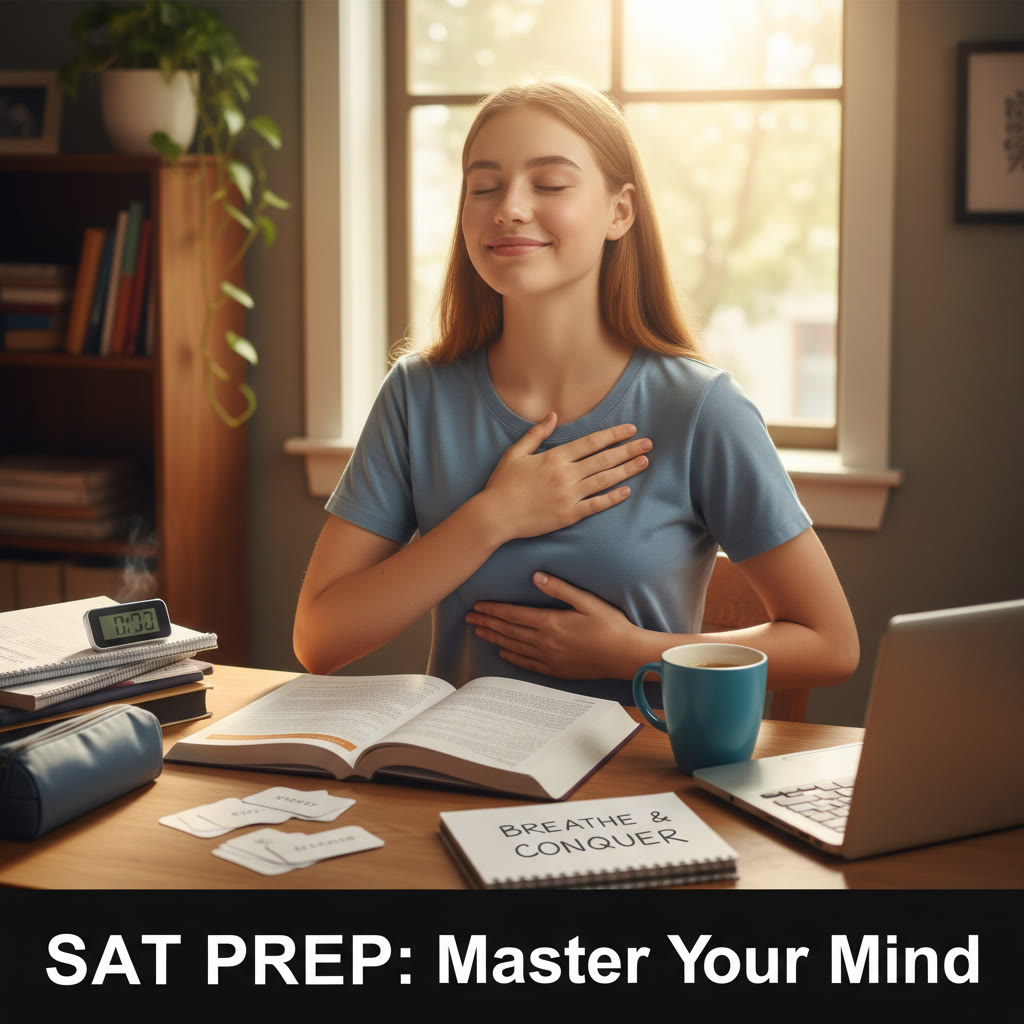
- Step-by-step: Place one hand on your chest and one on your belly. Breathe in so the belly rises more than the chest. Exhale fully, feeling the belly fall.
- Duration: 5–10 minutes a day builds resilience; 30–60 seconds provides a quick reset.
- When to use: Daily practice during study sessions; right before you open the test booklet.
4. Resonant (coherent) breathing
Why it works: This technique paces the breath to a frequency that maximizes heart rate variability, improving emotional regulation.
- Step-by-step: Breathe at about 5–6 breaths per minute (e.g., inhale 5 seconds, exhale 5 seconds).
- Duration: 10–20 minutes for practice sessions; 1–2 minutes for rapid stabilization.
- When to use: During study breaks to reset mental fatigue or as part of a morning routine to prime focus.
How to Practice So It Actually Works on Test Day
Doing breathing once the morning of the SAT is better than nothing—but real impact comes from consistent practice. The mind learns cues and physical pathways, so that when your heart starts racing on test day, automatic calming responses kick in.
A simple 2-week practice plan
This sample plan balances daily short practices with longer, focused sessions. If you have more than two weeks, extend each stage. If you have less time, prioritize morning and pre-test sessions.
| Week | Daily Short Practice | Longer Session (3–4x per week) | Goal |
|---|---|---|---|
| Week 1 | 3 minutes diaphragmatic breathing (morning) | 10-minute resonant breathing | Build awareness of breath and reduce baseline tension |
| Week 2 | 2 minutes box breathing before study | 15-minute mixed session (4-7-8 + diaphragmatic) | Make techniques automatic and start connecting them to test-like situations |
| Ongoing | 60-second resets during study breaks | 20-minute practice once weekly | Maintain resilience; use techniques intuitively on test day |
Track your practice in a notebook or app. Note not just duration but how you felt before and after: mental fog, confidence, stomach knots, time perception. Over two weeks you’ll start seeing clear patterns—maybe a particular technique works better before Reading than Math. That insight is gold.
Integrating breathing into study sessions
Make breathing part of the study flow, not an add-on chore. A few practical ideas:
- Begin each hour-long study block with one minute of box breathing to sharpen focus.
- After a difficult practice section, take a two-minute diaphragmatic break to reset instead of diving immediately into the next one.
- End practice tests with resonant breathing to decrease rumination and help consolidate learning.
Test-Day Strategy: Practical Routines That Stick
The exam room is full of small triggers: a ticking clock, rustling pages, and other students shifting in seats. Your pre-planned breathing routine becomes your anchor—something you control regardless of external chaos.
30–60 minutes before the test
- Find a quiet corner or sit in your car. Do two cycles of 4-7-8 breathing to settle nerves and, if possible, a 3–5 minute diaphragmatic session to bring oxygen to your brain.
- Avoid cramming. Use your breathing practice to shift into present-moment focus.
Right before opening the booklet
- Do 30–60 seconds of box breathing. It takes only a minute but helps steady the hands and attention.
- Take one last positive cue phrase—something simple like, “One question at a time”—while you breathe out slowly.
During the test (discrete resets)
You don’t need to announce anything or close your eyes for long. Try subtle breathing resets that are allowed and unobtrusive.
- Brief pause: Breathe in for 3, out for 4 while scanning the question.
- If you blank: Count silently and box breathe for 30–45 seconds behind closed eyes or focusing on the page to quickly reduce panic and bring back flexibility.
- Use your breaks between sections for a focused 1–2 minute diaphragmatic or resonant breathing reset to recharge for the next section.
Real Student Example: Turning Panic Into Performance
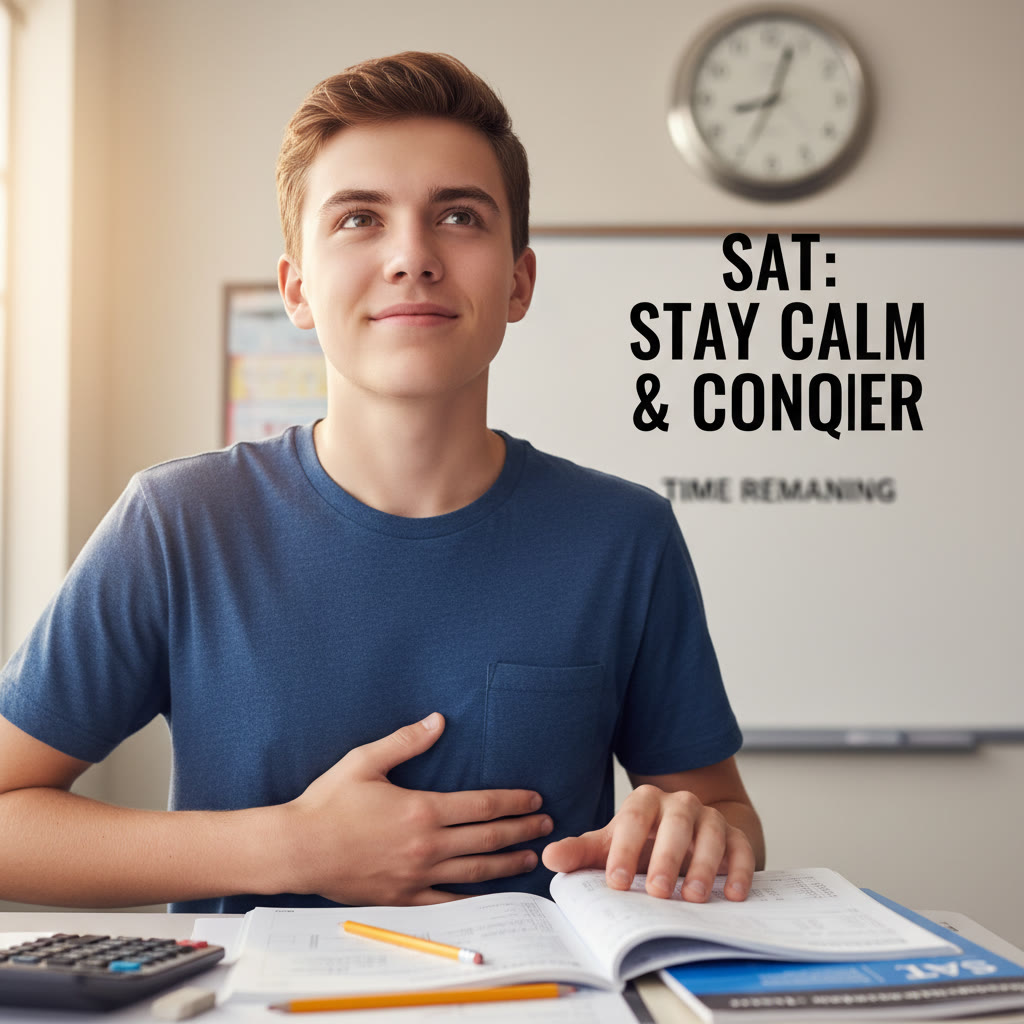
Emma, a high school senior, had a history of blanking during timed tests. She knew the material but felt trapped by spikes of anxiety during sections. We started with a simple experiment: before each practice test she did three minutes of diaphragmatic breathing and one minute of box breathing. During the test, she used a 30-second box breathing reset if she felt overwhelmed.
Within two weeks, Emma noticed fewer blanking episodes and faster recovery when she did stall. Her scores on timed sections began to reflect her true understanding rather than her panic level. The breathing practice became a small ritual—her mental reset—that allowed her to show up more consistently.
This is the same principle you can adopt: a small habit repeated becomes a dependable tool when the pressure is on.
Combining Breathing with Other Test-Day Tools
Breathing is powerful, but it pairs well with cognitive and behavioral techniques:
- Brief mindfulness checks: Notice three sensations (breath, feet on floor, pen in hand) to anchor attention.
- Practice under realistic conditions: Simulate timed sections and include breathing breaks so the technique transfers to the real test.
- Positive self-talk: Pair exhalations with short phrases like, “steady” or “one step.”
How Sparkl’s personalized tutoring fits naturally
Students often find it helpful to learn breathing and test-taking routines with guidance. Sparkl’s personalized tutoring offers 1-on-1 guidance where expert tutors incorporate anxiety-management strategies—like the breathing practices above—into tailored study plans. Tutors can model techniques during sessions, give feedback on timing and form, and use AI-driven insights to spot patterns in performance that indicate when anxiety is affecting results. That blend of human coaching and smart analytics helps make breathing practices habitual and applicable on test day.
Common Questions and Troubleshooting
What if breathing makes me lightheaded?
If you feel dizzy, you’re likely hyperventilating (breathing too quickly or deeply). Slow the breath down, focus on diaphragmatic breathing, and take smaller, gentler breaths. Practice in a seated position until the feeling subsides. If dizziness persists, stop and rest—the technique should not make you unwell.
What if I forget to breathe during the test?
That’s exactly why you practice. The first few times you might forget to use the technique in the heat of the moment. Over time, shorter practices and consistent cues (like taking a breath at the start of each page) make the behavior automatic.
How long until breathing makes a measurable difference?
Some students notice immediate reductions in anxiety after a single practice. More reliable changes in test performance—fewer blanking episodes, better pacing, improved focus—typically show up after consistent practice for 1–2 weeks.
Quick Cheatsheet: Techniques by Situation
- Waking up on test day: 5–10 minutes resonant breathing to prime focus.
- Before starting a section: 60 seconds box breathing to steady attention.
- During a panic spike: 30–60 seconds diaphragmatic breathing to stop the spiral.
- After a rough question: 30 seconds 4-7-8 or a short walk to reset mood and objectivity.
Final Thought: Small Practice, Big Payoff
Breathing techniques may feel surprisingly simple next to intense study schedules and strategy drills. Yet they directly affect the state of mind required for peak performance. Think of these practices as part of your test toolkit—like pacing strategies for the Math section or reading techniques for the Evidence-Based Reading section. When anxiety is lower and attention is steadier, the hours you’ve already spent preparing translate more reliably into the scores you want.
Whether you practice on your own or with 1-on-1 guidance—such as Sparkl’s tailored tutoring that integrates expert tutors and AI-driven insights into individualized study plans—make time for breath. On test day, a calm breath can be the difference between panic and presence. Breathe deliberately, show what you know, and remember: you’re better prepared than you may feel in the moment.
Takeaway Actions (Five-minute checklist)
- Try box breathing for 1 minute right now.
- Schedule 5–10 minutes of diaphragmatic breathing into your daily study block.
- Plan a 2-week practice schedule and track how you feel after each session.
- Assign a breathing routine to each test moment (before, during, after sections).
- If helpful, ask a tutor for 1-on-1 guidance to build a personalized plan and use AI-driven insights to refine timing and technique.
Small, repeated actions build confidence. Start with your breath and let steady focus follow.


























No Comments
Leave a comment Cancel