
Why graphs matter on the SAT (and why you should love them)
Graphs are the SAT’s way of asking you to think like a smart, practical problem solver. Instead of long algebraic gymnastics, many questions simply ask: “What does this picture mean?” Whether it’s a line showing a trend, a scatterplot suggesting a relationship, or a table of values hiding a pattern, graphs let the test pack a lot of information into a small space.
That makes graphical questions efficient for the test-makers—and often intuitive for students who know how to read them. The secret is not memorizing every possible graph, but learning the language of axes, scales, keys, and units. With a few solid habits and a little practice, you’ll quickly turn visual data into correct answers.
Overview: Common graph types you’ll see
Here’s a quick map of the most common graph types on SAT Math and the occasional graphic that can appear with Reading passages:
- Line graphs / time-series plots
- Bar graphs (and side-by-side bar charts)
- Histograms
- Pie charts / circle graphs
- Scatterplots (correlation and best-fit lines)
- Coordinate graphs of functions (lines, parabolas, piecewise graphs)
- Box-and-whisker plots (five-number summaries)
- Tables of values
- Number line diagrams and simple geometric graphs
Quick tip
Most SAT graph questions test a small set of ideas: slope and intercept, average vs. median, reading a value from a graph, comparing quantities, identifying trends, or translating between a table and a graph. If you can do those well, you’ll handle most graph items quickly.
Line graphs and time-series plots
What they look like: continuous lines connecting points over a horizontal axis usually representing time. These are the classic “stock price over months” or “temperature over days” displays.
What they test:
- Reading exact values by interpolating between ticks
- Slope as a rate (rise over run) — think “per unit time”
- Comparing segments (which interval has the steepest increase?)
- Identifying maxima, minima, and times when two lines intersect
Example: If a line rises from 20 at month 1 to 50 at month 4, the average rate of change is (50−20)/(4−1)=30/3=10 units per month. That simple slope idea comes up again and again.
Strategies for line graphs
- Estimate before calculating: eyeball where the line is, then confirm with precise arithmetic.
- Mark intercepts and note units—sometimes axis labels aren’t 1 unit per tick.
- For intersection questions, set up equations when the lines correspond to algebraic formulas; otherwise, read directly.
Bar graphs vs. Histograms: don’t confuse them
Bar graphs display categorical data—each bar corresponds to a label (e.g., favorite fruit), and gaps between bars are normal. Histograms show numeric ranges (bins) and must be interpreted as continuous-frequency data; adjacent bars touch because the intervals are contiguous.
Common SAT asks: compare heights (which category is largest), compute percent changes, or convert frequencies into probabilities or proportions.
Key differences
- Bar graph: categories, gaps between bars, order can be arbitrary.
- Histogram: numerical bins, contiguous bars, area matters if widths differ (but SAT usually uses uniform bins).
Pie charts / circle graphs
Pie charts show parts of a whole. On the SAT you’ll usually see percentages or angles, and questions often translate a slice into a number—”If a pie slice is 30% and there are 600 students, how many reported X?”
Tips for pie charts
- Convert percentages to fractions for quick math: 25% = 1/4, 10% = 1/10.
- If you get angles, recall that 360 degrees corresponds to the whole—so 90 degrees is 1/4.
- Watch rounding: SAT problems are designed so numbers work nicely without messy decimals most of the time.
Scatterplots and correlation
Scatterplots are powerful. They show the relationship between two quantitative variables and often include a line of best fit or a trend indicated visually. SAT questions ask you to identify positive/negative correlation, strength of association, or to use trend lines to estimate values.
Interpreting correlation
- Positive correlation: as x increases, y tends to increase.
- Negative correlation: as x increases, y tends to decrease.
- No correlation: points are widely scattered with no visible trend.
Important: correlation does not imply causation. If a Reading passage references a graph, be careful about the author’s claims—do they assume cause where only association is shown? That kind of reasoning often appears in evidence-based questions.
Coordinate graphs of functions (lines, parabolas, piecewise)
These are a staple of the Math section. A graph may show a linear equation, a quadratic (parabola), or a piecewise function. You might be asked to read roots, vertex, axis of symmetry, or to select an algebraic equation that matches the picture.
Common tasks
- Find x- and y-intercepts.
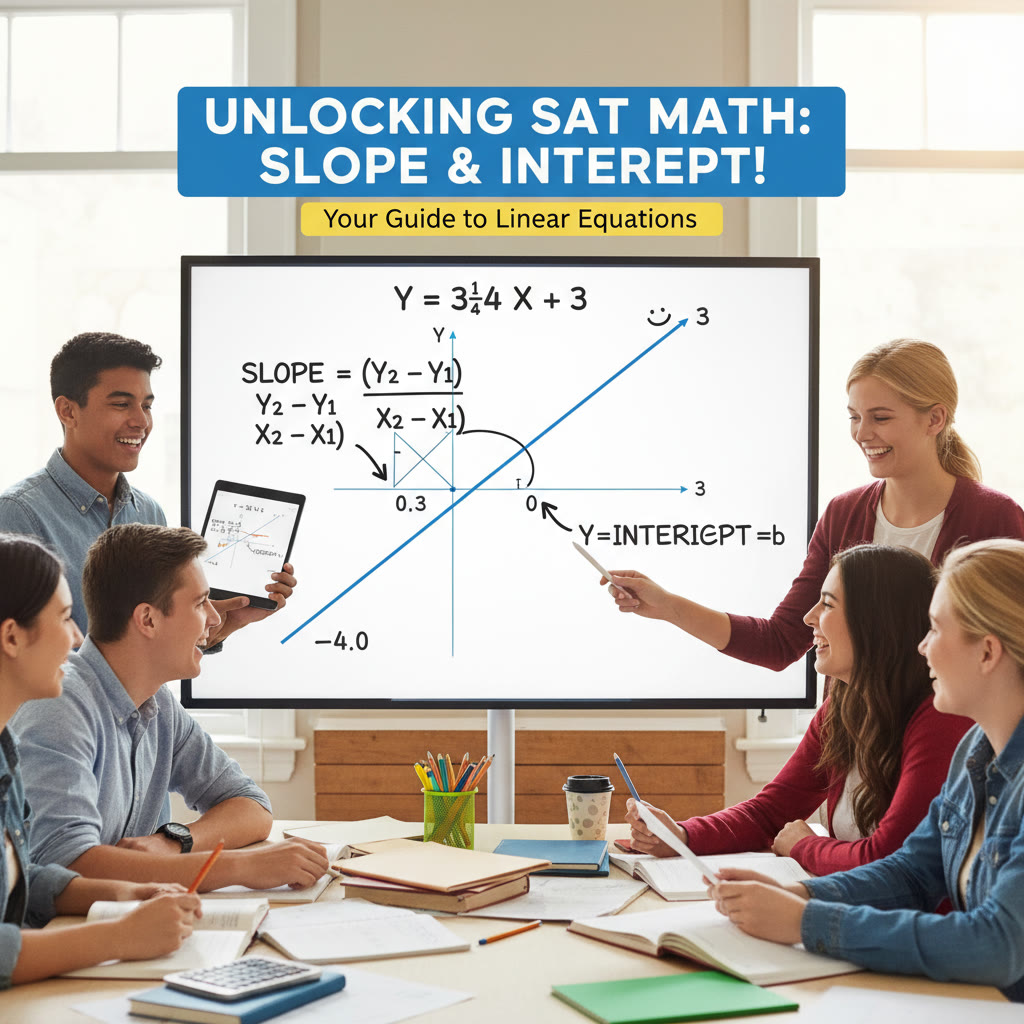
- Identify slope and y-intercept for lines.
- For quadratics: locate vertex, direction (up/down), and width (steep vs. wide).
- Translate between graph and function form (y = mx + b, y = ax^2 + bx + c).
Box-and-whisker plots and five-number summaries
Box plots are compact—median, quartiles, and extremes. The SAT uses them to compare medians, spreads (interquartile ranges), or to spot outliers.
What to watch for
- The middle of the box is the median; the box edges are Q1 and Q3.
- Whisker length shows spread; a long whisker means more extreme values on that side.
- Box plots can be misleading if samples have different sizes; always read the axis carefully.
Tables of values
Tables are deceptively easy because the data are explicit. SAT tasks include identifying patterns, computing averages, or translating a table into a graph or equation.
Quick habits
- Scan the headings and units first.
- Look for arithmetic patterns—differences, ratios, or repeated growth.
- If asked to estimate, interpolate between rows rather than guessing wildly.
Number line and simple geometric graphs
Number lines might show inequalities or absolute value positions; coordinate geometry problems may combine geometry and algebra (distance, midpoint, slope). Make sure you can read positions precisely and apply simple formulas when asked.
Common traps and how to avoid them
Recognizing traps will save you time. Here are the frequent mistakes students make with graphs on the SAT—and the fixes that actually work.
- Misreading the scale: Axes aren’t always 1 unit per tick. Always check the labels before using the graph.
- Assuming continuity: A bar graph of categories isn’t continuous—don’t interpolate between categories.
- Confusing histogram bins: The height represents the count in a bin, not a single value.
- Equating correlation with causation: In reading and thinking questions, watch authors’ claims and whether the graph supports causality.
- Rounding too early: Keep values exact until the last step; SAT numbers often simplify cleanly.
Worked example: reading a scatterplot and using a trend line
Consider a scatterplot that shows weekly hours studied (x) and quiz score (y). The points roughly align along a line, and the trend line goes through (2, 70) and (8, 88). A common SAT question: “According to the trend line, what is the predicted score for a student who studies 5 hours?”
Step 1: Compute the slope (rate of score increase per hour): (88−70)/(8−2) = 18/6 = 3. So the trend predicts a 3-point increase per extra hour.
Step 2: Find the y-intercept using y = mx + b. Using point (2, 70): 70 = 3(2) + b → 70 = 6 + b → b = 64.
Step 3: Predict at x = 5: y = 3(5) + 64 = 15 + 64 = 79. The predicted quiz score is 79.
This simple linear interpretation appears in many forms: sometimes you’ll estimate from the picture without doing exact algebra; other times you’ll be given the equation and asked to interpret slope or intercept in context.
Study strategies: how to practice graphs efficiently
Graphs are learned by seeing many of them and practicing the same set of skills. Here’s a practical plan you can put into action this week.
- Warm up with quick interpretation drills: 10 problems, 20 minutes. Focus on reading values, slopes, and trends.
- Do mixed sets: combine line graphs, scatterplots, and histograms so you don’t get fooled by format familiarity.
- Annotate every graph: circle units, underline the question, write the slope or key values in the margin.
- Time yourself. Practice recognizing what can be done mentally vs. what needs a calculation.
- Review errors deeply: when you miss a graph question, recreate the graph and ask why the trap worked.
How personalized tutoring accelerates this process
If you want faster progress, one-on-one work can be very effective. Sparkl’s personalized tutoring combines expert tutors with AI-driven insights to diagnose the exact graph skills you need, build tailored practice plans, and provide focused feedback. That targeted approach helps you eliminate recurring mistakes and build confident instincts much faster than practicing randomly.
Practical classroom-to-test transfers: Reading passages that include figures
While the majority of graph questions are in Math, the Evidence-Based Reading and Writing section sometimes includes passages with figures, charts, or tables. There you’ll need to integrate the graphic with the passage’s claims—often underlining or noting whether the figure supports the author’s argument.
Questions you might face in Reading
- “Which choice best describes what the figure indicates?” — literal interpretation.
- “Which statement is supported by both the passage and the figure?” — synthesis.
- “Which claim overstates what the figure shows?” — critical evaluation.
Good practice: when you see a figure, write a one-line summary before reading the question—this prevents the passage’s rhetoric from biasing your interpretation of data.
Comparison table: Graph types, what they test, and quick tricks
| Graph Type | Common SAT Tasks | Quick Tricks |
|---|---|---|
| Line graph | Rates of change, intersections, precise values | Check axis units, compute slope as rate, estimate between ticks |
| Bar graph | Compare categories, percent changes | Read category labels first; convert counts to percentages if needed |
| Histogram | Frequency, density, mean/median estimation | Note bin widths and that bars touch; use midpoints to estimate |
| Pie chart | Parts-of-whole calculations, angle interpretation | Convert to percentages or fractions; 360° = whole |
| Scatterplot | Correlation, best-fit predictions, outliers | Assess direction and strength; use trend line for estimates |
| Box plot | Comparing medians and spreads, spotting outliers | Compare medians directly; IQR = box length |
| Table | Pattern recognition, interpolation, translating to equations | Check units and compute differences/ratios quickly |
Two cautionary examples — what trips students up
Let’s walk through two short traps you might see on test day.
Trap 1: Skipping axis labels
A bar chart shows “Category A” with a bar up to the top of the axis labeled “10,000” and Category B at half that height. If you assume the axis is linear but the axis is actually logarithmic or in thousands, your comparison will be wrong. The SAT rarely uses logarithmic scales, but it will use non-1 tick spacing or units like “thousands.” Always read the axis label.
Trap 2: Extrapolating outside the data range
Scatterplots with trend lines are tempting to extend far beyond the last point. The SAT may ask you to estimate within the given domain—answers that require extrapolation are often wrong because the modeled relationship may not hold outside the observed range. Stick to interpolation unless the question explicitly asks you to project forward and gives clear guidance.
Practice plan: 4 weeks to graph confidence
Here’s a short schedule that balances speed and depth. Spend 30–60 minutes per session, 4–5 days a week.
- Week 1 — Foundations: Work through each graph type, 20 problems per type. Focus on reading values and units.
- Week 2 — Mixed practice: Timed sets with 30% graphs and 70% mixed Math. Review mistakes thoroughly.
- Week 3 — Problem solving: Tackle applied questions (word problems with graphs, translating between table/graph/function).
- Week 4 — Simulation: Take two full-length practice sections (Math + Evidence-Based Reading) and identify graph-related errors. Target weak areas with short daily drills.
If you want help building and following a plan like this, working with a tutor can shorten your learning curve. Sparkl’s personalized tutoring offers 1-on-1 guidance, tailored study plans, expert tutors, and AI-driven insights that pinpoint where you lose points on graphs—so every practice minute counts.
Final thoughts: make visual literacy a habit
Graphs are everywhere on the SAT because they’re a compact way to evaluate reasoning. The good news is that you don’t need to memorize exotic formulas—just practice reading what the picture actually says. Annotate, check units, estimate before calculating, and treat the graph as a narrative that supports a simple mathematical claim.
After a few deliberate practice sessions, your brain will start to recognize patterns automatically. You’ll spot slopes, outliers, and misleading scales in the first few seconds—exactly the kind of speed and accuracy the SAT rewards.

Quick checklist to bring into every test section
- Read axis labels and units first
- Scan the question to know what to extract (value, rate, percent, comparison)
- Estimate mentally, then compute precisely
- Watch for common traps: scale, continuity, extrapolation
- Annotate and eliminate wrong answer choices quickly
Graphs are one of the friendliest parts of the SAT: they reward clear thinking and careful reading. Practice with purpose, learn the small set of skills these visuals test, and consider targeted help if you want faster improvement. With a steady approach, graphs will stop feeling like puzzles and start feeling like opportunities to pick up easy points on test day.
Good luck—and enjoy the view. The test is asking you to read a picture. Once you can do that reliably, you’ll be surprised how many questions fall into place.




















No Comments
Leave a comment Cancel