

One week to go: calm down and get strategic
Seven days before the SAT can feel like the most important—and most anxious—week of your life. That’s normal. The good news? When time is limited, focus matters more than frantic repetition. The goal in the last week is not to learn every obscure rule or algebra trick; it’s to sharpen, prioritize, and enter test day confident and calm.
This guide gives you a practical, day-by-day approach and the thinking behind it: how to choose what to practice, when to do full-length tests, how to correct mistakes so they actually stick, and how to arrive on test day rested and ready. If you’re working with Sparkl’s personalized tutoring, many of these steps will fit naturally into your plan—your tutor can help tailor practice sets, provide 1-on-1 guidance for weak spots, and use AI-driven insights to spot patterns in your errors that you might miss on your own.
Core principles for the final week
Before you open a practice book, keep these principles in mind. They will help you prioritize time and energy when everything feels urgent.
1. Targeted practice beats volume
Doing ten random sections will not help as much as doing two focused sections that deliberately attack your weakest question types. Identify the 2–3 things that cost you points most often—timing, specific math topics, comma rules, or reading passage strategies—and spend disproportionate time on them.
2. Practice under pressure, but practice smart
Simulate test conditions for at least one full practice test, but don’t make every session a marathon. Mix full tests with short, intense practice sessions (25–50 minutes) on targeted topics to keep energy and focus high.
3. Learn from mistakes—systematically
It’s not enough to mark an answer wrong. Record why the mistake happened, what pattern it fits (careless, concept gap, timing), and what the corrective action is. Reviewing the same mistake type multiple times is what changes performance.
First step: quick diagnostic and priority list (Day -7)
Start the week with a calm, honest check-in. You don’t need a full test; a 60–90 minute practice block across sections is enough to reveal patterns.
- Take two 25-minute Reading passages, one 25-minute Writing section, and 30 minutes of Math (split calculator and no-calculator items if you can).
- Time yourself strictly. Note which questions you guessed on, which you ran out of time on, and which you got wrong after careful thought.
- Create a priority list of up to three targets. Example: (1) reduce careless errors in Algebra II questions, (2) increase Reading passage accuracy on Science/Social Studies topics, (3) finish Writing section in time without wild guessing.
Once you have the list, decide where each hour will go for the next seven days. If you have a Sparkl tutor, they can help interpret the diagnostic and convert it into a tailored study plan—complete with targeted practice sets and follow-up checks.
Designing the week: a practical schedule
Below is a flexible schedule you can adapt around school, sleep, and obligations. The two keys: (1) at least one full-length practice test under timed conditions mid-week or early in the week, and (2) focused review sessions every day that correct specific mistakes.
| Day | Main Focus | Practice Type | Goal |
|---|---|---|---|
| Day -7 (Start) | Diagnostic & plan | Short timed sections | Identify 2–3 priorities |
| Day -6 | Targeted practice: Weakest topic | Drills + problem sets | Improve accuracy on specific question types |
| Day -5 | Full-length practice test (timed) | Proctored test simulation | Test pacing, stamina, logistics |
| Day -4 | Review test mistakes & strategy | Error log, targeted review | Fix patterns identified in the test |
| Day -3 | Section-specific work | Mixed timed drills | Sharpen techniques; practice timing |
| Day -2 | Light practice & confidence building | Short sections, review formulas | Conserve energy; recall key rules |
| Day -1 (Rest) | Rest and logistics | Light review, sleep | Be calm and ready |
Adapt this based on your test date (e.g., move the full-length test earlier if your test is on a Saturday and you want a dress rehearsal). If you’re short on time, prioritize a full-length test plus two focused sessions on your top weaknesses.
How to run a full-length practice test so it helps
Not all practice tests are created equal in value. The point of a full-length test in the last week is to practice pacing, simulate fatigue, and reproduce the cognitive environment of test day so you can identify practical fixes.
- Take it under as-real conditions as possible: timed sections, breaks only where allowed, and a quiet environment. Wear the clothes you plan to wear on test day to get used to comfort and pockets for materials.
- Use the same calculator you will use on test day, and make sure batteries/backup batteries are charged.
- After finishing, mark the questions you guessed on or ran out of time for. Those become the priority for immediate review.
How to review a practice test effectively
Once the test is done, don’t immediately take another test or drill. Spend time on analysis and correction:
- Sort wrong answers into categories: careless errors, timing, content gap, or misunderstanding the question.
- For careless errors, write down the trigger (e.g., misread negative sign, copy error) and do 5–10 similar problems focusing only on eliminating that error.
- For content gaps, review the concept briefly and do a short set of problems that apply it in different ways.
Keeping an error log is key: a simple table in a notebook listing the question type, error type, corrective action, and follow-up date will do wonders for retention.
What to do each day: focused strategies by section
Reading (comprehension, not speed reading)
Reading is about active, efficient engagement. In the last week, prioritize:
- Passages that feel slow for you—practice the 10–12 minute timing per passage until you can answer questions accurately in that window.
- Identifying question types you miss: main idea, function, inference, or detail. Do small targeted sets (3–4 questions of the same type) to build pattern recognition.
- Practice annotation: a single-line main idea, tag tone words, and mark contrasting cue words like “however” or “despite”. That 5–10 second habit saves time.
Example drill: take a single passage, spend 3–4 minutes annotating, then answer only inference questions for that passage. Repeat on similar passages to improve extraction of implied information.
Writing and Language (rules with rhythm)
Writing is the section of rules applied repeatedly. Last-week focus:
- Review high-yield grammar rules (subject-verb agreement, pronoun clarity, verb tense consistency, comma usage in compound/introductory clauses).
- Do short, timed sets of 15–20 questions focusing on one rule at a time—this builds automaticity far better than mixed, unfocused practice.
- Learn to spot the rhetorical question types: transition, word choice, and sentence order problems. Rehearse the logic—what is the paragraph trying to do?
Math (smart practice beats more problems)
Math in the last week is about error elimination and formula fluency.
- Make sure basic formulas and strategies are memorized: area, volume, percent-change, distance-rate-time basics, and function notation interpretation.
- Prioritize the specific content you miss—if you miss geometry problems with similar triangles, do 10 focused problems and write the core steps on a note card to review each day.
- Practice without over-relying on complicated algebra: sometimes a number plug-in or estimation is faster and less error-prone.
Quick drills and micro-sessions
Short, sharp practice is a last-week superpower. Mix 20–40 minute sessions into the day when energy is high.
- 20-minute vocabulary and phrasing drills: scan sentences and choose the concise answer.
- 30-minute math problem set focused on a single topic (e.g., quadratic equations, ratios).
- 25-minute reading speed/accuracy block: one passage and review only inference questions.
Test-day logistics and the day-before checklist
Practical details are surprisingly powerful anxiety reducers. The day before the test, switch from training to logistics and light confidence-building work.
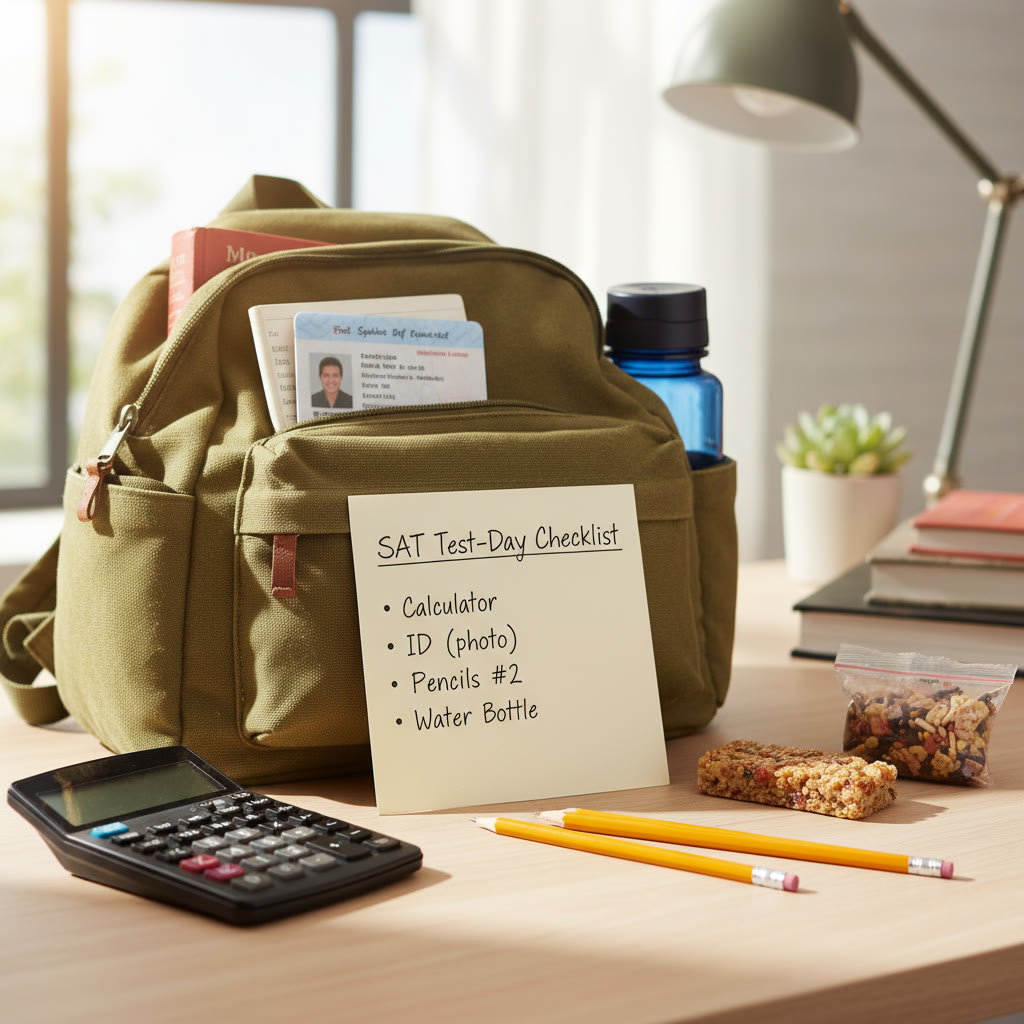
- Pack your bag now: admission ticket (or printed confirmation), photo ID, two sharpened pencils, approved calculator with fresh batteries, snacks, water, and a light jacket.
- Set two alarms and plan travel time with buffer. Know where the test center is and where you’ll park or meet transportation.
- Eat balanced meals; avoid a new heavy food that might upset your stomach.
- Light review only—flashcards, formula sheet, or a handful of problems that you know you can do. No new content.
- Go to bed early. Aim for a consistent sleep schedule and at least 7–8 hours the night before the test.
Mental game: focus, confidence, and calm
How you feel matters. Small mental strategies can reduce stress and improve concentration.
- Use a short pre-test routine: three deep breaths, a quick positive phrase (“I prepared well”), and a glance at your focused cheat-sheet of formulas and quick reminders (only in your head, not on the test).
- If you get stuck, have a reset plan: mark the question, move on, and return later. Don’t let one problem steal time or confidence.
- Practice mindfulness or focused breathing for 2–3 minutes before each section during practice sessions so the habit is automatic on test day.
How to use Sparkl’s personalized tutoring in the final week (if available)
If you’ve been working with Sparkl, leverage the last week for surgical improvements. A tutor can:
- Create a last-week study plan that matches your exact weaknesses instead of giving generic advice.
- Provide 1-on-1 guidance to explain mistakes quickly and clearly, and assign targeted drills that address the exact skill you’re missing.
- Use AI-driven insights to spot recurring error patterns and prioritize questions that are most likely to help you improve your score in seven days.
A few sessions in the final week with a focused tutor are often better than many hours of unguided practice because the tutor short-circuits unhelpful habits and gets you practicing the right things immediately.
The error log: your single best tool
Keep a running error log during the week. Make columns for date, question type, specific mistake, corrective action, and follow-up. At the end of the week, quickly review the log and test yourself on recurring items.
This guide gives you a practical, day-by-day approach and the thinking behind it: how to choose what to practice, when to do full-length tests, how to correct mistakes so they actually stick, and how to arrive on test day rested and ready. If you’re working with Sparkl’s personalized tutoring, many of these steps will fit naturally into your plan—your tutor can help tailor practice sets, provide one-on-one guidance for weak spots, and use AI-driven insights to spot patterns in your errors that you might miss on your own.
Sample day-by-day micro-plan (customizable)
Here’s a fill-in-the-blank sample you can copy into a notebook. Adjust times to fit your day.
- Morning (45–60 minutes): Active review of one weak area (e.g., algebra problems with quadratic formula). Three focused problems, then three variations.
- Afternoon (30 minutes): Reading passage drill—annotate and answer inference and function questions only.
- Evening (30–45 minutes): Writing rule review—20 targeted questions on comma usage and parallel structure.
- Night (10 minutes): Quick error log update and a 5-minute breathing exercise.
Common last-week mistakes and how to avoid them
- Trying to learn too much new content. Fix: reinforce high-yield rules and eliminate small mistakes instead of cramming new topics.
- Doing too many mixed practice sets with no focus. Fix: split practice into targeted drills that address your top two weaknesses.
- Neglecting sleep and nutrition. Fix: prioritize rest; performance is sharply reduced by fatigue and poor diet.
- Over-relying on a single practice test as the only measure. Fix: use tests for pacing and error patterns, and follow them with correction sessions.
Final morning routine (on test day)
Keep it simple and repeatable:
- Wake up with enough time to eat a stable breakfast: protein and complex carbs (e.g., eggs and toast, yogurt and fruit).
- Skim a 1-page cheat-sheet of formulas and one quick mental checklist (pacing plan, fill bubbles, eliminate silly errors).
- Get to the test center early, breathe, and settle into a calm rhythm. Remember: you’ve prepared; now execute.
Parting encouragement
The last week is powerful because focused, consistent effort compounds. Small changes—fixing a recurring careless error, getting better at one question type, mastering the timing on one section—add up. This week is not about dramatic reinvention; it’s about getting sharper, calmer, and more deliberate.
Whether you go it alone or lean on Sparkl’s personalized tutoring for targeted sessions and AI-driven insights, make choices that save time and build confidence. You can turn seven thoughtful days into meaningful score gains. Breathe, prioritize, practice with purpose, and walk into the test room ready to show what you’ve learned.























No Comments
Leave a comment Cancel