
Welcome — why science passages matter on the Digital SAT
If the phrase “science passage” makes you picture microscopes, lab coats, and math you don’t understand — take a breath. The science passages on the Digital SAT aren’t trying to trick you with advanced concepts. Instead, they test how well you read, reason, and use evidence. Think of them as short research stories: a setup, results, and a set of questions that ask you to connect dots.
This blog walks you through the patterns you’ll repeatedly see in science passages, gives clear strategies for each pattern, and outlines a study plan that fits into a busy student’s life. I’ll include examples and comparisons, and even a simple table you can screenshot for quick review. If you want guided practice tailored to your strengths and weaknesses, Sparkl’s personalized tutoring (1-on-1 guidance, tailored study plans, expert tutors, and AI-driven insights) can fit naturally into the final section of this guide.
What the Digital SAT science passages actually are (and what they are not)
First, a reality check. The science passages are not college-level research papers. They are short, often readable reports or summaries that present a question, methods, and findings — sometimes different viewpoints. The test is about:
- Interpreting data in charts and tables
- Finding evidence in the passage to support specific answers
- Comparing hypotheses or experimental results
- Drawing logical inferences — not generating new scientific knowledge
So even if you don’t know the technical vocabulary, you can still do well by focusing on how information is presented and how the questions are framed.
Key patterns you’ll see in science passages
Across many Digital SAT forms you’ll encounter repeatable structures. Recognizing these patterns saves time and reduces stress.
Pattern 1 — Short experiment + data table or graph
Most common. The passage describes an experiment, often with a table or graph showing results. Questions ask you to read the graphic, combine it with the text, and choose the best answer supported by both.
How to attack it:
- Scan the graph or table first. Note units, axes, legend, and any labels.
- Underline the research question in the passage; it usually lines up with what the data shows.
- Answer data questions by marking exactly which row/column/point you used — the SAT rewards evidence-based answers.
Pattern 2 — Competing hypotheses or interpretations
Two or more scientists present different explanations for the same observations. Questions ask you to identify which hypothesis best fits the evidence or which would be weakened by new data.
How to attack it:
- Make a quick pros/cons note for each hypothesis: which evidence supports it, which challenges it?
- Expect answer choices that rephrase evidence — don’t over-interpret wording.
- Watch for causal language. The SAT is cautious: correlation ≠ causation unless the passage says otherwise.
Pattern 3 — Method-focused passages (how the study was done)
These passages emphasize experimental setup and limitations. Common question types ask about how a change in methods would influence results or which limitation is most important.
How to attack it:
- Identify variables (independent, dependent) and any controls used.
- Note sample size and sampling method — these often appear in limitation questions.
- Link methodological details to possible biases in conclusions.
Pattern 4 — Historical or descriptive science passages
Less common but useful to recognize: these read more like a short encyclopedia entry or history of a scientific idea. Questions emphasize vocabulary-in-context, main idea, and inference.
How to attack it:
- Focus on the author’s viewpoint and the passage’s purpose (explain, argue, describe).
- For vocabulary questions, rely on context clues nearby rather than assumed scientific meaning.
Pattern 5 — Paired passages (compare and contrast)
Two short passages on related topics are presented side-by-side. You’ll be asked to compare conclusions, evidence, or methods.
How to attack it:
- Make a quick two-column note: Passage A — main claim and support; Passage B — main claim and support.
- Answer cross-passage questions by explicitly referencing which passage supports which idea.
Common question types and how they map to patterns
When you’re practicing, label questions by type. Over time you’ll recognize which ones you finish quickly and which need more time.
Evidence-based (text + data) questions
These ask not just for the right answer but for the sentence or figure that justifies it. Always point back to the passage; the correct answer will be directly supported.
Inferential questions
These require you to read between the lines. The key is that a correct inference must be the most reasonable given the passage. Avoid answers that introduce outside knowledge.
Data interpretation questions
Graph and table questions test your ability to read trends, compare groups, and understand units. They’re often quick points if you read the axis carefully.
Vocabulary-in-context questions
These ask for the meaning of a word as used in the passage. Context is king. Plug the answer back into the sentence to see if it fits logically.
Methodology and limitation questions
These test critical thinking about experimental design. If an answer choice suggests something the passage didn’t allow for, it’s probably wrong.
Practical reading strategies — a step-by-step routine
Turn the patterns into a repeatable routine. Here’s a compact, time-tested approach you can put on a sticky note and use on test day.
60–30–10 routine
This is a timing and focus strategy that balances comprehension with question-answering:
- 60% of your initial time — read the passage quickly but carefully, and scan any figure. Annotate the main claim, the approach used, and the main result.
- 30% of your time — answer the straightforward questions (data and vocabulary ones first).
- 10% of your time — tackle the tougher inference and cross-passage questions. If something still stalls, flag it and return if you have time.
This routine helps you avoid getting stuck on a single tough question early and keeps momentum.
How to read graphs and tables fast and accurately
Many lost points come from misreading axes, units, or legends. Practice these quick checks:
- Read axis labels and units before interpreting trends.
- Check the legend for what each color or symbol means.
- Note whether values are averages, percentages, raw counts, or rates.
Mini checklist when a graph appears
- What are the axes and units?
- Is there a legend or multiple data series?
- Is the scale linear or logarithmic? (Rare, but check.)
- Does the graph show a trend, a difference between groups, or variability?
A short example (walkthrough)
Imagine a passage about two fertilizers tested on tomato plants. The passage describes percent increase in yield for Fertilizer A and Fertilizer B across three soil types and includes a table of averages and standard deviations.
- Step 1: Scan the table: Fertilizer A shows +12%, +5%, +14% across soils. Fertilizer B shows +11%, +10%, +15%.
- Step 2: The passage notes small sample size in one soil type. Mark that as a limitation.
- Step 3: When asked which fertilizer is more consistently effective, choose the one with smaller standard deviations or more uniform increases — check the table, not general wording.
That’s it: use data first, text second, and treat the passage’s claims with the experimental context in mind.
Common traps and how to avoid them
The SAT loves answer choices that look right at first glance but fail on closer inspection. Here are recurring traps and clear ways to dodge them.
Trap: Overreliance on prior knowledge
Don’t let what you know from biology class trump what the passage says. The SAT expects answers based on passage information only.
Trap: Misreading qualifiers
Words like “may,” “suggest,” “likely,” or “no significant difference” change meaning. If the passage says “suggests,” an answer stating a definitive causal claim is wrong.
Trap: Picking the answer that sounds scientific but isn’t supported
Look for explicit textual support. If you can’t find a sentence that backs the claim, it’s probably a distractor.
Study plan: 8 weeks to steady improvement
Here’s a balanced plan that mixes practice, analysis, and review. Adjust the timeline to your test date and current skills.
Weekly structure
- 3 focused practice sessions (45–60 minutes) on science passages — one short, one medium, one timed full set.
- 1 review session (30–45 minutes) to analyze mistakes: pattern, question type, and any misread graphs.
- 1 mixed practice session (60 minutes) including reading and math to mirror real test context.
Milestones by week
Follow this progression to build confidence and skills:
- Weeks 1–2: Learn patterns, do untimed practice, and create a personal error log.
- Weeks 3–4: Introduce timed sections and focus on data interpretation speed.
- Weeks 5–6: Work on inference questions and paired passages; simulate full digital practice tests.
- Weeks 7–8: Final polishing, focus on endurance, and targeted review of persistent weaknesses.
Quick reference table: question types, cues, and quick tactics
| Question Type | Common Cues | Quick Tactic |
|---|---|---|
| Data interpretation | Tables, graphs, units, error bars | Read axes first; locate exact row/column/point |
| Evidence-based | “Which choice provides the best evidence” | Find the sentence that directly supports answer |
| Inference | “Suggests,” “most likely,” “implies” | Choose the most reasonable conclusion strictly from passage |
| Method/limitation | Sample size, controls, randomization | Link method details to what they would affect in results |
| Vocabulary-in-context | Bolded or unfamiliar words in sentence | Use surrounding sentence to substitute a meaning |
Study tools and practice resources you should use
Practice is essential. Official practice materials are ideal for understanding real item styles. Complement them with targeted passages and timed sections. If you’re working with a tutor — or considering one — choose someone who focuses on evidence-based strategies, data interpretation, and timed practice.
Note: if you want deeply personalized support, Sparkl’s tailored study plans and expert tutors can help you prioritize weaknesses uncovered by practice tests and deliver 1-on-1 guidance. Their AI-driven insights can highlight recurring error patterns so your sessions are efficient and focused.
Test-day tips specifically for science passages
- Start with the data: When a graph or table is present, look at it before reading every word of the passage.
- Annotate sparingly but clearly: Circle the main claim and underline where evidence appears.
- Don’t get trapped by fancy language: If an answer choice requires outside knowledge, it’s wrong.
- Use the flag-and-return method: If a tough inference is eating time, flag it and finish easier questions first.
How to measure progress and avoid plateaus
Keep an error log with three columns: question type, mistake reason, and corrective strategy. Every week review patterns. If you keep missing the same type (e.g., data interpretation), shift more practice toward that type and simulate conditions (timed, digital device) until you stabilize.
When to bring in a tutor — and what to expect
Tutors are most effective when they target specific, persistent issues. Consider a tutor if:
- You’ve plateaued despite regular practice
- You consistently lose time on a particular question type
- You want accountability and a structured, adaptive plan
Good 1-on-1 tutoring focuses on problem diagnosis, deliberate practice, and tailored strategies — for example, turning your error log into a focused set of drills. If you choose a tutoring program like Sparkl, expect a mix of expert feedback, a tailored study plan, and tools that analyze your practice data to guide sessions more intelligently. 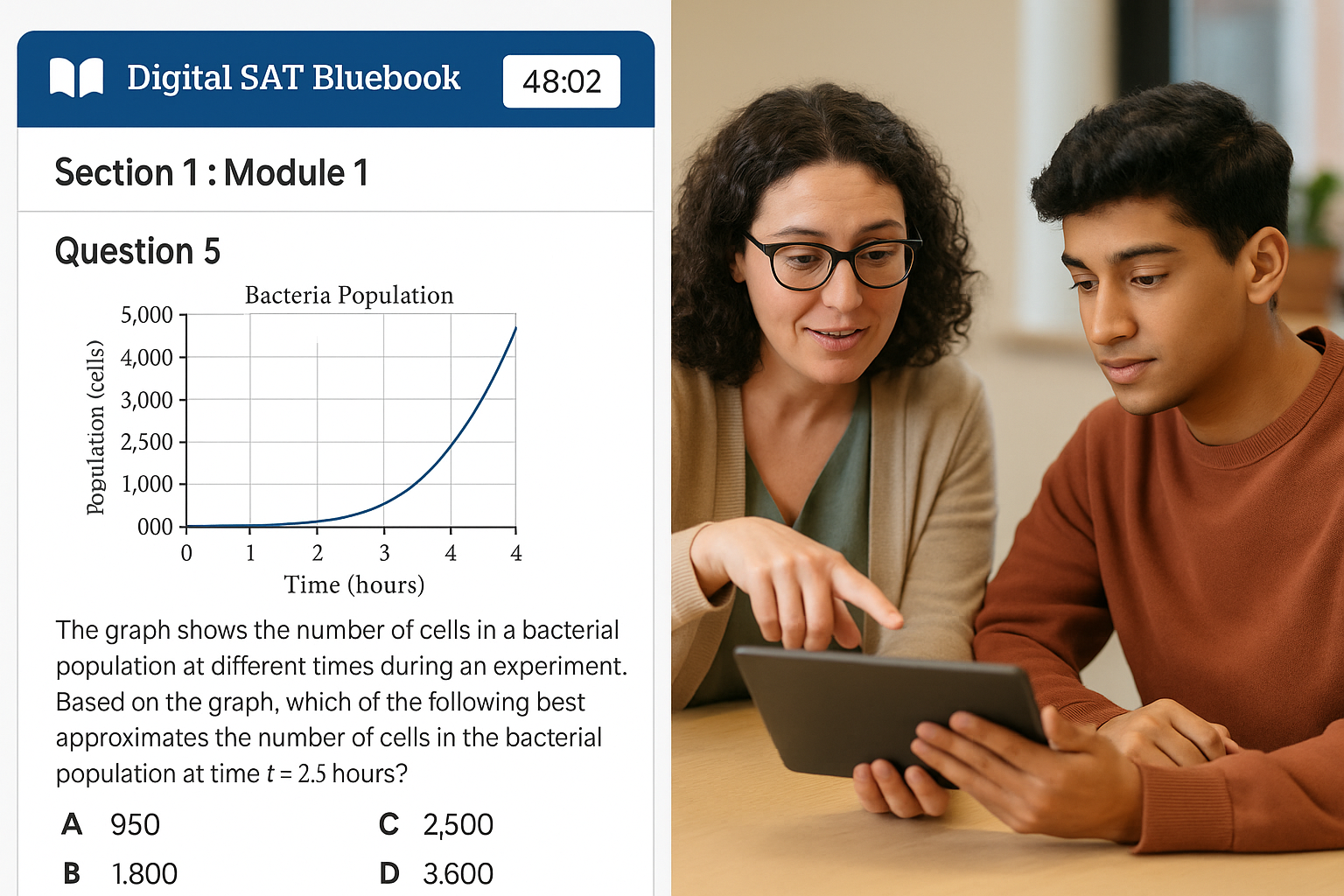
Final checklist before the test
- Know how to use the digital testing interface — practice on the Bluebook app or equivalent mock environment.
- Practice with at least two full timed digital sections so endurance is familiar.
- Review your error log and refresh on common traps and data-check steps.
- Sleep well the night before and eat a steady breakfast — focus beats cramming.
Parting thoughts — science passages are a reading test in disguise
The Digital SAT’s science passages reward careful reading, clear use of evidence, and calm decision-making. They are not a test of how much science you know, but of how skillfully you can use the information in front of you. Master the patterns — experiment description + data, competing interpretations, method-focused write-ups, descriptive pieces, and paired passages — and you’ll convert anxiety into predictable performance.
If you want faster progress, a short series of personalized sessions can help. Sparkl’s tutors combine one-on-one coaching with tailored study plans and AI-driven insights to pinpoint what will move your score most efficiently. That kind of targeted support fits naturally into the 8-week plan described above and often accelerates improvement without adding stress.
Want a simple next step?
Start a two-week focused routine: three science passage sessions per week (timed), one weekly review, and one session where you practice reading graphs only. Track mistakes in an error log. If you’d like help converting your error log into an efficient study plan, consider scheduling a trial session with a tutor who can offer tailored guidance and practice — especially if you prefer 1-on-1 instruction with measurable progress.
Closing
Science passages on the Digital SAT are beatable. Learn the patterns, sharpen your data reading, keep an honest error log, and apply the 60–30–10 routine. With deliberate practice — and help when you need it — you’ll walk into test day calm, focused, and ready to translate those passages into points.
Good luck — and remember: the smartest tool is the one you use consistently. Study smart, not just hard.



















No Comments
Leave a comment Cancel