

Introduction: Numbers Tell a Story, but Not the Whole Story
Walk through any headline that compares average SAT scores by state and you’ll see the same pattern: some states cluster toward the top, others toward the middle or bottom. It’s tempting to treat those numbers as simple rankings — that State A is better at preparing students and State B is not. But averages are shorthand. Behind them is a complicated weave of policy, demographics, educational practices, and local culture.
This post looks beyond the rankings to explain why average SAT scores differ by state and region. I’ll break down the major factors, use concrete examples, show an easy-to-read table that summarizes cause-and-effect, and finish with practical, region-sensitive tips students can use to boost their scores. Along the way you’ll see how targeted supports — like Sparkl’s personalized tutoring with 1-on-1 guidance, tailored study plans, expert tutors, and AI-driven insights — can help address gaps that local averages reflect.
What the Average SAT Score Actually Reflects
An average SAT score is a snapshot: it aggregates the results of everyone who took the test in a state during a particular time period. But a snapshot can be misleading if you don’t know what the camera is pointed at. A few key realities shape that snapshot:
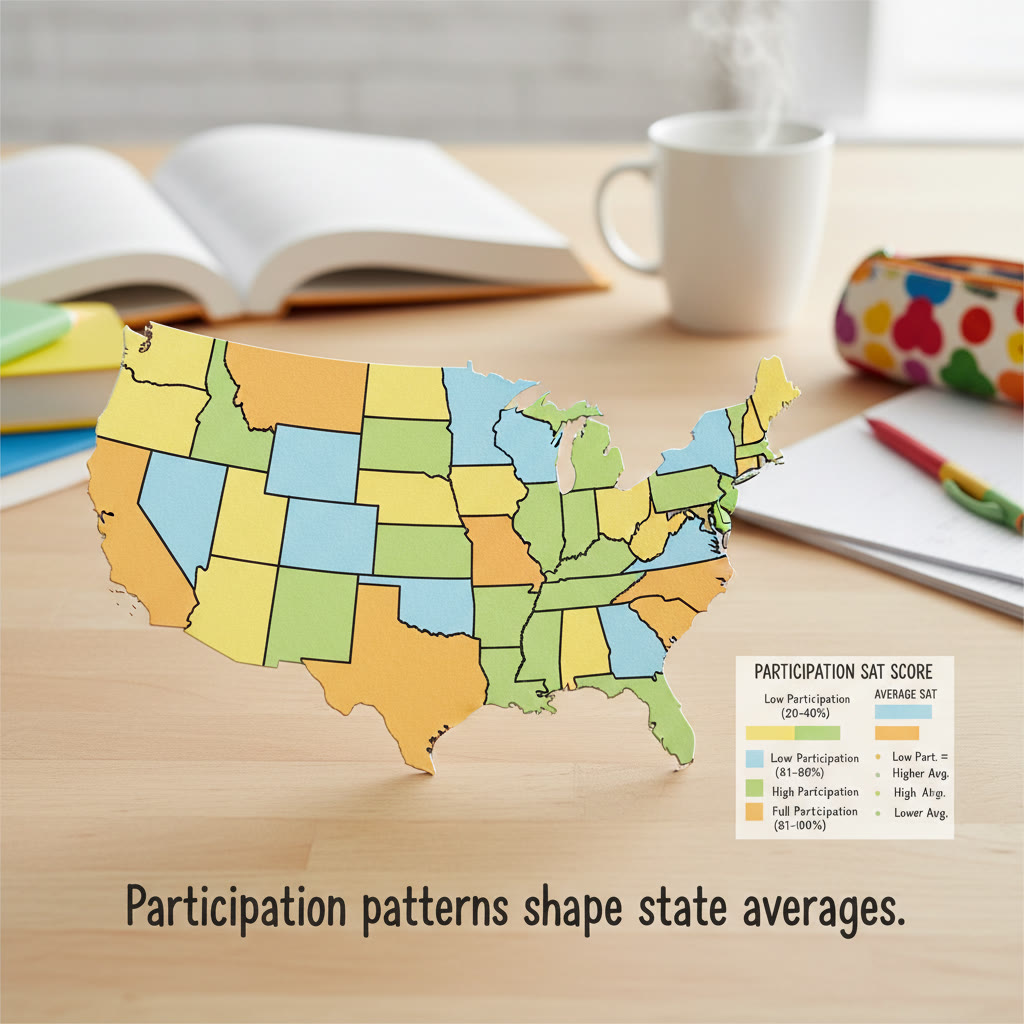
- Participation rate: states that require or encourage broad participation often show lower averages because the test pool includes a wider range of academic preparation.
- Who takes the test: if mostly college-bound, well-resourced students take the SAT, averages tend to be higher than in states where every junior must take it.
- Language and population diversity: regions with many English learners can show lower verbal scores for reasons unrelated to intelligence or potential.
- Funding and curriculum alignment: how money is spent and whether high school curricula align with SAT skills matter a lot.
These are not excuses — they’re context. Understanding them helps families, schools, and students make smarter decisions about preparation and college planning.
Major Drivers of State and Regional Differences
1. Test Participation Policies and Who Takes the SAT
One of the clearest drivers of variation is participation. Some states have policies that encourage or require all juniors to take the SAT. Others treat the SAT as an elective for students focused on selective colleges. When a state administers the SAT to nearly all students, the average will necessarily include learners who are still early in their academic journey, students who are English learners, and those with limited access to prep resources. That broader sample pushes the average down compared with states where mostly college-focused students take the test.
Example: Imagine two neighboring states. State X requires all juniors to take the SAT for school accountability; State Y doesn’t. State X’s average includes a wide spectrum of students, while State Y’s average reflects a self-selected group already aiming for college. Comparing the two without noting the participation difference is like comparing apples and oranges.
2. Socioeconomic Factors and Resource Access
Socioeconomic status (SES) is strongly associated with SAT outcomes. SES influences access to college counseling, paid test prep, quiet study space, and even the time available for study (students working part-time have less study time). Where median household incomes are higher and school funding is robust, students often have more opportunities to build the skills the SAT measures.
That said, SES is not destiny. Targeted intervention, school-level programs, and high-quality tutoring can create big gains for students regardless of background. A student who finds consistent practice and feedback can improve scores dramatically in months.
3. Language Diversity and English Learners
Regions with larger proportions of English learners (ELs) often show lower average Reading/Writing scores. This is not a reflection of reasoning ability but of English-language experience. The SAT is a language-heavy test: vocabulary in context, long reading passages, and precise grammar rules.
Practical implication: EL students may benefit more from focused vocabulary building, reading practice with scaffolding, and explicit instruction in test-specific language skills than from generic math drills.
4. Curriculum Alignment and Instructional Priorities
Does the high school curriculum emphasize the skills the SAT tests? Some systems prioritize project-based learning, local assessments, or career and technical education. Those things can be excellent, but if classroom instruction doesn’t cover certain algebraic manipulations, evidence-based reading strategies, or formal writing practice, students will find those SAT question types unfamiliar.
When curriculum aligns with college-readiness standards — and when teachers get professional development on teaching those skills — average scores tend to be higher.
5. Urban vs. Rural Differences
Rural regions often face fewer advanced course offerings, longer commutes, and smaller peer cohorts for academic competition. Urban regions can concentrate resources — magnet schools, tutoring businesses, SAT practice programs — but also have wide inequities inside city limits. The result is that regional averages can mask tremendous within-region variation.
6. Policy Choices: Accountability, Graduation Requirements, and Test-Optional Trends
Education policy matters. When a state uses the SAT for accountability or requires it for graduation benchmarks, participation grows and averages shift. Conversely, the growth of test-optional admissions in colleges can change which students feel the SAT is important, thereby altering the test-taking pool.
Policy changes can also cause jumps or dips in a state’s average from year to year, so look for trends rather than single-year snapshots.
7. Access to Prep and Local Culture Around College
Some communities have a prevailing culture that emphasizes college admissions, dedicated counselors, and local businesses that offer prep. In other areas, students and families may focus on alternative pathways like careers and apprenticeships, which shifts who takes the SAT and how much effort is invested in preparation.
Comparisons that Clarify: Two Hypothetical State Profiles
Rather than cherry-picking real states, let’s compare two hypothetical profiles to illustrate how different combinations of factors produce different averages.
- State A: Universal SAT administration for all juniors, large rural population, moderate school funding, many English learners, emphasis on career and technical education in some districts.
- State B: SAT mainly taken by college-oriented students, higher median household income, strong AP and honors offerings in suburban districts, robust private and school-based prep programs.
State A’s average might appear lower, but that number includes students with a range of goals and backgrounds. State B’s higher average reflects a narrower group of students already pursuing college pathways. The right response is not to assume failure in State A; it’s to identify where supports like targeted prep and curricular alignment can help all students demonstrate their abilities.
Table: Factors That Drive Average SAT Differences (Illustrative)
| Factor | Typical Effect on State Average | Why |
|---|---|---|
| Participation rate (high) | Often lowers average | Includes broader range of academic preparation; more non-college-intending students |
| High socioeconomic status and school funding | Tends to raise average | Greater access to prep resources, experienced teachers, and advanced courses |
| Large population of English learners | Can lower verbal scores | Language skills affect reading and writing-heavy sections |
| Strong curriculum alignment with SAT skills | Raises average | Students practice similar question types and develop tested skills in class |
| Urban concentration of prep services | Varies—can raise or create wider dispersion | Some students access intensive prep; others face persistent gaps |
Real-World Context: Interpreting Differences Carefully
When admissions officers or educators look at state-by-state averages, they often ask sensible questions: Are differences due to true disparities in preparation? Or are they artifacts of policy and who takes the test? The answer is: usually both. That’s why college counselors look at individual student performance, course rigor, extracurriculars, and context alongside a single test score.
For students and families, the key takeaway is that a state average is a backdrop, not a verdict. Your score is about what you know and how well you prepare. There are reproducible ways to improve performance regardless of the zip code where you grew up.
Actionable Strategies for Students — Tailored to Region-Specific Needs
Below are practical, region-sensitive steps. I’ve grouped them so a student or family can quickly pick approaches that fit common local scenarios.
If You’re in a High-Participation State (Average Looks Lower)
- Normalize the context: know that many peers may not be aiming for selective colleges; your score should be compared to students with similar college goals.
- Focus on high-impact skills first: test-taking strategies, sentence completion, evidence-based reading, and algebra basics.
- Use scheduled school test dates as a low-stress practice opportunity; then target specific gaps before a retake.
- Consider 1-on-1 help: a personalized tutoring program can accelerate progress by tailoring lessons to your current skill level. Sparkl’s personalized tutoring offers tailored study plans and expert tutors who can help you prioritize the right areas.
If You’re in a Wealthier, Lower-Participation Area (Average Looks Higher)
- Don’t assume your score is guaranteed: the competition is real at selective colleges — higher averages mean tougher competition among applicants.
- Build an evidence-based study plan: timed practice tests, focused skill blocks (e.g., algebra fluency, reading pace), and score tracking.
- Practice under conditions that mirror test day; consider simulations with small stakes and realistic timing.
- Layer in advanced practice: reviewing common question traps, improving data interpretation in the math section, and refining expression and style for the writing tasks.
If You’re an English Learner or in an Area with Many EL Students
- Prioritize vocabulary in context and reading comprehension strategies. Not just memorizing words — practice using them in arguments and evidence chains.
- Work on timing: language-heavy passages can feel slow; practice skimming for structure and main ideas before deep reading.
- Seek targeted instruction: an experienced tutor can scaffold complex passages and build confidence. Sparkl’s 1-on-1 guidance and AI-driven insights help identify linguistic patterns that cause the most missed questions.
How Schools and Communities Can Respond
State averages also point toward system-level interventions. A few practical levers schools and districts can pull:
- Curriculum mapping: ensure core high school courses include practice with the types of reasoning and problems that appear on the SAT.
- Early outreach: begin SAT awareness and skill-building in sophomore year so juniors aren’t learning crucial test strategies for the first time the year of testing.
- Equitable access to prep: offer low-cost or free group workshops, practice test days, and guided study groups in partnership with community organizations.
- Use assessment data smartly: identify common gaps at the district level and invest in professional development to address them.
Short Study Blueprint: A 12-Week Plan That Works Almost Anywhere
This condensed plan assumes you have at least three hours per week to study (more is better). It’s adaptable by region — focus more on reading and language if you’re an English learner, more on algebra and data analysis if math is your weak spot.
- Weeks 1–2: Diagnostic test + identify top three weaknesses. Build a study calendar that addresses those areas every week.
- Weeks 3–6: Focused skill blocks. Use short, daily drills (30–45 minutes) and one longer weekly practice section under timed conditions.
- Weeks 7–9: Full timed practice tests every 7–10 days; detailed review of every missed question. Aim for pattern recognition — what kinds of errors recur?
- Weeks 10–12: Polishing and stamina. Simulate test-day conditions, refine timing strategies, and keep daily micro-practice on the weakest skill.
If you want a turbocharged version of this plan, one-on-one tutoring tailors the weekly routine to you. Sparkl’s tutors pair expert coaching with AI-driven insights to track progress and refine the plan, saving time and increasing score gains.
Measuring Improvement: Beyond a Single Score
Don’t judge progress only by raw score. Track these metrics:
- Error patterns: Are you fixing the same mistake type repeatedly?
- Timing: Can you finish sections with time to spare?
- Consistent practice: Are you maintaining daily habits?
- Stress management: Are practice test nerves decreasing over time?
Improvements on these metrics usually translate into score gains. Tools like detailed score reports and tutor feedback help make those patterns visible so students can change strategies quickly.

Final Thoughts: Use Context, Then Act
State and regional differences in average SAT scores are meaningful, but they’re not destiny. A lower state average often signals opportunity: a chance to bring more students the resources and guidance they need to show what they can do. A higher average often signals competition and the need for strategic effort.
For students, the practical message is straightforward: focus on the levers within your control. Align your study plan with your real weaknesses, practice under realistic conditions, and get focused feedback. For many students, targeted help — whether from a school program, a community workshop, or personalized tutoring — is the accelerator that turns potential into measurable results. Sparkl’s personalized tutoring program, with 1-on-1 guidance, tailored study plans, expert tutors, and AI-driven insights, is designed to do exactly that: cut through noise and give students the focused practice that works.
Remember: an average is a starting point for understanding context, not the endpoint of your story. With the right plan and support, students from any state or region can improve their SAT scores and open more college choices.
Quick Checklist: What to Do Next
- Take a timed diagnostic test to learn your baseline.
- Pick one high-leverage skill to improve this week and practice it daily.
- Schedule one full practice test per month and review every missed question.
- Consider 1-on-1 coaching if progress stalls — personalized plans can often save months of effort.
Closing
Every state average is a conversation starter. Use it to ask better questions about access, opportunity, and support. Then turn those questions into action. Your score is a reflection of preparation — and the right preparation, tailored to you, can change everything.


























No Comments
Leave a comment Cancel