
The quiet advantage: why pacing deserves its own practice sessions
Most students spend hours drilling vocabulary, mastering algebra, or dissecting evidence-based reading questions. That makes total sense: you can’t answer a question you don’t understand. But there’s a second, quieter skill that sits between knowing an answer and getting it right when it matters—timing. Practicing pacing separately from content study trains your brain to move efficiently, manage stress, and avoid the two biggest score killers on test day: wasted time and panic.
This article walks you through why separating pacing practice matters, how to design short, high-impact pacing drills, what to expect, and a realistic weekly plan. Along the way I’ll give practical examples, comparisons, and even a sample timing table. If you work with a tutor or with a service like Sparkl’s personalized tutoring, these methods fit perfectly into 1-on-1 guidance and tailored study plans that combine content mastery with time-smart strategies.
Why pacing is its own muscle
Think of the SAT as a race where the course itself is a mix of sprint segments and steady stretches. Knowing the subject matter is like having strong legs. Pacing is learning when to sprint, when to conserve, and how to recover. These are distinct cognitive and behavioral skills.
1) Cognitive load and decision speed
When you’re under a ticking clock, reading comprehension and problem-solving take longer. Your brain must not only find the answer but also monitor the clock, evaluate whether to skip, and decide when to guess. That double task—content plus time management—creates extra cognitive load. Practicing pacing on its own helps you automate the clock-monitoring behaviors so that solving the content becomes the primary task again.
2) Metacognitive calibration
Meta-cognition is thinking about your thinking—knowing how long a question should reasonably take and whether your approach is efficient. Separately timed drills help you calibrate expectations. Once you know that an average Reading passage should take you 10–11 minutes, you’ll immediately recognize when you’re lagging and adjust before panic sets in.
3) Stress inoculation
Time pressure is stressful. But repeated exposure in controlled practice reduces that stress. Just like practicing a difficult piano piece at a slow tempo before increasing the metronome, you can break timing into manageable stages and build tolerance. Practicing under timed constraints independently of content study gives you repeated, focused exposure to the sensation of racing the clock without the extra variable of learning new material simultaneously.
How separate pacing practice improves accuracy and score
It might seem counterintuitive: why practice speed if you value correctness? Because smart pacing increases both.
- Reduced careless errors: Extracting questions from fatigue-driven errors reduces overall loss of points.
- Better allocation of time: You’ll know when to invest an extra minute vs. when to move on and return later.
- Higher confidence: Calm test-takers make clearer choices and avoid overthinking easy items.
In other words, pacing practice is not speed for speed’s sake. It’s about creating a rhythm where correct answers are produced reliably and efficiently.
Concrete timing goals: how long should a question take?
Exact timing depends on your strengths and the specific test, but target ranges help you develop a baseline. Use these as starting targets; your goal is to tighten around them.
| Section | Questions | Total time | Target per question |
|---|---|---|---|
| Reading | 52 | 65 minutes | ~1:15 per question; ~10–12 minutes per passage |
| Writing & Language | 44 | 35 minutes | ~45 seconds per question |
| Math (No Calculator) | 20 | 25 minutes | ~1:15 per question |
| Math (Calculator) | 38 | 55 minutes | ~1:25 per question |
These per-question times hide the real complexity—for example, Math sections include easy and hard questions, and Reading has passages that vary by topic and density. Use these targets to set a tempo, then refine based on performance.
Types of pacing practice (and when to use each)
Different drills develop different sub-skills. Rotate these drills through your study weeks.
1) Micro-sprints (1–5 minutes)
Purpose: speed, first-pass decision making.
- Example: 2-minute grammar blitz—do as many Writing & Language questions as you can, marking only the ones you’re confident about. No second-guessing.
- Why it works: Builds automaticity for routine question types and improves your internal clock for when to skip.
2) Passage-level timing (10–12 minutes)
Purpose: realistic pacing for Reading passages.
- Example: Take one Reading passage and time yourself for 10 minutes. Don’t stop for a single tricky question until you finish the passage. Score it, then review the missed questions for why you ran over time.
- Why it works: You learn rhythm across the paragraph-question workflow: skimming, mapping, and answering.
3) Block math drills (20–30 minutes)
Purpose: build problem selection and time allocation skills for math’s mix of question difficulties.
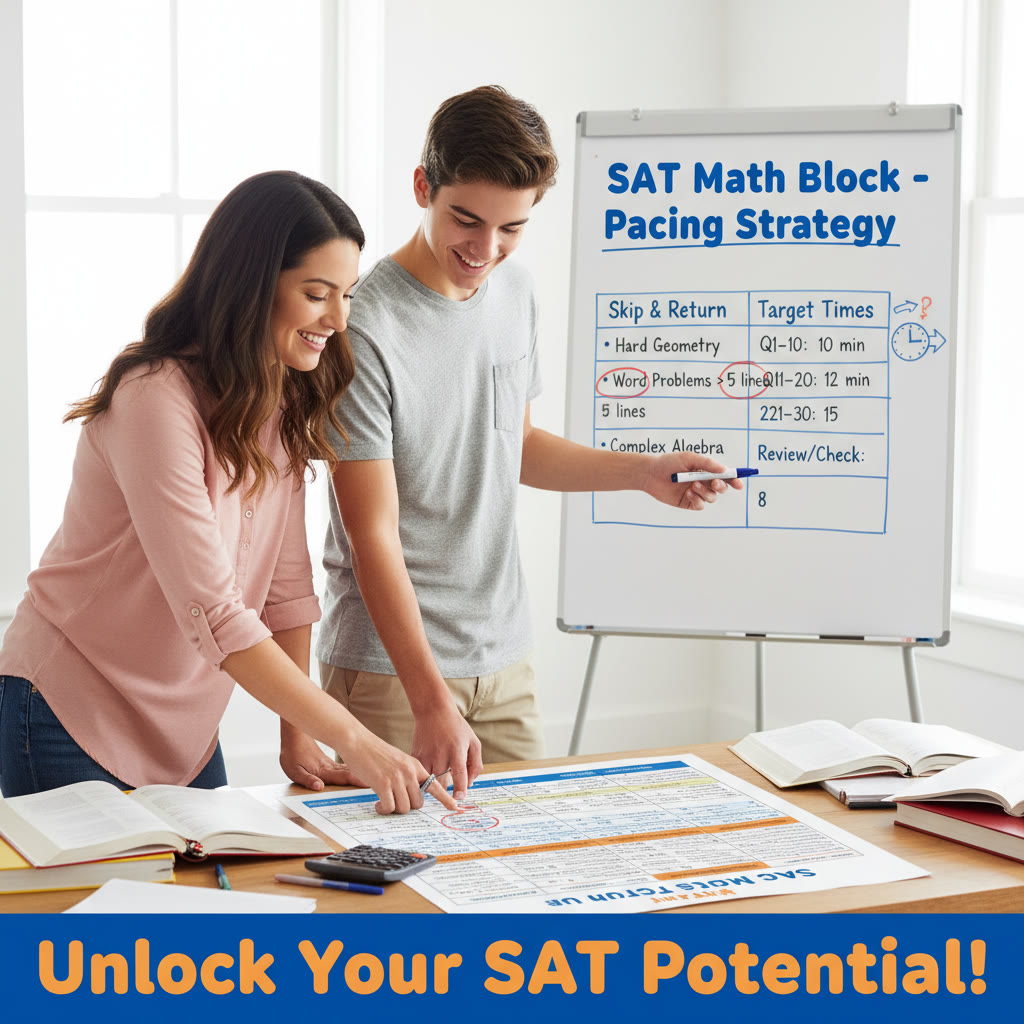
- Example: Set 25 minutes for a mixed set of 20 math questions. Practice quick classification: easy (solve), medium (use strategic steps), hard (flag and skip initially).
- Why it works: Math success is often about triage—deciding which problems deserve the clock’s attention.
4) Full-section timing (real test tempo)
Purpose: stamina and realistic pacing across an entire section.
- Example: Do a full Reading section in 65 minutes without stopping. After, note where time leaked—was it a specific passage or question type?
- Why it works: Helps you practice pacing under sustained pressure and notice fatigue patterns.
Sample drills you can do in 20–40 minutes
Short sessions are often the most productive because they let you focus on a single pacing skill without wearing out.
- 10-minute reading passage: Practice one passage at race pace; log time per question category (detail, inference, function).
- 5-minute grammar stack: 12 Writing questions back-to-back; aim for quick identification of common error types.
- 25-minute math block: Flag three hardest problems immediately and come back with remaining time.
- 1-minute decision drills: Look at an SAT-style question and decide—solve, estimate, skip—in under a minute. Build your skip/return muscle.
How to practice pacing without sacrificing content learning
The key is to separate training goals. Some sessions are purely content—deep explanations, error analysis, and concept building. Other sessions are pure pacing practice. On the week where you have limited time, split your session into two halves: the first half content, the second half a 20–30 minute pacing workout.
Guidelines
- Don’t combine heavy new learning with a heavy pacing test. New content slows you for the wrong reasons.
- Record the time you spend on each question during pacing drills so you can identify trends.
- After pacing drills, do targeted review: why did a specific question take too long? Was it unfamiliar vocabulary? Weak algebraic set-up? Fix that in a separate content session.
Tracking progress: what to measure and how often
Good pacing practice is measurable. Keep a simple log with these fields:
- Drill type and duration
- Average time per question or per passage
- Accuracy during the drill
- Number of flagged/skipped questions
- Subjective stress level (1–5)
Measure weekly. The first three weeks will show the steepest gains in time-awareness; after that you’ll refine accuracy while maintaining tempo. If you’re working with a tutor—Sparkl’s personalized tutoring, for example—this log becomes incredibly useful for tuning one-on-one sessions and getting AI-driven insights on weak patterns.
Sample weekly plan: integrating pacing with content
This is a realistic plan for a student studying 10–12 hours a week. It balances content, pacing drills, and a full timed section each week.
| Day | Main focus | Session | Notes |
|---|---|---|---|
| Monday | Content (Reading) | 60 minutes | Deep passage analysis |
| Tuesday | Pacing (Reading) | 30 minutes | 3 passages at 10–12 min each + log times |
| Wednesday | Content (Math) | 60 minutes | Concept practice + error review |
| Thursday | Pacing (Math) | 30 minutes | 25-minute math block + skip-return practice |
| Friday | Mixed short drills | 45 minutes | 5-min grammar + 1-min decision drills + micro-sprints |
| Saturday | Full timed section | 65–80 minutes | Rotating section each week; full review afterward |
| Sunday | Rest or light review | Optional 30 minutes | Review mistakes, stretch mentally |
Adjust the plan to fit your strengths—stronger readers might reduce reading content and increase math pacing, and vice versa. If you’re using Sparkl’s personalized tutoring, your tutor can tailor the plan based on weekly performance and integrate AI-driven insights to target the exact timing behaviors that need the most work.
Troubleshooting common pacing problems
1) I keep running out of time on the last passage
Try reversing your order: start with the last passage on practice and see if your speed is consistent. Often, fatigue or earlier inefficient reading is to blame. Introduce a short warm-up: 5 minutes of quick comprehension questions to get brain circuits firing before the test-like passage.
2) I finish with time but make careless mistakes
Finishing quickly is good, but accuracy matters. Add in “quick checks”: after finishing a passage, spend the last minute scanning for common mistakes (signs like misread dates, swapped pronouns, arithmetic mistakes). Practicing these one-minute checks during pacing drills reduces careless slips.
3) I panic when the clock shows 10 minutes left
Practice with a countdown visible so you get used to the feeling. A better technique is to rehearse a recovery script: when you see there are 10 minutes left, you immediately flag all remaining questions you can’t answer in 2 minutes and answer the rest. Rehearse the script until it becomes automatic.
How tutors and technology make pacing practice smarter
Off-the-shelf practice is useful, but individualized feedback accelerates progress. A tutor can:
- Identify which question types consume your time
- Create drills targeting your weak spots (e.g., data interpretation in Math, inference questions in Reading)
- Use timed accountability during 1-on-1 sessions
Sparkl’s personalized tutoring combines expert tutors with tailored study plans and AI-driven insights to spot where your time leaks are and to prescribe targeted pacing exercises. That means less guessing about what to practice and more time working on the exact behaviors that will move your score.
Real-world examples: two student stories
Student A: the perfectionist
Background: Strong content knowledge, but gets absorbed by a challenging Reading passage and loses 10–15 minutes per section.
Intervention: Micro-sprints and a strict skip-and-return rule. During practice, Student A forced a pass on questions that took longer than 90 seconds, flagged them, and returned only if time permitted. After three weeks their average Reading section time per passage dropped by nearly three minutes and accuracy on the first pass improved.
Student B: the speedster with careless errors
Background: Finishes early on Math but often misreads details or makes arithmetic mistakes.
Intervention: Built-in one-minute checks at the end of each section and accuracy-focused micro-drills. The result was slightly longer per-question time but a substantial reduction in careless errors and better scaled scores.
Both students benefited from targeted pacing practice tailored to their profiles—something a structured tutoring program can create and monitor.
Putting it together: a 6-week plan to see clear gains
Start with baseline tests and logging. In weeks 1–2 focus on awareness: do timed micro-drills and start a log. Weeks 3–4 emphasize strategy: introduce skip-return rules and one-minute checks. Weeks 5–6 simulate test conditions and tune recovery scripts. Expect to refine, not revolutionize: pacing gains compound slowly but reliably.
Final checklist for pacing mastery
- Set per-question and per-passage time targets.
- Practice pacing separately at least twice a week.
- Keep a simple log of times and accuracy.
- Use micro-drills for quick improvements and full sections for stamina.
- Develop and rehearse skip-and-return and 1-minute-check scripts.
- Consider one-on-one guidance—personalized tutoring and AI-driven insights can short-circuit inefficient practice patterns.

Parting thought: practice the clock like you practice content
Most test prep focuses on the “what”—what skills you need, what formulas to memorize, what words to know. The “when”—when to spend your time, when to skip, when to return—is equally important. Pacing is a learnable skill you can train separately and intentionally. When balanced with targeted content review, it converts wasted minutes into right answers.
If you want a faster way to get there, consider pairing your practice with Sparkl’s personalized tutoring approach: one-on-one guidance, tailored study plans, and AI-driven insights that help you spend practice time where it matters most. The clock on test day won’t get any kinder, but your relationship with it can become a lot more productive.
Start small, measure honestly, and build the habit of racing smart—not just fast. Your score will thank you.





















No Comments
Leave a comment Cancel