
Why simulating test-day conditions in Bluebook is the single smartest thing you can do before the Digital SAT
If you’ve taken practice problems in a spare five minutes between classes, you’re doing something — and that’s good. But if your goal is to walk into the testing center calm, confident, and ready to demonstrate your best abilities, nothing beats a full dress rehearsal in Bluebook that mirrors test day. Think of it like orchestra practice: mastering individual measures is necessary, but the performance comes down to how everything sounds together under the lights.
Bluebook isn’t just a place to click answers — it’s the official environment you’ll face on test day. Practicing inside it gives you a realistic feel for the adaptive format, the interface tools, timing, and the physical rhythm of the test. When you intentionally recreate test-day conditions, you reduce surprises, sharpen pacing, and condition your mind to perform when it matters most.
Big-picture benefits at a glance
- Comfort with the interface: know where the tools, flagging, and answer-review features live.
- Accurate pacing: practice the exact time pressure you’ll face and learn what a healthy pace feels like.
- Reduced test anxiety: familiarity breeds calm; the unknown is what triggers panic.
- Better strategy testing: trial different approaches (read-first vs. question-first, flag-and-move, etc.) under real conditions.
- Valid practice scores: Bluebook’s scored practice tests simulate the multistage adaptive scoring you’ll encounter.
What “test-day conditions” really means — and what to include in your simulation
It’s easy to say “simulate test day” and harder to execute. A true simulation recreates as many factors as possible that influence your performance: environment, timing, breaks, materials, nutrition, and mindset. Below are practical elements to include and why they matter.
1) Environment: where you sit, what you hear, and what you see
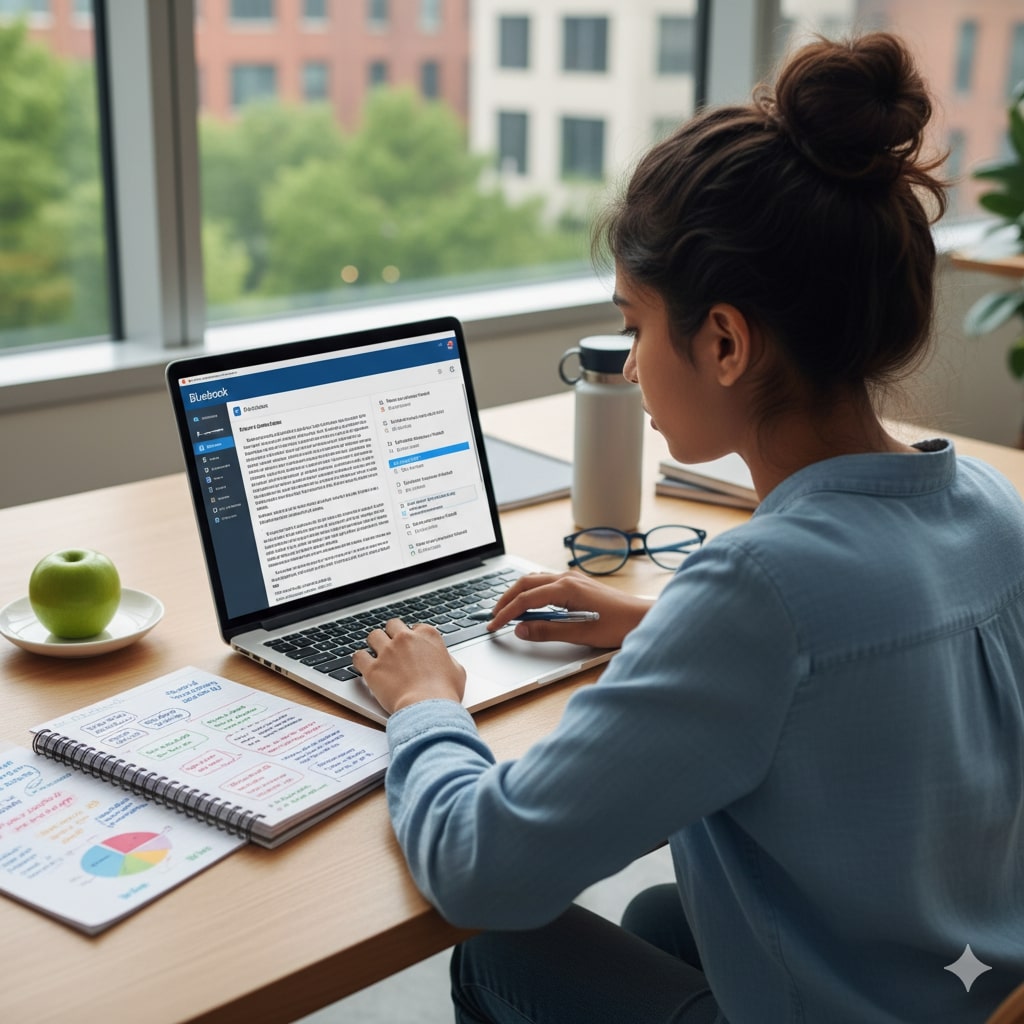
Choose a quiet, desk-like surface (not a bed or couch). Sit upright in a chair, facing forward. Avoid background TV, loud music, or phone notifications. If you’re testing in a school-provided device, try the same platform (Windows, macOS, iPad, Chromebook) as often as possible.
Photo Idea : Student at a simple desk with a laptop running Bluebook, natural light, water bottle, and a small timer — cozy, focused atmosphere.
2) Timing: replicate the clock and the flow
Treat the timing seriously. Start the clock at the same time you would on test day — don’t stop for texts, pets, or sudden chores. Use the Bluebook timed full-length practice tests to mirror the test’s adaptive modules. If you have school-day accommodations or plan to take the weekend test, practice under those exact timing settings.
3) Breaks and transitions
Allow the same break structure you’ll have on test day. Stand, stretch, use the restroom, and practice calming breaths. Transitions between modules can be brief but they matter — a five-minute mindfulness routine during a scheduled break can reset focus and prevent mental drift.
4) Materials and allowed items
Only use what you’ll be allowed on test day: approved calculator for math modules (where applicable), scratch paper if permitted by your test center, and a silent watch or timer if you use one. Don’t use sticky notes or external browser tabs. If you rely on assistive technology, practice with it in Bluebook to iron out configurations.
How simulating test-day conditions helps the three critical aspects of SAT performance
When you break down the test into measurable components, the benefits of simulation become clear. Let’s look at timing, accuracy under pressure, and emotional control.
Timing: learn what “good pace” feels like
The Digital SAT’s adaptive structure changes question mix between modules based on your performance. Timing strategies that work for linear paper tests don’t always translate. Running full Bluebook tests helps you calibrate a per-question rhythm: how quickly to skim a passage, how long to spend on a grid-in math problem, and when to flag a question for review without sacrificing overall momentum.
Accuracy under pressure: practice transferring skills into answers
Answering a math problem on a worksheet is different from answering it while the clock ticks and the screen highlights options you’ve eliminated. Simulation forces you to execute problem-solving under realistic cognitive load — and that’s where skill becomes score. You’ll see which question types reliably slow you down and can then focus targeted practice where it pays off most.
Emotional control: reduce the power of panic
Test anxiety often arises from the unknown. By repeatedly exposing yourself to the Bluebook environment, your emotional response to the testing situation will habituate: the environment becomes ordinary, and your nervous system responds with less fight-or-flight. That makes it easier to think clearly when the tough question arrives.
Practical step-by-step plan to run a perfect Bluebook simulation
Below is a reproducible plan you can use in the weeks before test day. Aim to run at least two full simulations: one 3–4 weeks prior to test day to identify weak spots, and one within 7–10 days of the test for a final rehearsal.
Pre-simulation checklist (30–60 minutes before)
- Charge your device fully and close unrelated apps.
- Clear your study space; have water and allowed materials within reach.
- Wear comfortable clothing similar to what you’ll have on test day.
- Set a digital timer as backup and silence your phone completely (out of sight).
- Decide on a small pre-test routine (deep breaths, positive affirmation) and use the same one before practice runs.
During the simulation
- Sign into Bluebook and select a full-length practice test.
- Begin the test and stick to the official timing without pausing for unscheduled breaks.
- Use the interface tools (flag, annotation, line reader) as you would on test day.
- During scheduled breaks, stand up, walk for 2–3 minutes, and hydrate — no screens.
- When you finish, resist the urge to immediately check answers; instead, record how you felt, the strategies you used, and where you got stuck.
Post-simulation review (60–90 minutes)
Analyze your performance in two passes:
- First pass — Situational: where did timing break down? Which modules felt rushed?
- Second pass — Content-based: which question types (sentence correction, data interpretation, algebra) were problematic?
Then build a targeted practice plan to address the most frequent or costly errors.
How to interpret your Bluebook practice results (and turn them into gains)
Bluebook scores and feedback are useful, but raw numbers don’t tell the full story. Look at your results through the lens of patterns and effort.
Track these key metrics
| Metric | Why it matters | What to do |
|---|---|---|
| Module scores (first vs. second) | Shows how your performance adapts during the test’s adaptive stages. | Practice maintaining focus through the fatigue point; simulate the full test rather than piecemeal sections. |
| Time per question | Reveals pacing inefficiencies and question types that stall you. | Practice timed drills for slow question types; practice skimming techniques for dense passages. |
| Answer-change frequency | High rates may indicate second-guessing or poor initial read. | Practice trusting your first careful read; use flags instead of changing answers impulsively. |
| Question clusters missed | Shows content weaknesses (e.g., geometry vs. algebra, inference vs. detail questions). | Create targeted practice sets and review core concepts with short, repeated drills. |
Common pitfalls when simulating — and how to avoid them
Some students simulate, but not effectively. Here are common missteps and straightforward fixes.
Pitfall: practicing with distractions
Fix: Make your practice sacrosanct. Turn off notifications, tell family you’re unavailable, and avoid multitasking. If you can’t get absolute quiet, use earplugs to simulate a testing room.
Pitfall: pausing the test to look up concepts
Fix: During simulation, focus only on performance. If a concept trips you up, mark it for review after the test and include it in a targeted study session rather than breaking the simulation flow.
Pitfall: repeating the same small section in isolation
Fix: Use modules for skill drills, but run full-length Bluebook tests at least twice before test day. Cumulative fatigue and transitions are where small mistakes compound into big score differences.
Example two-week rehearsal schedule (realistic, busy-student friendly)
This schedule assumes your test is two weeks away and you have limited study time each day. It emphasizes quality rehearsal in Bluebook combined with focused review.
| Day | Plan | Duration |
|---|---|---|
| Day 14 | Full Bluebook simulation (first dress rehearsal) | 4 hours |
| Day 13 | Review missed concepts from Day 14; targeted drills (math or reading) | 60–90 minutes |
| Day 12 | Short timed practice set + strategy tuning | 60 minutes |
| Day 8 | Practice specific weak areas; light full-length run if needed | 2 hours |
| Day 7 | Full Bluebook simulation (final dress rehearsal) | 4 hours |
| Day 6–3 | Short targeted drills, review notes, light exercise, sleep hygiene focus | 30–60 minutes/day |
| Day 2–1 | Rest, light review of formula sheets, calm practice routine; avoid intense cramming | 30 minutes/day |
Where personalized help fits — using tutoring to amplify simulations
Simulating is powerful, and you don’t have to do it alone. Personalized tutoring can accelerate the improvement you see from practice tests. For instance, Sparkl’s personalized tutoring can help in ways that slot naturally into simulation work: one-on-one guidance to analyze Bluebook practice runs, tailored study plans that target the question clusters you miss most, and expert tutors who suggest pacing adjustments based on your module results. If you prefer data-backed suggestions, AI-driven insights from a tutoring program can pinpoint weak skills and recommend concrete drills to try in your next Bluebook simulation.
Use tutoring sessions to:
- Debrief a full Bluebook run and diagnose recurring errors.
- Practice pacing strategies in real time with a tutor’s stopwatch guidance.
- Get mental strategies for test anxiety and focused breathing between modules.
Final checklist for a successful Bluebook simulation
- Run at least two full Bluebook timed practice tests before test day.
- Simulate breaks, allowed materials, and the testing environment accurately.
- Record your pacing, emotional state, and persistent errors after each run.
- Use targeted drills between simulations, not endless full tests without review.
- Consider a few tutoring sessions to accelerate progress and add accountability.
One last thought: treat practice as a performance rehearsal, not punishment
At its core, simulating test-day conditions in Bluebook is an act of kindness toward your future self. It reduces uncertainty, builds muscle memory for pacing, and turns the unfamiliar into the ordinary. Approach each simulation with curiosity — what surprised you? What felt better than last time? Celebrate small gains: a faster read time on a certain passage type, steadier breathing during breaks, or fewer answer changes.
In the end, the digital SAT is a combination of content knowledge, strategy, and mental steadiness. Simulating test day in Bluebook trains all three simultaneously. Follow the plan, analyze honestly, and iterate — and you’ll walk into the testing room with a practiced calm that makes a real difference.
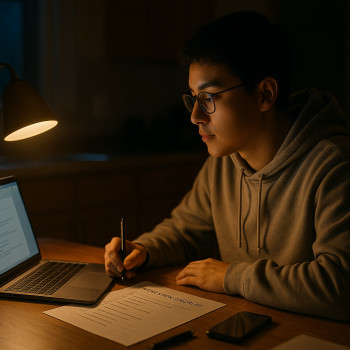
Photo Idea : Close-up of a student’s hands using Bluebook on a laptop, a small notebook with timing notes beside it, and a pen — shows focus and preparation.
Ready to try your first full simulation?
Pick a Saturday, follow the checklist above, and commit to the full run. Afterward, spend time reviewing strategically — that’s where the score gains come from. If you want extra help turning your practice data into progress, consider a short series of personalized tutoring sessions to debrief your Bluebook runs and design the most efficient study path forward.
Good luck — and remember: practice in Bluebook isn’t just practice for the test. It’s practice for your best, most composed performance on the day that counts.


























No Comments
Leave a comment Cancel