

IB Chemistry IA: turning a good experiment into a great analysis
Think of your Chemistry IA as more than a lab exercise; it’s your chance to think like a scientist and convince an examiner that you did. The experiments you run are important, but what truly separates a competent IA from an outstanding one is depth of analysis — the part where raw numbers become insight. This article walks you through practical choices and concrete techniques to optimise the whole process: from a sharply focused research question to clean data, meaningful graphs, robust uncertainty analysis, and a razor-sharp evaluation.

Why analysis matters more than procedural showmanship
Examiners are looking for intellectual ownership. They can spot a neat method from a mile away; what they reward is evidence that you wrestled with the chemistry: hypothesising mechanisms, extracting relationships from data, quantifying uncertainty, testing assumptions and suggesting realistic improvements. A well-run experiment with weak interpretation will score lower than a modest experiment that demonstrates real scientific reasoning.
The five pillars your IA should balance
Across the IA you’ll be judged on a combination of qualities — clarity of purpose, depth of research and contextual understanding, the quality and analysis of data, the rigour of evaluation, and how well you communicate your ideas. Keep these pillars in mind as you plan and write; they will guide which details you emphasise.
- Personal engagement: original thinking, genuine curiosity and thoughtful decision-making.
- Exploration: a clear, focused research question with sound scientific context.
- Analysis: accurate data processing, correct use of mathematics and statistics, and interpretation of results.
- Evaluation: critical discussion of uncertainty, limitations, and realistic improvements.
- Communication: clarity, structure, labelling, and appropriate use of scientific language and units.
Choosing a research question that lets you show analysis
A research question is the single most important decision you will make. A brilliant IA often starts with a question that is narrow enough to measure cleanly, yet rich enough to allow interpretation. Avoid vague phrasing and make sure your focus allows quantitative analysis.
Characteristics of a strong research question
- Specific and measurable (identifies variables and the range you will test).
- Rooted in chemical theory (offers a hypothesis that can be tested and explained).
- Experimentally feasible in the school lab with accessible apparatus and safe chemicals.
- Open to meaningful analysis — e.g., allows plotting, fitting a model, or deriving an equilibrium/kinetic parameter.
Examples: weak vs strong
| Weak research question | Why it’s weak | Improved (strong) research question |
|---|---|---|
| How does temperature affect the rate of reaction? | Too vague (which reaction? what temperature range? what rate measurement?). | How does temperature between 20°C and 50°C affect the rate constant of the iodine clock reaction using fixed concentrations of A and B, measured via initial-rate analysis? |
| What affects the pH of a salt solution? | Open-ended; hard to isolate variables or produce quantitative analysis. | How does the concentration of ammonium chloride (0.01–0.10 M) affect the pH of its aqueous solution at constant temperature? |
Strong questions give you a pathway to analysis: identify the independent, dependent and controlled variables, and consider what mathematical relationships you can extract (rate laws, equilibrium constants, linear relationships after transformation, etc.).
Design: plan so your analysis is possible and credible
Design isn’t just about listing equipment. It’s about designing measurements that minimise uncertainty and let you test your chemical explanation. Think: precision, reproducibility and the physics/chemistry behind the measurement technique.
Practical planning checklist
- Decide how many data points are needed across the independent-variable range to reveal a trend — more is not always better if each point is noisy.
- Include replicates to estimate random error (at least three repeats for key measurements is a solid minimum).
- Record units, instrument resolution and method of timing/measurement so you can propagate uncertainty later.
- Identify potential systematic errors (e.g., heat loss, incomplete mixing) and plan controls or corrections.
- Sketch how you will process raw data to extract the quantity of interest (e.g., initial rate, equilibrium constant, slope of linearised plot).
Time-saving tip
Do a short pilot run before you collect the full dataset. A pilot will reveal whether your measurement method produces clean, reliable numbers and whether the variable range is appropriate — much easier to adjust early than to re-run a whole investigation.
Collecting data: habits that pay off during analysis
Data collection is where care and discipline turn into power during analysis. Treat your lab notebook as evidence: timestamped steps, raw observations, anomalous readings and the full trace of how you obtained each value.
Best practices in the lab
- Log raw data before any averaging or rounding. Keep sign of outliers but don’t discard them without a reason.
- Measure instrument precision — e.g., burette readability, thermometer resolution — and record it so you can include it in uncertainty estimates.
- When timing reactions, use consistent triggering and make note of human reaction time if appropriate.
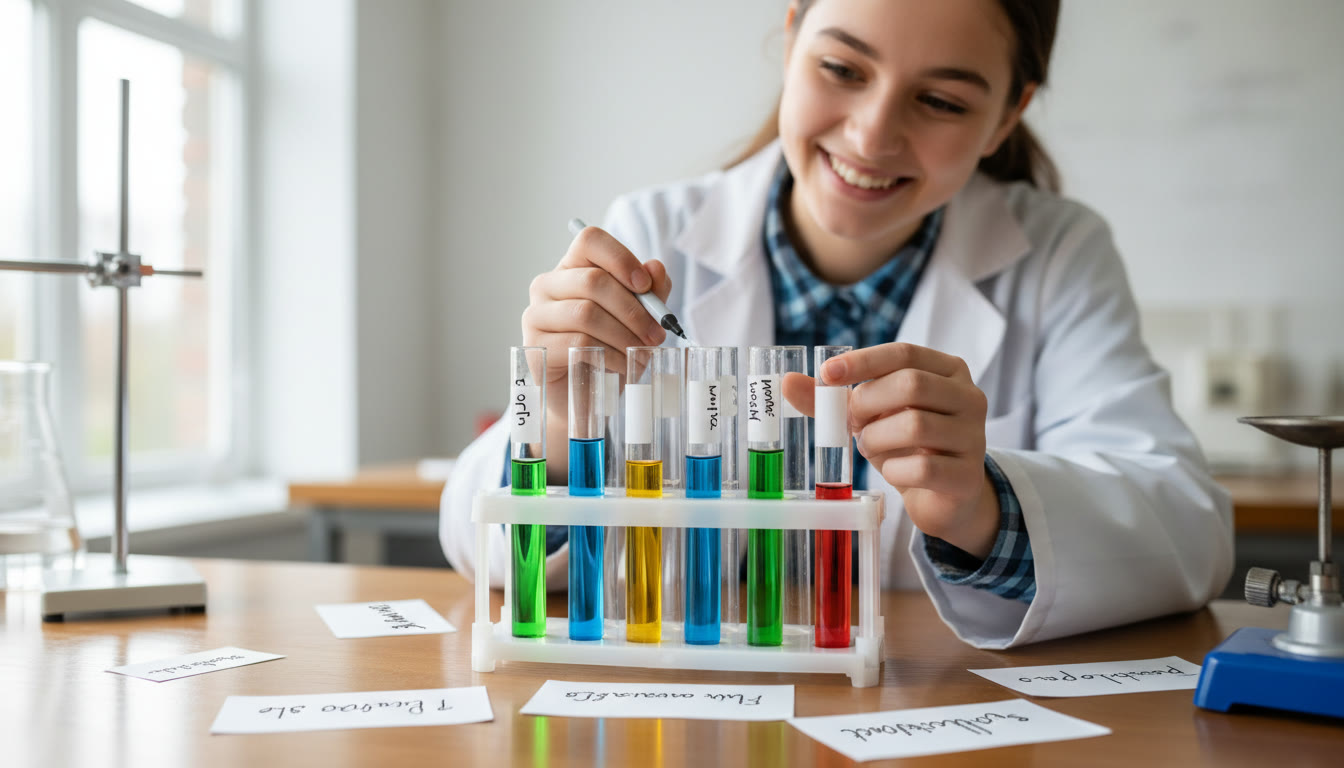
- Take photographs of setup and unusual observations; they can support your evaluation and personal engagement.
Presenting data clearly: tables, graphs and units
Good presentation is the bridge between raw numbers and analysis. Use tables to show raw data and derived quantities, and graphs to reveal relationships. Axes, labels, units and appropriate significant figures matter.
Sample data table (format to use in your IA)
| Trial | Independent variable (e.g., [A] / M) | Measured quantity (initial rate / M s⁻¹) | Average rate | Standard deviation | Instrument uncertainty |
|---|---|---|---|---|---|
| 1 | 0.020 | 1.23×10⁻³ | 1.25×10⁻³ | 0.02×10⁻³ | ±0.01×10⁻³ |
| 2 | 0.020 | 1.27×10⁻³ | |||
| 3 | 0.020 | 1.25×10⁻³ |
When you include a table like this in your report, add a short one-line caption describing how the values were obtained (e.g., “Average of three initial-rate measurements; instrument resolution listed below”). Keep raw and processed data both available; examiners want to see the chain from measurement to final value.
Showing real analysis: move beyond plotting points
Plotting data is necessary but not sufficient. Real analysis demonstrates understanding of the underlying chemical model and uses mathematics to test it. Here are concrete ways to elevate your analysis.
1. Choose the right transformation
If your theory predicts non-linear relationships, transform data to a linear form so slope and intercept have physical meaning. Examples: for first-order kinetics, plot ln([A]) vs time; for Arrhenius behaviour, plot ln(k) vs 1/T. Explain why the transformation is appropriate and what the slope/intercept represent.
2. Fit sensibly and report statistics
Use the simplest model that’s chemically justifiable. If you fit a line, report slope, intercept and their uncertainties. If you use least-squares fitting, note the goodness-of-fit (e.g., R²) and interpret whether deviations are random or systematic rather than leaving it as a number without comment.
3. Propagate uncertainty
Don’t leave uncertainty as an afterthought. Propagate instrument uncertainty into derived values (e.g., from concentration and volume into molarity; from timing precision into rate). When possible, show how uncertainties affect the final conclusion — can you still distinguish between two competing models within error?
4. Look at residuals and patterns
Residual plots — the differences between observed and model-predicted values — are a powerful diagnostic. A random scatter of residuals supports the chosen model; structure in residuals (e.g., a curve or trend) suggests a missing variable or an incorrect model.
5. Use alternative analyses to test robustness
If your IA claims a rate law, show evidence from more than one approach: initial-rate method plus an integrated-rate plot, for example. If parameter estimates change a lot with small method changes, say so and discuss why.
Writing the analysis section: clarity and narrative
Your analysis should read like a short argument. Start with the model or hypothesis, present the processed data that tests it, show the maths (with one worked example calculation), then interpret the numbers in chemical terms.
- State the model: e.g., “Assuming first-order kinetics with respect to A…”
- Show the transformed plot and the fitted equation: “ln([A]) = -kt + ln([A]0)” and include slope = -k with units.
- Give one clear calculation: show how k was calculated from the slope and include propagated uncertainty.
- Interpret: relate the value and uncertainty back to chemical meaning (e.g., comparison with expected literature magnitude or mechanistic implications).
Evaluation: the place for honest, insightful reflection
Strong evaluations do three things: identify the most important sources of error, estimate their effects, and propose realistic improvements that could actually change the outcome if implemented. Avoid generic statements; be specific.
Good evaluation points
- Quantify how a systematic error would shift your results. For instance: “A 2% systematic under-measurement of concentration would reduce the calculated rate constant by ~2%, shifting the slope by…”
- Explain whether anomalies are due to random scatter, instrument drift, or an overlooked variable.
- Suggest concrete redesigns that address the key limitation: better temperature control, more precise timing, alternative detection methods (e.g., spectrophotometry vs visual endpoint).
Communication: make it readable and exam-friendly
Organisation counts. Use clear headings, label graphs with axis titles and units, and include a short, focused conclusion that answers the research question directly and in light of the data and uncertainties.
Formatting and style tips
- Write the research question and hypothesis at the start, and reiterate the answer in the conclusion.
- Number tables and figures and reference them in the text (e.g., “see Figure 2 for the Arrhenius plot”).
- Keep mathematical steps concise; include full algebra for one example and summarise the rest.
- Use significant figures consistently — keep raw data recorded fully, but present processed results with appropriate sig figs based on uncertainty.
How to demonstrate personal engagement without stretching the truth
Personal engagement is not about being flashy — it’s about thoughtful choices and clear reasoning. Explain why you selected your system, what you changed and why, and how your interpretation reflects thoughtful engagement with the chemistry. Documenting a pilot study, unexpected observations, or a creative but justified technique shows ownership.
If you seek targeted feedback while preparing, working with a tutor for focused guidance on structure, maths and interpretation can be helpful. For example, Sparkl offers one-on-one support, tailored study plans and expert feedback that can help you tighten the analysis sections and check uncertainty calculations. If you use a service to refine your approach, make sure the work and thinking remain your own.
Common student mistakes and how to avoid them
- Too broad a question — leads to shallow analysis. Fix: narrow the range and measure a parameter you can analyse quantitatively.
- Describing data instead of analysing it — use fitted models and explain them rather than just narrating trends.
- Ignoring units and uncertainties — they are essential for meaningful conclusions.
- Overlooking residuals or patterns — these often hold the key to deeper insights.
- Submitting raw method notes without justifying choices — explain why each decision helps answer the research question.
Managing time and word economy
Your IA is judged on quality, not quantity. A tight, focused 1,500–2,000 word analysis that demonstrates real chemistry is better than a sprawling 4,000-word document with filler. Allocate time so your analysis and evaluation are not rushed: collect data early, reserve time for uncertainty propagation and graphing, and draft your evaluation after you’ve processed the data — that’s when the most honest reflections emerge.
Final checklist before submission
- Does your research question clearly define the independent and dependent variables?
- Is your experimental range appropriate to reveal the expected trend?
- Have you shown raw data and processed results with uncertainties?
- Are your graphs properly labelled with units and fitted lines (and do you interpret slopes/intercepts)?
- Have you quantified the most important errors and suggested realistic improvements?
- Does your conclusion answer the research question directly and in light of your data and uncertainties?
Closing thought
Your Chemistry IA is a staged scientific conversation: pose a clear question, choose measurements that can answer it, and use analysis to connect your numbers to real chemical ideas. That chain — question, measurement, processing, interpretation, and critical evaluation — is what examiners reward. If you embrace that structure and show honest, quantitative thinking at each step, you’ll not only improve your IA scores but also build the kind of scientific reasoning that stays with you beyond the Diploma Programme.
























No Comments
Leave a comment Cancel