
How to Practice Physics Numericals Effectively: A NEET-Focused Guide
Physics numericals often feel like a gatekeeper: they test whether you can convert a sentence into a picture, a picture into equations, and equations into a confident, accurate answer under time pressure. For NEET aspirants, where the exam is MCQ-based with negative marking and strict OMR discipline, numericals are not just exercises — they are high-impact scoring opportunities. This guide walks you through a friendly, practical, and exam-aligned approach to practicing physics numericals so you improve both speed and accuracy without losing conceptual clarity.

Start with the right mindset: clarity over memorization
Numericals are a thinking process, not a memory contest. Yes, formulas are tools you must know, but their real power appears when you understand why they work. Before you begin drilling, set a small, manageable promise to yourself: every problem you practice should teach you one concrete thing — a trick, a conceptual connection, or a common pitfall to avoid next time.
Why conceptual clarity matters
- You can derive or adapt formulas when a question looks unfamiliar.
- Concepts help you choose the right approximations quickly.
- Understanding prevents repeated mistakes that drilling alone can’t fix.
Keep a slim notebook of ‘one-idea-per-page’ notes: the intuition behind equations, typical limits, and quick sketches you can revisit between mocks.
Know the exam context and align your practice
Any effective practice plan respects the rules of the game. For NEET-style preparation that focuses on physics numericals, remember these exam features and train accordingly:
- MCQ-based format — the final answer must match one of the options, so practice methods that directly lead you there.
- Negative marking for incorrect options — blind guessing is risky, so learn elimination and educated-guess techniques.
- Strict OMR discipline — practice filling answers cleanly, and do timed full-length sessions to mimic real conditions.
- Three-hour full-length mock practice sessions are essential — they train stamina, pacing, and resilience.
Practical implication
When you practice, time yourself, mark your rough work clearly, and habitually write the final answer in one line so transferring it to OMR is fast and error-free.
Build a rock-solid foundation
Your ability to solve a numerical fast and accurately rests on a handful of core habits and skills. Practice these until they become automatic.
Master units and dimensions
Checking units is the single most underused trick. Before trusting an answer, run a units check. If the final units don’t match what the question asks for, you know something went wrong. Dimensional analysis also helps exclude impossible formula choices.
Know constants, orders of magnitude and common approximations
Memorize a handful of standard constants and common conversions (like 1 eV in joules, g near 9.8 m/s2, etc.) and keep a short formula sheet for quick reference during early practice. Learn useful approximations and when they apply — they save time and reduce arithmetic errors.
Equations are stories — learn the narrative
For every major formula ask: what assumptions are behind it? When does it break down? For instance, kinematics equations assume constant acceleration. When acceleration changes, pick energy methods or impulse-momentum instead.
Structured practice: a layered approach
Practice numericals in progressive layers so you build fluency, not just familiarity.
- Layer 1 – Basics: Simple problems that reinforce definitions, direct formula application, and unit conversions. Master these before you move on.
- Layer 2 – Application: Multi-step problems that require linking two or three ideas — for example, combining conservation laws with kinematics or energy with simple harmonic motion.
- Layer 3 – Synthesis: Complex problems and those that demand an insight (clever substitution, limiting-case check, or estimation). These often appear in harder practice sets.
- Layer 4 – Timed MCQ practice and mocks: Full-length strategy practice with OMR discipline and time pressure to develop exam temperament.
How to move between layers
Spend most of your early weeks in layers 1 and 2; as accuracy rises, gradually increase the share of layer 3 problems. By the time you do regular full-length mocks, at least 60–70% of your practice should be timed and MCQ-focused.
Topic-wise focus and how to allocate time
Not all topics demand the same kind of practice. Mechanics requires lots of drawing and multi-step algebra; electricity asks for circuit intuition; optics benefits from ray diagrams and approximations. The table below proposes a balanced weekly practice distribution for numericals. Use it as a starting template and tweak it by your weak/strong areas.
| Topic | Focus | Problems/week | Time/week (hrs) | Difficulty mix |
|---|---|---|---|---|
| Mechanics (dynamics, kinematics) | Free-body diagrams, energy, impulse | 15 | 6 | Easy 40% / Medium 40% / Hard 20% |
| Work, Energy & Power, Rotational | Conservation tricks, moments | 10 | 4 | Easy 30% / Medium 50% / Hard 20% |
| Electrostatics & Circuits | Network simplification, potential vs field | 10 | 4 | Easy 30% / Medium 50% / Hard 20% |
| Magnetism & EM | Force on charge/current, induction | 8 | 3 | Easy 40% / Medium 40% / Hard 20% |
| Optics & Waves | Ray diagrams, interference, Doppler | 8 | 3 | Easy 50% / Medium 40% / Hard 10% |
| Thermodynamics & Kinetic Theory | PV work, heat capacities, ideal gas | 6 | 2.5 | Easy 40% / Medium 40% / Hard 20% |
| Modern Physics & Radioactivity | Photoelectric, nuclear calculations | 6 | 2.5 | Easy 50% / Medium 40% / Hard 10% |
| Misc (Units, Dimensional checks, Estimations) | Quick checks, approximations | 6 | 1.5 | Mostly Easy |
Techniques to speed up without sacrificing accuracy
Speed is a byproduct of clarity and practice. Here are tried-and-true techniques you should fold into your training.
Read, visualize, plan (RVP)
- Read the question fully, underline what is given and what is asked.
- Visualize with a quick sketch and label knowns and unknowns.
- Plan which principle or chain of equations will link knowns to the unknown.
Use elimination and smart plugging for MCQs
When algebra looks messy, check options: sometimes plugging in the choices or testing limiting cases identifies the right option faster than full algebra. Eliminate options with wrong dimensions immediately.
Keep arithmetic tidy — and learn a few tricks
- Round intermediate numbers sensibly and note when an approximation is used.
- Factor common terms before numeric substitution to simplify arithmetic.
- Know squares and cubes of small integers, multiplication tricks, and power-of-ten shortcuts for quick work.
When to stop and check
If a calculation is taking disproportionately long, pause and ask: is there a symmetry, conservation law, or substitution that makes this easier? If none, note the problem for later review and move on to save time in a timed session.
Simulate the exam: 3-hour full-length mocks and OMR discipline
Practice under exam-like conditions until the process is automatic. That means timed sections (or full three-hour sessions), a strict ban on notes/disallowed aids, and a practice OMR sheet to train transfer etiquette.
How to structure mock practice
- Do several full-length three-hour mocks under exam rules every week in the later months of your preparation cycle.
- Score under the same marking scheme — respect negative marking and practice educated guessing only when you can eliminate one or more options.
- After each mock, spend double the test time analyzing mistakes: where did you lose time, make arithmetic slips, or misread the question?
OMR discipline and rough work
Train your habit of writing the final numerical answer in one place in a clear format, and practice filling OMR bubbles quickly and accurately. In the exam, avoid transferring answers in a panicked rush — regular practice removes that rush.
Error analysis: the engine for real improvement
Practice without analysis is repetition, not progress. Make an error register and classify mistakes under clear buckets: conceptual, algebraic, arithmetic, reading/interpretation, careless. For each mistake record a corrective action: re-derive the idea, add one practice problem type to your plan, or add a sticky note reminder to your formula sheet.
A simple error-log format
- Problem ID (source and number)
- Type of error (conceptual / calculation / misread)
- Why it happened (e.g., forgot sign convention)
- Fix (practice questions, note, mnemonic)
Use diagrams and derivations as your thinking tools
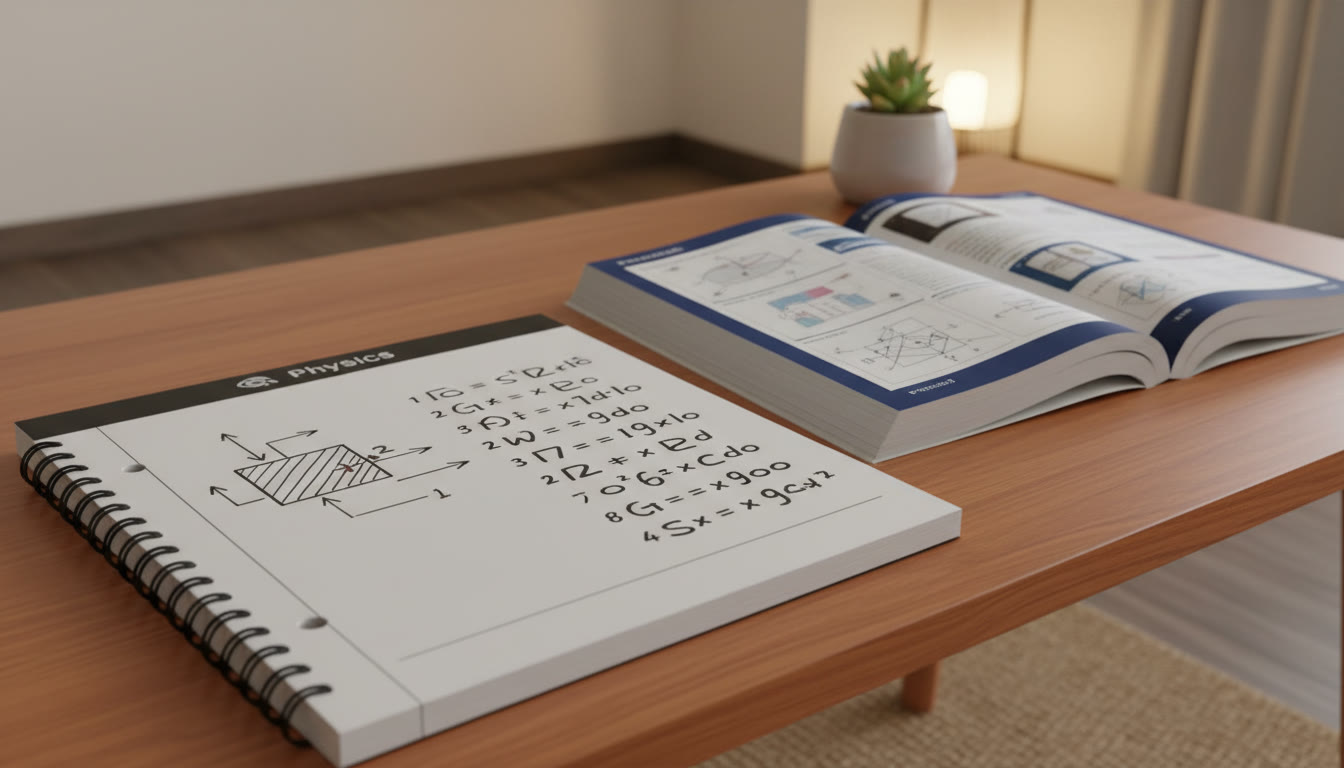
Draw free-body diagrams, ray diagrams, circuit equivalents, and energy flow charts even when the exam doesn’t ask for them explicitly. Diagrams reduce algebra and expose hidden assumptions. Treat derivations as reverse-engineering tools: understand a formula by tracing what it assumes, and you will know exactly when to apply it.
Learning from solved examples and mixed-topic sets
Solve worked examples to learn the template for a problem type, then immediately practice fresh problems of the same template. After mastering templates, switch to mixed-topic sets so that test-day mental flexibility is trained — you need to identify which template fits quickly when questions are shuffled by topic in a single paper.
Three-problem drill
Pick one topic, do an easy, medium, and hard problem back-to-back. Write a one-sentence summary after each set about the core trick used. This creates pattern-recognition in your brain.
Personalization and when to seek guided help
Every student has different friction points: calculation speed, algebra fluency, conceptual gaps, or exam anxiety. When your error register shows a repeating category of mistakes despite practice, targeted guidance saves time. For tailored help that combines one-on-one support, structured study plans, and data-driven insights, consider a personalized tutoring approach where a coach diagnoses recurring errors and prescribes focused practice. For example, some students benefit from one-to-one sessions that reframe weak topics into tractable steps while others need AI-driven practice plans that adapt by performance.
If you explore personalized support, ensure tutors focus on problem-structure, mistake analysis, timed practice, and building exam habits, not only on providing more solved problems.
Keeping practice sustainable: rhythm and recovery
Intense practice must be sustainable. Alternate heavy numerical days with lighter conceptual revision or mock-analysis days. Rest and active recovery (light revision, revision flashcards, or sketching formulas) are essential to keep your decision-making sharp during three-hour practice sessions.
Weekly rhythm example
- 3 focused numerical-practice days (layered problems)
- 1 mixed-topic timed session
- 1 full-length mock or half-mock with OMR practice
- 2 lighter days for review, derivations, and error-log work
Small checks that produce big gains
- Always box the final answer in rough work so transfer to OMR is fast and reliable.
- Use limiting-case checks to validate answers quickly (e.g., consider mass->0 or distance->infinity limits).
- Mark questions you skip in the first pass and return with a strict time cap — don’t linger.
- Prioritize high-yield numericals in subjects that historically carry weight and align with your strengths.
Example: a clean way to solve a two-step numerical
Problem template: A block slides down an incline with friction and compresses a spring at the bottom. Find compression x. Approach: sketch the setup; write energy balance; account for frictional work; solve algebraically keeping symbols until the final substitution; check units and limiting cases (zero friction -> larger compression). This method reduces algebra mistakes and gives a clear path to options if used with MCQ elimination.
Final checklist before a mock or exam
- One clean formula sheet on your desk for revision (not for the actual exam).
- Calculator practice if permitted in your mock environment — know what you can compute mentally.
- Practice filling OMR forms accurately and quickly.
- Simulate the three-hour rhythm: first pass on easy picks, then medium, then return for harder problems.
Closing thoughts: practice with purpose
Physics numericals are best conquered by combining steady concept work with deliberately structured practice: small daily habits, a layered practice plan, timed full-length mocks, and disciplined error analysis. Keep your practice realistic and exam-aligned: visualize the problem, plan the solution, do tidy arithmetic, and always run quick checks on units and limits. When preparation is surgical rather than scattershot, speed and accuracy follow naturally. End every study week with a short review of your error log and a tiny tweak to the next week’s plan; that continuous iteration is where most gains live. This focus on purposeful practice, steady testing under real conditions, and consistent correction will sharpen problem-solving into a reliable exam skill.

















No Comments
Leave a comment Cancel