
Mastering Chemistry: A Practical Roadmap to the 99 Percentile in JEE Main
Chemistry is often the decisive subject for students chasing a 99 percentile in JEE Main. It sits between fast-scoring conceptual questions and unforgiving numerical problems. Hit the right balance — concept clarity, timed practice, and exam discipline — and Chemistry becomes a reliable source of high, stable marks. This article walks you through a human, no-nonsense plan: what to study, how to practice, how to revise, and how to behave on the day of the exam.

Know the Exam Context: Pattern, Marking, and Mindset
Before you design a schedule, be crystal clear about the test environment. JEE Main questions are objective in format, with a mix of classic multiple-choice questions and numerical-type items. The exam demands a full three-hour session of sustained focus — practicing full-length, timed mocks that mirror that 3-hour endurance is not optional; it is mandatory. Negative marking applies to incorrect MCQ attempts, so accuracy and smart risk management matter more than reckless attempts. Also, be practical: do not expect descriptive partial credit. In short, every chosen option must be justified in under a minute; every calculation must be efficient and checked.
Exam habits that win
- Mock frequency: schedule full-length 3-hour mock tests regularly to build stamina and timing instincts.
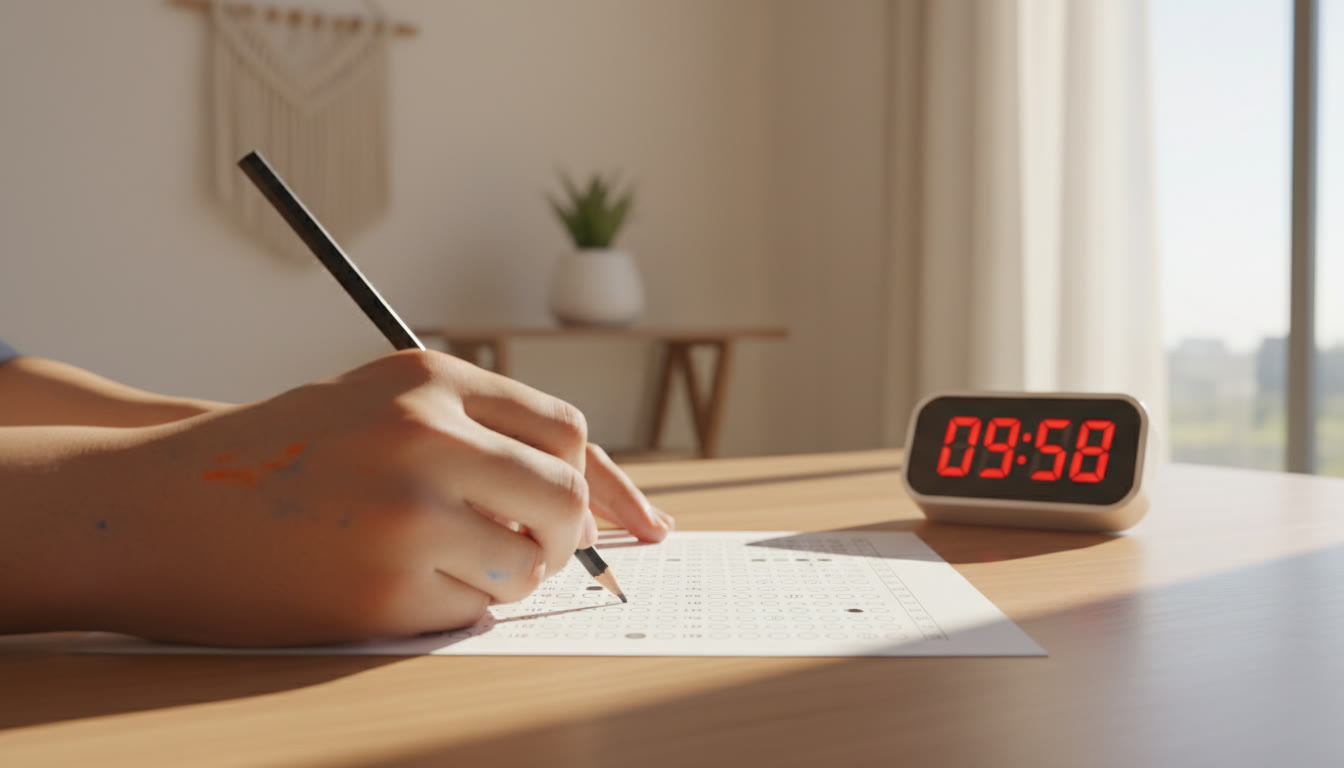
- OMR discipline: practice shading bubbles accurately and avoid loose pencils or smudges; small slips cost big marks.
- Negative-marking caution: eliminate wrong options systematically rather than blind guessing.
- Section awareness: treat Chemistry as both a quick-scorer and a safety net — aim to secure a high, steady section score.
Set a Target, Then Back-Calculate
Instead of fixing a target percentile as an abstract number, translate it into tactical milestones: consistent sectional scores, error limits per test, and the number of perfect/near-perfect topic blocks you must achieve. For example, decide the number of safe marks you need from Chemistry every mock to reach your overall goal; then plan backward to cover topics that will give you those marks reliably.
Divide Chemistry into Three Actionable Buckets
Make simple buckets: Physical, Organic, and Inorganic. Each demands different habits. Treat them as separate projects with aligned timelines.
Physical Chemistry — Build Speed with Conceptual Anchors
Physical Chemistry is calculation-heavy, but almost every numerical follows well-defined principles. Your job is to reduce calculation time and error rate.
- Master the fundamentals: dimensional analysis, unit conversions, log rules, and approximation techniques (when permitted).
- Create and keep a compact formula sheet; update it after every mock with the few new tricks you learned.
- Practice 3-hour timed sets that force you to solve a mix of quick two-line numericals and longer multi-step problems.
- Focus topics: stoichiometry, thermodynamics, chemical equilibrium, electrochemistry, kinetics, and basic quantum/atomic models — these reappear frequently in different forms.
- Technique tip: for multi-step problems, write intermediate results clearly and use estimation to verify answers quickly.
Organic Chemistry — Map Reactions, Not Pages
Organic succeeds on pattern-recognition. Make reaction maps, not long verbatim notes.
- Prioritize understanding reaction mechanisms at a conceptual level; then memorize only what’s necessary — reagents, conditions, and typical product patterns.
- Practice name reactions and common transforms by doing short timed quizzes: identify reagents, predict products, choose the correct mechanistic step.
- Use skeletal mechanisms to anchor each reaction type so you can eliminate improbable options quickly in MCQs.
- Organic questions often reward lateral thinking — synthesis path, reagent identification, or functional group interconversion — so practice diverse MCQ formats.
Inorganic Chemistry — Smart Memorization and Concept Clusters
Inorganic is the domain of rules, trends, and exceptions. Instead of rote lists, build small clusters that explain a group of facts together.
- Organize the periodic table into small narratives: stability trends, oxidation state behavior, acid-base tendencies, and complexation patterns.
- Create mnemonics for groups of ions, common salts, and reduction-oxidation outcomes — but always tie mnemonics back to reasoning so you can handle twist questions.
- Practice quick recall drills under timed conditions; many inorganic MCQs test recognition more than deep derivations.
- Highlight exceptions as high-probability question seeds: inert-pair effect, anomalies in ionization energies, and coordination chemistry quirks.
Weekly Time Allocation: What to Practically Do
Use a rolling plan that mixes learning, practice, and revision. Below is a practical weekly allocation you can adapt depending on your strengths and the time you have left until the test cycle.
| Focus Area | Weekly Hours | Primary Activity | How to Practice |
|---|---|---|---|
| Physical Chemistry | 8–12 | Timed numericals & concept reviews | Problem sets, formula sheet updates, time-bound drills |
| Organic Chemistry | 6–9 | Reaction mapping & MCQ packs | Reaction maps, mechanism quizzes, synthesis puzzles |
| Inorganic Chemistry | 4–6 | Recall drills & concept clusters | Flashcard practice, quick recall tests, concept tables |
| Full-length Mock Tests | 3–6 | 3-hour endurance tests | Complete test, detailed error analysis, test-specific corrections |
| Revision & Mistake Correction | 4–6 | Spaced repetition & error log | Rework missed problems, consolidate weak sub-topics |
Daily and Weekly Routine — A Real Example
Here is a compact daily rhythm you can follow on study days. Adjust durations by your available hours but keep the structure consistent.
- Morning (2 hours): Concept revision — alternate Physical then Organic weekly.
- Midday (2 hours): Focused problem solving — a timed set of 8–12 mixed questions.
- Afternoon (1–1.5 hours): Inorganic quick drills and flashcards.
- Evening (1–2 hours): Test-style practice — past MCQs or a portion of a mock under strict time.
- Night (30–45 minutes): Error log review and formula map update.
Across the week, replace one evening session with a full 3-hour mock to build stamina and simulate OMR discipline.
Mock Tests: How to Use Them So They Actually Help
Mock tests are not trophies; they are your laboratory for failure and correction. The value is in analysis, not in the raw score.
Before the Test
- Practice full 3-hour sessions under realistic conditions. Your brain must learn the timing tension.
- Ensure OMR discipline: practice shading, rough work placement, and quick rechecks.
During the Test
- Scan the paper quickly and mark easy Chemistry questions first — claim those low-hanging marks early.
- When stuck, apply elimination. If two options remain after elimination, make a calculated decision but remember negative marking.
- Keep track of time with mini-milestones: where you should be at 60, 120 minutes, and so on.
After the Test — The Gold Happens Here
- Create a detailed error log: question, mistake type (conceptual/careless/calculation), correction, and a short note on prevention.
- Rework every wrong or doubtful question until you can solve it without hints. Add the topic to your high-priority revision list.
- Update your formula sheet and reaction maps with any new shortcuts or patterns observed.
Smart Revision: Spaced Repetition and Active Recall
Revision is not re-reading. Use active recall and spaced repetition. Your formula sheet should become a test in itself: cover and reproduce, flashcard quick checks, and weekly micro-tests for previously revised material. For Organic, draw reaction chains from memory. For Physical, solve a set of 10 quick numericals that cover all major formulas you plan to use in the next mock.
Tools, Notes, and How to Use 1-on-1 Tutoring Effectively
Some students benefit from occasional personalized intervention to clear stubborn blocks. If you choose to seek guided help, use it for targeted problem areas and exam strategy — not as a passive content replacement. For example, focus sessions can be about:
- Untangling a tricky electrochemistry concept in Physical Chemistry.
- Refining approach to multi-step synthesis problems in Organic Chemistry.
- Building compact inorganic concept clusters for fast recall.
Consider Sparkl‘s personalized tutoring for short, targeted interventions if you need them — 1-on-1 guidance, tailored study plans, expert tutors for particular weak points, and AI-driven insights that help prioritize questions and revision cycles. Use any tutoring time to solve past mistakes together, practice high-yield question types, and build a bespoke revision checklist for the final weeks.
Common Mistakes and How to Avoid Them
- Memorization without understanding: If a reaction or numerical behaves differently in a twist question, understanding saves you; memorizing won’t.
- Too many un-analyzed mocks: Taking many tests without analyzing errors solidifies bad habits.
- Ignoring OMR practice: Errors in filling the OMR cost more than a missed question.
- Blind guessing under negative marking: Use elimination; if you cannot eliminate confidently, skip and recover time elsewhere.
- Last-minute cramming of new topics: In the closing phase, focus on consolidation and weak-area repair, not brand-new chapters.
Two Practical Examples — How to Turn Concepts into Answers
Example 1: Thermodynamics trick. If a question gives multiple processes and asks spontaneity at a temperature range, don’t rush into algebra. First, write down which variables change (delta H, delta S), then map probable sign combinations. Quick sign logic removes many distractors before you compute.
Example 2: Organic reaction identification. If reagents and conditions are listed, visualize the transformation on a skeletal structure. Ask three quick questions: does the reagent act as an oxidizer/reducer/nucleophile? Is a rearrangement likely? What intermediate would form? These three checks often eliminate two options immediately.
Last Weeks: Prioritization and Psychological Readiness
In final stretches, prioritize high-yield topics and consistent test practice. Keep these rules:
- Lock the basics: equilibrium, kinetics, major organic transforms, periodic trends.
- Maintain one full 3-hour mock per week with proper OMR practice.
- Switch to quick maintenance for topics that are already strong; sharpen weak topics with micro-sessions.
- Sleep and nutrition: your brain needs stable energy to execute on the exam day — don’t sacrifice sleep for last-hour cramming.
Quick Checklist for Exam Day (Chemistry-Focused)
- Bring at least two HB pencils and an eraser suitable for the OMR.
- Carry a clean, compact formula sheet for last-minute glance the evening before (not on test day).
- In the first 20 minutes of the test, lock in easy Chemistry questions to build confidence.
- Allocate time for rechecks: leave the last 20–25 minutes to review answers and the OMR mapping.
- If you face a time crunch, prioritize accuracy over attempts — a few well-secured Chemistry marks beat many uncertain ones.
Closing Thought
Scoring around the 99 percentile in JEE Main Chemistry is a predictable outcome when you combine principled study — clear concept maps, timed practice that mirrors the 3-hour format, disciplined OMR habits, and an organized error-log-driven revision routine. Treat each mock as an experiment: collect data, analyze errors, and craft targeted corrections. When your weekly cycles show steady reduction in repeat errors and rising accuracy in timed sets, the percentile will follow. Study smart, practice deliberately, and keep the exam conditions — timing, OMR, and negative marking — central to every preparation decision.

















No Comments
Leave a comment Cancel