
Two-Year JEE Advanced Preparation: A Calm, Strategic Roadmap
Thinking about cracking JEE Advanced over two years can feel like standing at the foot of a mountain — exciting, a little daunting, and absolutely climbable with the right map. This article is that map: a conversational, practical, and steady plan that treats learning as a craft. Over the next two years you will build depth, forge exam habits, and convert curiosity into consistent performance. We’ll keep things realistic: the exam environment is objective and strict, with multiple-choice and numerical-type questions, timed full-length tests (typically three hours per paper), negative marking rules in several question types, and clear answer-submission protocols. That means clarity, discipline, and targeted practice beat last-minute panics every time.

Why a Two-Year Plan Works (and how to use it)
Two years gives you breathing room. It isn’t about stretched-out procrastination; it’s a deliberate timeline that separates learning phases, reduces stress, and allows measurable progress. In a two-year cycle you can:
- Build conceptual depth in each subject without skipping fundamentals.
- Balance school or board responsibilities with high-quality JEE practice.
- Create repeated cycles of practice — learn → apply → review — across multiple topics.
- Develop robust exam habits: time allocation, question selection, and pressure handling.
Treat the two years as four major phases: Foundation, Consolidation, Intensification, and Final Polish. Each phase has a distinct purpose and measurable outcomes, so progress looks like a collection of small wins rather than one huge, vague hope.
Big-picture Roadmap: Phases and Purpose
Below is a compact phase table you can adapt to your calendar. Replace the generic month blocks with your actual start point and track progress weekly.
| Phase | Months | Primary Focus | Weekly Time Range | Key Deliverables |
|---|---|---|---|---|
| Foundation | Months 1–6 | Concept clarity, basic problem sets, syllabus mapping | 12–20 hrs (school students), 25–40 hrs (full-time) | Topic notes, short problem bank, fundamentals checklist |
| Consolidation | Months 7–12 | Deeper practice, mixed-topic problem solving | 15–25 hrs (school), 30–45 hrs (full-time) | Mid-level test scores, error log, core chapter mastery |
| Intensification | Months 13–18 | Full-length mocks, timed sections, weak-topic attack | 20–30 hrs (school), 40–55 hrs (full-time) | Regular mock cadence, steady rank improvement, refined strategy |
| Final Polish | Months 19–24 | Targeted revision, high-frequency mocks, exam discipline | 20–35 hrs (school), 45–60 hrs (full-time) | Consistent mock performance, mistake-free short notes, exam readiness |
How to adapt the roadmap to your life
If you’re studying alongside school, preserve mental bandwidth for boards and weekly classes; favor steady daily sessions rather than marathon nights. Full-time aspirants can follow a heavier timeline but must guard against burnout by scheduling rest and varied activities.
Year 1 — Building Rock-Solid Fundamentals
The first year is not the place to chase high mock ranks. It’s the place to be unafraid of slow, careful work. Your goals are clarity and reproducible method: you should be able to explain core ideas in your own words and solve standard problems confidently.
- Start with a clean syllabus map: list chapters from Physics, Chemistry, and Mathematics and mark confidence levels.
- Prioritize understanding derivations and why a method works, not just how to replicate steps.
- Create short, single-page topic notes — these become your revision gold later.
- Practice progressively: easy → moderate → hard. Don’t skip the easy ones; they build intuition.
Make an error log from day one. Every time you make a mistake, record: topic, question, what went wrong, and one corrective action. A well-maintained error log turns confusion into a targeted study list.
Year 2 — Intensify, Test, and Polish
The second year is where foundations meet execution. Balance heavy mock-test practice with ruthless revision of weak topics. Consciously reduce the introduction of new broad topics; switch to mixed-topic problem rounds and timed sections.
- Increase mock frequency in stepwise fashion — for example, one full-length mock every two weeks ramping to weekly in the final months.
- Simulate exam conditions: three-hour timed papers, minimal breaks, no phone, and the same morning routine as the exam day.
- Work on exam discipline: question selection strategy, time distribution per paper section, and managing negative marking risk.
As your mock scores rise, shift attention to stability: consistent scores across repeated tests beat occasional spikes. Use quantifiable targets (e.g., reduce careless errors by X% in four weeks) rather than vague promises.
Weekly and Daily Routines That Actually Work
Consistency beats volume. Pick a sustainable daily rhythm you can keep for months. Here are two adaptable templates: one for school-going aspirants and one for full-time preparation.
| Type | Morning | Afternoon | Evening | Night |
|---|---|---|---|---|
| School + JEE | 45–60 min concept review / problem set | School classes / short revision | 2–3 hrs focused practice (topic-based) | 30–45 min light revision, sleep routine |
| Full-time JEE | 1.5–2 hrs core subject (deep work) | 2–3 hrs practice or coaching sessions | 2–3 hrs mock/section practice & analysis | 45–60 min revision, planned rest |
Weekly structure
- Designate at least one full-length timed mock every 1–2 weeks in the second year; do shorter timed sections weekly.
- Reserve one day a week for slow revision and error-log consolidation.
- Keep a “light day” to prevent burnout — lean review, mental recovery, and planning.
Study Techniques and Problem-Solving Habits
Technique overrides time. Two hours of focused, deliberate practice is worth more than six hours of distracted study. The following techniques are practical and repeatable:
- Active recall: After reading, close the book and write out the main steps or derivation from memory.
- Spaced repetition: Revisit tough topics at increasing intervals — days, weeks, then months.
- Mixed problem sets: Practice mixed-topic sets to mimic exam unpredictability.
- Teach to learn: Explaining a topic aloud or to a peer reveals gaps fast.
- Micro-deadlines: Give yourself 20–40 minute sprints within a study session to maintain momentum.
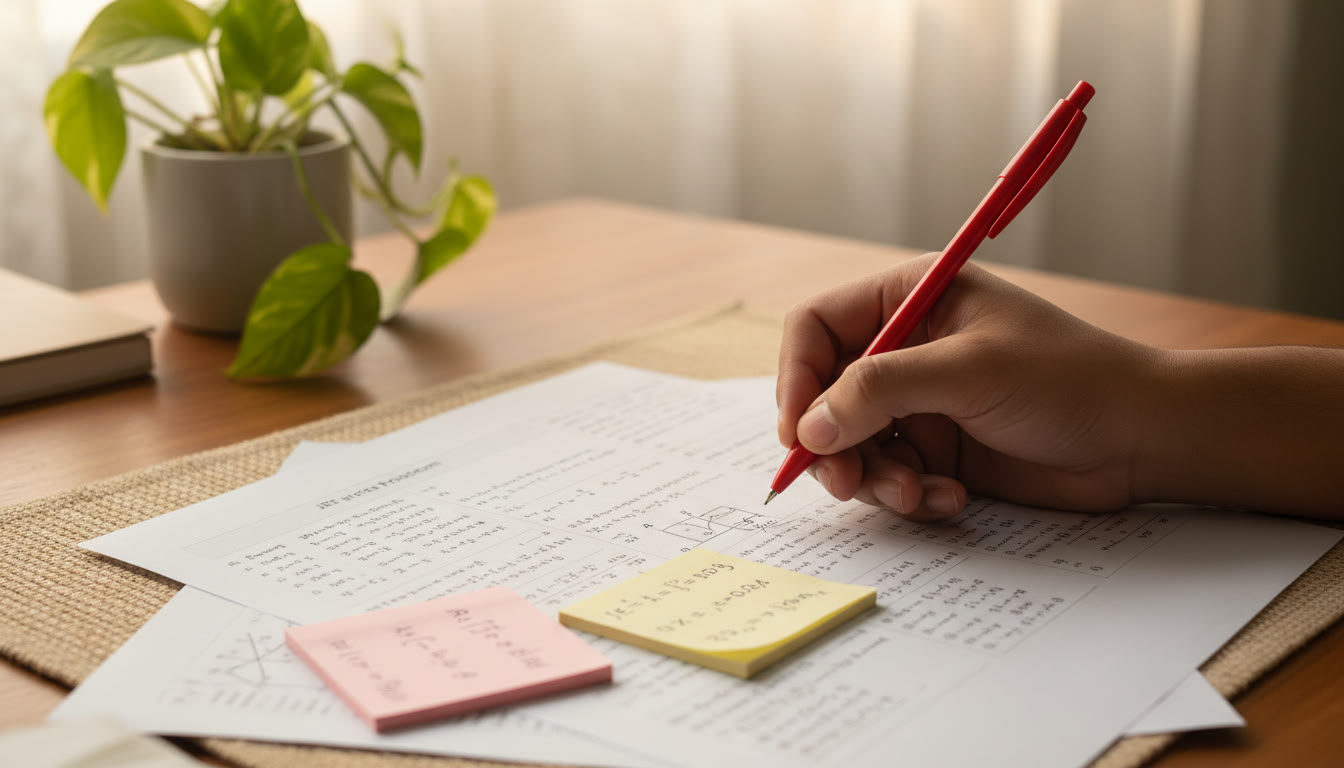
Mock Tests: How to Make Every One Count
Mocks are not just performance checks — they are your most powerful training tool. Treat every mock as a test run for your mind and your routine. Follow a strict post-test analysis flow:
- Grade immediately and record raw scores and section-wise accuracy.
- Identify careless errors, concept errors, and time-management issues separately.
- Fix the immediate mistakes: re-solve the question, rewrite notes, and add a remedial problem to the next week.
- Track trends: Are careless errors decreasing? Are specific topics repeatedly weaker?
Because negative marking exists in many question types, practice the art of selective attempt: answer the questions you can solve quickly and accurately first, then return to time-consuming items. Learning to make smart decisions under time pressure is an exam skill as much as knowing content.
Subject-by-Subject Playbook
Physics
Physics rewards physical intuition and numerical practice. Focus on first-principle derivations, dimensional checks, and typical modeling tricks (approximations, limiting cases). Make short formula sheets with assumptions listed — knowing when a formula applies is as important as memorizing it. Regularly solve end-of-chapter and mixed-topic problems to learn transfer between mechanics, electricity, optics, and modern physics.
Chemistry
Chemistry breaks down well into three manageable parts: physical, organic, and inorganic. For physical chemistry, practice numerical problem patterns and ensure you can derive key relations quickly. For organic chemistry, learn reaction logic and practice mechanism steps until they are intuitive. For inorganic chemistry, build memory tools — structured charts and consistent short notes — but couple memorization with conceptual links so recall is fast under pressure.
Mathematics
Mathematics is about technique and pattern recognition. Prioritize mastering problem approaches: how to convert a verbal idea into a mathematical strategy. Maintain a separate collection of problem templates (e.g., integration tricks, inequality templates, coordinate geometry shortcuts) and practice problems of increasing variation. Show full solutions at least once; later, practice compressed, exam-friendly write-ups that preserve clarity and speed.
Handling Negative Marking and Exam Discipline
Negative marking penalizes random guessing. A pragmatic rule: eliminate options first; if you can reduce choices markedly or can logically reason to an answer, attempt. If you have no idea and cannot narrow choices, skip. Time management here is vital — a saved minute spent on selection often beats chasing a high-risk question.
Also train for the exam interface and rules. Familiarize yourself with the computer-based answer submission, rough-sheet usage, on-screen navigation, and the exact marking scheme for different question types. Simulated practice under these protocols makes the actual test feel familiar rather than surprising.
Mindset, Health, and Avoiding Burnout
High performance is sustained by balance. Protect sleep — regular 7–8 hour nights are not optional. Nutrition, short daily movement, and mental pauses (even ten minutes of breathing or a walk) pay back in concentration. Emotional health matters: mark small victories, and if anxiety spikes, revert to basics — a simple problem set completed is proof of progress.
Using Personalized Help Effectively
One-on-one guidance can accelerate the two-year curve when used correctly. Personalized tutoring helps you focus on the exact gaps that standard schedules miss — targeted problem selection, weekly corrective plans, and tailored pacing. For example, Sparkl‘s personalized tutoring often highlights how a short, guided session can remove a week of confusion by clarifying a single recurring mistake. Seek tutors who combine conceptual clarity with exam-smart tactics and who help you translate mock analysis into concrete action items.
When you use personalized support, aim for these outcomes: clearer topic maps, faster error correction cycles, and a documented plan for each week. AI-driven insights and data-backed study plans are useful only if you follow up with disciplined practice and reflective review.
Practical Checklists and Mini-Routines
- Daily: 1 focused concept session, 1 practice set, 15–20 minutes error-log review.
- Weekly: 1 timed section, 1 topic consolidation session, update the error log.
- Monthly: 1 full-length mock (increase frequency later), assess trends, reset the next month’s micro-goals.
Sample Two-Year Outcome Goals (Milestones)
| Milestone | When (approx.) | Success Markers |
|---|---|---|
| Conceptual Comfort | End of Foundation phase | Explain core topics in your own words; solve standard problems without help |
| Problem Agility | Mid second year | Handle mixed-topic sets with timed sections; error rate falls noticeably |
| Exam Readiness | Final months | Consistent mock scores under timed conditions and clean short notes for last-minute revision |
Final Thoughts: A Two-Year Investment in Skill
Two years is long enough to craft understanding, habits, and exam poise. If you sequence learning sensibly, maintain honest mock analysis, and protect your health, you convert steady effort into dependable performance. The advantage of a planned two-year approach is cumulative: small daily gains become large competency wins, and by the final months you no longer scramble to learn — you polish what you already know.
Build clarity before speed, measure your progress with real mocks, and use targeted guidance where it removes recurring mistakes; this combination turns the two-year timeline from an intimidating stretch into a sustainable, confidence-building pathway to exam readiness.























No Comments
Leave a comment Cancel