
Turning the gap into your launchpad: a clear timeline after JEE Main
You’ve finished JEE Main — whether that felt like a relief, a test drive, or a wake-up call — the weeks ahead matter more than how you felt on the day. This stretch is not about frantic coverage; it’s about surgical focus: patch the gaps that cost ranks, polish exam temperament, and convert every practice hour into rank gain. Think of the period between Main and Advanced as a performance window with three priorities: clarify concepts, sharpen application, and build unshakable exam habits.

What changes (and what stays the same)
After JEE Main your objective shifts from broad scoring to targeted rank improvement. The test style you’ll face in Advanced is objective and application-driven: objective questions including multiple-choice and objective numericals, time-bound papers of roughly exam-length (practice full-length, three-hour mocks to match the real pace), and sections where accuracy matters because wrong answers often carry penalties. The testing environment is computer-based now, so “answer-entry discipline” replaces the old idea of OMR handling: practice the interface, simulate exam timing, and train your concentration for uninterrupted stretches.
Two other constants remain: the exam rewards deep understanding, and repeated, reflective practice beats frantic coverage. Assume questions will test combinations of concepts more than straightforward textbook plugs, so the emphasis must be on flexible problem-solving.
Assess first: honest diagnostics that guide every hour
Diagnose not just what but why
Run a 72-hour audit of your recent Main performance. Don’t stop at “I missed 10 questions in Physics.” Break each mistake down: conceptual gap, careless arithmetic, misread question, time pressure, or unfamiliar question format. A mistake logged without cause is noise; a mistake with cause becomes a launch-point for targeted correction.
- Create a mistakes log: record topic, exact error, time taken, and the corrective step you’ll do next (mini-sessions, formula recall, targeted practice).
- Tag topics by urgency: high-priority (high-weight + recurring errors), medium (occasional slip-ups), low (rarely missed).
- Measure speed vs accuracy: for a recent mock, note average time per question for each section and the accuracy percentage — that will tell you where to slow down, and where to push pace.
Prioritize by impact
Not all topics give equal return for time invested. In Physics and Math, core pillars like mechanics, electricity & magnetism, calculus and algebra typically carry heavy weight; in Chemistry, strong organic and physical fundamentals often decide quick rank gains. Make a short list of 12–18 topics that are truly “rank drivers” and keep them at the center of your plan.
Flexible timelines: choose the plan that fits the weeks you have
Every candidate has a different amount of time between Main and Advanced. Below are three practical timelines — pick the one that matches your calendar and personality. Across all plans, the backbone is the same: focused revision, regular full-length mocks (three-hour exam simulations), and disciplined error correction.
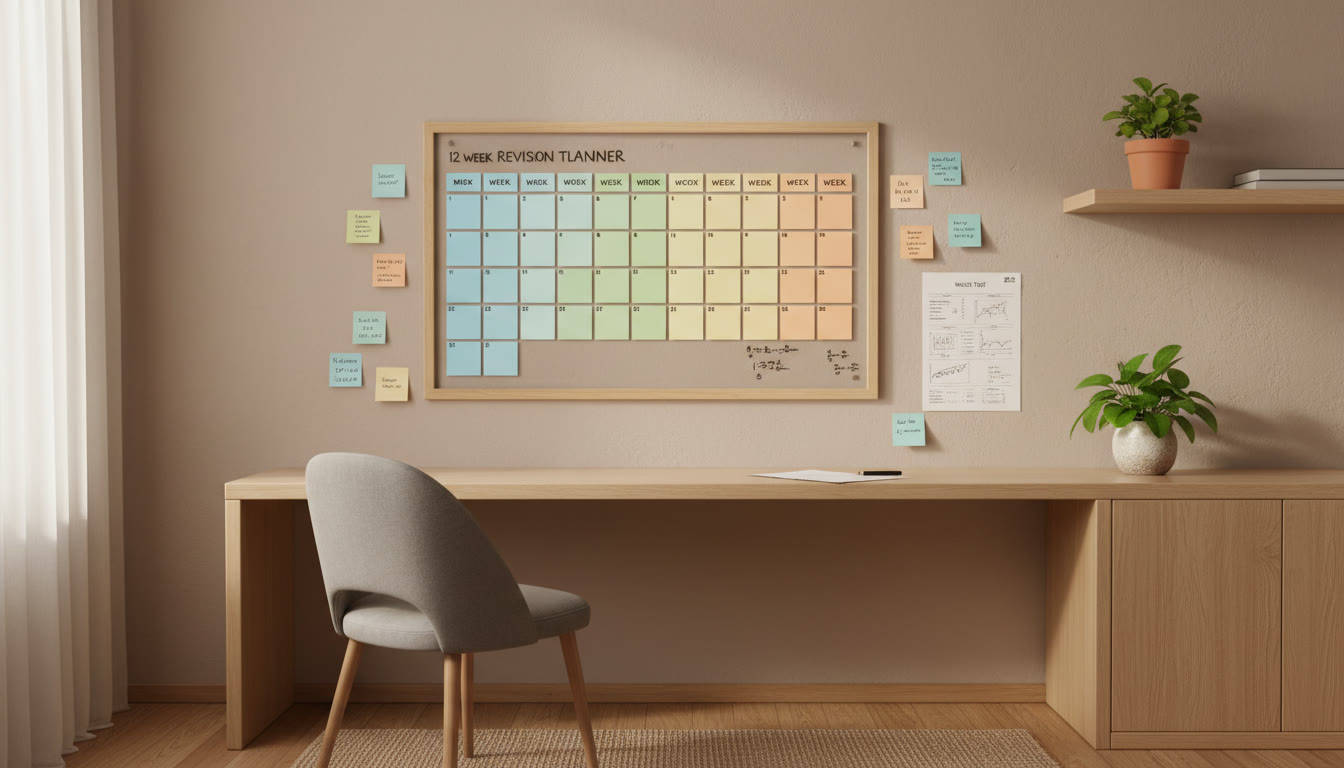
12-week (ideal) roadmap
| Weeks Remaining | Focus | Weekly Goal | Mock Frequency | End-of-Week Deliverable |
|---|---|---|---|---|
| Weeks 12–9 | Concept consolidation + selective practice | Finish core notes for rank-driver topics; 80% clarity on fundamentals | 1 light sectional test + 1 timed practice per subject | Concept checklist and short error log |
| Weeks 8–5 | Application + mixed problem sets | Build problem-bank for core topics; start timed full-length practice | 1 full-length mock + 1 sectional mock | Top-20 mistake list and strategy notes |
| Weeks 4–2 | Sharpening speed and accuracy | Achieve target paper-level accuracy in simulated tests | 2 full-length mocks + daily timed sets | Final revision sheets and confident topic map |
| Week 1 | Stabilize and simulate | Light revision, avoid new topics, focus on flawless execution of known material | 1 final full-length mock in exam-like conditions | Exam-day checklist and calm routine |
This table is a template — personalize the weekly goals based on your audit. If a topic keeps causing blunders, move it up the priority list and allocate a focused mini-block to drill it until errors fall by at least 50%.
8-week accelerated plan
Condensed and intense: weeks 8–5 are about completing revision notes; weeks 4–2 focus on full-length mock rhythm and rapid error cycles; last week is consolidation. Increase mock frequency and reduce topic breadth: cover fewer topics but reach problem depth on those.
4-week crash plan
Only for candidates with very limited time. The rules: stop learning new major topics, exclusively revise high-yield notes, do daily full-length three-hour mocks (or two if fatigue sets in), and spend equal time fixing recurring mistakes. This plan is about maximizing accuracy on the material you already know.
Mock tests: how to practice so that practice counts
Quality over quantity
A full-length mock in exam-like conditions (three hours, same question-type mix) is the single most valuable practice tool. The test itself is only 20% of the value; the analysis is the remaining 80%. After every mock, do a systematic two-pass analysis:
- Pass 1 — Quick score and emotional check: how close did you come to your target and how did you feel across sections?
- Pass 2 — Deep error audit: for each wrong or slow solution, record the root cause and a corrective micro-action (e.g., re-derive this formula, practice 10 similar problems, memorize a shortcut).
Mock cadence by timeline
In longer timelines, start with 1 mock/week, move to 2, and peak at 2–3 mocks/week during the sharpening phase. In 4-week plans, aim for 4–5 timed sectionals and 2 full-length mocks per week (manage fatigue carefully).
Concrete daily structure: sample routines that actually work
Sample day (for a 10-hour focused study day)
- Morning (2.5–3 hours): Concept revision and short, high-focus problem set on one subject — do the hardest problems of a topic when you’re fresh.
- Midday (2–3 hours): Sectional practice or topic problem bank — timed blocks with strict time limits and no distractions.
- Afternoon (1 hour): Light rest, active recall using flashcards, one-page formula sheets.
- Evening (2–3 hours): Full-length style problem solving or past-paper practice; simulate pressure.
- Night (30–60 minutes): Error log update and a short plan for the next day — always close with a micro-goal.
Shorter days must keep the same structure: sharpen one theme each day instead of many. The goal is focused repetition, not random problem hunting.
How to decide whether to attempt a question under negative marking
Simple decision heuristics
- If you can eliminate at least one option reliably, your expected value of attempting rises; use elimination where possible.
- For questions where calculation cost is high and the probability of a correct guess is low, skip and save time for higher-confidence items.
- Maintain a running “time bank”: if you are ahead of schedule in the first half, you can attempt more borderline problems later; if behind, tighten selection.
Important: do not assume partial marks where the official pattern does not specify them. Practice under the strictest interpretation of marking rules unless you have up-to-date, official confirmation otherwise.
Tools that multiply returns: notes, error logs, and spaced revision
Make your cheat-sheet your anchor
One-page formula sheets per topic, plus a quick “why this works” line, are gold. Convert every new insight into a one-line memory anchor. When you reach the final two weeks, your formula sheets and error logs should be the only materials you carry for daily review.
Manage an error-book like a coach
Every wrong answer gets a short entry: topic, mistake type, corrective action, and date. Revisit recent entries on a 3-day cycle and older entries on a 10-day cycle. This spaced repetition collapses forgetting and converts mistakes into lasting strengths.
How to use help, and where personalized tutoring fits naturally
Targeted coaching can speed up error correction and reduce wasted hours. If you’re repeatedly stuck on the same subtopics, focused one-on-one guidance helps unblock you much faster than solo trial-and-error. Sparkl‘s personalized tutoring, with one-on-one guidance, tailored study plans, expert tutors and AI-driven insights, is one way to get that targeted support: a tutor can help you shorten the error cycle, build a custom problem bank and hold you accountable to the timeline you choose.
When to bring in a tutor or mentor
- When your mistakes repeat despite practice and you can’t identify a corrective action.
- When time is short and you need a prioritized, personalized plan to maximize rank gain.
- When you need periodic checks of technique (time management, on-screen answer entry, and mock-simulation feedback).
Common pitfalls and how to avoid them
- Coverage chase: trying to learn new major topics in the final weeks — avoid this. Consolidate known strengths.
- Passive revision: rereading notes without problem solving. Replace passive hours with active problem application.
- Mock-overload: taking too many mocks with no analysis. Each mock must be followed by disciplined correction.
- Ignoring the exam interface: practice on the same kind of computer interface (timers, navigation, and answer-entry patterns).
Sample 3-week micro-schedule (last push)
| Week | Primary Focus | Daily Tasks | Mocks |
|---|---|---|---|
| Week 3 | Consolidation of rank-driver topics | 2 hours concept revision, 4 hours problem bank, 1 hour error log | 1 full-length mock + 2 sectional sets |
| Week 2 | Accuracy and speed | Timed problem sets, technique refinement, mock analysis | 2 full-length mocks + daily 1-hour timed practice |
| Week 1 | Stabilize and rehearse | Light revision sheets, short sleep-friendly study blocks, mock simulation | 1 final full-length mock (exam-like conditions) |
Exam-day rhythm and on-screen discipline
Before the test
- Sleep, a light nutritious meal, and a short revision of one-page sheets — avoid new content.
- Have a short warm-up: 20 minutes of quick recall (formulas and short tricks), and a breathing exercise to reduce adrenaline spikes.
During the test
Follow the plan you practiced in mocks: read each question carefully, mark easy ones first, and maintain a running time-check. For on-screen tests, practice navigation and answer-entry: always confirm your marked answers before moving sections if your mock analysis shows entry mistakes. Keep hydration and minimal, quiet focus techniques ready.
Mental resilience: small habits that compound
Short, consistent habits beat marathon sessions. A nightly 20-minute reflection on what you learned, why mistakes happened and one micro-goal for the next day keeps momentum. Build micro-rewards for meeting weekly milestones — these small psychological boosts reduce burnout and sharpen focus.
Final checklist before you step into the exam
- Comfort with the exam interface: practiced full-length timed mocks on screen.
- Polished one-page revision sheets for all rank-driver topics.
- Latest mock-analysis: top-10 mistakes fixed and not reappearing in two consecutive mocks.
- Exam-day routine rehearsed and sleep schedule aligned.
Closing thought
The stretch after JEE Main is an opportunity to convert breadth into precision. Build a plan that prioritizes high-impact topics, practice exam-length tests under strict conditions, and turn every mistake into a repeatable corrective step. Keep your schedule realistic, analyze deeply after every mock, and focus on steady, measurable improvements rather than last-minute coverage. With disciplined practice, smart prioritization, and targeted support where needed, the weeks you have can produce dramatic rank gains.























No Comments
Leave a comment Cancel