

Why past-year questions (PYQs) are the repeater’s smartest tool
If you’re returning to the JEE battleground after a previous attempt, PYQs (past-year questions) are not merely practice items — they are a diagnostic microscope, a pacing coach, and a reality-check calendar all rolled into one. Smart repeaters use PYQs to see exactly where the exam tests understanding, what types of tricks recur, and which topics consistently carry weight in the real exam environment.

Why PYQs matter more for repeaters than for first-timers
- They reveal persistent patterns: repeaters can spot recurring themes and question styles that matter across cycles.
- They expose exam temperament: solving PYQs under timed conditions teaches you how the exam expects quick decisions under negative marking pressure.
- They focus revision: instead of revising everything superficially, PYQs tell you which chapters demand depth.
Understanding the exam realities PYQs reflect
Core exam features to keep in mind
Use PYQs with these truths in mind: the format is MCQ-driven, full-length test simulations run about three hours, incorrect attempts attract negative marking, and strict answer-entry discipline (the OMR/computer-entry equivalent) is enforced. Answers must be clear and final: partial descriptive steps rarely earn credit in MCQ settings, so your practice should prioritize final-answer accuracy, justification speed, and methodical answer-entry practice.
What PYQ analysis actually reveals
- Topic frequency and weight — which chapters supply most direct questions and which appear as tricky multi-concept items.
- Difficulty spread — how many straightforward vs. tricky vs. time-consuming questions appear in a paper.
- Question style — numerical calculation, conceptual one-liner, assertion–reason style, interpretation-based diagrams, or multi-step integration.
First step: a short diagnostic that orients your PYQ plan
Before you build a long program, do a focused diagnostic using PYQs. Pick three consecutive past papers (or three representative papers across different cycles), and take one full-length timed mock that mirrors exam rules. Your goal is to gather data, not to panic.
Diagnostic checklist (what to record)
- Raw score and subject-wise split (Physics / Chemistry / Mathematics).
- Time per question average and time-wasters (which questions you spent most time on).
- Error classification: careless, conceptual gap, missing technique, calculation mistake, or mis-entry.
- OMR/answer-entry mistakes or guesses that backfired because of negative marking.
From diagnosis to a PYQ-first weekly routine
Once you have diagnostic data, divide your preparation weeks into focused phases. The table below gives a compact 12-week structure you can scale to a longer timeline. It centers PYQs at every stage: diagnosis, consolidation, timed simulation, and targeted polishing.
| Phase (weeks) | Primary focus | PYQ work | Mocks | Weekly goal |
|---|---|---|---|---|
| Weeks 1–2 | Deep diagnostic & patching basics | Topic-wise PYQs: 8–12/day across subjects | 1 short diagnostic (3-hour simulation at end) | Identify top 10 weak topics; stabilize fundamentals |
| Weeks 3–5 | Concept consolidation | Targeted PYQs on weak topics; mixed sets for variety | 1 full-length mock/week | Gain 8–15 marks on weakest topic blocks |
| Weeks 6–8 | Speed & accuracy | Timed PYQ sets, section-wise time drills | 2 full-length mocks/week + analysis | Reduce careless error rate by 50% |
| Weeks 9–10 | Polish high-yield topics | High-frequency PYQs + mixed revision papers | 2 full-length mocks/week | Convert near-miss questions into secure answers |
| Weeks 11–12 | Exam simulation & consolidation | Full past papers in exam conditions | 3 full-length mocks across two weeks (strict simulation) | Stabilize score and fine-tune time management |
How to scale this plan
If you have more than 12 weeks, repeat the consolidation and speed phases; if you have fewer weeks, truncate earlier phases but keep a minimum of two strict mock simulations under exam rules.
Practical PYQ routines: daily and weekly templates
Daily PHASE template (example)
- Warm-up (30–45 minutes): quick concept revision or formula flashcards for weakest topics.
- PYQ practice (90–120 minutes): timed topic-wise sets from papers; record time taken and solution route concisely.
- Problem deepening (60 minutes): re-solve one PYQ where you were wrong and write a short note on the trick used.
- Wrap-up (15–30 minutes): error log update and planning for the next day.
Weekly rhythm
- At least one timed, full-section attempt for each subject.
- One full-length mock every 7–10 days during consolidation, increasing to twice weekly during speed phase.
- A weekly review session focused on error patterns rather than problem count.
How to solve PYQs so they really teach you
A three-step approach for each PYQ
- Solve under exam constraints: set a clock and decide a strict time cap for the question based on its estimated difficulty.
- Write a micro-solution: 2–4 lines capturing the core idea and the decisive step. This trains mental compression and recall.
- Classify the error if you miss it: conceptual gap, method gap, arithmetic error, misread, or time management.
Why writing a micro-solution helps
PYQs typically reward precise ideas. When you compress a solution into two lines, you force clarity. Later, when a similar pattern shows up in a mock, you can recall the micro-solution faster than a full derivation.
Subject-wise PYQ tactics (brief, high-impact)
Physics
- Focus on first principles: many PYQs test a basic model used in slightly unusual ways.
- Practice dimensional checks and limiting-case quick-tests — both save time and avoid silly mistakes.
- Identify common question clusters: kinematics setups, energy vs. work problems, electrostatics pattern recognition, optics shortcuts.
Chemistry
- Separate theory-based conceptual questions from numerically heavy physical chemistry items and plan practice accordingly.
- Reaction-mechanism style questions usually require reaction recognition; build a concise formula/reaction bank from PYQs.
- For organic problems, practice electron-flow intuition and simple named reaction recall as micro-notes.
Mathematics
- PYQs reward method selection: spotting whether a coordinate geometry question is best tackled by vector/coordinate trick or by transformation saves time.
- Build a toolbox of 5–7 standard tricks per major topic (calculus, algebra, coordinate geometry, trigonometry).
- Solve past problems both algebraically and with a sketch — geometric insight often delivers faster answers.
Mock tests: more than just numbers on a scoreboard
Simulate the three-hour full-length experience exactly
Treat a mock as a rehearsal for the entire exam day: start at the scheduled time, follow the same breaks, and strictly respect the answer-entry discipline. Practicing full-length tests trains stamina, pacing instincts, and the specific habit of making clean, final choices under negative-marking pressure.
How to analyze a mock efficiently
- First pass: tally correct, incorrect, and unattempted answers.
- Second pass: for each incorrect or skipped question, write the immediate reason for the miss — a single word tag (careless/concept/technique/math/time/entry).
- Third pass: make a short action item — for example, “redo practice set X with time cap 6 minutes” or “revise the relevant theorem and make a one-line flashcard.”
Handling negative marking and OMR/answer-entry discipline
Negative marking makes reckless guessing costly. That doesn’t mean avoid guessing entirely; it means guess strategically. Use PYQ practice to calibrate when a guess is worth the risk: is there a one-in-two chance after quick elimination? If yes, a calculated guess might be reasonable. If not, leave it. Equally important is practicing the mechanical act of final answer entry — whether on a computer screen or an OMR-like sheet — because mis-entries and multi-click mistakes are surprisingly common and avoidable.
Simple rules to follow in every timed PYQ session
- Decide a time cutoff for each question category and stick to it (e.g., 0–2 minutes for straightforward, 2–6 for moderate, 6+ for advanced).
- When in doubt, mark and move — but record the question in your error log immediately so it’s examined thoroughly later.
- Practice answer entry under timed conditions until it becomes reflexive and error-free.
Using an error log and review cycle to convert failures into marks
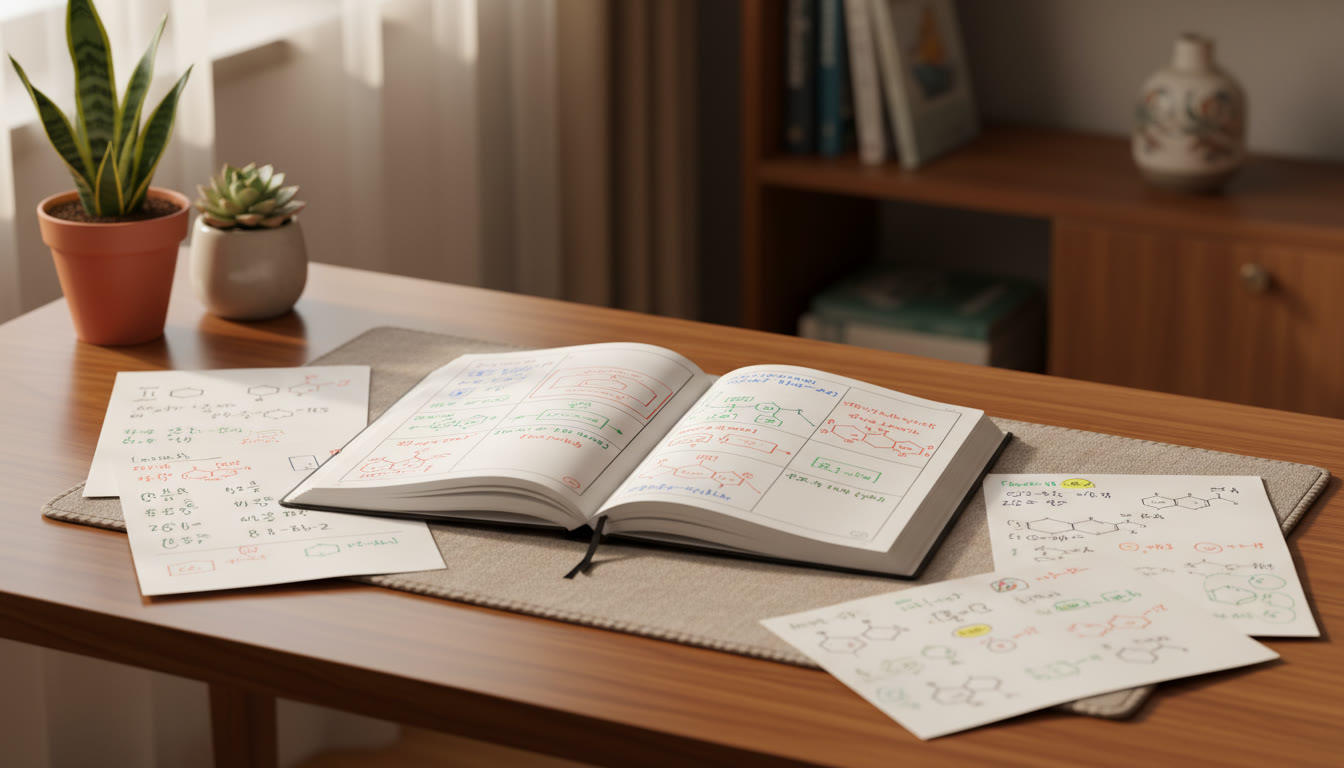
An error log is the repeaters’ compounding engine: each mistake documented well becomes a future mark gained. Keep a concise log: question reference, mistake tag, micro-solution, and a rule-of-thumb note for spotting similar traps next time.
Sample error-log columns
- Paper/Date • Q# • Subject • Mistake tag
- Micro-solution (2–4 lines)
- Action to prevent (practice set or concept note)
How to prioritize PYQs when time is tight
If your clock is short, prioritize high-frequency topics seen in multiple past papers, then the topics you personally miss most often. That is, strike a balance between global exam signals (what exams commonly ask) and your personal weakness map (what you personally fail to nail). Use PYQs in increasing difficulty sequence: secure the low-hanging marks first, then invest time in multi-step winners.
When and how to involve coaching, mentorship, or personalized help
Some repeaters find the biggest leap comes when they pair disciplined PYQ work with targeted mentorship. Personalized 1-on-1 guidance can quickly untangle persistent conceptual blocks and help tailor the PYQ schedule to your strengths and weaknesses. For example, Sparkl‘s personalized tutoring can help you convert error logs into daily micro-drills, provide tailored study plans, and use AI-driven insights to highlight the PYQs most likely to increase your score. If you choose a tutoring route, ensure the help focuses on amplifying your PYQ practice, not replacing it.
Sample weekly micro-plan (compact checklist)
- Monday: Topic PYQs (Physics focus), 90 minutes + 20-minute error-log update.
- Tuesday: Topic PYQs (Chemistry focus), 90 minutes + 20-minute micro-solution writing.
- Wednesday: Topic PYQs (Mathematics), timed problem pairs, + short revision notes.
- Thursday: Mixed-set PYQs (all subjects), time-managed section practice.
- Friday: Focused rework: redo missed PYQs from earlier in the week without notes.
- Saturday: Full-length mock (exam conditions) or two sectional timed mocks.
- Sunday: Mock analysis, error log consolidation, plan tweaks for next week.
Common PYQ traps and smart avoidance techniques
- Trap: Over-reliance on memorized tricks. Avoid by understanding derivations and why a trick works.
- Trap: Skipping verification for algebra-heavy answers. Avoid by quick sanity checks and dimensional analysis where possible.
- Trap: Time-sink questions that appear solvable but consume too much exam time. Avoid by clear time limits and practicing the pivot to intelligent skipping.
Final checklist before a strict PYQ mock
- Sleep and nutrition: treat the mock like exam day — no late-night cramming before a mock.
- Materials: clock, quiet space, answer-entry device or simulated OMR sheet, scratch paper, calculator policy awareness if applicable.
- Mental plan: decide your section order and what counts as a guess before you start.
Conclusion
A disciplined PYQ plan turns past papers from mere homework into a predictive training system. Repeaters who combine careful diagnosis, timed full-length simulations, systematic error logging, and focused topic drills convert steady effort into measurable score gains. Use PYQs to train decision habits — when to attack, when to skip, how to enter answers cleanly — and let each past question teach you one robust habit or trick. With consistent practice, structured review, and targeted correction, PYQs become the most reliable path for turning prior experience into improved performance in the upcoming entry cycle.




















No Comments
Leave a comment Cancel