
How I Went from a 9k JEE Rank to Under 1k: A Practical, Step-by-Step Strategy
I still remember the moment I opened my rank card: 9,032. It was a punch to the gut, but not the end of the story. What followed was a disciplined rewrite of how I studied, practiced, and thought about the exam. This is not a romantic overnight transformation—it’s a methodical, test-driven, human strategy that moved me steadily toward the top band. If you’re reading this because you’re stuck around the same range, consider this a friendly, practical blueprint: what I did, what worked, and how to adapt it to your own strengths.

Step 1 — Brutal Self-Audit: Understand Why 9k Happened
The first week after my result I did nothing but collect evidence. No motivational speeches, no drastic schedule changes. I treated my performance like data. Ask yourself: did you miss concepts, lose time, make silly calculation mistakes, panic in the last hour, or mismanage attempts because of negative marking? List every single reason you can remember with proof: mock reports, practice papers, error lists, and flagged chapters.
Diagnostic checklist I used
- Subject-wise accuracy in recent mocks (Physics / Chemistry / Mathematics).
- Topic-level weak areas (mechanics vs. optics, electrostatics vs. circuits, organic vs. physical, algebra vs. calculus).
- Question-type weakness: single-correct MCQ, multiple-correct MCQ, integer-type or numerical problems.
- Timing pattern: how many questions left unanswered in last 60 minutes?
- Carelessness vs. concept gap — did re-attempts after a gap show improvement?
Turn each line into a measurable metric. You can’t fix what you don’t measure.
Step 2 — Build a Focused, Realistic Study Plan (Not a Fantasy)
After the audit, I created a plan that did two things: (1) maximized return on time invested, and (2) forced frequent real-condition practice. The core idea: fewer topics done deeply beats broad-but-shallow coverage. That doesn’t mean skipping topics you can’t afford to miss; it means prioritizing high-yield topics while scheduling lower-yield topics into short, sharp rotations.
Weekly hours and subject balance I followed
| Week Type | Physics | Chemistry | Mathematics | Total Weekly Hours |
|---|---|---|---|---|
| Concept + Practice | 12–15 | 10–12 | 14–16 | 36–43 |
| Mock + Revision | 8–10 | 8–10 | 10–12 | 26–32 |
| Peak Simulation | 6–8 | 6–8 | 6–8 | 18–24 |
Use those ranges to build your week. Early on, more concept/practice hours; closer to the exam, fewer learning hours and more full-length mocks and revision.
Sample daily routine (weekday)
- Morning: 2–3 hours focused on the weakest topic (fresh brain time).
- Midday: 2 hours practice problems + short revision notes.
- Afternoon: Rest/light review (short assignments, flashcards).
- Evening: 3 hours mixed practice (timed sets) and concept cleanup.
- Night: 30–45 minutes summary notes or error-log review.
Step 3 — Treat Mocks Like the Real Exam: Frequency, Focus, and Feedback
Mistake I made at 9k: I treated mocks as checkpoints, not training. The shift that pushed me under 1k was: I started treating mocks as the primary tool for learning, not only assessment. I scheduled full-length, 3-hour mocks every weekend under exam-like conditions. I simulated the exam time, environment, and answer discipline — that means strict timing, no phone, and the same break schedule I would follow on exam day.
Key mock-test rules I stuck to:
- Always full 3-hour simulation (never shortened). This builds endurance and pacing.
- Negative marking discipline: practice selective attempts, not blind attempts. Know when to leave a question.
- OMR-style attention: even in CBT, mark answers with the same care as bubbling OMR to avoid silly slips. Treat the on-screen selection as if it were a physical mark—you must be methodical.
- Immediate post-mock error analysis within 24 hours while memory is fresh.
| Metric | Why it matters | Target |
|---|---|---|
| Attempted | Shows risk management | 60–85 (depending on accuracy) |
| Accuracy | Shows quality of attempts | 70%+ (aim for subject-wise improvement) |
| Time per question | Helps pacing | ~2–3 min average, with faster on easy questions |
Step 4 — Subject-wise Tactical Playbook
Every subject needs a different approach. You can’t study all three the same way and expect consistent gains.
Physics — Conceptual clarity and selective depth
Physics rewards deep understanding of core principles that you can apply creatively. I built small concept maps for each major unit. For mechanics, I reduced the syllabus into 10 recurring problem-types and practiced each until I could solve them with two or three different methods. That helped me when a mock presented a novel twist.
- Make a short list of 8–12 canonical problems per major chapter and master them.
- When stuck, redraw the problem: identify conserved quantities, symmetries, and limiting cases.
- Use dimensional checks and quick approximations to validate answers under time pressure.
Chemistry — Build speed without losing accuracy
Chemistry is a mix: certain chapters are memory-based, others are problem-intensive. I separated chemistry into three buckets: memory (organic reaction names, periodic trends), practice (physical chemistry numerical problems), and logic (inorganic concepts and reasoning). Each week I scheduled a short flash recall session for memory items and longer practice blocks for numericals.
- Memorization: short daily recall sessions (15–20 minutes) for reactions and reagents.
- Problem practice: timed sets for physical chemistry to build calculation speed.
- Notes: maintain one-page cheat-sheets per chapter for last-minute revision.
Mathematics — Pattern recognition and timed problem drills
Mathematics becomes a speed-and-accuracy game at advanced levels. I stopped solving entire chapter question banks randomly. Instead, I categorized problems by trick type (e.g., substitution, symmetry, inequalities) and drilled those categories under time pressure. I also trained to identify low-effort, high-yield questions to secure marks quickly during the test.
- Daily timed problem clusters of 6–8 questions focusing on one trick-type.
- Weekly long-form problem session to maintain stamina for long calculations.
- Maintain a ‘fallback toolkit’—a small sheet of proven methods for common problem types.
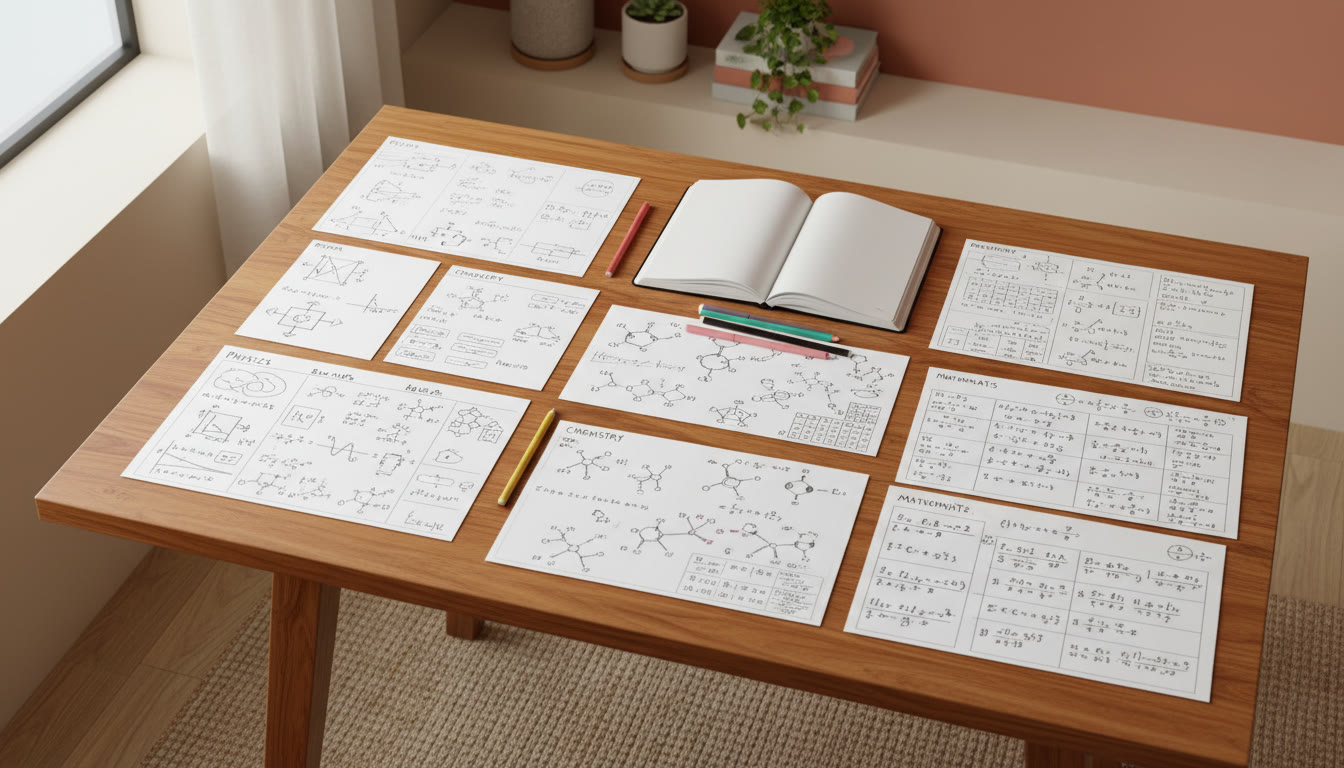
Step 5 — Error Analysis: Turn Mistakes into an Instruction Manual
After every mock I ran a strict error analysis. Errors landed in three buckets: conceptual, careless, and strategy (bad attempt choices). Each bucket had a different fix.
| Error Type | What to log | How to fix |
|---|---|---|
| Conceptual | Chapter, brief reason why incorrect | Targeted re-study and 5 new problems of the same concept |
| Careless | Arithmetic slips, sign errors, missing units | Two-step verification routine and slow down on similar problems |
| Strategy | Poor attempt choice or time misallocation | Simulate decision-making in timed practice and review attempt patterns |
Never leave an error as just a red mark. Turn it into a drill. I incorporated two daily mini-drills from my error log—10 minutes in the morning and 20 minutes in the evening.
Step 6 — Time, Pace, and Exam-DAY Rituals
One of the biggest differences between my 9k self and my sub-1k self was how I handled the exam clock. Time management isn’t an innate skill; it’s trained. I learned to break the paper into blocks and to re-evaluate my attempt strategy at fixed checkpoints (after 30, 90, and 150 minutes).
- Early paper: aim to secure 40–50 easy marks in the first 60 minutes — quick wins.
- Middle paper: tackle moderate questions and avoid getting stuck for long on one problem.
- Last hour: flag and attempt only questions you can finish reliably; no heroics.
For the exam-day ritual, I kept it simple: consistent sleep for several nights before, a light breakfast, and a short mental rehearsal of pacing. I practiced the exact sequence during mocks: login routine, how to mark for review, and how to switch efficiently between question sections. Remember that even in computer-based exams, OMR-style discipline (careful and deliberate marking of selected answers) matters because mental slips transfer to screen clicks too.
How Personalised Support Helped (and When to Use It)
At one point, I realized a bottleneck: I could spend 10 hours fixing something that an experienced coach could fix in 30 minutes. That’s when I leaned on targeted, personalised support for surgical improvements—an expert to point out why a line of reasoning fails or an AI-driven insight to detect recurring error patterns in my mocks. That targeted help cut weeks off my learning curve.
For me, small doses of personalised tutoring were effective when they were tightly focused: one-on-one sessions for calculus technique, timed problem-review sessions, and a few diagnostic reviews of my mock analytics. If you try tutoring, make sure it delivers tailored study plans, one-on-one guidance, expert feedback, and data-driven insights that show where your time will yield the best rank improvement. I used Sparkl’s focused mentoring and AI summaries for specific weak topics, which helped me close stubborn gaps quickly.
Common Mistakes That Keep Ranks Stagnant
- Studying without measurable outcomes: hours logged without progress metrics.
- Overdoing new content and underdoing revision. Revision cements gains.
- Ignoring full-length, timed mocks. They’re the single best predictor of performance.
- Chasing every advanced problem: be selective and ensure you have a strong base first.
- Not tracking error types—repeating the same mistake is wasted practice.
Concrete 8-Week Action Checklist (What to Do Week by Week)
Use this as an executable loop: learn, practice, test, analyze, tweak.
- Weeks 1–2: Brutal audit + close weakest 20% topics. Start weekly 3-hour mock on weekend.
- Weeks 3–4: Target high-yield topics with daily mixed practice sets; increase mock frequency if possible.
- Weeks 5–6: Simulate exam weeks: two full mocks per week, one detailed error-analysis day.
- Weeks 7–8: Peak simulation and consolidation—reduce new learning, maximize revision and targeted fixes.
Keep each week accountable with three numbers: accuracy change, net score change, and % of error types reduced. If one of the three doesn’t move, change the intervention.
Small Habits That Compounded Into Big Gains
I credit many small daily habits with the final leap under 1k: consistent error logging, nightly 20-minute review summaries, weekly timed sets of 8–12 mixed questions, and a strict practice of leaving tough questions for a second pass rather than getting stuck. These micro-habits saved mental energy and reduced careless errors.
Closing Notes — A Final, Practical Point to Carry Forward
Rank improvement is not magic; it’s an iterative engineering problem. You measure, you test under realistic conditions, you fix the weakest link, and you repeat. Prioritise full-length, timed mock practice, maintain strict negative-marking discipline, treat your mistake log as a curriculum, and balance deep concept work with timed speed practice. When you add focused personalised help in small, surgical doses—targeting the exact problems your data reveals—you accelerate the whole process. Keep the plan simple, track the right metrics, and respect the exam’s format by training your pacing and answer-discipline relentlessly.





















No Comments
Leave a comment Cancel