
Mock-Test Mastery: How to Treat Every Practice as a Step Toward 95+ Percentile
Imagine walking out of a full-length mock test feeling calm, precise, and satisfied with the score you just earned. That’s not luck — it’s the result of a deliberate approach to mock-test practice. This article walks you through a practical, human-centered strategy to convert mock-test hours into consistent, measurable gains so you can aim for a 95+ percentile in the JEE Main exam. The ideas here are built for sustained progress: smart simulation, careful analysis, and purposeful corrections.

Start with the Right Mindset: Why Mocks Matter More Than Scores Alone
Mocks are not just score checks. They are motion sensors that reveal your strengths, weak links, timing pattern, and stress points. Students who break into the 95+ percentile bracket treat mocks as diagnostic tools and training sessions simultaneously:
- Diagnosis: identify conceptual gaps, careless errors, timing leaks, and question-selection habits.
- Training: practice time management, question triage, and stamina for the full 3-hour test window.
- Calibration: align perceived difficulty with real exam difficulty and build confidence in judgment calls.
Keep one rule: your first mock of a cycle should be taken without preparation or idealization — a raw baseline. That score is a starting point, not a verdict.
Understand the Test Context You’re Training For
Accurate practice mirrors the exam’s format and constraints. For JEE Main that means:
- MCQ-based questions across Physics, Chemistry, and Mathematics — your practice must mimic multiple-choice thinking and elimination strategies.
- Full-length, timed sessions (three-hour simulations) to build concentration and pacing under continuous pressure.
- Negative marking: guessing without method is risky; learn educated-guessing via elimination and probability assessment.
- Discipline with answer recording—if you practice on paper or OMR sheets, train the same way you’ll fill answers on test day.
- No expectations of partial credit for descriptive or incomplete answers in MCQ contexts — treat every answer as discrete and final.
Design a Mock-Test Schedule: Quality, Variety, and Recovery
Mocks should be frequent enough to generate feedback and spaced enough to allow focused correction. A model schedule balances full-length tests, sectional drills, and low-intensity review days.
Sample 8-week mock rhythm (flexible and scalable)
| Phase | Weeks | Full-length Mocks/week | Sectional/Drills | Primary Focus |
|---|---|---|---|---|
| Benchmark | 1 | 1 | Light | Baseline & time-tracking |
| Build | 2–4 | 1–2 | Targeted drills (2–3 sessions/week) | Fix concepts, speed work |
| Polish | 5–6 | 2 | High-quality sectional mocks | Accuracy and triage strategy |
| Simulation | 7–8 | 2–3 | Full-revision, light drills | Exam-day routine & stamina |
Adjust this cadence to your remaining weeks and exam window. The key: every mock must have a follow-up — the review.
How to Take a Mock So It Teaches You Something Useful
Before the Test
- Simulate exam conditions: same start time, no distractions, one device, and full three-hour block.
- Prepare materials: calculator rules (if any practice tool allows it), scratch paper, pens, water, and a clock you won’t constantly check but can glance at.
- Mental checklist: eat a steady meal 90–120 minutes before, quick warm-up with 10–15 minutes of light revision (formula sheet), and a breathing exercise to steady nerves.
During the Test
Adopt a triage-first approach. Your brain will naturally slow and fuzz after long stretches; structure prevents drift.
- Pass 1 (30–60 minutes): Rapid scan and solve the easiest questions across all sections — collect low-hanging marks fast.
- Pass 2 (next 90–120 minutes): Attack medium-difficulty questions; commit to each one a pre-decided maximum time. If a question exceeds that time, mark and move on.
- Pass 3 (final 20–40 minutes): Revisit flagged items and selectively attempt high-value tougher questions only if time allows.
- Use elimination: educated guesses that use elimination of wrong options are far better than random attempts where negative marking is in force.
- OMR and answer recording discipline: if you practice with OMR or computer interface, get into the habit of regular switching between question paper and answer sheet to avoid mis-bubbling.
Post-Mock Analysis: Where Real Improvement Happens
Most students check the score and feel relieved or devastated — but skip the part that creates progress. Post-mock analysis is a predictable, repeatable routine that turns every mock into lasting learning.
Five steps to an effective review
- Step 1 — Cool down: take a short break so emotions don’t dictate the review.
- Step 2 — Re-solve mistakes: without the clock, re-solve each wrong question and any guessed answer you marked right. Write the solution cleanly; forcing the solution path builds recall.
- Step 3 — Classify errors: tag each mistake as Conceptual, Careless, Calculation, Misread, or Time-Related.
- Step 4 — Make action items: write a precise action (e.g., re-derive topic X, do 10 algebra problems focusing on sign errors, make memory flashcards for reaction mechanisms).
- Step 5 — Schedule corrections: slot the action items into your weekly plan immediately — speed of correction matters more than volume.
Use an Error Log — Your Personalized Data Dashboard
Tracking mistakes over time reveals patterns that a single mock cannot. Build a compact table you update after every mock.
| Mock # | Attempted | Accuracy (%) | Top Error Types | Time Leak (mins) | Correction Plan |
|---|---|---|---|---|---|
| Example Mock 1 | 60 | 72 | Careless, Conceptual (Electrostatics) | 12 | Daily 20-min electrostatics problems; accuracy drills |
Over weeks, convert this log into metrics: average accuracy trend, most frequent error topics, and time saved per mock. Aim for steady improvements, not spikes.
Section-wise Micro-Strategies
Physics
Physics rewards deep understanding and practice with varied numeric setups. Your mock-based plan should include:
- Problem clusters: identify 5–8 core problem types (kinematics, laws of motion, electrostatics, optics, etc.) and rotate them in drills.
- Units and estimation: quick unit checks and rough estimations catch silly mistakes before they become wrong answers.
- Derivations as tools: use concise derivations to create a mental toolbox for problem solving rather than rote memorization.
Chemistry
Chemistry is the most mixed-format section — conceptual organic reactions, formula-based physical chemistry, and inorganic facts. In mocks:
- Segment practice: treat physical, organic, and inorganic separately for correction cycles.
- Reaction maps and pattern recognition: build quick reaction flowcharts for commonly tested transformations and use them while reviewing mock errors.
- Concept-to-problem bridge: when you miss a question, ask whether it was a recall gap or a chain-of-reasoning gap.
Mathematics
Mathematics demands accuracy and time-investment. Use mocks to tune decision-making: when a question is worth 4 marks but eats up 20 minutes, is it worth it under your strategy? Core tips:
- Master standard techniques that solve families of problems (e.g., inequalities, integrals tricks, coordinate geometry templates).
- Practice clean, minimal working: extra algebra steps invite sign errors; practice compact notation and outcome-checking.
- Time-box deep problems: set a maximum solve time per problem and respect it; a beaten clock is a friend in competitive tests.
Time Management and OMR Discipline
Time is the limiting resource in a three-hour test. Specific habits to form in mocks translate directly to exam security:
- Pre-allocate time slices per section and per pass; treat the allocation as a flexible guide, not a rigid law.
- Regularly check that your answer marking aligns with the question numbers — misalignment loses multiple marks and is avoidable.
- If you practice OMR sheets, use the same pen pressure and bubble method you will on exam day; practice fast and accurate bubbling so it becomes automatic.
Common Mistakes Students Make (and How to Fix Them)
- Over-guessing early in the test: fix by setting a guessing threshold based on elimination confidence.
- Failing to rework wrong answers: re-solving wrong answers immediately after a mock cements the correction.
- Allowing a single hard question to consume test time: practice time-boxing and active review flags.
- Neglecting stamina: practice full three-hour mocks to build sustained attention; the brain gets faster, not just smarter, with repetition.
How to Turn Each Mock into Growth — Practical Templates
Use two short templates after every mock: a one-page correction note and a 30-minute focused drill plan. The note records the top three error types and the concrete fixes. The drill plan schedules specific problems and exact practice goals (e.g., “Solve 12 electrostatics numericals with time cap 10 mins each”). These tiny rituals convert feedback into action.
Leverage Personalized Help Without Losing Ownership
Coaching and personalized help can accelerate targeted correction. For example, using Sparkl‘s personalized tutoring and benefits — 1-on-1 guidance, tailored study plans, expert tutors, and AI-driven insights — can help you prioritize the exact topics your mock log shows as recurring weaknesses. The trick is to use support to sharpen your own practice habits, not to outsource the hard work.
Simulate Exam Day, Not Just the Paper
Mock tests are mental marathons; the more closely you mirror exam day the less the real day will surprise you. This includes:
- Start time simulation (wake, meal, commute pattern if applicable).
- Three-hour continuous conditions: avoid pausing for long stretches or breaking for social media between sections.
- Active interruption practice: train to recover focus quickly after short bathroom or stretch breaks during the drill window.
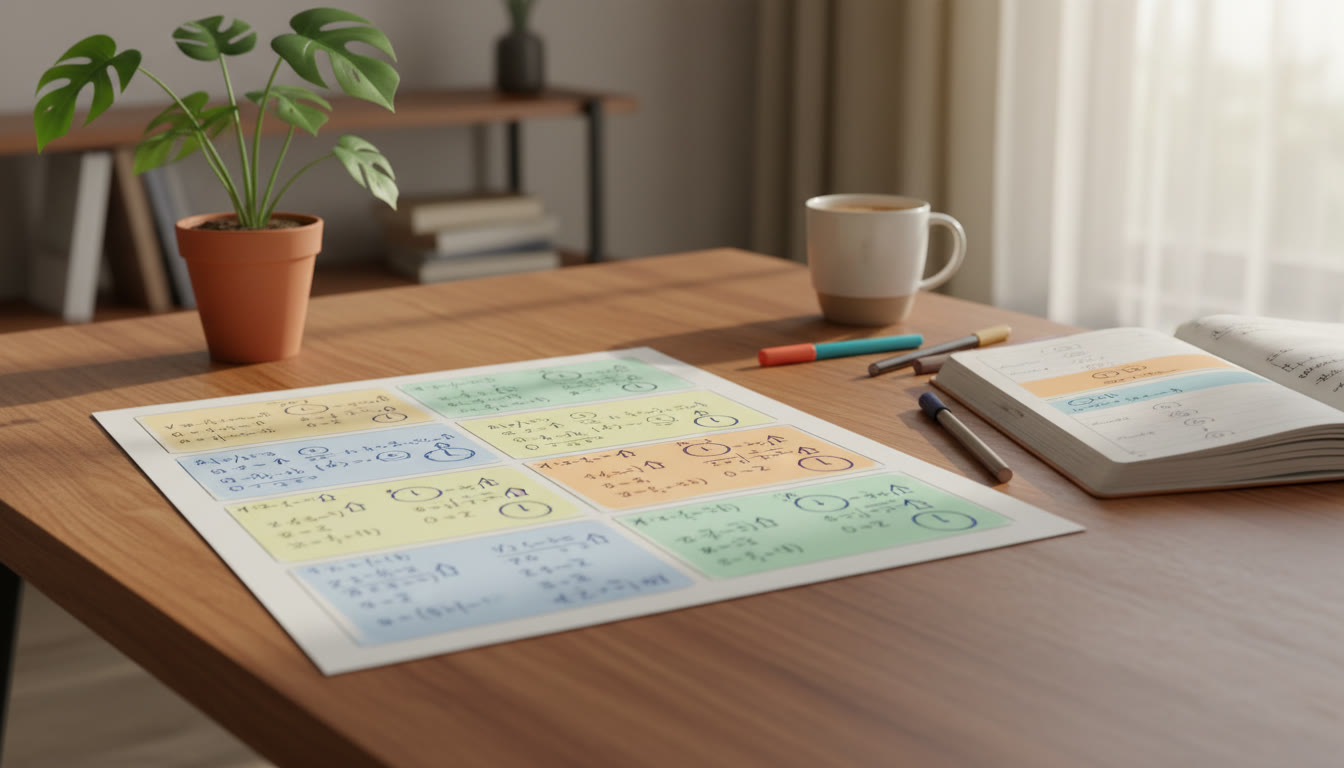
Sample Attempt-Accuracy Plan to Target 95+ Percentile
Percentiles shift with the competition, but the practical handle is attempt-quality. Instead of chasing raw attempts, aim for a balance of smart attempts and high accuracy. A stable, test-ready approach often looks like this:
| Focus | Target (Practice) | Rationale |
|---|---|---|
| Attempt Rate | ~60–70% of paper | Enough attempts to accumulate high marks while preserving accuracy. |
| Accuracy on Attempts | > 80% | High accuracy protects from negative marking and builds percentile growth. |
| Section Balance | No single section collapse | Cross-sectional strength avoids weak-section penalties in overall rank. |
These are practice goals — test-to-test you’ll refine them by tracking your error log and time usage.
Daily and Weekly Micro-Habits That Compound
- Short post-mock reviews (30–60 minutes) within 24 hours to lock corrections.
- Daily quick drills: 20–45 minutes focused on the most common errors from your log.
- Weekly themed review: one day to revise all corrections from recent mocks and build a compact formula/reaction sheet.
Final Checklist Before a Mock or Exam
- Know the pattern of the paper you are taking and confirm whether the platform is CBT or OMR-style practice.
- Carry or prepare the exact materials you will use during practice (watch the clock, not your phone).
- Fill out an answer-check routine: last 10 minutes reserved to ensure your answers are correctly recorded and numbered.
- Review your error log weekly and commit a tiny, concrete correction for the top recurring mistake.
Closing Thought: The Mock-Driven Path to 95+ Is Practical and Predictable
High percentiles come from repeated cycles of realistic practice and ruthless correction. Treat mocks as disciplined experiments: control the variables, collect honest data, and act on the findings. With consistent three-hour simulations, strict post-mock routines, focused sectional drills, and careful time-and-OMR habits, you build not only a score but a reliable test-day process. Over time those habits compound into the resilience and precision that a 95+ percentile demands.



















No Comments
Leave a comment Cancel