

Why a Mock-Test-First Mindset Is the Shortcut to the 99 Percentile
Imagine the exam day as a three-hour window where clarity, timing and confidence decide everything. Mock tests are not just practice questions; they are controlled experiments that tell you how you think under pressure, what habits cost you marks, and which topics yield the most return for time invested. If you want the 99 percentile, mocks should be the backbone of your preparation — not an afterthought.

In this blog we’ll build a realistic, step-by-step mock-test strategy you can apply across the current cycle. The focus is practical: how to schedule 3-hour full-length mock practice, how to treat MCQs with negative marking, how to keep perfect OMR discipline during simulation, and how to convert every mock into measurable improvement. Where precise, personalized support helps, options like Sparkl’s 1-on-1 tutoring, tailored plans and AI-driven insights can accelerate the learning loop — but the core methods here work for every serious aspirant.
Understand the Benchmark: What “99 Percentile” Really Means
Percentile vs Score vs Performance
Percentile is relative. Hitting the 99 percentile means you performed better than 99% of the test-takers in that session, not that you achieved a fixed raw score. That’s why consistent, simulated practice is critical: percentiles shift with difficulty and cohort performance. Your mock-test strategy should therefore focus on repeatable excellence — accuracy, time management and selective attempts — not just chasing a single raw-mark target.
MCQ Nature, Negative Marking and Exam Rhythm
The current testing format relies heavily on multiple-choice questions (and similar objective formats). You must master choosing the right answer quickly and confidently. Understand the negative-marking rule used in the current cycle and build conservative guessing policies: when elimination leaves you with two choices and you have a rational threshold for expected value, it may be worth the attempt; blind guessing rarely is.
The Anatomy of an Effective Mock-Test Strategy
Make Every Mock a Full 3-Hour Simulation
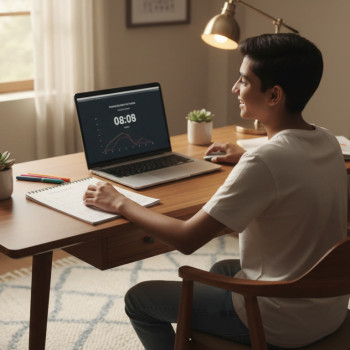
Short practice sets are useful for drills; mock tests must be full-length and taken under test-like conditions. That means a continuous, timed 3-hour slot with the same breaks (or no breaks) you expect on exam day. Simulate ambient noise, thermal comfort, and exam software or OMR conditions so your body and mind adapt to the stamina requirement.
Simulate the Answering Interface and OMR Discipline
Even if you’re practicing on a computer, treat the mock like it’s an OMR sheet: map question numbers precisely, double-check answer entry, and avoid last-minute mass-answering. OMR discipline matters because a misaligned or mistyped answer on a real sheet costs a full mark plus the opportunity cost of time spent fixing it. Train yourself to mark answers deliberately and to verify the mapping after every 15–20 questions.
Pre-Mock Checklist: Little Things That Save Marks
- Know the exact rules for negative marking and the scoring pattern in the current cycle.
- Prepare a short formula sheet and quick-conversion notes for units and constants that you’ll keep in your study area.
- Set up a quiet 3-hour slot, remove phone distractions, and have water/snack ready for quick energy (if allowed in your practice space).
- Warm up with a 10–15 minute revision of high-yield formulas and one short mental math drill to activate speed.
- Decide your first-pass strategy before starting: which sections you’ll target first and how long you’ll spend on each in the initial scan.
Time Allocation That Matches Accuracy
Time allocation should be guided by your personal strengths but anchored in realistic targets. The following table gives a practical template you can tweak to your profile.
| Subject | Minutes Allocated (of 180) | Target Attempts | Target Accuracy (%) | Why this focus |
|---|---|---|---|---|
| Physics | 60 | 20–25 | 80–90 | Problem-solving heavy; time per question can vary |
| Chemistry | 60 | 25–30 | 85–95 | High-yield conceptual and factual questions |
| Biology | 60 | 20–28 | 85–95 | Factual and application-based (adapt per your subject mix) |
Note: If your actual exam focuses on Physics, Chemistry and Mathematics, replace Biology with Mathematics and adapt time per your strengths. The template above prioritizes accuracy over raw attempts: it is better to answer fewer questions correctly than many incorrectly when negative marking is in play.
Minute-by-Minute: How to Spend the 180 Minutes
First 10–15 Minutes — Calm, Scan, and Plan
Quickly scan all sections. Mark cluster of easy questions in each section without solving them fully — this is your “harvesting map.” Decide which subject to attack first based on confidence and momentum: many students prefer to start with their strongest subject to secure early marks and boost morale.
Middle 120 Minutes — Timeboxing & Focused Execution
Use 15–20 minute focused blocks. Within each block, aim to solve the marked easy questions first, then proceed to medium-difficulty ones. If you hit a hard question, flag it and shift on — returning later with a fresh 20–30 minute window to avoid getting trapped.
Last 30–45 Minutes — Triage and Verification
Reserve the final 30–45 minutes for the remaining flagged problems and a careful verification pass. Re-check your answer mapping (OMR or on-screen), and allocate at least 10 minutes to sanity-check calculations where a sign or decimal place could cost you points.
Question Selection and Mental Accounting
Build a ‘Harvest-Then-Explore’ Habit
Start by harvesting all the easy, near-certain questions. This secures a base score quickly and reduces stress. After that, explore medium questions that give good return for time. Hard, speculative questions can be left for the final triage unless you’ve built specific strategies for them.
Use a Clear Guessing Policy
Decide ahead of time when guessing is rational. A common rule: guess only when elimination leaves you with two options and your confidence after elimination is above a predefined threshold. Track what percentage of your guesses in mocks are successful; if it’s low, tighten the rule.
Handling Negative Marking: Math, Not Mystery
Negative marking is a mathematical constraint you can manage. Consider expected value: if a wrong answer costs 1/3 of the marks for a correct response (for example), the expected gain of a blind guess among four options is negative. But if you can eliminate even one option, the expected value improves. Train elimination techniques: look for contradictions, dimensional mismatches, and answer relationships across options.
Post-Mock Analysis: Turn Every Mistake Into Action
Make an Error Log — and Use It Religiously
After every mock, create a concise error log with these columns: Topic, Mistake Type (conceptual, careless, calculation, time), Frequency, Immediate Fix. Use this log to prioritize what to revise before the next mock. Frequent small mistakes beat rare conceptual gaps in the race to 99 percentile: the latter may cost fewer marks but the former erodes accuracy.
Root-Cause, Don’t Just Memorize Corrections
If a problem is missed, ask why: did you misread the question, forget a sign, or misunderstand a core concept? Fixes vary: deliberate slow re-reading practice for careless errors; targeted concept videos or problem sets for conceptual gaps; timed drills for speed. Use mini-experiments in practice: if a correction reduces the mistake rate in the next mock, it’s a robust habit to keep.

How to Improve Across Mock Cycles — A Practical Progression
Metrics That Matter
- Accuracy (correct answers / attempted)
- Attempts (number of questions attempted)
- Average time per question by difficulty tier
- Type of mistakes (careless vs conceptual)
Track these across mocks. Your target is not identical raw scores every time but improving accuracy while maintaining or gradually increasing attempts. Small steady wins — 2–3% accuracy gains per cycle — compound into giant leaps in percentile.
Sample 8-Week Mock Improvement Plan (Flexible)
- Weeks 1–2: Baseline full-length mock + comprehensive error log; focus on closing the three most frequent mistake types.
- Weeks 3–4: Introduce targeted weekly micro-tests (30–45 minutes) on weakest topics; one full mock at week 4.
- Weeks 5–6: Speed drills, timed sectional practice, and at least two full mocks under stricter conditions.
- Weeks 7–8: Polished revision of error-log topics, maintenance of stamina with weekly full mock, and practice verification runs for OMR discipline.
Throughout, maintain a rotation: concept repair, timed practice, and full mock. If you have access to personalized support, Sparkl can help turn your mock analytics into tailored weekly plans and connect you with expert tutors for targeted weakness repair.
Practical Examples: Two Common Mock-Day Scenarios
Scenario A — The Over-Attempter
Symptoms: High attempts, low accuracy, heavy negative marking penalty. Fix: Cut the first-pass attempts by 20%, focus on harvesting high-confidence items, and log each guessed question. Re-evaluate after two mocks: attempts should fall but net score should rise.
Scenario B — The Under-Attempter
Symptoms: Very high accuracy, low attempts, leaving easy marks untried. Fix: Time-based drills to push safe attempts (easy and medium difficulty) and practice shifting from analysis paralysis to decisive answering. Add a time tracker to each question in mocks to map where time leaks occur.
Technical Habits That Separate the 99 Percentile Student
- Exact question mapping: never enter answers without confirming question number and answer slot alignment.
- Two-pass answering: pass 1 harvests and secures easy marks; pass 2 tackles medium questions; pass 3 is for hard questions and verification.
- Effective note-making: keep a one-page cheat-sheet of persistent pitfalls and formulae (for revision only — not for exam day).
- Stamina building: practice longer study windows and timed mocks to build three-hour concentration.
- Calibration of confidence: after every mock, list which guessed answers were correct and why; use that to refine your guess thresholds.
Using Analytics and Personalized Help Without Losing Autonomy
Mock analytics — time-per-question, error clustering, and topic heatmaps — are powerful. If you’re using a service or a mentor, insist on action-oriented feedback: one-page weekly plans, 1-on-1 troubleshooting for stubborn topics, and AI-driven insights that point to patterns you might miss. Tools should serve your plan, not replace your judgment. For example, Sparkl’s approach pairs data with human tutors so you get both pattern-detection and targeted teaching.
Mindset: Why Consistency Beats Last-Minute Intensity
Percentile performance isn’t just about brains; it’s about predictable performance on demand. Mocks train predictability. The student who takes regular, analyzed, and corrected mocks tends to improve steadily, while the student who crams in a single burst sees erratic gains. Build mock-taking into your weekly routine and treat every mock as a diagnostic, not an exam of identity.
Final Checklist Before Your Next Mock
- Confirm test rules and negative-marking pattern for the current cycle.
- Set a 3-hour uninterrupted block and clear your environment.
- Prepare an error log template to fill within 24 hours of finishing the mock.
- Decide your first-pass subject order and the guess-elimination threshold.
- Reserve focused time after the mock for root-cause analysis and targeted correction work.
Conclusion
Working toward the 99 percentile is a disciplined process of simulation, measurement, and correction. Full-length, timed mocks that respect the MCQ format, negative marking, and OMR-like answer discipline reveal both your strengths and the quiet habits that cost marks. Use a structured time-allocation plan, maintain an error log, and iterate deliberately: improve accuracy, then scale attempts safely. Personalized guidance can speed up this loop by translating mock analytics into focused study plans and one-on-one fixes, but the core progress comes from repeated, corrected full-length mocks and honest analysis. Stay methodical, refine one habit at a time, and let the mock-test cycle make you reliably better.
























No Comments
Leave a comment Cancel