
JEE Study Plan That Helps You Stay Consistent Daily
Consistency is deceptively simple and surprisingly hard. For many JEE aspirants, the difference between a chaotic month of frantic work and steady month-by-month improvement is not the number of hours, but the rhythm students build into each day. This article gives you a human-friendly, practical plan to turn small daily habits into big outcomes—while respecting the real exam context: MCQ-based testing, negative marking, three‑hour full-length mock practice, and the focused syllabus of Physics, Chemistry, and Mathematics. The tone here is conversational, not preachy—think of this as a study buddy mapped onto a planner.
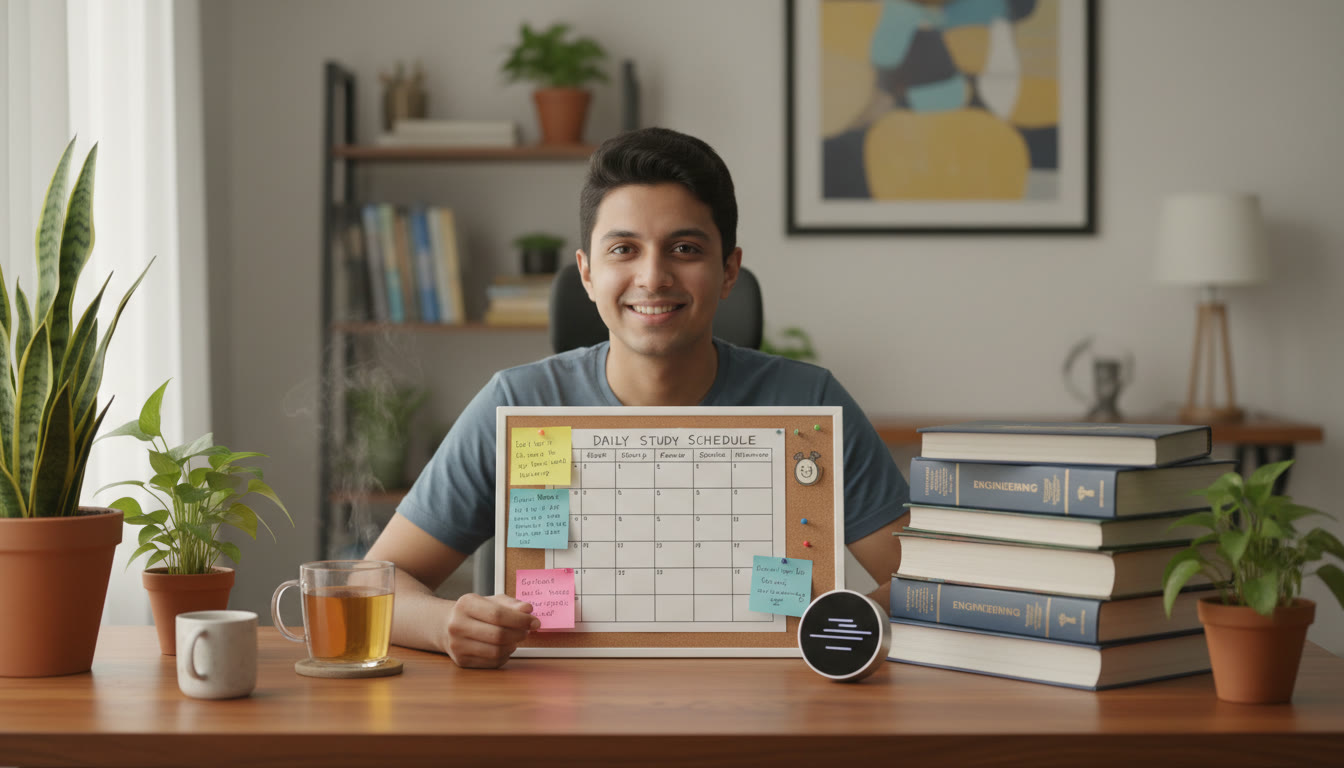
Before we dive into templates and tables, remember one truth: steady, focused practice beats unpredictable marathon sessions. A carefully designed daily plan converts your motivation into measurable progress, reduces anxiety on test day, and makes mock-test feedback actionable.
Why daily consistency matters more than cramming
When preparing for an exam that tests conceptual clarity and problem-solving under time pressure, like JEE, daily consistency creates three advantages:
- Retention through spacing: small, repeated exposures to topics beat one-time cramming because they strengthen memory traces.
- Faster error correction: regular practice exposes weak areas quickly, so your next day’s plan can fix them.
- Exam temperament: daily timed practice builds the stamina and attention needed for a three‑hour exam environment—whether computer-based or OMR-style practice tests.
Principles to design your daily JEE routine
These design rules keep your plan realistic and flexible—so it survives busy days and feels satisfying rather than punishing.
- Block time, don’t multitask: Reserve dedicated blocks for theory, problem practice, and revision. When you switch tasks frequently you lose momentum.
- Mix active recall and problem-solving: Read a concept for 20 minutes, then spend 40–50 minutes solving related problems. Active recall builds the bridge from reading to application.
- Short, frequent revision cycles: Every day include a 20–30 minute slot to revisit past topics using flashcards or quick problem sets.
- Quality over quantity: Five well-solved problems with full analysis beat ten half-attempted ones.
- Simulate the exam regularly: Weekly or biweekly full-length mocks (three hours) are essential—treat them like the real thing.
- Track progress with simple metrics: accuracy in topic tests, time per question, and number of syllabus topics revised per week.
Daily routine blueprint: a flexible template
Below is a sample weekday structure that balances learning, practice, and review. Start with this template and adapt to your peak concentration hours (some students are sharper in the morning, others at night).
| Time | Activity | Goal |
|---|---|---|
| 06:00–06:30 | Wake-up + light revision (flashcards/short formulas) | Activate memory; low-effort revision |
| 07:00–09:00 | Deep study block (concepts & derivations) | Concept clarity in a focused window |
| 09:30–11:30 | Problem practice (mixed difficulty) | Apply concepts to solve 6–10 problems |
| 12:00–13:00 | Lunch + rest | Mental reset |
| 13:30–15:00 | Short revision + weak-topic practice | Consolidate weak areas |
| 16:00–18:00 | Mixed subject problems or tests | Simulate exam pressure in small bursts |
| 19:00–20:00 | Light reading or concept review | Low-stress consolidation |
| 21:00–22:00 | Summarize learning and plan next day | Close the loop and set micro-goals |
How to distribute subjects across the week
Balance is key. Don’t do all Physics one week and all Maths the next—mix them so your brain keeps switching gears and forms cross-topic problem-solving muscle memory. A useful pattern is to keep one major subject per deep morning block and rotate minor topics in the afternoon.
- Monday/Thursday mornings: Mathematics deep work (new topics + practice).
- Tuesday/Friday mornings: Physics deep work (derivations + conceptual problems).
- Wednesday/Saturday mornings: Chemistry deep work (organic mechanisms, inorganic reactions, physical chemistry numericals).
- Afternoons: Mixed-problem sessions across subjects.
Subject-specific daily habits (short, powerful wins)
Tiny, subject-specific routines compound quickly. Pick one or two of these for each study day.
Physics
- Start with the fundamental principle: restate the concept in one sentence, then derive a core formula by hand.
- Solve 2–3 conceptual MCQs and 1–2 numerical problems that require multi-step reasoning.
- Use diagrams and free-body sketches—treat them as memory aids, not answers on the exam paper.
Chemistry
- Separate time for organic mechanisms, inorganic facts, and physical chemistry numericals each week.
- For organic: practice mechanism steps by writing them out; for inorganic: maintain a rapid-fire flashcard review; for physical: solve numericals with units every day.
Mathematics
- Prioritize problem types: algebraic manipulation, calculus techniques, coordinate geometry practice.
- Daily problem quota: 6–8 problems with varied difficulty; one problem should be time-consuming and push depth.
Mock tests: the backbone of a realistic plan
Mocks are not just evaluations—they are training. A full-length mock replicates exam pacing, stamina demands, and decision-making under negative marking.
- Schedule a 3‑hour full-length mock once a week at minimum; increase frequency to twice per week in the final months before the test window.
- Treat the mock like the real exam: same start time, same breaks (if allowed), and identical answer-entry discipline (simulate OMR or CBT input). This builds exam-day routines.
- Post-mock review is essential: spend at least 60–90 minutes analyzing mistakes—separate careless errors, concept gaps, and time-management lapses.
A practical 3-hour mock timeline
This sample timeline helps you practice time allocation and decision-making during a three-hour exam.
| Phase | Minutes | Action |
|---|---|---|
| Initial pass | 60 | Attempt all easy and clear questions—aim for accuracy, not speed. Mark uncertain ones for review. |
| Focused solving | 70 | Work on moderate to hard problems you left earlier; prioritize higher-value sections. |
| Review & sanity check | 40 | Revisit marked questions, verify calculations, and ensure OMR/CBT inputs are correct. |
| Final check | 30 | Quick scan for missed questions and fix any entry errors. |
Negative marking and decision rules
Negative marking changes how you approach every MCQ. Adopt simple heuristics to avoid losing marks unnecessarily.
- If you can eliminate two options out of four, your expected value of guessing improves—consider a calculated attempt.
- For blind guesses with no elimination, skipping is usually safer than random guessing.
- Keep a short column in your test diary: “Careless, Concept, Time” for each error. This helps you see patterns and correct them in daily practice.
OMR / CBT discipline: small habits that matter
Whether you’re practicing on paper, OMR, or a computer screen, discipline in answer entry prevents easy mark losses.
- Always transfer answers carefully—double-check the question number and the answer code you fill.
- During CBT practice, use the built-in marking flag feature strategically: mark and move on; revisit flagged questions only during review slots.
- On paper/OMR practice, treat the sheet like an OMR: use pencil only where appropriate and practice clean erasures.
Using personalized tutoring to stay consistent
Personalized guidance can accelerate consistency by converting your weak areas into targeted plans. If you try one-on-one help, look for tutors who build tailored study plans that slot into your daily rhythm rather than imposing generic schedules.
For example, Sparkl’s approach to personalized tutoring often includes tailored study plans, focused one-on-one guidance, and AI-driven insights that flag topic weaknesses—features that fit naturally into a daily consistency strategy without overwhelming your calendar.
How to use tech, but not be ruled by it
Apps and analytics are useful—track time spent, topic-wise accuracy, and mock-test trends. But don’t let dashboards replace simple reflection: the most powerful habit is writing down three concrete improvements after each mock and scheduling them into the next three study days.

Weekly review: the engine of steady improvement
At the end of each week spend 45–60 minutes checking three things: accuracy trends per subject, time-per-question averages, and revision coverage. Convert that review into three micro-actions for next week (e.g., ‘practice 10 more thermo problems’, ‘revisit calculus chain rule mistakes’).
Sample weekly tracker (simple and actionable)
| Metric | Target | Actual (end of week) | Action |
|---|---|---|---|
| Full-length mocks | 1 | Schedule a timed mock on Sunday | |
| Accuracy – Physics | ≥70% | Redo missed conceptual questions | |
| New topics learned | 3 | Write 1-page summary for each | |
| Revision slots completed | 5 | Move any missed slots into early next week |
Common pitfalls and simple fixes
- Pitfall: Ignoring small errors. Fix: Log every careless mistake and fix the root cause within 48 hours.
- Pitfall: Practicing only solved examples. Fix: Reserve problem time for unsolved, mixed questions mimicking exam distribution.
- Pitfall: Skipping mocks when a topic is unfinished. Fix: Use partial-day mocks or sectional timed tests so you keep the mock habit alive.
Real-world comparisons: think of study like physical training
A sprinter trains explosively; a marathoner trains for endurance. JEE is a hybrid: it requires the speed to solve MCQs under time pressure and the endurance to stay accurate for three hours. Your daily plan should therefore mix sprint-like focused problem bursts with steady longer practice sessions. This combination builds both accuracy and speed.
Personalize without overcomplicating
Two students can follow the same template and get different results because of personal rhythms. Keep these personalization knobs simple:
- Morning vs evening preference: Pick your hardest subject for your peak hours.
- Energy-based pacing: If concentration dips after lunch, shift review tasks to that window and reserve heavy problem solving for morning.
- Weekly load: In busier academic weeks, keep daily slots short but consistent—30–45 minute focused sessions beat skipping entirely.
How to measure “consistency” meaningfully
Consistency isn’t just showing up; it’s showing up with the right intent. Track three simple indicators for a month:
- Percentage of scheduled study blocks completed.
- Number of weak-topic sessions scheduled and completed.
- Improvement in mock-test accuracy (net correct minus negative marks).
Improvements in these numbers over 4–6 weeks indicate you’re building an enduring habit rather than short-term hustle.
Short checklist for every study day
- Start with a clear goal for the day (what you will achieve and why).
- Include one active recall session (flashcards, written summary).
- Do at least one timed problem block to practice speed and OMR/CBT discipline.
- End by writing two things you learned and one thing to fix tomorrow.
Closing academic thoughts
Staying consistent for JEE is a discipline of small, repeatable actions: focused morning blocks, frequent mock practice that mirrors the three‑hour exam, attention to negative‑marking decisions, strict answer-entry habits for OMR or CBT formats, and a weekly review loop that converts test feedback into next-day actions. Implementing these ideas slowly—one new habit every week—creates momentum that lasts through the entire preparation cycle. With steady daily practice, smart use of mocks, and targeted correction of weak areas, conceptual clarity and exam temperament improve together; that combination is what ultimately shows up on the scorecard.













No Comments
Leave a comment Cancel