
Should You Study NCERT for JEE Main Chemistry? A Practical Roadmap
Let’s start honest: every JEE aspirant asks this at least once — is NCERT enough for Chemistry, or will it leave you short on those tricky MCQs? The short, helpful truth is: NCERT is the foundation, not the entire house. For many students, a disciplined, clever NCERT-first approach will yield a large chunk of the marks in the Chemistry section. But like any foundation, it needs the right finishing, polishing and testing to stand up under exam pressure.
This guide walks you through why NCERT matters, where it shines, and where you should add targeted practice. I’ll offer subject-wise tactics (Physical, Organic, Inorganic), mock-test habits that respect the MCQ format, and practical weekly actions you can start today. I’ll also show when individualized help — for example, Sparkl‘s personalized tutoring — fits naturally into a plan.
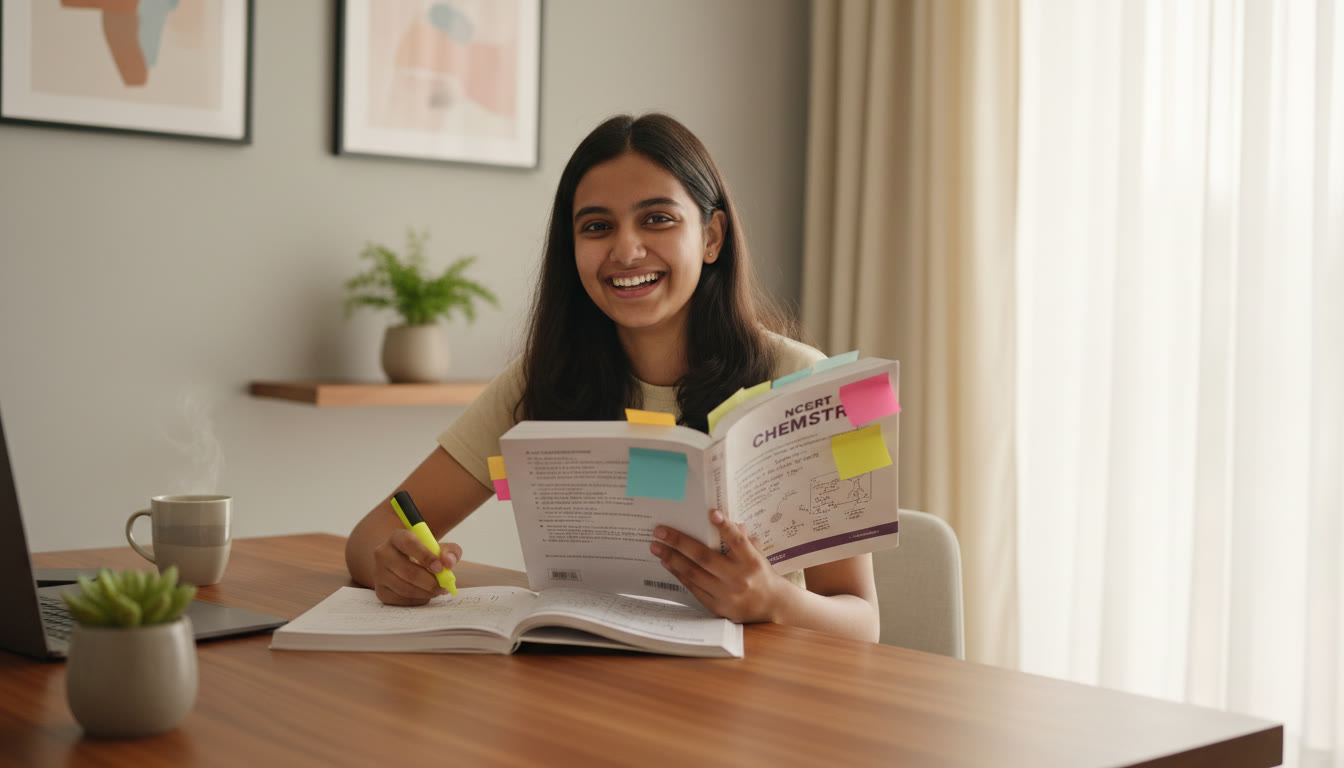
Why NCERT Matters for JEE Main Chemistry
NCERT chemistry books are written with clarity and a focus on fundamentals. For JEE Main — an MCQ-driven, time-bound test with negative marking and the need for three-hour full-length mock practice — clarity of concept is gold. Many questions are direct or slightly twisted applications of facts and concepts presented in NCERT, especially in Inorganic Chemistry. NCERT’s strength is that it gives you correct definitions, consistent representation of molecular structures, clear explanations of reaction trends, and crisp numerical examples that build intuition.
Exam-context realities to keep in mind
- Format: JEE Main emphasizes objective questions and timed performance; practice under exact time constraints is essential.
- Negative marking: Accuracy matters — guessing without strategy can cost you points, so a clear NCERT-first knowledge base reduces unnecessary risk.
- Full-length mock practice: Simulating three-hour tests helps you manage speed, stamina, and marking strategy for MCQs.
- Discipline: Whether you practice on paper (OMR-style) or on a computer (CBT), follow strict test behavior: no careless marking, careful reading of options, and managing rough work efficiently.
- No partial credit for descriptive answers: For MCQ-based testing you must aim for full correctness rather than relying on partials.
What NCERT Gives You — Chapter by Chapter
Think of NCERT as the conceptual map and fact bank. From the basics of atomic structure and stoichiometry to the reaction trends in the periodic table, NCERT lays out the essentials in a concise and examinable way. It’s especially reliable for core facts, standard reaction sequences, nomenclature, and basic problem types.
Strengths that directly translate into marks
- Inorganic facts and reactions: Clear statements and boxed facts which are often the seed of direct MCQs.
- Organic basics: Functional group behavior, simple mechanisms and named reaction basics that form the backbone of logical reasoning questions.
- Physical foundations: Derivations and worked numerical examples that build method and approach for problem-solving.
- Diagrams and tables: Useful for quick visual recall during timed exams.
When NCERT Is Sufficient — And When It Isn’t
NCERT will carry you very far. For many students, a thorough NCERT reading and disciplined revision can secure a solid score in Chemistry. But JEE Main can also include questions that demand faster numerical work, trickier combinations of facts, or higher conceptual fluency — and that’s where focused practice beyond NCERT is helpful.
| Area | NCERT Strength | When to Add Practice |
|---|---|---|
| Inorganic | High — factual and directly examinable | Memorize systematically; add mixed MCQ sets for recall under time pressure |
| Organic | Good — mechanisms and basics explained | Do more multi-step MCQs and reaction pathway practice for synthesis-style items |
| Physical | Solid conceptual base and worked examples | Practice speed and alternative problem-solving methods for tricky numericals |
Quick rule of thumb
- Start with NCERT until you can explain each concept in your own words and solve every example.
- If you consistently miss MCQs on the same topic in mocks, add targeted practice resources for that topic.
- Don’t pile on advanced books before you’ve extracted every exam-relevant point from NCERT.
Subject-wise Strategy: How to Use NCERT Smartly
Inorganic Chemistry — Treat NCERT as the backbone
Inorganic is where NCERT shines brightest. Many direct MCQs are lifted from simple explanations, tables, and statements. Make a habit of converting every bold statement and table in NCERT into one-line flashcards. Memorize trends (electronegativity, oxidation states, trends in melting points), key reactions, and common salts and complexes. Before moving to other reference practice, ensure you can answer or recall every assertion in the NCERT pages for the major inorganic chapters.
Organic Chemistry — Build with mechanisms and practice
NCERT gives you the basics: functional group behavior, common reagents, and simple mechanisms. For success in MCQs, turn those basics into quick heuristics. Instead of rote memorization only, practice reasoning: why does a substituent direct to ortho/para, how resonance stabilizes intermediates, and how sterics affect outcomes. Then drill reaction sequences and retrosynthesis-style MCQs until you can work them flexibly under time pressure.
Physical Chemistry — Concept, then speed
NCERT lays out the concepts and worked numerical examples. Use those to learn methods. After that, prioritize speed and alternative tricks: approximation techniques, dimensional reasoning, and small shortcuts (without compromising accuracy) that work for MCQs within the three-hour mock constraint. Time your numericals so you know which to attempt, which to bookmark, and which to skip temporarily.

Concrete Steps: A Practical 6-Week NCERT-First Routine
Below is a compact routine that balances reading, note-making, and exam simulation. Adjust the weekly load to your available time.
| Week | Focus | Daily/Weekly Actions |
|---|---|---|
| 1–2 | Thorough NCERT reading | Read chapters, make margin notes, highlight key tables; do NCERT end-of-chapter numerical exercises |
| 3 | Consolidation & flashcards | Create one-line flashcards for inorganic facts and reaction maps for organics; daily revision |
| 4 | Targeted practice | Do topic-wise MCQs, build speed on physical numericals, maintain error log |
| 5 | Full-length mock & analysis | Do a 3-hour full-length mock under strict conditions; analyze mistakes and fix concepts in NCERT |
| 6 | Revision and adaptation | Revise flashcards, hit weak topics, and do mixed timed sections |
How to use mocks to feed back into NCERT
After each full-length mock, categorize mistakes: conceptual gaps, careless mistakes, speed issues, or unfamiliar fact-based questions. For concept gaps, return to the NCERT chapter and rewrite the explanation in your own words. For fact-based misses, make or revise flashcards — NCERT is your canonical source for those facts.
Common Mistakes Students Make with NCERT
1. Reading passively
Many students read NCERT like a story and assume things will stick. Active reading — underlining, writing one-line summaries, and turning facts into MCQs — changes retention drastically.
2. Treating NCERT as ‘enough’ without timed practice
NCERT builds knowledge but timed application is a different skill. Combine NCERT study with three-hour timed mocks to build exam temperament and to practice negative-marking strategies.
3. Skipping physical chemistry numericals
Physical Chemistry rewards familiarity. If you only memorize and never practice numerical sets that push speed, you will lose time on the test and may guess too much — a costly trade under negative marking.
How to Supplement NCERT — Carefully and Purposefully
Once NCERT is solid, supplement selectively. The goal is not more books; it’s more high-value practice. Here are effective supplements:
- Mixed MCQ sets for time-bound practice.
- Topic-wise difficulty ladders — start easy, then medium, then hard.
- Full-length mock tests under strict exam simulation to sharpen stamina and OMR/CBT discipline.
- One-on-one or small-group sessions if you need targeted fixes for recurring errors.
If you want tailored support while following an NCERT-first path, consider personalized tutoring: Sparkl‘s personalized tutoring can provide 1-on-1 guidance, tailored study plans, expert tutors, and AI-driven insights that highlight which NCERT points need more practice. That kind of focused help is most useful when you know NCERT well but need to convert understanding into consistent exam performance.
Real-World Examples: Turning NCERT Sentences into MCQ Wins
Here’s a mini exercise: take a boxed fact or trend from NCERT — for example, a statement about oxidation states, stability of carbocations, or solubility trends — and convert it into a one-line flashcard. Next, create a 4-option question by changing a variable in the fact (different element, substituent, or condition). This practice bridges passive memory and test-ready recall, and it’s one of the most effective tricks to extract marks from NCERT chapters.
Checklist: Daily and Weekly Habits That Work
- Daily: 30–45 minutes of NCERT revision (flashcards and one short numerical).
- Three times a week: 60–90 minutes of topic-wise MCQs with timed sections.
- Weekly: One full-length three-hour mock under strict test conditions; analyze immediately after.
- Monthly: Review error log and map repeated mistakes back to specific NCERT sections.
When to Seek Extra Help — The Right Way
Extra help accelerates progress when you’ve already exhausted NCERT and targeted practice but still face persistent weaknesses. Look for support that gives:
- Clear diagnostics (pinpointing exact conceptual gaps).
- Actionable study plans that respect your NCERT-first base.
- Personalized problem sets and timely feedback on errors.
For students who prefer guided personalization, Sparkl‘s tutors combine one-on-one coaching with data-driven insights so your NCERT work converts into higher accuracy in mock tests, improved time management, and fewer careless slips.
Final Practical Tips — Small Moves That Add Up
- Make a single ‘must-know’ one-page NCERT cheat sheet for each major chapter; review it weekly.
- Use flashcards for inorganic names, oxidation states, and reagent behavior; quiz daily.
- When you practice numericals, force yourself to write the key formulae and units — small errors often cost marks.
- Simulate exam conditions: three-hour mock, no phone, timed breaks, and a disciplined marking strategy that accounts for negative marking.
- Keep an error log that records exactly why you missed a question (concept, calculation, misread), and link each entry to the related NCERT page.
Myth-Busting: Quick Answers to Common Doubts
“Is NCERT too basic for JEE Main?”
No — it’s basic in presentation but exam-focused in many essential facts, especially in Inorganic Chemistry. It’s the most efficient first stop.
“Should I skip NCERT and go straight to advanced books?”
No. Skipping NCERT is like building on sand. Use NCERT first, then layer focused practice on top.
“Can I rely on only NCERT for top scores?”
Many students achieve very good Chemistry scores with strong NCERT mastery plus disciplined mock practice. For the very top percentile, targeted extra practice is usually necessary — but the base will still be NCERT.
Wrap-up: A Practical Verdict
NCERT is non-negotiable as your starting point for JEE Main Chemistry. It gives reliable facts, clear explanations and the conceptual foundation you need for exam-style reasoning. Treat it as the center of your strategy: read actively, make one-line flashcards, and convert facts into timed MCQ practice. Use full-length three-hour mocks to develop speed, accuracy and stamina, and simulate OMR/CBT discipline to avoid careless losses. When you have persistent gaps, add targeted practice and consider focused one-on-one support to translate NCERT knowledge into consistent performance.
Build from NCERT, practice smartly, and let tests tell you where to level up next. The academic path from clear fundamentals to exam-ready execution is direct, and the steps above give you a practical map to follow.
Good mastery of NCERT, combined with disciplined timed practice and precise revision, is the most reliable academic route to strong Chemistry performance in JEE Main-style exams.























No Comments
Leave a comment Cancel