
Why a Practice-Test Protocol Matters for Humanities AP Exams
If you’re preparing for AP English Language, AP English Literature, AP United States History, AP European History, AP World History, or AP Art History, you already know the humanities demand not only content knowledge but also clarity of thought, speed, and a practiced voice. A well-designed practice-test protocol does more than mimic exam day — it trains your brain to think like an examiner, manage time, and convert feedback into measurable improvement.
Below you’ll find a step-by-step protocol for running humanities-only practice tests that are realistic, useful, and respectful of your time. The advice blends structural details (timing, materials, environment), active strategies (note-taking, targeted review), and reflective practices (scoring rubrics, error analysis). Where it naturally fits, you’ll also see how Sparkl’s personalized tutoring can accelerate progress through tailored study plans and expert 1-on-1 guidance.
Practical tip: treat each practice test like a lab — you are the scientist, the test is the experiment, and your study plan is the protocol you refine after every run.
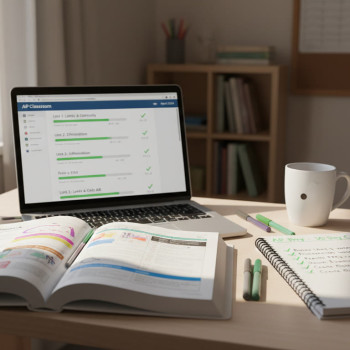
Photo Idea : A quiet study desk arranged like a testing station — notebook, timer, printed practice prompt, and a mug of tea. This evokes calm readiness and focus.
Before the Practice Test: Preparation Checklist
Good practice begins long before you read the first prompt. The goal of pre-test preparation is to remove friction so that your cognitive energy is entirely devoted to thinking, writing, and answering. Use the checklist below to standardize your test setup and make each practice run comparable to the next.
- Choose the right test content: pick released College Board practice sections or high-quality prompts aligned with the current course and exam format.
- Set the environment: quiet room, no phone notifications (airplane mode or a different room), comfortable chair, good lighting.
- Gather materials: printed passage(s) or digital file, pens/pencils, blank scratch paper, a visible timer (digital or analog), and any allowed reference items for practice (e.g., rubrics).
- Decide the purpose of this run: full test simulation, timed section practice, or targeted skills (e.g., DBQ thesis writing).
- Calibrate time: mirror official section lengths and breaks. If you’re simulating a full exam day, schedule the correct section order and break timings.
- Record baseline metrics: starting score estimate, confidence level, time-of-day — these small data points matter for later analysis.
Setting the Clock: Timing Protocols for Common Humanities Sections
Timing is the engine of any practice-test protocol. For humanities sections, the structure usually includes a multiple-choice or stimulus-reading part followed by free-response essays or document-based questions. Below is a compact table summarizing typical section lengths and question counts for commonly taken AP humanities exams. Use this as a template when you plan a full or partial simulation.
| AP Exam | Section I | Section II | Total Time |
|---|---|---|---|
| AP English Language | Multiple Choice: ~45–60 min | 3 Free-Response Essays: ~120 min | ~3 hours |
| AP English Literature | Multiple Choice: ~60 min | 3 Free-Response Essays: ~120 min | ~3 hours |
| AP United States History | MCQ: ~55–60 min; SAQ: ~40 min | DBQ: ~60 min; Long Essay: ~40 min | ~3 hours 15 min |
| AP European & World History | MCQ: ~55–60 min; SAQ: ~40 min | DBQ: ~60 min; Long Essay: ~40 min | ~3 hours |
| AP Art History | Multiple Choice: ~60 min | Free-Response: ~90–120 min | ~3 hours |
Use the table as a base, but always check the exact timing and question counts for the specific exam you’re targeting. When in doubt, model your practice on the most recent exam formats provided by official exam descriptions.
Note: If you’re using AP Classroom or released College Board practice materials, align your timing with their suggestions to ensure realism.
Critical habit: practice with the same time pressure you’ll face on exam day. If you always give yourself extra minutes, you’ll build a false sense of security.
During the Practice Test: Strategy and Conduct
How you behave during a practice test matters as much as what you study beforehand. Treat it like an experiment that needs consistency.
- Start with a brief pre-reading ritual: 60 seconds of calm breathing, scan the entire test to plan pacing, then begin the clock.
- Use a visible timer and checkpoint times: e.g., for a 60-minute MCQ section, mark 30–35 minutes as a mid-check.
- Answer strategy for MCQs: do a first pass for easy questions; mark and skip the hard ones for a focused second pass.
- Essay strategy: build a quick outline (2–5 minutes) for each essay before you write. This dramatically improves organization and clarity.
- For DBQs and source-based prompts: spend up to 15 minutes parsing sources and drafting a thesis; integrate at least four documents directly into your argument where relevant.
- Document your choices: keep a small log of major decisions (e.g., “spent extra 10 minutes on Q2” or “skipped MCQ 32”); this helps post-test analysis.
Photo Idea : A student mid-write, arm extended toward a timer on the desk, with annotated documents spread out — illustrates pacing and source integration in action.
After the Practice Test: Scoring and Feedback Protocol
The value of a practice test lies in the feedback loop. Without careful scoring and targeted review, practice will feel like busywork. Implement a two-stage scoring and analysis procedure: immediate scoring for objective items and deep rubric-based scoring for essays.
Step 1 — Immediate Objective Scoring
- Grade all multiple-choice items immediately. Record your raw score and convert it to a percent.
- For short-answer or SAQ-style items, draft a model answer and mark whether each component is present.
Step 2 — Rubric-Based Essay Scoring
- Use official AP rubrics or released scoring guidelines to score each essay. Assign scores for thesis/claim, evidence and commentary, reasoning, and writing quality as relevant.
- Be ruthless but fair: if you’re unsure, err on the side of a stricter score — this creates a clearer improvement path.
- Annotate the essay with the rubric categories missing or weak.
Record the following data in a simple spreadsheet after every practice test: date, exam section, raw score, rubric scores per essay, time spent per question/essay, top 3 error types, and next-step actions. Over time you’ll see patterns — maybe thesis clarity is consistently weak, or time management fails on DBQs. These signals are gold.
Targeted Review: Turning Errors into Growth
Once you have scored the test, schedule a focused review session within 24–48 hours. The fresher the memory, the more precise your corrections will be.
- Identify patterns: categorize errors as content gaps, misreading, time pressure, or writing mechanics.
- Design micro-practice: if you miss inference questions, do a set of 20 targeted inference MCQs; if thesis statements are weak, write and critique 5 thesis statements in 30 minutes.
- Use spaced repetition for factual content and thematic review — brief, frequent sessions beat marathon cramming.
- Consider a tutoring check-in: a 1-on-1 session with an expert can quickly diagnose recurring issues and provide tailored practice. Sparkl’s personalized tutoring offers targeted sessions and AI-driven insights to track progress across repeated practice tests.
Designing a Practice-Test Calendar
Consistency and progression are the keys to a calendar that builds competence rather than exhaustion. Lay out a 6–8 week cycle leading up to the exam that alternates full simulations with targeted sectional practices.
- Week 1–2: Baseline test, then two focused weeks improving weakest skill (e.g., thesis craft, evidence integration).
- Week 3–4: Full-length simulation every 7–10 days; between simulations, complete targeted practices and timed essays.
- Week 5–6: High-frequency short simulations (one section per day) and cumulative review of rubrics.
- Final 2 weeks: Two full practice exams spaced one week apart; taper study the last 3–4 days with light review and sleep optimization.
Note: The calendar should be adaptable. If a practice test reveals a major deficit, insert an intensive remediation block before the next full simulation.
Using Technology and Resources Wisely
Digital tools can enhance practice if they are used intentionally. Choose tools that help you track time, measure progress, and store scored essays.
- Use a spreadsheet or simple app to track metrics across tests (scores, timings, error types).
- Record one or two essays for voice/proofreading checks — reading your essay aloud helps locate awkward phrasing.
- When using online practice items, simulate test conditions by disabling assistive pop-ups and using a full-screen timer.
- Consider platforms that offer personalized tutoring and progress analytics; Sparkl’s personalized tutoring and AI-driven insights, for example, can turn repeated practice data into customized study plans and 1-on-1 coaching sessions.
Common Pitfalls and How to Avoid Them
Even the best students can fall into a few predictable traps during practice testing. Here’s how to catch and correct them.
- Pitfall: Inconsistent conditions. Fix: always simulate the same environment for full runs (same time of day, quiet space).
- Pitfall: Over-scoring optimism. Fix: score strictly with official rubrics and get an external review when possible.
- Pitfall: Feedback avoidance (i.e., not analyzing mistakes). Fix: schedule a non-negotiable 30–60 minute review immediately after scoring.
- Pitfall: Ignoring time data. Fix: track time per question/essay and set checkpoint goals to build pacing awareness.
Sample Post-Test Rubric Breakdown (for Essays)
Here’s a simple rubric you can apply immediately after writing to self-score essays consistently. Adapt the categories to match the official AP rubric of your exam.
| Category | Points Possible | What to Look For |
|---|---|---|
| Thesis/Claim | 0–3 | Clear, specific claim that directly answers the prompt. |
| Evidence and Support | 0–4 | Relevant, specific evidence used effectively and cited (documents or textual references). |
| Analysis and Reasoning | 0–4 | Explains how evidence supports the thesis, demonstrates causal or thematic links. |
| Organization and Coherence | 0–2 | Logical paragraphing, strong transitions, and clear progression of ideas. |
| Writing Mechanics | 0–1 | Grammar and clarity sufficient to not impede meaning. |
Real-World Example: How One Student Improved a DBQ
Sarah, a rising senior, started with a baseline DBQ score that missed points for weak contextualization and shallow analysis. Her protocol involved:
- Baseline full practice DBQ with timed conditions.
- Immediate rubric scoring and identification of the two weakest categories: Context (0–1/7) and Analysis (1–7/7).
- Two-week micro-practice block: daily 20-minute drills on contextualization prompts, plus mentor review of outlines.
- One 1-on-1 tutoring session focused on constructing strong thesis statements and weaving documents into argument. This session included model outlines and three live revision rounds.
- Second DBQ practice under timed conditions showed measurable gains: a clearer thesis and two extra analytic points.
Outcome: Sarah’s iterative approach — simulate, score, remediate, repeat — turned a weak area into a reliable strength. Personalized tutoring helped target her exact weaknesses and accelerate improvement.
When to Bring in Tutoring and How to Use It
Tutoring is most valuable when it targets repeating, high-impact errors. Don’t hire a tutor just to “review everything.” Instead, use practice tests to identify 2–3 recurring issues and direct tutoring sessions to those problems.
- Use one or two full practice tests to find trends (e.g., weak use of evidence, time mismanagement on the MCQ section).
- Book short, goal-driven tutoring sessions that focus on that gap. For example, 90 minutes to overhaul DBQ thesis construction — not a generic hour that tries to cover multiple subjects.
- Ask the tutor to model examples and provide two weeks of precise follow-up practice activities.
Sparkl’s personalized tutoring model pairs targeted 1-on-1 guidance with tailored study plans and AI-driven insights to help you prioritize the highest-leverage skills for humanities exams.
Simulated Exam Day: A Checklist for Full Runs
When your calendar calls for a full simulated exam day, replicate the official flow as closely as possible:
- Wake and breakfast: follow your usual morning routine so physiological conditions are similar to test day.
- Start times: begin morning sections at the same time you’d start the exam (e.g., 8 a.m.).
- Breaks: mimic official break lengths and activities — avoid cramming during breaks.
- Materials: use only the allowed materials; no unauthorized notes or extra references.
- Post-test debrief: after the final section, write a short reflection on what felt different from previous runs (energy, pacing, question difficulty).
Measuring Progress: From Practice to Prediction
Over multiple practice runs, you should be able to see trends that predict your likely exam performance. Key metrics to watch:
- Average rubric scores across essays (trendline should be upward).
- MCQ accuracy by question type (e.g., inference vs. vocabulary-in-context).
- Time per question/essay — are you consistently finishing with minutes to spare?
- Error taxonomy: percent of errors due to misreading vs. content gaps vs. time pressure.
When these metrics converge — improved raw scores, better rubric marks, and efficient pacing — you’ll have a confident, evidence-based sense of readiness.
Final Week Protocol: Taper and Consolidate
The final week before the AP exam is not the time for radical change. You want to solidify gains, not chase last-minute miracles.
- Complete one final full simulation early in the week under strict test conditions and score it carefully.
- Between simulations, focus on light, targeted practice sessions (30–45 minutes) focusing on the most stubborn weaknesses.
- Prioritize sleep, healthy meals, and low-stress review activities like reading high-quality sample essays and annotating quick outlines.
- On the day before the test, do a short timed section only if it calms you; otherwise, rest and mentally rehearse your pacing plan.
Closing Thoughts: Treat Practice as a Skill-Building Engine
Practice tests are more than assessment — they’re a structured learning mechanism. When you treat them like experiments (with controlled conditions, precise measurements, and iterative improvements), you turn anxiety into actionable data and randomness into a plan. The humanities reward clarity, voice, and disciplined argumentation — all skills you can build deliberately with a consistent practice-test protocol.
If you’d like help turning your practice results into an individualized plan, consider short, targeted tutoring sessions. Personalized 1-on-1 guidance can quickly translate recurring test data into concrete skill drills and essay templates that fit your voice. Combining that human insight with analytics from repeated practice tests creates a high-speed pathway to measurable improvement.
Photo Idea : A tutor and student reviewing a scored essay together, pointing at specific rubric comments — emphasizes collaboration and targeted feedback.
Quick Reference: Practice-Test Protocol Checklist
- Pre-Test: pick official-style prompts, set environment, gather materials, set explicit goals.
- During Test: follow timing, use checkpoint times, outline essays, annotate sources, log deviations.
- Post-Test: score objectively, apply rubrics, identify patterns, design micro-practice.
- Follow-Up: schedule targeted tutoring if needed, keep a results spreadsheet, iterate every 7–10 days.
With structure, reflection, and focused action, your humanities practice tests will stop being a source of dread and start becoming the clearest predictor of success on AP Day. Remember: practice smart, score honestly, and iterate quickly. Your best performance comes from deliberate work, not last-minute panic.


























No Comments
Leave a comment Cancel