
Why the Class 9 to 10 transition matters (and how the right books change everything)
Moving from Class 9 to Class 10 feels like a small jump with a big spotlight. The content becomes tighter, the questions reward clarity and application, and the way you use a book changes as much as the book itself. Instead of collecting dozens of books at random, a thoughtful selection — and a plan for how to use each book — turns study time into progress time.

This guide is about books + behaviour: which texts to prioritise, how to use them for deep understanding, and how to convert practice into board-ready answers. It’s written for CBSE students preparing to bridge the gap between foundation (Class 9) and board-focus (Class 10) using sensible, evergreen strategies rather than short-lived shortcuts.
What actually changes: study depth, exam shape, and assessment habits
Conceptually, Class 9 builds the frame and Class 10 asks you to dress it up smartly. Expect:
- Greater emphasis on application: Questions often test how you apply a concept, not just whether you can recite it.
- Board-style answer expectations: Clear steps in maths, labeled diagrams in science, and coherent answers in social science earn marks.
- Full-length practice matters: Time management and answer presentation are practiced through mock tests that mirror the formal exam setting.
That means your book choices should include materials for concept-building, question variety, and exam-format practice. NCERT textbooks are the backbone; everything else should support them in a deliberate way.
How to choose the right books (three rules that simplify the search)
- Start with the official textbook: Read it actively, annotate, and make it your first revision tool.
- Add focused practice: Choose books that offer graduated difficulty and plenty of solved examples plus practice questions.
- Use sample papers and marking schemes: Practice under timed conditions and mark answers against official-style rubrics to learn what examiners expect.
Subject-wise book strategy (what each book should do for you)
Below is a compact, subject-wise plan you can follow. Use the table to decide which book to open first, second, and third for each subject.
| Subject | Primary Book (Use daily) | Supplementary Resources (Use weekly) | How to use them |
|---|---|---|---|
| Mathematics | NCERT textbook: clear concepts and solved examples | Graded practice book & a problem-solving workbook; plenty of mixed sample papers | Learn concepts from NCERT, then solve graded exercises. Reserve problem books for deeper questions and time-bound mixed papers for exam practice. |
| Science (Physics, Chemistry, Biology) | NCERT textbook + lab manual | Topic-wise question banks for numerical practice; diagrams workbook for biology | Master definitions and experiments in NCERT, practice calculations step-by-step, and draw labelled diagrams repeatedly until they’re exam-ready. |
| Social Science (History, Civics, Geography, Economics) | NCERT textbooks: structured chapters and maps | Map practice books, source-based question compilations, quick revision notes | Map and source practice are essential. Convert long paragraphs into rapid-recall bullet points and practise structured answers using evidence from the textbook. |
| English (Language & Literature) | Prescribed textbook and reader (for literature) | Grammar and composition workbook; sample papers for long/short writing | Annotate poems and chapters; practice unseen passages, and write timed compositions. Use model answers to learn tone and structure. |
| Second Language / Regional | Prescribed textbook | Practice reader, grammar drills, and question banks | Focus on reading fluency, grammar usage, and short answer precision. Regular translation exercises help clarity. |
| Computer / Information Technology | Prescribed textbook + lab manual | Practical exercise book and mock practical tasks | Code/practical practice is essential: attempt sample programs and practical tasks until execution is smooth and well-documented. |
Why NCERT stays central (and how to use it like a pro)
NCERT texts are written to align with the syllabus and the way questions are often set in board-level assessments. Make NCERT your first read, and then:
- Underline key lines and write margin notes linking concepts to examples.
- Attempt all the in-text and end-of-chapter questions without peeking at solutions.
- Create a single-page summary for every chapter — this turns heavy content into quick revision sheets.
How to use each category of book (practical tips)
Books fall into functional categories. Treat them accordingly rather than as a pile of answers.
- Core Textbook (NCERT): Read, re-read, and rewrite. Use it for definitions, fundamental derivations, and diagrams. Most board questions draw on its language and examples.
- Exemplar / Advanced exercises: Use these to deepen understanding; tackle them after you are comfortable with the basics.
- Practice/Question Banks: Use for targeted drills—topic-wise practice first, then mixed practice to prepare for unpredictability.
- Sample papers & previous years’ papers: Reserve these for time-bound practice; always mark them using the official marking approach.

Sample checklist when buying a practice book
- Does it follow the prescribed syllabus and chapter order?
- Are questions graded by difficulty (easy → moderate → hard)?
- Does it include solved examples and stepwise marking hints?
- Are there enough full-length papers or mocks included?
Turning books into a study plan: rhythm, not chaos
A book only becomes useful when matched with a study rhythm. Below is a simple phased approach you can apply to every subject so that reading a chapter actually leads to marks on the day of the exam:
- Phase 1 — Foundation build (Read + Understand): Read the chapter from the textbook and make detailed notes.
- Phase 2 — Guided practice (Apply): Solve in-text exercises and worked examples; use a practice book for extra questions.
- Phase 3 — Exam simulation (Apply under pressure): Take timed sectional tests and a full-length mock paper.
- Phase 4 — Consolidation (Revise smartly): Use your one-page summaries and attempt quick revision tests every few days.
| Phase | Typical duration | Main activities | Books to use |
|---|---|---|---|
| Foundation | 2–3 sessions per chapter | Read, annotate, make summary notes | NCERT textbook + lab manual |
| Guided Practice | 3–5 practice sessions | Topic-wise exercises, exemplar problems | Practice book & exemplar |
| Exam Simulation | 1–2 full tests per subject | Full-length timed papers, answer marking | Sample papers & previous years’ compilations |
| Consolidation | Ongoing | Quick revisions and flashcard tests | One-page notes and quick test book |
How to practice with sample papers and marking schemes
Sample papers are not just for testing memory — they teach exam behaviour. When you do a paper:
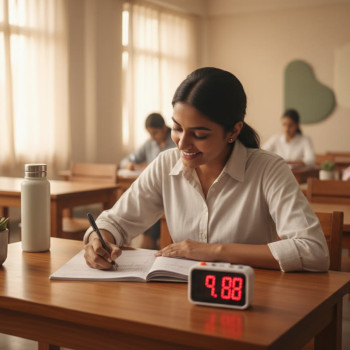
- Time the paper strictly. Simulate exam conditions — no phone, no music, and only allowed materials on the table.
- Mark using model answers or marking guidelines. Note where you lost marks and why (concept, careless error, time pressure).
- Convert weak areas into targeted practice tasks and pick specific pages from practice books to correct them.
Notes, diagrams, and derivations: how to make them exam-proof
Diagrams and derivations reward repetition and clarity. Turn every important diagram into a 3-step routine: draft → label → annotate. For derivations, write a compact version and a fully worked version — the compact one is for last-minute recall; the worked one teaches structure.
- Create a formula sheet for each science/math chapter with one example per formula.
- Use two-colour pens for diagrams: one colour for structure, another for labels and annotations.
- Practice lab-style write-ups from your lab manual until the format becomes second nature.
Common mistakes students make with books — and how to avoid them
- Collecting too many books: Instead of breadth, prioritise a textbook, one good practice book per subject, and sample papers.
- Skipping NCERT: Some students chase only advanced questions. Start with NCERT and build up.
- Practicing without marking: Timed practice without marking against a rubric teaches speed but not correctness. Always self-mark or get your paper reviewed.
- Not revising smartly: Re-reading whole chapters is time-consuming; use one-page summaries and active recall instead.
How tailored support can fit into a book-based plan
Books do the heavy lifting, but personalised guidance helps you select the right problems and correct exam habits faster. Sparkl’s personalised tutoring can step in where a book can’t: diagnosing weak topics, setting a bespoke practice schedule, and tracking improvement. Look for tutors who translate book practice into exam-ready answers rather than just giving more worksheets.
Sample 12-week per-subject roadmap (apply this pattern across subjects)
This is a flexible template. Substitute chapters and practice resources from the tables above.
| Weeks | Focus | Daily activity | Books/resources |
|---|---|---|---|
| 1–3 | Foundation: read and understand | Read chapter, make notes, attempt NCERT examples | NCERT textbook, lab manual |
| 4–7 | Guided practice: apply and solve | Solve end-of-chapter exercises and exemplar problems | Practice book, exemplar |
| 8–10 | Exam simulation and mixed practice | Timed sectional tests and one full-length mock | Sample papers & previous papers |
| 11–12 | Consolidation | Quick revision sheets, targeted fixes, final mock | One-page notes, quick test book |
Using analytics to improve — a simple tracking method
After every mock, track three numbers: score, time taken per section, and error type (conceptual/careless/time). Over a few mocks you’ll see patterns. Convert those patterns into micro-goals: e.g., “reduce algebra careless errors by 50%” or “finish map questions within 15 minutes.” That makes your book practice measurable and actionable.
Final revision tactics in the last few weeks
- Prioritise high-yield NCERT points and one-page summaries.
- Do at least two full-length mocks per subject under timed conditions and one quick revision test every alternate day.
- Practice the toughest diagrams and long-answer formats until they are neat and consistent.
- Maintain sleep and a steady routine; cognitive fatigue blunts the benefit of last-minute cramming.
Choosing the best books for the Class 9 to 10 transition is the first step; using them with discipline, structured practice, and exam-style feedback is what turns reading into results. With NCERT at the core, targeted practice books for skill-building, and regular full-length mocks, a student converts knowledge into accurate, exam-ready answers.
Transition success depends on clarity of concept, regular timed practice, and systematic revision built around high-quality resources and focused effort.






















No Comments
Leave a comment Cancel