
CBSE 30-Day Plan for High Scoring Students
Thirty days is long enough to reset priorities and short enough to keep intensity honest. If you’re a CBSE student aiming for a high score, this plan treats those four weeks like a focused training camp: diagnostic clarity on Day 1, a rhythm of practice and review, regular full-length mock tests, and a final sharpening of presentation and time management. This is not a miracle schedule; it’s a realistic, evidence-driven rhythm that fits the CBSE exam pattern — syllabus alignment, value-based marking, and the need for neat, well-structured answers.

How to use this guide
Read it as a coach that talks you through each week. Adapt block lengths to your lifestyle and subjects. Keep one clear diagnostic paper, a mistake log, two full-length mock tests per week (in the middle weeks), and a cheat-sheet of formulas and quick facts you’ll review every night. If you need one-on-one guidance to convert the plan into your personal timetable, Sparkl provides tailored study plans, expert tutors, and AI-driven insights that help identify weak spots fast.
Why a structured 30-day plan works
There are three reasons a month of concentrated effort pays off for CBSE exams. First, the syllabus is fixed and finite — targeted revision beats scattered cramming. Second, the marking system rewards clarity, correct steps, and presentation; you can improve score without relearning the entire syllabus by focusing on how you answer. Third, repeated timed practice builds exam temperament: you learn question-selection, pacing, and stress control, not just content.
What we mean by ‘CBSE-style’ preparation
- Align every study session with the official syllabus topics relevant to your subjects.
- Practice full-length papers in exam conditions; time yourself and follow the marks distribution when allocating minutes to questions.
- Use diagrams, derivations, and worked solutions as learning tools — make them neat and labelled so they become exam-ready.
- Focus on presentation: clear steps, box key answers, underline final points, and write legibly.
Day 1: Honest diagnosis and a workable plan
Start with a single diagnostic paper per subject: one recent sample or a past-style paper you haven’t prepared for. Treat it like an assessment, not the start of study — don’t panic over marks. The goal is to map topics into three buckets: Strengths (frequent, high-accuracy topics), Salvageable (topics you can fix with targeted practice), and Long-term Weaknesses (topics needing more time).
Day 1 checklist
- Take one timed diagnostic paper per major subject (limit to 2–3 hours per paper if you are testing multiple subjects in one day).
- Mark answers strictly against the marking scheme to learn the style of expected answers.
- Create a mistake log: note question type, exact error (conceptual, careless, time-pressure), and how many marks lost.
- List must-do topics (top 40% of syllabus that carries most practical weight) and must-avoid traps.
Weekly structure: how to allocate the 30 days
Divide the 30 days into four overlapping phases: consolidate, practice & extend, exam-simulate, and polish. The table below shows a compact plan you can adapt by subject difficulty and personal strengths.
| Week | Focus | Key Activities | Daily Time Allocation |
|---|---|---|---|
| Week 1 (Days 1–7) | Consolidate fundamentals | Finish quick topic-wise revision of Strengths; patch Salvageable topics; make formula/definition sheets | 3–5 hours focused study + 30–60 min review |
| Week 2 (Days 8–14) | Practice & targeted problem solving | Timed practice sets, start full-length mock once this week, 2–3 focused concept drills | 4–6 hours with blocks for mock review |
| Week 3 (Days 15–21) | Exam simulation | Two full-length mocks, strict timing, detailed marking and error correction | 4–6 hours including mock time |
| Week 4 (Days 22–30) | Polish & memory work | Short active revision, formula sheets, last-minute concept fixes, light mocks | 2–4 hours with nightly review |
Sample daily schedule (pick and adapt)
| Time | Activity | Purpose |
|---|---|---|
| 06:00–07:00 | Quick revision (formulas, short notes) | Wake-up recall; low-effort memory consolidation |
| 09:00–11:00 | Deep work: difficult topic / problem sets | High-concentration practice |
| 13:00–14:00 | Light revision / short mock section | Apply morning learning; maintain momentum |
| 16:00–18:00 | Subject 2 practice (writing/diagrams) | Presentation and answer-structure work |
| 20:00–21:00 | Review mistakes and update log | Turn errors into permanent learning |
Designing effective daily sessions
Make each block purposeful. Use a simple formula: 10–15 minutes setup, 60–90 minutes focused work, 5–10 minutes mini-break, then a 15-minute wrap-up that writes down three things you learned and one problem you still need to correct. This wrap-up is the secret: it forces reflection and makes nightly review meaningful.
Micro-strategies that add marks
- Always start a long question with a one-line outline of your approach — markers appreciate clarity.
- Label diagrams clearly and write units next to numerical answers.
- Where steps matter (maths, chemistry derivations), write each step on a new line so partial credit is visible.
- Practice handwriting at least twice a week; neat answers read well and feel more confident to the examiner.
Subject-wise high-yield advice
Every subject needs a different balance of recall, application, and presentation. Below are concise, exam-focused tips you can apply in the 30-day cycle.
Mathematics
- Prioritize question types that repeat across years: quadratic applications, integrals with standard substitutions, coordinate geometry basics, and problem-solving methods. Drill 10–15 high-variation problems per topic.
- During mocks, mark time-per-question and practice skipping and returning — this improves overall accuracy under pressure.
Science (Physics, Chemistry, Biology)
- Physics: practice numerical setup and units. Write down the knowns and unknowns before solving. Keep formula sheets organized by chapter.
- Chemistry: balance conceptual questions with mechanism practice. For practical chemistry, rehearse short, clear procedural language for experimental questions.
- Biology: make labeled diagrams and concise definitions. Use flow-charts to memorize cycles and processes.
English and Languages
- Practice one comprehension passage daily and two short writing tasks per week — aim for structure: intro, two development paragraphs, conclusion.
- Revise high-frequency grammar points and vocabulary in short bursts.
Social Science
- Create timelines and cause-effect maps for history, and practice map skills clearly and accurately.
- For political science and economics topics, memorize definitions and practice short, high-yield examples demonstrating understanding.
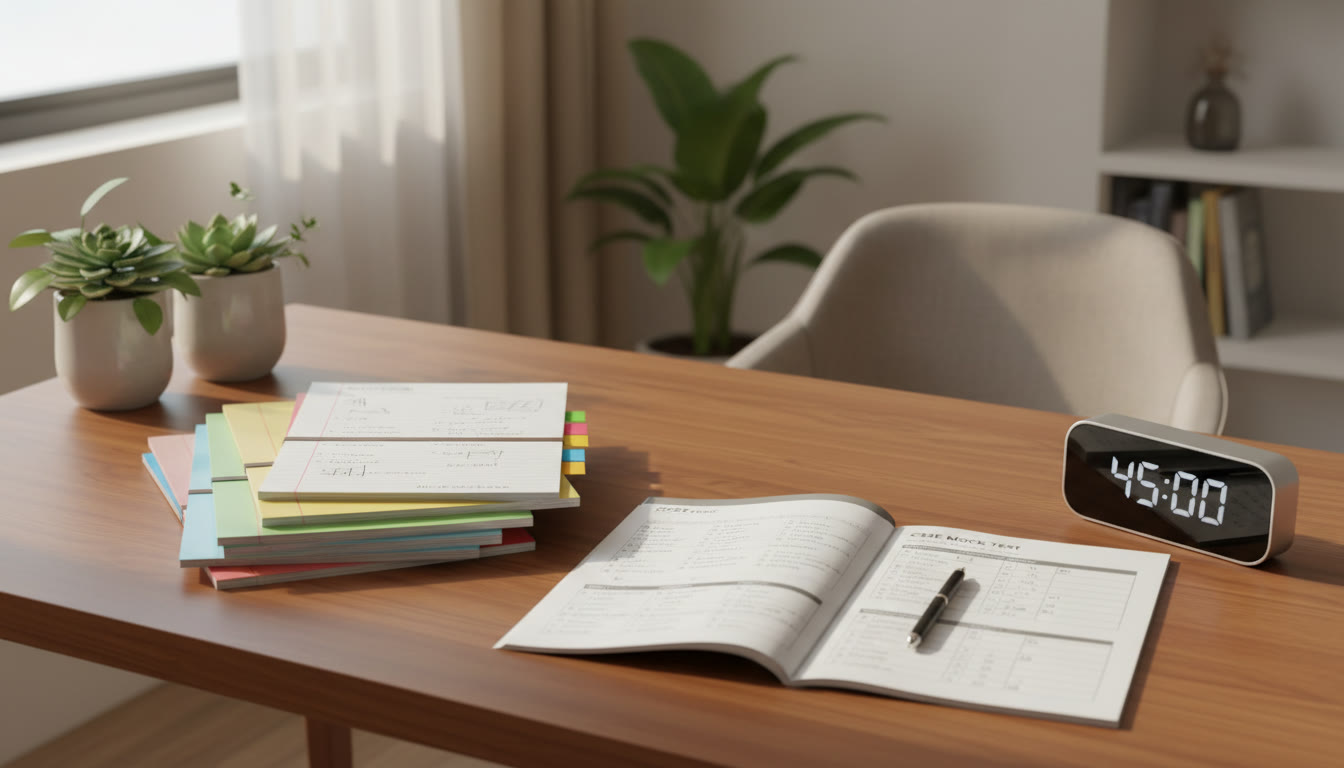
How to run full-length mock tests so they actually improve your score
Mocks are the backbone of a 30-day plan. They should be taken like the real exam: timed, without notes, and with full adherence to the paper’s marks and instructions. After each mock, spend at least as much time marking and analyzing as you spent taking it.
Mock test routine
- Simulate exam conditions: desk, silence, realistic allowed materials (calculator if permitted).
- Time strictly by section; allocate minutes by marks. Practice skipping long questions at first read, and return if time allows.
- Mark using the official-style key, and write down lost marks by category: content gap, method error, careless mistake, time issue, or presentation flaw.
- Create targeted mini-sessions from the mistake log: 20–30 minute practice blocks that address recurring errors.
How to get the most from a marked mock
- Rewrite 2–3 answers you lost marks on, applying the ideal structure you’d use in the exam.
- Convert conceptual errors into flashcards or short notes; convert careless errors into timed practice drills.
- Track progress across mocks: are errors moving from conceptual to careless? That’s progress.
Memory, recall and revision techniques that stick
When time is limited, how you revise matters as much as what you revise. Use active recall and spaced repetition instead of passive reading. Turn headings into questions and force yourself to answer without notes.
Practical revision toolbox
- One-page cheat sheets per chapter that contain only formulas, essential definitions, and one solved exemplar problem.
- Flashcards for quick recall: definitions, key dates, reaction steps, or formula derivations.
- Mind maps to see connections — for example, link a Physics concept to its mathematical consequences and a related experimental setup.
- Nightly 15-minute recall: before bed, write down five things you learned that day and one question you still struggle with.
Time management and mental fitness
High scores are often decided by the student who can think clearly under time pressure. Practice pacing drills: give yourself 10–12 minutes for a 6-mark question in practice and learn how to decide which questions to attempt first. Sleep, hydration, and short breaks are non-negotiable — a well-rested brain solves problems faster.
Two-minute reset
When you feel panicked during a mock or revision session: close your eyes for 90 seconds, breathe slowly, and list the three next actions on paper. That interruption converts anxiety into a short plan and often saves marks lost to rushed, unfocused work.
How personalized tutoring can fit into the 30-day cycle
Personal coaching is useful when you need targeted correction quickly. A short series of one-on-one sessions can help with exam-style answer writing, clearing persistent conceptual blocks, or creating a revision timetable that fits your strengths. For students who want guided, adaptive practice and feedback, Sparkl offers one-on-one guidance, tailored study plans, expert tutors, and AI-driven insights that highlight the highest-impact improvements for each student.
What to expect from focused tutoring in this month
- Rapid gap analysis: the tutor helps translate your mock performance into the two or three changes that will produce the most marks.
- Answer-level feedback: correction on presentation, structure, and clarity — not just content.
- Tailored practice: targeted question banks and time-bound drills shaped around your mistake log.
Final 7 days: polish, confidence, and consolidation
The last week is less about learning new material and more about making what you know exam-ready. Prioritize three things: (1) error-free practice in your weakest topics, (2) nightly review of distilled cheat sheets, and (3) two to three short mocks that focus on timing and answer quality rather than score-chasing.
Checklist for the final days
- Carry a one-page summary for each subject: formulas, key definitions, and two solved models per question type.
- Practice time-managed sections rather than whole papers every other day to avoid burnout.
- Simulate the first 15 minutes of the exam: read instructions carefully, plan your order of answering, and decide which high-scoring questions you will attempt first.
Common pitfalls and how to avoid them
- Pitfall: Relearning rather than refining. Fix: Use practice to identify weak points and then refine those, don’t re-study what you already know well.
- Pitfall: Overdoing new content in Week 4. Fix: Reserve new learning for small, high-payoff topics only.
- Pitfall: Ignoring presentation. Fix: Spend 10 minutes per session practicing neatness and structured answers.
Sample 3-day mini-cycle to repeat every week
Cycle these short plans across the month to maintain momentum: Day A (Deep concept + practice), Day B (Mock section + correction), Day C (Light review + speed drills). Repeat and rotate subjects so each subject appears at least twice per week in a deep session and once in a mock session.
Closing academic note
Follow the diagnostic-first approach, practice with full-length mocks under timed conditions, prioritize the marking-style and presentation that CBSE values, and use short, focused revision sessions to convert understanding into exam-ready answers. Consistency, honest error analysis, and intentional practice in the final 30 days will produce measurable score gains when aligned with the syllabus and marking expectations.
























No Comments
Leave a comment Cancel