

CBSE High Score Strategy for Science Students
Science can feel like a mountain of facts, formulas, diagrams and lab notes — but it doesn’t have to be overwhelming. With the right map, steady steps and a few clever shortcuts, every concept becomes manageable and every test becomes an opportunity to show what you truly understand. This guide is for curious students who want a reliable, enjoyable path to high scores in CBSE science exams, built around concept clarity, smart practice, and exam-savvy presentation.

Start with the Big Picture: Understand the Exam Ecosystem
Know the components
Before plotting a study plan, spend fifteen minutes mapping the exam ecosystem. CBSE science evaluation commonly includes a theory paper, practical/internal assessments, and sometimes project work or viva components. Each part tests a different skill: conceptual reasoning in theory, procedural accuracy in practicals, and communication in viva or project presentations. Treat each as a separate target: build concept fluency for theory, procedural confidence for practicals, and crisp presentation for projects and vivas.
What examiners are looking for
Examiners award marks for clarity, correctness and the demonstration of understanding. That means: a clear final answer, correctly labeled steps, accurate units and diagrams where needed, and concise reasoning that connects facts rather than just listing them. Presenting answers in the way the marking scheme expects — legible handwriting, labeled diagrams, numbered steps and a final boxed or underlined result for calculations — converts knowledge into marks.
Build Your Foundation: Concept First, Memorization Second
Make core textbooks your backbone
Your primary goal is to make core concepts comfortable. Start with a reliable textbook that aligns with the CBSE syllabus and read chapters actively: ask questions, write simple summaries at the end of each topic, and solve the in-text examples without peeking. The aim is not just to finish pages but to be able to explain each idea to a friend in plain language.
Active study techniques that work
- Teach to learn: Explain a topic aloud as if your friend is hearing it for the first time — gaps reveal themselves quickly.
- Feynman notes: Write a one-page summary of a chapter in the simplest words possible; revisit to refine.
- Concept maps: Draw quick diagrams linking ideas (e.g., energy → forms → transfer methods).
- Spaced recall: Revisit tricky ideas at increasing intervals to move them from short-term to long-term memory.
Smart Practice: Questions, Numericals, and Practical Work
Design practice sessions with purpose
Instead of random problem-solving, structure practice sessions by question type. Spend a block on short-answer questions, another on long answers or derivations, and a focused session for numerical problems. Rotating like this builds adaptability so you won’t be thrown by any mix on test day.
Numerical accuracy and presentation
For physics and chemistry numericals, accuracy includes units, significant figures and clear steps. Always:
- Write knowns and the formula you will use.
- Show algebraic steps before plugging in numbers.
- Keep units through steps and give a clear boxed final answer with units.
Practical exams and viva: turn them into a scoring advantage
Practical exams reward neatness, correct observations, error-conscious conclusions and clear communication. Keep your lab records tidy, write precise observations in tables, label graphs, and practice short, confident oral explanations of each experiment. Practicing a mock viva with a peer or teacher reduces nerves and improves clarity.
Plan With Purpose: A Weekly Structure That Scales
Having a plan that balances new learning, practice, and revision is essential. Below is a sample weekly plan that many students find realistic and effective; adapt the hours to suit your schedule and academic load.
| Study Component | Focus | Suggested Hours/Week |
|---|---|---|
| Theory & Concept Building | Read chapters, make notes, solve in-text examples | 6–10 hours |
| Problem Practice | Numericals, derivations and long-answer practice | 4–6 hours |
| Short-answer & MCQ Drills | Timed practice, concept checks | 3–5 hours |
| Practical & Project Work | Lab record keeping, graph plotting, mock vivas | 2–4 hours |
| Revision & Mock Tests | Full-length mocks and review | 3–6 hours |
Full-length mock tests — your rehearsal for the exam
Full-length mock tests are non-negotiable. They train your stamina, sharpen time allocation and expose weak spots. When you take a mock, simulate exam conditions strictly: true time limit, no notes, and full adherence to instructions. After the mock, spend at least as much time reviewing as you did taking the test: identify repeated errors, mark-shemes you missed, and rewrite two or three answers to better show how you would present them in the real exam.
Answer-Writing That Converts Knowledge to Marks
Structure your answers for the marker
Examiners scan answers looking for a clear final response and the reasoning that supports it. Use this mini-format for many answers:
- Lead statement: Start with a one-line direct answer if the question asks for a fact or conclusion.
- Steps/Reasoning: Present numbered steps or bullet points for processes and derivations.
- Supporting detail: Use a labeled diagram or equation where relevant.
- Final statement: A concise conclusion or boxed numerical result.
Diagrams, labels and presentation
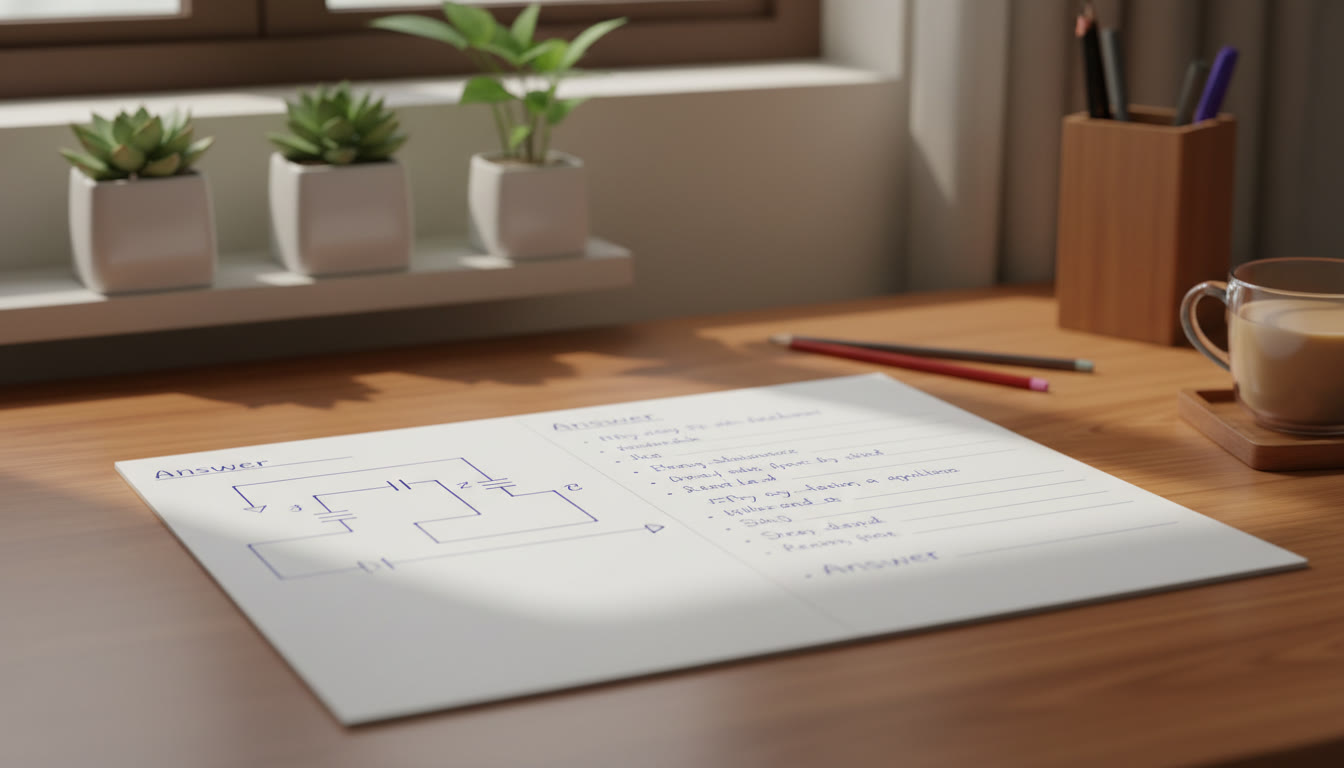
A neat diagram with clear labels and directions can win marks quickly. Practice drawing the essential diagrams for each topic until you can reproduce them in under two minutes. Use arrows, label parts, and write one short sentence linking the diagram to the answer when necessary.
Time Management: Read, Plan, Execute
Use reading time wisely
At the start of an exam, spend the first 10–15 minutes scanning the paper: identify questions you can answer quickly, flag the long or tricky ones, and build a rough time plan. Prioritize high-scoring questions you can complete with confidence, then move to partial-challenge items. Always leave a 5–10 minute window at the end for quick revision of answers and check units in numerical responses.
Allocate time by marks
Divide the available time by the total marks to get a per-mark time metric, then allocate time blocks for long questions, short questions, and revision accordingly. If you see a question worth significant marks, resist the urge to over-explain; instead, present structured, concise reasoning and clear steps.
Revision Recipes: What to Review and When
Layered revision
Revision works best in layers. The first pass is broad: revisit every chapter and ensure you can answer basic questions. The second pass is targeted: solve representative problems from weaker topics. The third pass is polishing: memorize key formulas, revisualize important diagrams, and rehearse problem-solution frameworks under timed conditions.
Create a one-page formula and concept sheet
Summarize formulas, definitions, and quick concept reminders on a single sheet for each major subject area. During last-minute revision, these sheets act as high-density memory triggers. Make them handwritten — the act of writing helps retention.
When to Ask for Help and How to Use Tutoring Effectively
Recognize the right time to seek support
If a topic consistently resists understanding after several focused attempts, that’s a good sign you need targeted help. Smart tutoring is not a shortcut; it’s a way to unstick specific bottlenecks — for example, getting a one-hour walkthrough that explains a recurring confusion in mechanics or stoichiometry can save weeks of ineffective practice.
What effective tutoring should offer
- 1-on-1 guidance that targets the exact concepts you find difficult.
- Tailored study plans that fit your pace and exam timeline.
- Focused practice and model answers that reflect CBSE-style marking expectations.
- AI-driven insights (where available) to highlight weak spots and suggest practice tasks.
For students who want that focused support, a helpful option is Sparkl‘s personalized tutoring, which blends one-on-one guidance, tailored study plans, expert tutors, and AI-driven insights to help resolve specific gaps without replacing your core study efforts.
Common Pitfalls and How to Avoid Them
Rote repetition without understanding
Memorizing answers word-for-word is risky in a system that tests understanding. If you can rephrase a concept and apply it to a slightly different problem, you’ve moved beyond rote learning. Aim to solve variations of the same problem rather than repeating identical questions.
Poor answer presentation
Even correct answers can lose marks if they’re buried in messy handwriting or unclear steps. Practice clean writing and clear numbering to make life easier for the marker — and for yourself when you review your answer later.
Ignoring the marking scheme
Always practice with a mindset of the marking scheme: show the steps that carry marks, label diagrams, and state final results separately. If a solution contains partial work, ensure the partial steps are visible and logically ordered so the examiner can award appropriate credit.
Subject-Specific Focus: Quick Guidance
Physics
- Emphasize conceptual understanding of laws and the ability to translate a physical situation into equations.
- Practice free-body diagrams, step-by-step derivations and numerical setups.
- For theory answers, connect the principle to the result explicitly: don’t assume the marker fills the gaps.
Chemistry
- Balance your time between theory (reaction mechanisms and definitions) and numerical practice (mole calculations, concentration problems).
- When writing equations, be tidy and indicate states and conditions where relevant.
Biology (if applicable)
- Focus on diagrams, key definitions, and processes that can be explained stepwise (e.g., photosynthesis, cellular respiration).
- Practice drawing labeled diagrams and use keywords that signal understanding.
Final Weeks: Consolidation and Confidence
Make tests and corrections the centrepiece
In the final weeks, make full-length mock tests your centrepiece. After each mock, carefully correct and list the types of mistakes: conceptual gap, careless algebra, unit error, or poor presentation. Turn those lists into specific practice tasks for the next mock.
Keep stress in check
Sleep, short exercise and healthy meals help cognitive performance far more than last-minute cramming. When worry spikes, take a 10–20 minute break to walk or breathe; return with a clear task list and a small, achievable study goal.
Checklist for Exam Day
- Carry essentials: admit card, stationery, calculator if allowed, and a clean set of spare pens.
- Arrive early and use the waiting time to lightly revise formulas and diagrams, not to panic.
- Read instructions carefully; follow the mark allocation and tailor the depth of your answer accordingly.
- Underline key words in the question and keep answers focused on what’s asked.
Closing Thought
High scores in CBSE science come from steady clarity: a foundation of clear concepts, targeted practice that mirrors the exam, thoughtful answer presentation, and disciplined revision. With structured practice, smart use of full-length mocks, and focused help when needed, every student can translate understanding into marks.
Study the syllabus with an examiner’s eye, practice with intention, present with clarity — and let your understanding do the talking.

























No Comments
Leave a comment Cancel