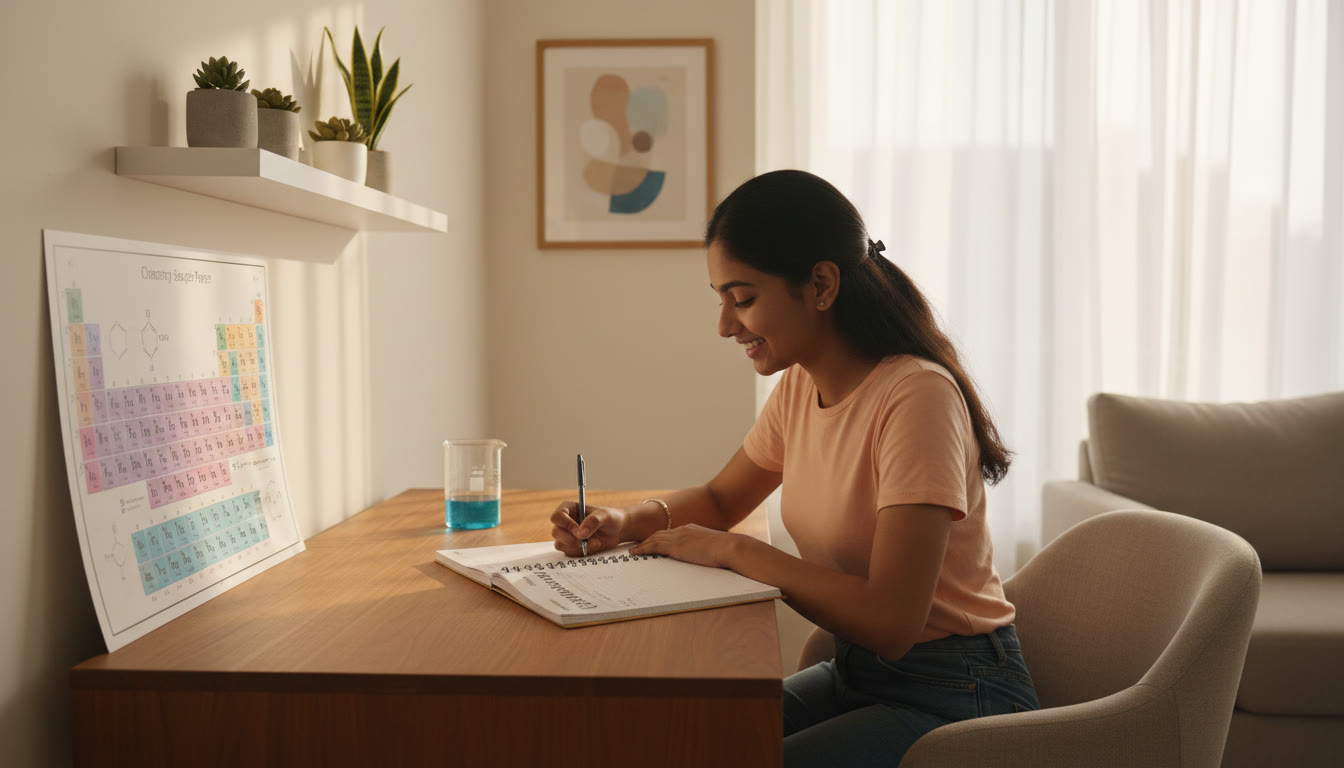

Why sample papers are your secret weapon in CBSE Chemistry
Think of sample papers as rehearsal for a play: the script, lighting cues and timing are all there, but you still need to practice until your lines flow naturally. For CBSE Chemistry, sample papers do more than give you practice questions — they reveal the exam’s rhythm, emphasise frequently-tested topics, and train you to convert knowledge into marks under time pressure.
Instead of treating sample papers as mere question banks, treat them as diagnostic tools: each paper tells you what the board values right now, which question-types keep showing up, and how marks are partitioned across concepts. Used with intention, sample papers accelerate confidence, clarity and exam-room speed.
Immediate benefits you’ll notice
- Clarity on question formats: short answers, long answers, numericals, mechanism sketches and case-based sets.
- Improved time sense: how long a 3-mark numerical takes versus a 5-mark derivation.
- Focused revision: sample papers quickly reveal weak chapters and recurring question themes.
Start by mapping the syllabus to question types
Before you dive into timed practice, make a one-page map that links every chapter to the kinds of questions you can expect. For example: physical chemistry → calculations and concept explanations; organic chemistry → reaction mechanisms and nomenclature; inorganic chemistry → definitions, structures, and reasons for trends. This map becomes your cheat-sheet for targeted practice.
How to build a quick topic-question map
- List chapters down one column and likely question-types across the top (definitions, numericals, mechanisms, experiment-based, assertion–reasoning).
- Tick which chapter commonly yields which question-type. Use this to prioritise practice.
- Update the map each time a new sample paper reveals a fresh pattern — this keeps your plan aligned with the latest updates.
Decoding the paper: approach each section like a strategist
Don’t rush in. A calm first read changes everything. Skim to identify easier questions you can secure quickly, mark the heavy numericals or long derivations for later, and note any internal choice that lets you drop a weaker topic.
Order-of-attack checklist
- Spend 8–12 minutes reading the entire paper. Mark easy wins and time-consuming items.
- Begin with short answers and objective-style questions to build momentum.
- Leave long answers and complex multi-step numericals for the middle portion when you are warmed up.
- Reserve the last 15–25 minutes to revise calculations, units, and to check chemical equations for balance.
Time-management: a practical plan for a theory paper
Most students do well when they convert marks into minutes and then add buffer time. Below is a realistic timing framework for a three-hour theory paper totalling seventy marks; adapt it to fit the actual duration and mark total for your cycle.
| Activity | Suggested time | Why it helps |
|---|---|---|
| Initial read-through | 8–12 minutes | Spot easy questions and plan your order of attempt |
| Objective & very short answers | 30 minutes | Quick points to secure easy marks and boost confidence |
| Short answers & 2–3 mark reactions | 45 minutes | Consolidate mid-weight marks while thinking through mechanisms |
| Numericals and derivations | 40–50 minutes | These need space: show work stepwise for clarity and marking |
| Long answers & synthesis questions | 35–40 minutes | Allocate time for structured exposition, diagrams and reaction steps |
| Review & corrections | 15–20 minutes | Fix arithmetic slips, check units and balanced equations |
As you practice, fine-tune these slices so they match your speed. The key is to leave revision time; unchecked arithmetic or missing units are expensive mistakes.
The answer blueprint: writing for marks
Examiners read quickly. A tidy, logically-ordered answer earns more than a messy, half-baked one. Structure each answer so it can be scanned: show the final result first (for numericals), then the supporting steps, and underline or box the final answer.
Formatting that wins marks
- Start numeric answers with the final value and unit. Example: “Concentration = 0.25 mol L-1“.
- Label diagrams clearly and draw only what’s necessary — neatness beats artistry.
- For mechanisms, use clear curved arrows, indicate reagents and conditions, and number steps if the process is multi-stage.
- When asked for reasons, keep each reason to one clear sentence — concise clarity is scored quickly.
Handling question types: targeted tactics
Very short answers (1 mark)
These test recall. Keep answers literal, precise and use standard terms the syllabus prefers. Avoid adding unnecessary context; a single accurate line wins the mark.
Short answers (2–3 marks)
- Combine a brief statement with one supporting sentence or a quick calculation step.
- For a 3-mark question that asks ‘give reason’, use a clear statement followed by a one-line justification or balanced equation.
Long answers (5+ marks)
These require organization: an introduction, a stepwise body, and a concise conclusion when appropriate. Use bullets or numbered steps if you need to present multiple related points — that helps the examiner trace your logic and award marks at each step.
Assertion–Reason and case-based questions
Read both assertions and reasons carefully. If they both look true, check the linking phrase: does the reason actually explain the assertion? For case-based sets, underline the data that ties directly to a conceptual point and reference that data explicitly in your answer — this shows you are not guessing but using the passage.
Numericals and stoichiometry: show your work clearly
Numericals are generous because marks are often allocated per step. Even where partial credit depends on the examiner’s marking scheme, a clean chain of reasoning helps the examiner follow your method. Label intermediate values, state assumptions (if any), and always include units.
Example format for a calculation
- Step 1: State the formula and why it applies.
- Step 2: Substitute numerical values (clearly label them).
- Step 3: Show the algebra and the final numeric answer with unit and appropriate significant figures.
Mock-test routine: from first attempt to peak performance
Practicing sample papers is a cycle: attempt → analyse → act → re-test. Skip the temptation to keep doing more papers without deep analysis; a single well-analysed paper improves competence far more than five unchecked attempts.
Weekly rhythm for effective mock practice
- Week 1: Take a diagnostic timed sample paper to establish baseline score and time habits.
- Week 2–4: Focused practice on weakest units revealed by the diagnostic paper; break down mistakes into conceptual, calculation and presentation categories.
- Week 5–6: Full-length timed tests under strict exam conditions, followed by thorough error mapping.
- Ongoing: Revisit any recurring errors until they no longer occur in two consecutive mocks.
For students who want tailored, one-on-one guidance, Sparkl‘s personalised tutoring and benefits include 1-on-1 guidance, tailored study plans, expert tutors, and AI-driven insights to prioritise sample-paper practice and track progress.
Using marking keys and model answers the smart way
After each mock, compare your solution with the marking key and a model answer. Don’t copy model answers; instead, extract the structure — how many points are expected, what keywords appear, and how diagrams are used. Re-write your answers in the model’s style to internalise the phrasing that examiners appreciate.
Common chemistry-specific pitfalls and fixes
- Forgetting units — Fix: make writing units part of your final checklist on every answer.
- Unbalanced chemical equations — Fix: balance equations on scratch first, then copy neatly into answer space.
- Skipping reagent/condition details in mechanisms — Fix: practise adding reagents as a habit; they often fetch marks.
- Poorly labeled diagrams — Fix: always use arrows and labels, and number important bonds or atoms referenced in your text.
- Arithmetic slips in multi-step numericals — Fix: box intermediate values to make review easier.

Practical paper prep: how sample-paper practice helps
Even when you’re focusing on the theory paper, sample papers often include experiment-based questions that mimic practical skills — observation, inference, titration calculations and error discussion. Practice answering these in short, precise paragraphs: state the observation, infer the cause, and propose a simple corrective or a reasoned explanation for any anomaly.
Self-assessment checklist after every paper
- Score accuracy: Which sections lost the most marks?
- Conceptual vs. careless errors: Were mistakes due to misunderstanding or avoidable slips?
- Time audit: Did any question take disproportionate time? Why?
- Presentation: Were diagrams clear and were final answers boxed or underlined?
A sample 8-week roadmap you can adapt
This is a model schedule that you can compress or expand depending on how far you are from your main exams. Replace weeks with days if you have less time left, and prioritise the highest-yield topics from your syllabus map.
| Weeks | Focus | Outcome |
|---|---|---|
| 1–2 | Full diagnostic sample paper, syllabus map, identify weak units | Baseline score and focused to-do list |
| 3–4 | Targeted practice on weak units; short answer and objective drills | Turn weak units into scoring ones |
| 5–6 | Two full-length timed mocks per week, deep analysis each time | Improved time-management and consistency |
| 7–8 | Polish: rapid revision notes, formula sheet practice, last few mocks | Confidence and error-free execution |
Study techniques that amplify sample-paper practice
- Active recall: after answering a question, close your book and try to reproduce the idea or mechanism from memory.
- Spaced repetition: revisit problem types after a few days to lock retention.
- Peer explain: teach a tough concept to a friend; explaining out loud exposes gaps quickly.
- Mini cheat-sheets: condense a chapter to one page of formulas, conditions and common reagents.
How to measure progress meaningfully
Don’t just track marks. Track the nature of mistakes you fix: conceptual misunderstandings eliminated, average time per numerical reduced, or number of error-free long answers in a mock. Progress is more robust when measured across behaviour changes, not just raw scores.
Exam-day strategy refined by sample-paper experience
- Start calm: use your first 8–12 minute paper read to plan. Confidence comes from that calm start.
- Secure easy marks first to reduce cognitive load for harder sections.
- Write legibly and structure long answers with short headings or numbered steps.
- Reserve time to check units, significant figures, and to ensure chemical equations are balanced.
Closing thought: turn practice into predictable performance
Sample papers are your bridge from knowing chemistry to scoring chemistry. When used deliberately — with analysis, revision and a clear timing plan — they transform weak spots into reliable marks. Build habit loops: attempt, analyse, correct, and re-test. Over time those loops shorten the gap between where you are and the level of performance you want to reach.
Good sample-paper practice sharpens problem selection, presentation and time sense — the three pillars of exam success in CBSE Chemistry.




















No Comments
Leave a comment Cancel