

Last 30 Days Plan to Improve Accuracy in CBSE
Thirty days before your CBSE exams is not a time to panic — it’s a time to get surgical. Accuracy wins exams: correct, clear, and complete answers score better than rushed or half-done ones. The next 30 days should be designed to reduce careless errors, solidify the most-scoring concepts, and replicate the exact exam conditions you will face. This plan focuses on four pillars: focused revision, targeted practice, smart mock-testing, and ruthless error analysis. Follow it with discipline, not burnout, and you’ll see predictable improvements in how often you get answers right the first time.

Why accuracy matters (CBSE context)
In CBSE-style assessments, marks are awarded for clarity, correct method, and completeness. Examiners reward logical steps, labeled diagrams, and the right answer supported by the right reasoning. A small careless slip — a wrong sign, a skipped step, or a misread instruction — can cost an entire question. Because marking follows a scheme, your practice must do the same: practice full answers, follow the expected structure, and learn how marks are distributed across parts of a question. Don’t rely on assumptions about partial credit; instead, write answers that clearly earn full allocation by showing key steps and labels that an examiner looks for.
Understand the marking mindset
When practicing, pretend you are the examiner for a minute: what will you tick off to award the full marks? That might be a correct formula, a labeled diagram, a step-by-step derivation, or a concise conclusion. If you practise with that checklist in mind you automatically reduce the chance of missing a required element. Also remember: the syllabus alignment matters — focus revision on the units and competencies listed for the current cycle so your practice mirrors what will appear in the papers.
How to use these 30 days — the approach
This plan balances consolidation and active correction. In week one you pull together and clear gaps; in weeks two and three you build accuracy with timed drills and full-length mocks; in the final week you refine, rest, and check for repeat mistakes. Each session should end with a quick review (10–15 minutes) of what went wrong and how you will fix it next time. Keep sleep, hydration, and short breaks part of the plan — accuracy collapses fast when you’re exhausted.
When tailored help speeds things up
If you find persistent patterns of error — recurring calculation slips, a weak subsection of a subject, or trouble translating steps into clear written answers — short, focused support can accelerate improvement. For example, Sparkl’s 1-on-1 guidance and tailored study plans are designed to identify exactly where you keep losing marks and give step-by-step correction. A few targeted sessions that focus on your error log, exam simulation, and marking-style feedback can make the last 30 days far more efficient.
Week-by-week roadmap (high level)
| Days | Primary Focus | Daily Time | Key Activities | Assessment |
|---|---|---|---|---|
| Days 30–22 | Consolidation & gap clearance | 4–6 hours (quality blocks) | Topic-wise revision, concept maps, error-log setup, short topic tests | Topic quizzes (timed, marked) |
| Days 21–15 | Targeted practice & accuracy drills | 5–6 hours (including timed drills) | Timed question banks, focus on weak areas, start half-length mocks | Sectional timed tests with marking-sheet review |
| Days 14–8 | Full-length mock simulations | 6–7 hours on mock days, 3–4 on recovery days | Full paper mocks, strict exam conditions, marking and detailed error analysis | Full-length mock with self/peer/mentor marking |
| Days 7–1 | Polish, light practice, rest | 3–4 hours; lighter, confident work | Quick revisions, formula sheets, light timed practice, sleep and routine | Short revision checks; no heavy new topics |
How to measure progress each week
Use three numbers every week: accuracy percentage (correct answers ÷ attempted), average time per question, and repeat error count (how many times the same mistake reappeared). Track them in a small weekly dashboard and set concrete targets: for example, move accuracy from 70% to 80% in two weeks, or reduce repeated calculation errors by half. The point is measurable, visible progress — subjective feelings aren’t reliable when stress rises near exams.
Daily routine template (a workable day)
| Time | Activity | Purpose |
|---|---|---|
| 06:30 – 07:15 | Quick morning revision (formulas/flashcards) | Activate memory with low effort |
| 09:00 – 11:00 | Focused concept work / practice | Deep work on current weak topics |
| 11:30 – 12:30 | Short sectional timed practice | Build speed with accuracy |
| 14:00 – 16:00 | Mock/Problem solving or lab revision | Apply concepts under pressure |
| 17:00 – 18:00 | Review & error log update | Turn mistakes into learning steps |
| 20:00 – 21:00 | Light reading, summaries, and calm recap | Consolidation and sleep prep |
Micro-tasks that improve accuracy
- Read a question twice; underline the exact demand before starting.
- Write the units next to numerical answers to avoid unit errors.
- Before finalizing an answer, do a one-line sanity check: does the sign, unit and order of magnitude make sense?
- For long answers, write a two-line plan (2–3 bullet points) to ensure you don’t omit steps.
- Keep a clean, labeled diagram even if the question asks for a short written answer — a labeled sketch often earns clarity marks.
Error log — the engine of steady accuracy gains
Nothing beats a disciplined error log. Every time you make a mistake, record it: the question, the exact error type, why it happened, and the corrective step. After a week, patterns emerge and you can build targeted drills to remove the most frequent mistakes.
| Date | Question/Topic | Error Type | Corrective Action |
|---|---|---|---|
| Day X | Quadratic formula application | Sign error in substitution | Practice 10 similar problems, verbalize substitution each time |
Types of error to tag: conceptual gaps, calculation slips, misread questions, incomplete answer structure, and time-pressure mistakes. Review the log every three days and convert high-frequency mistakes into a five-minute micro-drill that you repeat until the rate drops.
Subject-specific tactics to sharpen accuracy
Mathematics
In math, accuracy is about careful reading, correct formulation, and neat work. Always rewrite the question in your own words if it helps. Keep a personal formula sheet (for quick morning revision) and practice problems that force you to show every step: examiners award marks for method as much as final answers. Use rough work for intermediate calculations and then copy the final neat solution with units and box the answer where required. For time-pressed numerical questions, practice estimation checks: if your computed answer is wildly off the estimation, stop and re-check steps rather than continue confidently.
Science (Physics, Chemistry, Biology)
Scientific accuracy combines correct reasoning, labeled diagrams, balanced equations, and precise terminology. For numerical physics problems, keep a habit of listing knowns and unknowns, writing the formula used, and checking units. In chemistry, practice balancing equations and writing full steps for titrations and mole calculations. For biology, diagrams and clear labelling matter — treat diagrams as proof of understanding, not decoration. Remember: derivations and stepwise reasoning are learning tools; a clear derivation in practice often converts into a few easy marks in the exam.
Social Science
History, Geography and Political Science reward accuracy in facts, dates, maps and interpretation. Build short bullets for timeline events and practice writing concise evidence-backed points. For map-based answers, labeling and neat presentation matter. For source-based questions, practise extracting the exact point the source asks for and avoid long, vague paragraphs that drift away from the question.
Languages and English
In language papers, accuracy shows in grammar, spelling, and faithful comprehension. For writing tasks, plan your answer in two minutes, then write with clear paragraphs and proofread for one minute at the end. For comprehension, underline the parts of the passage that directly answer the question and paraphrase instead of copying when asked to summarise. Accuracy in expression often separates a good answer from a top-scoring one.
Mock tests and marking practice — simulate everything
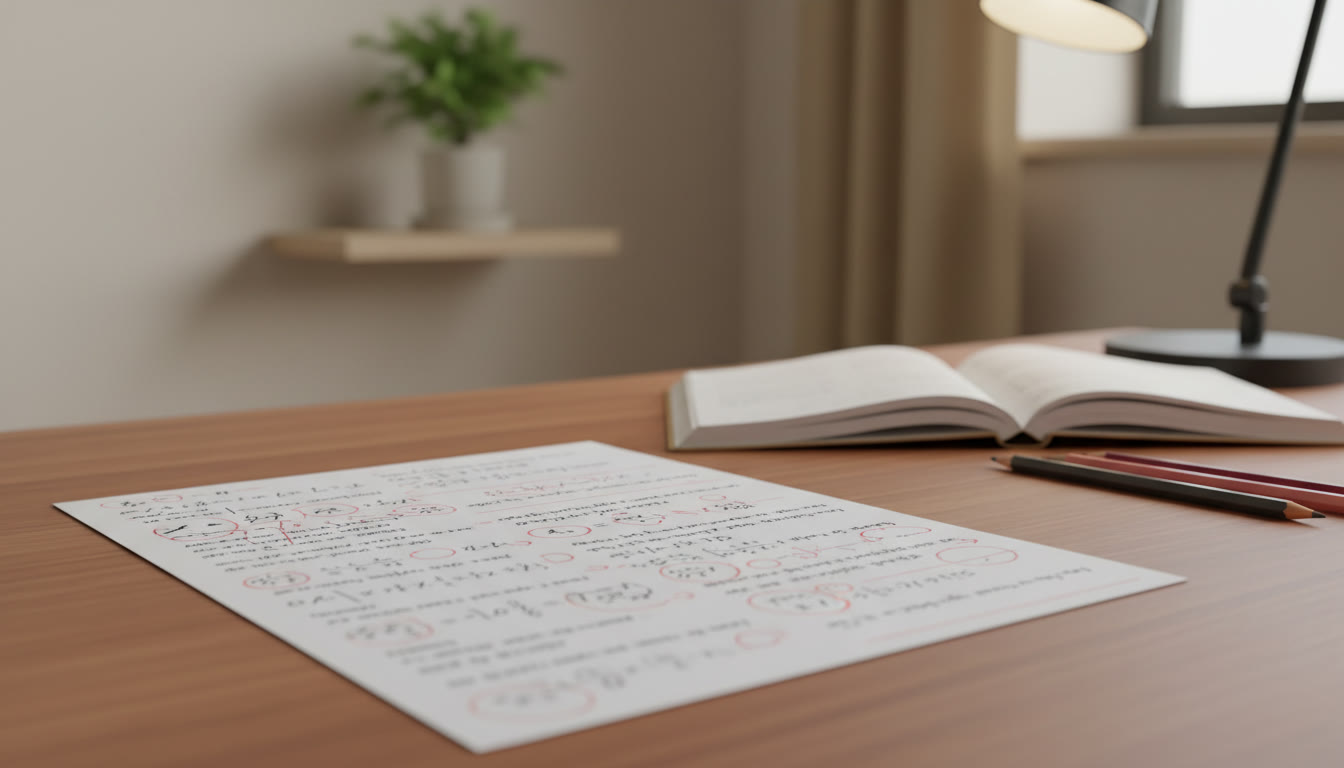
Full-length mocks are the single most predictive practice you can do. Take them under strict exam conditions — same duration, no phone, same breaks, and with only the allowed materials. After the test, mark using the same marking approach an examiner would use: award marks for each step you have practiced awarding in your attempt. Write short comments on where marks were lost and update your error log. Ideally, have one mock per week in the first three weeks and then two in the second week of full mock focus; spacing them gives you time to correct repeat mistakes between mocks.
Mock-test checklist
- Set an exact timer and follow section time allocations.
- Copy questions fully before answering to avoid misreads.
- Mark your paper immediately with a green/red system: green for fully correct, red for error type (calculation/concept/misread).
- Perform post-mock analysis within 24 hours while memory is fresh.
Smart practice methods that build lasting accuracy
Drill the most-common question types, not random problems. For each topic, identify the top 8–12 question patterns that keep appearing and practise those until you can do them accurately under time. Use spaced repetition: revisit each topic multiple times across the 30 days instead of one long cram session. When you correct a mistake, convert it into a ‘one-minute rule’: each time you encounter a similar problem, spend the first minute checking the exact point that tripped you up before solving.
Example: turn a calculation slip into a micro-skill
If you repeatedly make sign errors in algebra, add a quick routine before finalising any algebraic answer: (1) check each substituted sign, (2) re-evaluate final term’s sign by plugging a small number, and (3) write the final answer with sign and units once more. This small three-step habit prevents many full-question losses.
Final 7-day plan and pre-exam routine
The last week is about consolidation and calm. Reduce the intensity of new learning and prioritize clarity. Do one full-length mock early in the week, then switch to short, focused reviews each day: one hour for formulas, one for diagrams, and one for mental math or language editing. The last two days should remove stressors: fix supplies, practise the last few question types that still give trouble, and sleep. Keep a short checklist for exam morning — stationery, permissible aids, clear directions — and rehearse your travel to the exam centre if needed.
Common mistakes to avoid in the last 30 days
- Starting too many new topics — focus on finishing and polishing the important ones.
- Skipping post-mock analysis — practice without analysis is only repetition.
- Trusting memory instead of writing the plan — a short plan prevents omission in long answers.
- Ignoring question verbs: define, explain, compare, illustrate — each demands a different type of answer.
- Over-editing during the paper — allocate a fixed final review time instead of constantly reworking answers.
Test-day accuracy checklist
- Read the question paper fully for choice and section instructions before starting.
- Plan long answers in 1–2 bullet points before writing.
- Show key steps clearly and box final answers where useful.
- Reserve the final 8–12 minutes to recheck calculations and undone parts.
Closing thought
Accuracy is habit, not luck. With a clear 30-day structure — regular mocks, a detailed error log, subject-focused drills, and exam-style marking — you turn small, repeatable actions into reliable exam performance. Keep the process measurable: track accuracy, time per question, and repeat errors, and use those numbers to direct your practice each day. A steady, disciplined month will improve your precision far more than frantic last-minute cramming.


























No Comments
Leave a comment Cancel