

IB DP Exam Week: How to Avoid Silly Mistakes Under Pressure
There’s a special kind of frustration that hits you at the end of a long IB paper: you think of the perfect line, the clear diagram, the unit you forgot to add — five minutes after you hand it in. Those ‘silly’ mistakes are often not about knowledge; they’re about pressure, attention, and tiny habit gaps that grow into results you don’t want. This guide is written for students who want a two-year roadmap for the Diploma Programme and a practical, day-by-day approach to stop little errors from stealing big marks.

Why silly mistakes happen (and why that’s good news)
Understanding the cause is the first step to prevention. Silly mistakes are rarely signs of weak understanding; more often they come from:
- Mental fatigue and cognitive overload after long study sessions.
- Rushed reading — misreading a command term (“outline” vs “explain”) or missing a constraint like “in the context of…”.
- Poor exam mechanics — forgetting units, mislabelled graphs, arithmetic slips, or answer-format errors (e.g., leaving an answer without a required justification).
- Time pressure that leads to skipping checks or skipping easier marks to chase harder ones.
- Overconfidence with familiar topics: you assume you know the steps and don’t write them down clearly for the examiner.
The good news: these are fixable. They are habits and processes, not facts to memorize. With the right roadmap and a few reliable rituals, you can reduce the noise and let your real knowledge show through.
A two-year roadmap to reduce careless errors
Think of the Diploma not as a single exam but as a sequence of opportunities to build resilient exam habits. Below is a compact plan you can adapt to your subjects and workload.
| Phase | When | Focus | Weekly Habit | How this prevents silly mistakes |
|---|---|---|---|---|
| Foundation | First months of the DP | Master command terms, notation, and calculator/device rules | Weekly practice questions + glossary flash | Reduces misreading and format errors under pressure |
| Consolidation | Mid-course | Timed past-paper practice and simple checklists for each subject | One timed paper + one error-log review | Builds time sense and identification patterns for common slips |
| Polish | Pre-exam months | Mock exams, examiner reports, focused corrections | Full mock under exam conditions every few weeks | Simulates pressure and trains checking routines |
| Final rhythm | Weeks before exams | Logistics, micro-reviews, sleep and nutrition plan | Daily short review + nightly sleep routine | Keeps mind sharp to avoid fatigue-driven slips |
How to use this roadmap
Each phase is less about cramming content and more about adding a procedural layer to your study: checklists, micro-routines, and error logs. If you find particular errors (like dropped units in physics or missing references in essays), update the table and the weekly habit to target them. Over the two years, those small changes compound into a muscle memory for accuracy.
Monthly and weekly strategies: build accuracy now
Months before exams, the goal is to train accuracy under time constraints while keeping revision sustainable.
- Monthly: Take a past-paper exam under timed conditions, then spend one study session just cataloguing mistakes. Create an “error bank” — a list of the most frequent slips across subjects.
- Weekly: Do short, deliberate practices: 30–60 minutes focused on one skill (diagram labelling, command-term precision, algebraic manipulation), followed by a 10-minute review where you identify potential error traps.
- Error Log: Keep three columns: Mistake, Why it happened, How I will avoid it next time. Revisit the log before every mock and exam.
Two practical short-checklists to rehearse
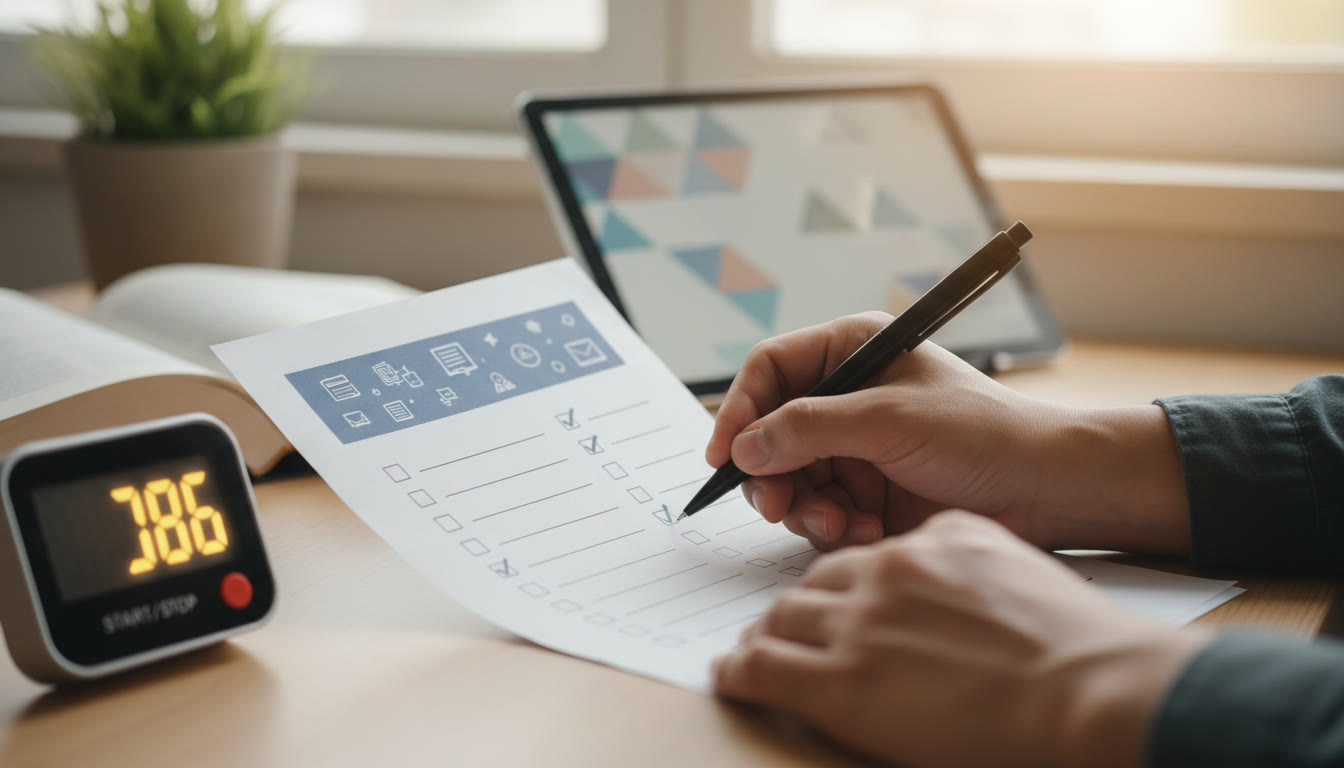
Memorize two simple, universal checklists that you use in every exam: one for before you start writing, and one for the final five minutes.
-
Pre-answer checklist
- Read the paper instructions and total marks.
- Underline command terms and constraints (“compare”, “without calculator”, “in context of”).
- Allocate time by marks and decide your order of attempt.
- Write a tiny plan for each long answer before you start.
-
Final five-minute checklist
- Check units, labels, and graph axes.
- Ensure every question has a clear final answer box or sentence.
- Recalculate any arithmetic that felt shaky.
- Make sure you answered exactly what was asked, not what you expected.
Subject-specific traps and quick fixes
Different subjects have predictable weak points. Below are common slips and a short, practical fix for each.
Mathematics (SL/HL)
- Common slip: Missing units, sign errors, incorrect rounding.
- Quick fixes:
- Write units after every intermediate result when applicable.
- Use a two-column scratch method: left for calculations, right for small comments (“units”, “assumption used”).
- Box final answers so the examiner can easily find them and you can be sure nothing important is hidden in the work.
Sciences (Biology, Chemistry, Physics)
- Common slip: Wrong significant figures, missing experimental context, labelling errors on diagrams.
- Quick fixes:
- Adopt a habit of annotating diagrams immediately and labelling axes before plotting.
- When a question asks for an explanation, start with a one-sentence claim, then add two supporting points — that structure reduces rambling and missed marks.
Languages and Literature
- Common slip: Misreading the rubric or misapplying a literary term.
- Quick fixes:
- Underline the required focus (text, theme, or character) and plan a succinct thesis before writing.
- Use a margin checklist: thesis, quote(s), analysis, link back to the question.
TOK and Extended Essay
- Common slip: Weak linking to knowledge questions or unclear methodology in the EE.
- Quick fixes:
- For TOK, always link arguments back to the knowledge question; write the link line early in each paragraph.
- For the EE, use a short template for each paragraph: claim, evidence, explanation, connection to research question.
Exam-week logistics and rituals
Exam week is as much about logistics as it is about knowledge. Little organizational details either save your energy or eat it.
- Pack your bag the evening before: pens, spare calculator battery, approved calculator, ruler, watch, ID, water bottle, and a printed exam timetable.
- Have a simple clothes plan so nothing is worrying you the morning of an exam.
- Plan meals that are familiar and balanced; avoid heavy or unfamiliar foods before a morning paper.
- Keep a short, flexible sleep schedule: a consistent bedtime and wake time for the exam period is better than last-minute all-nighters.
Exam-day techniques to avoid careless errors
On the day, follow a steady sequence of actions that reserve mental energy for thinking, not remembering what comes next.
- First five minutes: Skim the paper, note the total marks, circle the highest-mark questions you understand, and allocate time. If calculators are restricted, mark those questions in a special way so you don’t accidentally use one.
- While answering: Use short planning lines for essays and multi-step problems. If you’re doing a long numerical question, write the formula first and label your variables — that reduces algebraic slips.
- Cross-check half-way: When you finish one section, run a quick sanity check: does your answer magnitude make sense? (E.g., an energy value shouldn’t be negative in a context where it’s impossible.)
- Five-minute wrap: Use your final five-minute checklist to hunt down slipped units, unlabeled diagrams, and omitted justifications.
Mental strategies and staying calm
Working under pressure is a skill. Build small anchors that help you stay steady when time is tight.
- Breathing technique: 4-4-8 (inhale 4, hold 4, exhale 8) for 60 seconds before starting a paper to lower the heart rate.
- Two-minute resets: If you feel panic rising during an exam, close your eyes for 20 seconds, center, and scan your checklist.
- Micro-goals: Break the paper into chunks (e.g., finish question 1 set, then question 2 set). Reward completion with a slow breath — this combats rushing.
How to practice error-checking effectively
Checking is a learned, time-efficient skill. Practice checking the same way you practice problem solving.
- After a practice paper, spend 25% of your revision time only checking and annotating mistakes rather than re-doing entire papers.
- Create a ‘‘stupid-mistake’’ drill: pick three frequent errors and do ten short problems that force you to apply the correct check each time.
- Get someone else to mark one practice answer for clarity — what confuses another reader often confuses an examiner too.
Quick reference: common mistakes, immediate fixes
| Mistake | Immediate Fix | Apply When |
|---|---|---|
| Bad units | Write units on every line that contains a numeric result | Numerical physics/chemistry/math problems |
| Misread command term | Underline the command term and restate the task in one sentence | Essay and short-answer questions |
| Arithmetic slip | Recompute a key intermediate result independently (reverse-check) | Any multi-step calculation |
| Unclear diagrams | Label axes, units, and a short caption with the conclusion | Data response and experimental questions |
| Missing structure in essays | Write a 1-line paragraph plan before you expand | Long-response and essay questions |
How one-on-one guidance can fit into this plan
Some students benefit from targeted coaching around the particular mistakes they repeatedly make. A tutor can help translate your error bank into weekly drills and can simulate timed checks with you. If you choose to bring in guided support, make sure it focuses on:
- Turning your error log into focused practice.
- Running timed mocks with realistic checking slots built in.
- Creating a personalized exam-week routine that respects your sleep and concentration rhythms.
For example, Sparkl‘s personalized tutoring can provide 1-on-1 guidance, tailored study plans, expert tutors, and AI-driven insights to help you practice the exact checks that matter most in your subjects. When used to reinforce the roadmapped habits above, guided tutoring becomes a tool for efficiency rather than a shortcut.
Sample 48-hour pre-exam checklist
- 48 hours: Complete one timed paper in exam conditions; note major mistakes and create three targeted micro-drills.
- 24 hours: Light review of flashcards and formula sheets; pack bag and check logistics; no new topics.
- 12 hours: Short, gentle review of error log and one breathing session; avoid screens an hour before bed.
- 2 hours: Calm meal, hydrate, light movement; rehearse pre-answer checklist mentally.
- On arrival: Place ID and watch where you can see them; spend first five minutes scanning the paper.
Putting it all together: sample weekly plan in the final months
Here’s a compact weekly routine that mixes revision with checking practice. Adapt the hours to your timetable.
- Monday: Targeted micro-drills (45 minutes) + 15-minute error-log review.
- Tuesday: Timed past-paper section (90 minutes) + 30-minute checking practice.
- Wednesday: Content review (60 minutes) focused on misunderstood concepts.
- Thursday: Mock practice under exam conditions (full or partial) and post-mock analysis.
- Friday: Light review and mental reset, focus on sleep hygiene.
- Weekend: Consolidation — one timed paper or two long-response practice essays, plus peer or tutor feedback.
Final notes on mindset and growth
Reducing silly mistakes is not about perfection; it’s about predictable improvement. Replace self-criticism after an error with an exact, small fix: write it in your error bank and schedule one drill that week. Over time, your brain will trade reactive friction for automated checks. That is where marks are quietly won — in the tidy routines that strip pressure away from competence.
Academic rigor and calm preparation build together: a two-year roadmap, regular error-focused practice, a handful of exam-day rituals, and intentional rest will make the difference between knowing something in a panic and showing it clearly when it matters most. Good exam technique is not an afterthought; it’s a core part of subject mastery.
Approach each paper with the checklist mindset: read slowly, answer deliberately, and check consistently. The smallest habits — units on a line, a boxed final answer, a one-line plan — protect the work you already know and turn your knowledge into the marks you deserve.





















No Comments
Leave a comment Cancel