
IB DP Passion Projects: High-Signal Ideas for STEM Students
Passion projects are where curiosity meets credibility. For IB Diploma Programme STEM students, a well-chosen project does more than fill a CAS checklist — it becomes the clearest piece of evidence that you can design, iterate, measure and reflect. That’s the skill set universities and employers notice: technical competence wrapped in intentional planning and rigorous reflection.
Why “high-signal” projects matter (and how they differ from noise)
A high-signal passion project is one that communicates — quickly and honestly — what you learned, how you solved problems, and what impact you made or measured. It’s not the flashiest thing you can imagine, nor is it the simplest checkbox task. Instead, it scores high on clarity, replicability, evidence, and reflection.
- Clarity: a focused question or problem statement that guides decisions.
- Replicability: a clear method or process so someone else could follow your steps.
- Evidence: measurable outputs (data, code commits, photos, user tests) rather than vague claims.
- Reflection: documented learning linked to CAS learning outcomes and the IB learner profile.
What reviewers actually want to see
Whether it’s your CAS supervisor, a university admissions tutor, or a referee, people scan for authenticity and rigour. They want to know: Did you take initiative? Did you adapt when things went wrong? Did you learn new methods? Can you demonstrate outcomes with artifacts? Design projects that make these answers obvious.
Top high-signal passion project ideas for IB DP STEM students
Below are practical, field-tested directions that balance STEM learning, CAS outcomes and portfolio-worth evidence. For each idea I’ll explain what makes it high-signal, the core skills you’ll develop, and the types of artifacts that build a strong portfolio.
1. Community Air-Quality Network
Build a small network of low-cost sensors to measure particulate matter and temperature across different micro-environments (school grounds, playgrounds, near busy roads). Collect data over time, visualise trends, and write reflective analysis about sources, limitations and mitigation ideas.
- Why it’s high-signal: measurable data over time, clear methodology, direct community relevance.
- Skills: electronics (microcontrollers), data cleaning, time-series analysis, visualisation.
- Evidence: raw CSV logs, charts, photos of sensor deployments, a short technical report.
2. Low-Cost Open-Source Lab Equipment
Create an affordable open-source design for lab gear (e.g., a LED fluorescence adaptor for a phone microscope or a low-cost centrifuge). Document the design process, safety considerations, and validation against a standard protocol.
- Why it’s high-signal: design + validation shows engineering thinking and scientific rigor.
- Skills: CAD or prototyping, materials selection, bench testing, safety and ethics.
- Evidence: design files, build photos, test results, annotated build guide.
3. Assistive Technology Prototype
Develop a simple prototype that increases accessibility for a real person — for example a low-cost input device for a student with limited hand mobility. Conduct user testing and iterate based on feedback.
- Why it’s high-signal: human-centred design with measurable user outcomes and ethical reflection.
- Skills: prototyping, user research, iteration, empathy-driven testing.
- Evidence: user test videos, pre/post usability data, design iteration log.
4. Citizen-Science Biodiversity Survey
Run a biodiversity monitoring project using transects, camera traps or smartphone observations with community volunteers. Analyse species counts, seasonal patterns or habitat associations.
- Why it’s high-signal: long-term data collection and community engagement demonstrate responsibility and scientific process.
- Skills: field sampling, species ID, statistics, volunteer coordination.
- Evidence: datasets, identification keys used, training materials, outreach photos.
5. Open Educational App or Interactive Simulation
Build a small web or mobile app that explains a STEM concept (e.g., an interactive physics simulator). Focus on pedagogy — how the app helps learners — and measure engagement with simple analytics.
- Why it’s high-signal: code + pedagogy + measurable usage signals make impact tangible.
- Skills: software design, UI/UX, basic analytics, educational design.
- Evidence: repo commit history, usage screenshots, short user feedback summary.
6. Robotics for Service
Design a robot that solves a small, genuine service task around campus — delivering supplies, assisting with library returns, or automating a repetitive task. Document design choices and safety checks.
- Why it’s high-signal: physical build + proof-of-concept demonstration is very tangible.
- Skills: mechanics, control systems, testing, teamwork.
- Evidence: demonstration video, CAD files, control code, risk assessment.

7. Renewable Energy Microproject
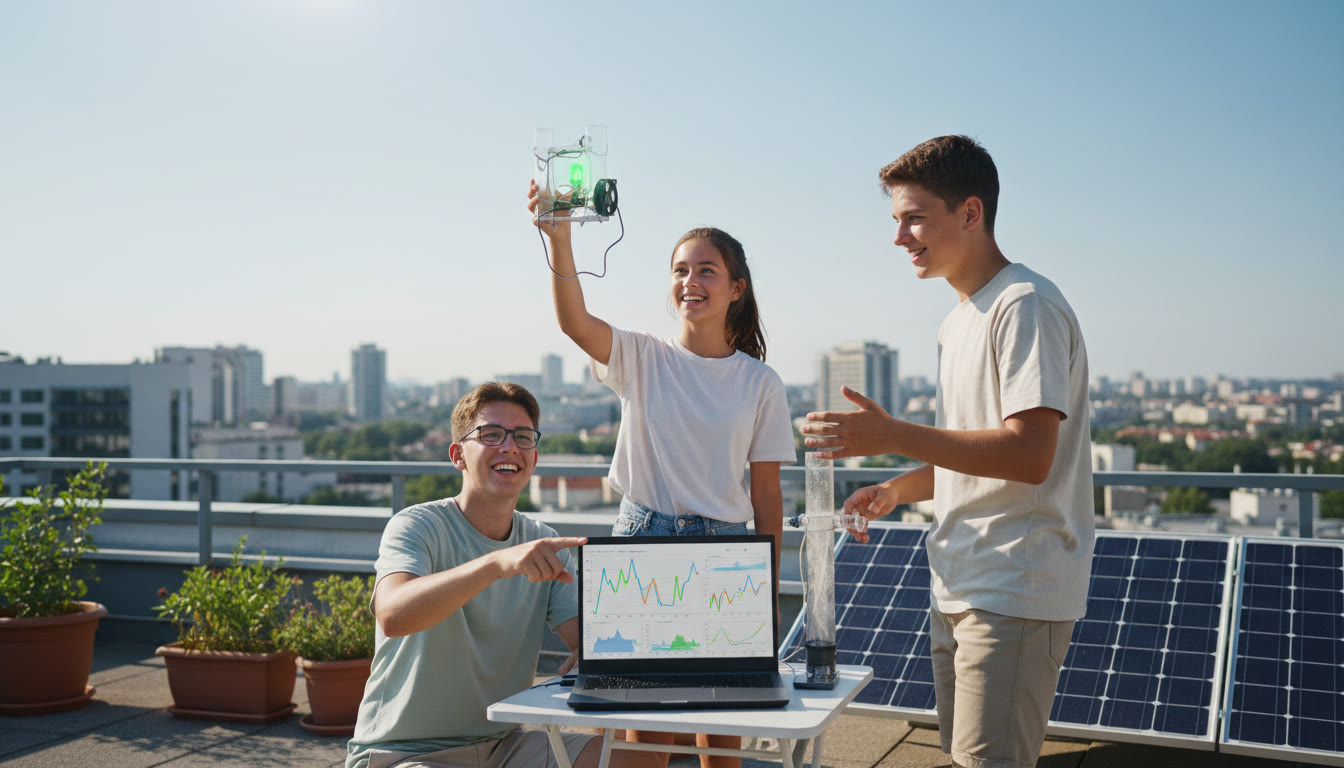
Install a small solar charging station for a community space or design a solar tracker to increase panel efficiency. Measure energy produced and reflect on the design trade-offs.
- Why it’s high-signal: measurable energy outputs plus sustainability narrative.
- Skills: circuit design, power calculations, data logging, sustainable engineering thinking.
- Evidence: energy logs, wiring diagrams, reflection on environmental impact.
8. Computational Modelling and Data Science Study
Use mathematical modelling or statistical analysis on an accessible dataset (local transport patterns, school energy use, environmental measurements). Focus on hypothesis-driven analysis and reproduce your steps in code.
- Why it’s high-signal: reproducible code + clear hypotheses show rigorous scientific practice.
- Skills: statistics, coding (Python/R), model validation, communication of uncertainty.
- Evidence: notebooks, datasets, model diagnostics, interpreted plots.
9. Soil and Water Quality Longitudinal Study
Collect samples over several months to test for pH, nitrates, turbidity or contaminants at multiple sites. Link results to land use or weather patterns.
- Why it’s high-signal: longitudinal sampling and methodical analysis show discipline and careful recordkeeping.
- Skills: lab techniques, sampling design, statistical comparison, mapping results.
- Evidence: lab notebooks, maps, supporting raw data files, SOPs followed.
10. Bioinformatics Mini-Research Project
Analyze public genomic or ecological datasets to answer a focused question, clearly state assumptions, and validate findings with robust checks.
- Why it’s high-signal: computational biology projects show cross-disciplinary competence and careful interpretation.
- Skills: sequence analysis or data wrangling, scripting, reproducible pipelines.
- Evidence: scripts, pipeline documentation, interpretation write-up.
11. IoT Smart Garden
Build an automated garden using sensors and actuators to optimise plant growth. Use data to compare different watering or light regimes and present results.
- Why it’s high-signal: merges hardware, biology and data analysis — tangible outcomes and repeatable experiments.
- Skills: sensors, microcontrollers, experimental design, basic machine learning for pattern recognition.
- Evidence: sensor logs, growth charts, build photos, user guide for maintenance.
12. Ethical AI Analysis Project
Examine a simple machine learning pipeline for bias or fairness in a small dataset relevant to your community. Propose mitigation strategies and test their effects.
- Why it’s high-signal: ethical engagement plus practical testing demonstrates maturity and reflexivity.
- Skills: ML basics, fairness metrics, critical analysis, policy-aware reflection.
- Evidence: notebooks, fairness metrics, a clear “before and after” mitigation analysis.
Quick comparison table: project snapshot
| Project Idea | Core STEM Skills | CAS Learning Outcomes Addressed | Estimated Time | Portfolio Artifacts |
|---|---|---|---|---|
| Community Air-Quality Network | Electronics, data analysis | Planning, perseverance, global issues | 3–6 months | Data logs, charts, deployment photos |
| Open-Source Lab Equipment | Prototyping, testing | Initiative, problem-solving, ethics | 2–4 months | Build files, test results, guide |
| Assistive Tech Prototype | User research, prototyping | Collaboration, service, ethics | 3–6 months | User tests, iteration log, video |
| Educational App | Software design, pedagogy | Initiative, skills development | 2–5 months | Code snapshots, analytics, feedback |
Aligning projects with CAS learning outcomes and the learner profile
High-signal STEM projects naturally map to CAS outcomes when you plan explicitly. Always write a short map that links a project activity to the formal CAS outcome. For example:
- Designing a test plan = demonstrates planning and initiative.
- Overcoming a failed prototype = shows perseverance and reflection on strengths and weaknesses.
- Running community testing = demonstrates engagement with wider issues and collaboration.
Frame your reflections so each major milestone answers: what did I do, what did I learn, and which CAS outcomes does this demonstrate? That makes supervisor sign-off and external review straightforward.
A practical roadmap: from idea to portfolio-ready
Turn ambition into evidence with a simple, repeatable roadmap you can apply to any project.
- Step 1 — Narrow the question: state a 1–2 sentence problem or research question.
- Step 2 — Plan and scope: list materials, methods, milestones and a realistic timeline.
- Step 3 — Run small experiments or prototypes quickly to validate assumptions.
- Step 4 — Collect evidence deliberately: photos, raw data, annotated commits or lab entries.
- Step 5 — Reflect regularly: short weekly logs and a substantive mid-project reflection.
- Step 6 — Validate and iterate: peer testing, supervisor feedback, adjusted methods.
- Step 7 — Final synthesis: a final reflection that links learning to CAS outcomes and learner profile attributes.
Keep a simple folder structure for your portfolio: a one-page summary, methods and timeline, raw evidence folder, and a reflections document with date-stamped entries.
Documentation and storytelling: how to build a standout portfolio
Documentation turns work into a story. Think of your portfolio as a narrative with clear evidence nodes. Each node should have:
- A timestamped artifact (photo, dataset, code commit).
- A short caption describing purpose and outcome.
- A reflection paragraph linking the artifact to learning outcomes and next steps.
Examples of strong artifacts: geotagged photos of deployments, time-stamped lab notebook PDFs, annotated code snippets, short demonstration videos, user-feedback forms, and supervisor endorsements. Avoid piling everything into a single document — keep pieces modular and easy to browse.
Sample reflection prompts that actually work
Reflections should be concrete and evidence-based. Use prompts like:
- What was the most unexpected obstacle, and how did you respond?
- Which technical skill did you develop, and how can you measure that improvement?
- How did your work affect others, and what did you learn from their responses?
- Which CAS outcomes does this activity address, and why?
Short example reflection (100–150 words):
“When our initial sensor readings showed inconsistent values across identical units, I realised our build process introduced variability. I designed a calibration routine using a controlled reference and re-tested three units. The calibration reduced variance by 40% and taught me the importance of reproducible assembly and documentation. This project improved my data-cleaning skills and demonstrated perseverance when the first method failed. It aligns with CAS outcomes around planning, perseverance and developing new skills.”
Translating project work for admissions and interviews
Universities want concise evidence. Use a one-line summary plus three bullet points on your CV or application:
- One-line: “Designed a community air-quality network and analysed six months of data to identify peak pollution periods near school grounds.”
- Bullets: skills (electronics, Python), measurable outcome (reduced data variance, or number of sensors deployed), and community impact (workshop or school briefing).
During interviews, focus on decision points: Why did you choose a particular method? What did you change when something failed? That level of process detail signals maturity.
Where targeted support helps — mentoring, labs and tutoring
Some parts of projects benefit hugely from one-to-one guidance: experimental design, statistical methods, or polishing reflections. When you need structured feedback on sequencing experiments or need help turning messy data into clear figures, targeted tutoring can accelerate progress and help you produce portfolio-ready artifacts. For example, Sparkl‘s personalized tutoring offers focused 1-on-1 guidance, tailored study plans, expert tutors and AI-driven insights that can help you clarify aims, debug code, or craft rigorous reflections — all without undermining your ownership of the work.
Common pitfalls and how to avoid them
- Over-ambitious scope: pick a narrow, testable question and iterate rather than trying to do everything at once.
- Poor documentation: capture evidence as you go instead of attempting a retrospective compilation.
- Lack of reflection: short, dated reflections beat long, generic summaries every time.
- Ignoring ethics and safety: always document risk assessments and consent when people are involved.
Final academic note
High-signal IB DP passion projects for STEM students are those that combine focused inquiry, measurable evidence and disciplined reflection. By narrowing your question, documenting every step, mapping activities to CAS outcomes and communicating results clearly, your project will stand out as a genuine demonstration of inquiry, skill and academic integrity.
















No Comments
Leave a comment Cancel