

Balancing Accuracy and Speed for a 99 Percentile in JEE
You’ve probably heard the phrase a thousand times: speed alone won’t get you to the top, but accuracy without tempo will leave unattempted marks on the table. For the JEE aspirant aiming for the 99 percentile, that balance isn’t a vague idea — it’s a disciplined habit you build, hour by hour, mock by mock. This article breaks that habit down into clear, practical steps: how to train your brain to think fast and right, how to structure mock tests and analysis, and how to tweak tactics for physics, chemistry, and biology so each minute counts.

Why accuracy and speed must be trained together
Think of speed and accuracy as two muscles that support one movement. If you push speed without the stabiliser of accuracy, you’ll make careless errors and suffer negative marking. If you obsess over perfect solutions for every question, you’ll run out of time. For JEE — an MCQ-based exam taken in a 3-hour window with negative marking and strict answer discipline — both qualities matter. Tests in this category reward selective aggression: picking the right battles and executing them reliably.
The examination environment enforces certain realities you cannot ignore: strict time limits, negative marks for incorrect attempts, and a format that demands clear final answers (no partial credit for descriptive work). Practice must therefore simulate those constraints so your instincts in the real test are tuned to the correct balance of caution and pace.
Core principles to accept before you act
- Quality of attempts beats quantity of frantic guessing.
- Speed is trained in small bursts; accuracy is strengthened by reflection.
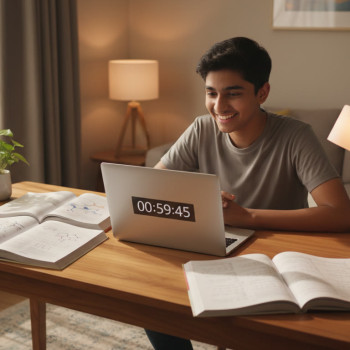
- Every mock must mimic the real conditions: a full 3-hour run, single sitting, and disciplined answer entry (OMR-like rules if practicing on paper).
- Use the syllabus alignment — Physics, Chemistry, and Biology — as a guide to allocate practice time logically across concepts.
How the test format shapes your strategy
Understanding the format is non-negotiable. JEE-style examinations are time-boxed MCQ tests where a correct response scores positively and a wrong one costs you. Many aspirants also practice on OMR sheets offline; that practice builds a habit of careful marking and double-checking, which helps prevent silly mistakes even in computer-based testing. Also remember: diagrams, derivations, and neat notes are vital study tools — they help you learn and retain — but they are not answers you can parcel into the MCQ system as partial credit.
What to simulate in every full-length mock
- Strict 3-hour timing without interruptions.
- A real attempt discipline: if you’re using paper for practice, mark answers OMR-style to train your hand and attention.
- Negative-marking awareness: treat each guess as a conscious decision.
- Full syllabus coverage across Physics, Chemistry, and Biology; track which concepts cost you time or marks.
Concrete strategies to increase accuracy without sacrificing speed
These tactics are practical and repeatable. Adopt one at a time, measure the effect, then lock it in.
1. The ’30-second check’ for every question
When you first read a question, spend 30 seconds to identify its type: routine, application, multi-step, or trap. If it’s routine, attack it. If it’s multi-step and you’re not immediately confident, mark it for review and move on — unless the question is quick to solve. This decision rule prevents early-time clogging.
2. Use elimination aggressively
MCQs reward informed elimination. Even if you cannot derive the full solution, discarding one or two options increases the expected value of a calculated guess and saves time. Learn common distractor patterns (dimensionally inconsistent options, sign errors in algebraic manipulations, misapplied formulae) so elimination itself becomes fast.
3. Train micro-sprints for speed
Speeding up is not about racing through whole tests; it’s about micro-sprints. Use 10–20 minute bursts focused on one concept or one question type (for example, kinematics problems with variable acceleration). Time yourself, aim to maintain accuracy above a predefined threshold, and then repeat until speed climbs without accuracy slipping.
4. Build a ‘must-know’ list and memorize engineered shortcuts
There are recurring formulae, standard integrals, solubility rules for chemistry, and common biological pathways that show up often. Keep a compact sheet of these and practice until recalling them is automatic. Automatic recall reduces cognitive load and buys time for reasoning on harder questions.
5. Adopt a disciplined marking ritual
Create a short checklist you run through before finalizing any answer: unit/scale check, sign check, plausibility estimate, and quick elimination sanity. This ritual takes 6–8 seconds and cuts careless mistakes dramatically.
Daily and weekly practice plan that builds both muscles
A consistent routine wins over last-minute sprints. Here’s a simple weekly template that balances concept practice, speed drills, and full mocks.
- Daily (2–3 hours): 45–60 minutes of focused concept work; 30 minutes of problem sets; 30 minutes of timed micro-sprints.
- Twice a week: one longer session (2–3 hours) solving mixed-question sets under near-test timing.
- Weekly: one full-length 3-hour mock in strict conditions, followed by analysis.
- Monthly: simulated exam morning routine plus performance diagnostic across topics.
When analyzing practice, always separate errors into categories: conceptual gaps, calculation slips, reading mistakes, and timing failures. Track them in a simple table and target the largest two categories for the next week.
Sample time allocation and attempt strategy (illustrative)
Below is a hypothetical table that illustrates how you might allocate 180 minutes across three subjects, with example attempt and accuracy targets. This uses an illustrative scoring model (for example practice purposes) to show how accuracy affects net score. Treat it as a planning tool, not an absolute rule.
| Section | Questions (illustrative) | Time Allocated (mins) | Average Time per Question (mins) | Target Attempts | Target Accuracy |
|---|---|---|---|---|---|
| Physics | 30 | 60 | 2.0 | 22–26 | 85%+ |
| Chemistry | 30 | 55 | 1.8 | 24–28 | 88%+ |
| Biology | 30 | 50 | 1.6 | 20–25 | 90%+ |
Note: The above numbers are illustrative. The core idea is to aim for high accuracy on a large portion of attempted questions, and to reserve time for high-yield review and difficult items.
Section-wise tactical pointers
Physics
- Prioritize conceptual clarity: once a concept is clear, many questions become routine and quick.
- Practice recognizing classic templates: energy conservation, kinematics patterns, and circuit equivalences.
- Use dimensional checks and limiting-case reasoning to catch algebraic slip-ups fast.
Chemistry
- Memorize key reactions, common reagents, and periodic trends for quick eliminations.
- Organic synthesis and reaction outcome questions are often pattern-based; practice mental mapping of functional groups.
- In physical chemistry, practice numerical techniques and approximation so calculations are fast and reliable.
Biology
- Focus on high-frequency topics and mechanism summaries that can be recalled as short sequences.
- Diagram-based recall helps: converting a paragraph into a small flowchart can save time during the test.
- Train to spot distractors where options include superficially correct facts but wrong context.
Mock-test methodology: run it like the real thing, analyse like a scientist
Quality of mocks matters more than quantity. A few intense, well-analysed full-length tests will beat dozens of casual attempts. Follow this cycle:
- Run a 3-hour mock in real conditions. No phone, same time of day you’ll take the exam, same breaks (if any).
- Immediately after the mock, note first impressions: energy levels, where time bunched, and questions left for review.
- Next day, do a structured analysis: log each question you missed, annotate the cause, and write a short corrective plan (example: re-study chapter, redo 10 similar questions, practice micro-sprints).
- Track improvements across tests. If careless mistakes persist, reduce speed targets slightly and increase accuracy drills until mistakes fall below a threshold you set.

How to read scores in a meaningful way
Rather than treating percentage or percentile as the only metric, break performance down into: net score per section, accuracy rate (correct/attempted), attempted:unattempted ratio, and error categories. A high net with low raw attempts indicates efficient selection. A high raw attempt with low accuracy signals a need to sharpen elimination and reading skills.
Common pitfalls and quick fixes
- Overattempting while accuracy is low: Pause and drop your attempt target for a week; focus on accuracy drills and re-evaluate.
- Spending too long on early questions: Use the 2-minute rule. If stuck beyond that, mark and move — come back if time allows.
- Ignoring silly mistakes: Keep an error log. If a category appears repeatedly, design a micro-exercise to eliminate it.
- Panic-driven guessing: Convert guessing into informed elimination or skip; random guessing increases negative marks and stress.
When personalized guidance helps: making targeted leaps
Some plateaus respond well to outside help. If you find consistent errors in conceptual areas or your mock-to-mock variance is high despite disciplined practice, targeted 1-on-1 guidance can accelerate progress. For example, the right coach can identify the recurring thinking error causing calculation slips, or prescribe a tailored study plan that shifts practice mix from topic A to topic B.
If you choose to explore guided support, consider platforms that focus on individual diagnostics and provide tailored plans, expert tutors, and AI-driven insights that help prioritize weak areas efficiently. One option that fits this description is Sparkl‘s personalized tutoring, which emphasizes one-on-one guidance, tailored study plans, and data-driven recommendations to reduce wasted practice time and improve both speed and accuracy.
Quick checklist to run before any test day
- Sleep well the night before; fatigue kills precision.
- Warm up with 20–30 minutes of light, timed practice to enter test rhythm.
- Start with confidence by tackling a few quick wins in the first 20 minutes.
- Use your marking ritual before finalizing any answer.
- Reserve 10–15 minutes at the end for review of flagged questions, focusing on suspected calculation or reading errors.
Final thought: make the balance automatic
Moving from conscious balance to automatic balance is the final step. When you no longer agonize over whether to speed up or slow down — when your first instinct is the right one — you are operating at a level that produces 99-percentile outcomes. Build routines that enforce good habits: timed micro-sprints, strict mock-test rules, a habit of immediate analysis, and periodic recalibration of targets. Over time, those tiny improvements compound into a steady, reliable performance under pressure.
This is an academic conclusion: training accurate speed combines focused practice on core concepts, disciplined timing rituals, and methodical analysis of errors. By treating mocks as experiments and study time as targeted practice, you convert uncertainty into predictable gains.






















No Comments
Leave a comment Cancel