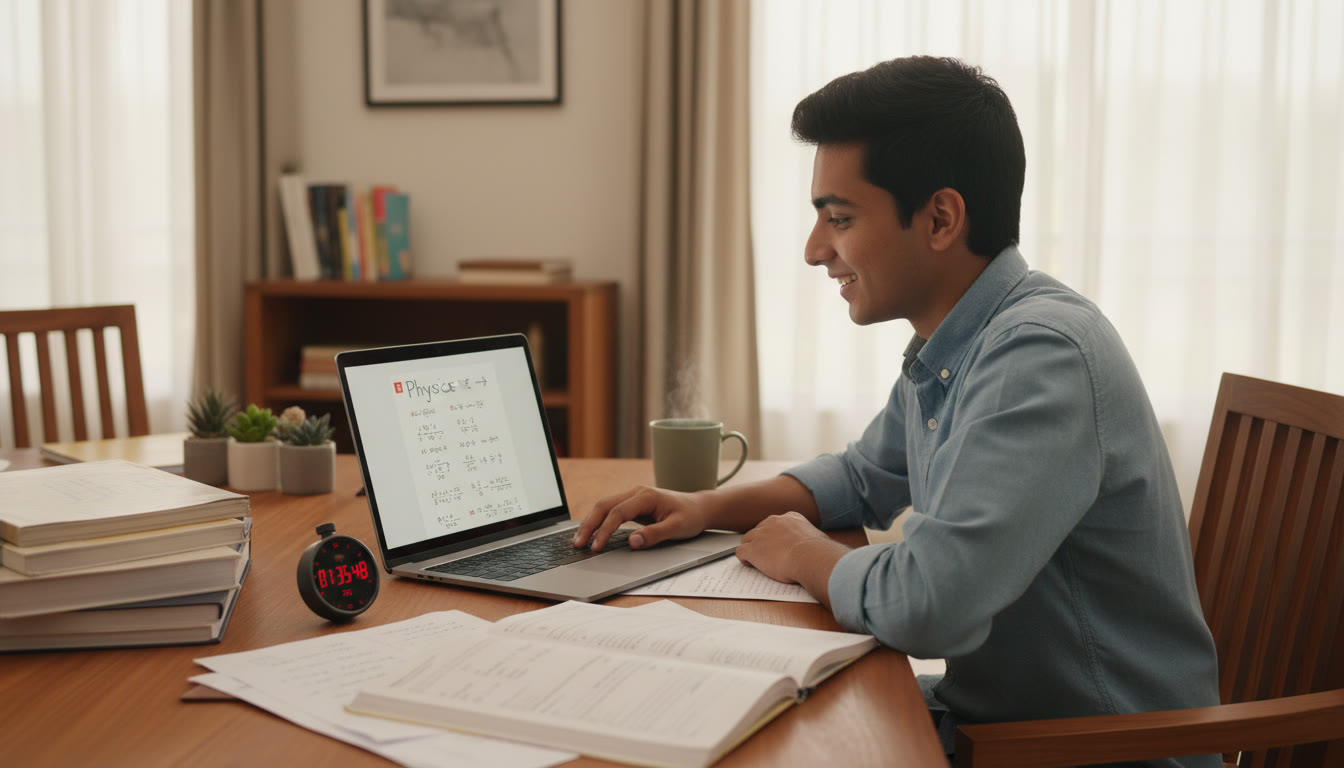

Best PYQ Strategy for JEE Main Preparation
Every student who sits for the JEE Main is looking for an edge: an approach that turns practice into predictable performance. Previous year questions, or PYQs, are not just practice problems — they are a map of what the exam actually values. When you use them the right way they teach you structure, timing, common traps, and the precise application of fundamentals. This blog will walk you through a practical, mock-centric PYQ strategy that dovetails with full-length 3-hour practice tests, the MCQ format, negative marking realities, and the disciplined approach you need for a computer-based exam. Think of this as the route from scattered attempts to a surgical, repeatable preparation routine.
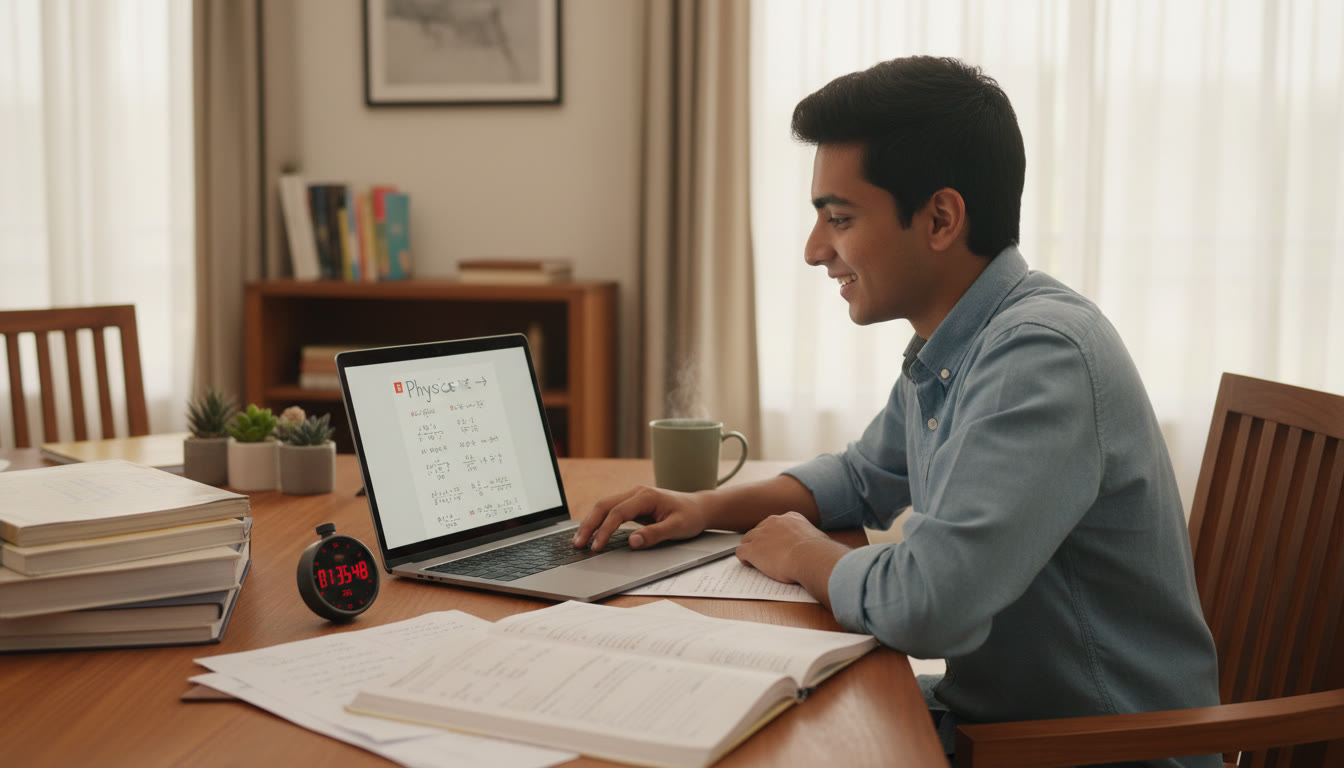
Why PYQs are your single most efficient resource
There are three reasons PYQs punch above other practice material. First, they reveal exam priorities: chapters that are tested often, the typical depth of questions, and the mix of conceptual versus calculation-heavy items. Second, PYQs compress the exam’s language and phrasing into real examples — learning to translate that language into equations and diagrams saves time on test day. Third, when you couple PYQs with regular 3-hour mock practice, they act like a mirror: you see not only which concepts you miss, but how you miss them (careless error, weak concept, or time pressure).
Understanding the JEE-style context
The test context shapes the best way to use PYQs. JEE Main is delivered as MCQ-style questions in a timed, single-session format that typically demands a three-hour sustained focus. There is negative marking on incorrect choices, and the exam is strictly objective — partial credit for descriptive steps is not awarded. Today the test is computer-based, so the care you apply to marking answers on an OMR sheet should translate into deliberate clicks, flagging strategies, and careful time checks in a mock computer interface. All study choices and PYQ techniques below assume the core syllabus of Physics, Chemistry, and Mathematics and the need to combine accuracy with speed.
How to choose and organize PYQs
Not all PYQs are equally useful. The selection of which questions to practice, and when, makes all the difference. Use this simple multi-axis filter when curating sets:
- Topic alignment: pick questions that match your weak topics and high-weight chapters.
- Difficulty spread: have a healthy mix of straightforward, moderate, and tough questions.
- Type coverage: include pure conceptual, multi-step calculation, assertion-reason, and matrix-match format items where applicable.
- Recency and pattern: spend more time on question-types or formats that appear repeatedly across cycles.
- Mock integration: always fold a PYQ set into a timed slot that imitates a test segment.
Here is a compact table that helps you decide focus and strategy for common topic clusters:
| Topic Cluster | Why it matters | PYQ Strategy |
|---|---|---|
| Mathematics – Calculus | High scoring, often multi-step | Practice graduated PYQs: warm-up short-answers, then one full-length problem under time |
| Physics – Mechanics | Concept-rich with clear modeling | Focus on free-body diagrams from PYQs and recreate assumptions before solving |
| Chemistry – Physical | Formula application and data analysis | Convert PYQs into mini data-interpretation drills and memorize key relations |
| Mathematics – Algebra & Coordinate Geometry | Frequent and time-efficient if patterns learnt | Compile pattern templates from PYQs and create one-line solution paths |
| Chemistry – Organic & Inorganic | Memory plus reasoning | Link PYQs to reaction maps and periodic trends; make quick recall cues |
The solve → analyze → fix → revisit loop
Good practice is not solving a lot of questions — it is learning from each question until the same error never repeats. Use this four-step loop for every PYQ you tackle.
- Solve: Attempt the question under timed conditions. If you are doing a batch, simulate a 15–30 minute block and treat it like part of a mock.
- Analyze: Mark whether the error (if any) was conceptual, procedural, arithmetic, or careless. Note how long each step took.
- Fix: Create a micro-task to address the root cause — a 10-minute revision note, a mini-drill of 5 targeted problems, or a short conceptual write-up.
- Revisit: Schedule the same question or a close variant into spaced revision after 3–7 days and again after two weeks.
Keep an error log with entries like: question ID, topic, error category, correction procedure, next review date. This log is the heart of focused improvement: over time the list shrinks and the quality of practice rises.
Sample 8-week PYQ-backed mock plan
Below is a practical plan that blends PYQs, focused learning, and regular 3-hour full-length mocks. Tailor the daily hours to your available study time and use the mock slot as a non-negotiable simulation of test day.
| Week | Focus & Goals | Daily Regimen | Mock / Assessment |
|---|---|---|---|
| 1 | Audit: 30 PYQs across topics; create error log | 1 hour PYQs, 1 hour concept fixes, 30 min revision | Short 2-hour sectional test |
| 2 | Topic blocks: 2 chapters practice each from PCM | Timed PYQ sets, plus 1 mock segment daily | Full-length 3-hour mock at weekend |
| 3 | Pattern recognition and shortcut building | Practice template problems and derivations | Analyze mock, refine error log |
| 4 | Consolidation and speed work | Daily 60–80 PYQs in short bursts, focused revision | Full mock; target time splits |
| 5 | High-frequency chapters deep dive | Targeted PYQ packs + conceptual mini-lessons | Adaptive mock focusing weaker sections |
| 6 | Mixed mocks and error-free goals | Two timed mock segments + error corrections | Full-length mock; simulate exam rules strictly |
| 7 | Revision loop and memory cues | Active recall: create flashcards from PYQs | Section-wise timed test |
| 8 | Final sharpening and stress control | Light PYQ solving, rest, and mental rehearsal | Final full-length mock under exam conditions |
How to approach PYQs during a mock
A mock is where strategy meets execution. Treat each 3-hour mock as an opportunity to practice exam mechanics as much as knowledge. Here are the mechanics to test and the checklist to follow during every mock:
- Simulate the exact time: a single uninterrupted 3-hour session with no phones or distractions.
- Use marking flags wisely: do a first pass for high-confidence solves, flag the rest for careful review.
- Maintain strict time boundaries: allot time per section and stick to it.
- Record metrics immediately after the mock: attempted count, accuracy, time per question, and top three error causes.
After the mock, resist the temptation to only look at your score. The score is the symptom; the analysis is the cure. Use the error log to partition mistakes into actionable buckets.
Time management and negative-marking tactics
Negative marking changes the arithmetic of guessing. Uninformed guesses are costly, but controlled eliminations can be profitable. Use this rule of thumb during an MCQ-based test:
- If you can eliminate two options decisively in a four-option question, the expected gain favors an educated guess.
- If elimination leaves you with three options, be cautious: the expected value falls and guessing becomes riskier.
- Avoid last-minute random guessing on whole sections — instead, earmark questions early in the test for a final targeted pass if time remains.
- Time investment per question: cap warm-up questions to 1.5–2 minutes on first pass; reserve 4–6 minutes for higher-difficulty flagged items on later passes.
Practice this arithmetic in mocks: calculate hypothetical score changes for different guessing strategies and use that feedback to calibrate your on-test risk appetite.
Turning PYQs into durable understanding
Solving a PYQ once is helpful; turning it into durable knowledge requires transformation. Convert each solved PYQ into one or more of the following:
- A two-line summary that captures the core trick or theorem used.
- A one-sentence ‘why this method’ justification that links the question to a syllabus node.
- A micro-drill: three variants of the question that change a parameter or condition.
This process builds a library of bite-sized concepts you can quickly review before a mock or on the morning of an exam section. Over time this pays off more than raw volume of practice.
Common traps PYQs expose — and how to fix them
PYQs are notorious for exposing recurring traps. Here are the most common and the fix you can apply today:
- Misreading units or signs — fix: always write units down during calculation and check signs at each step.
- Dropping assumptions — fix: start every physics problem by listing assumptions and boundary conditions.
- Over-long calculation paths — fix: learn and practice standard shortcuts from PYQs to trim algebra.
- Memory gaps in chemistry — fix: condense reaction maps into single-page cheat sheets for repeated review.
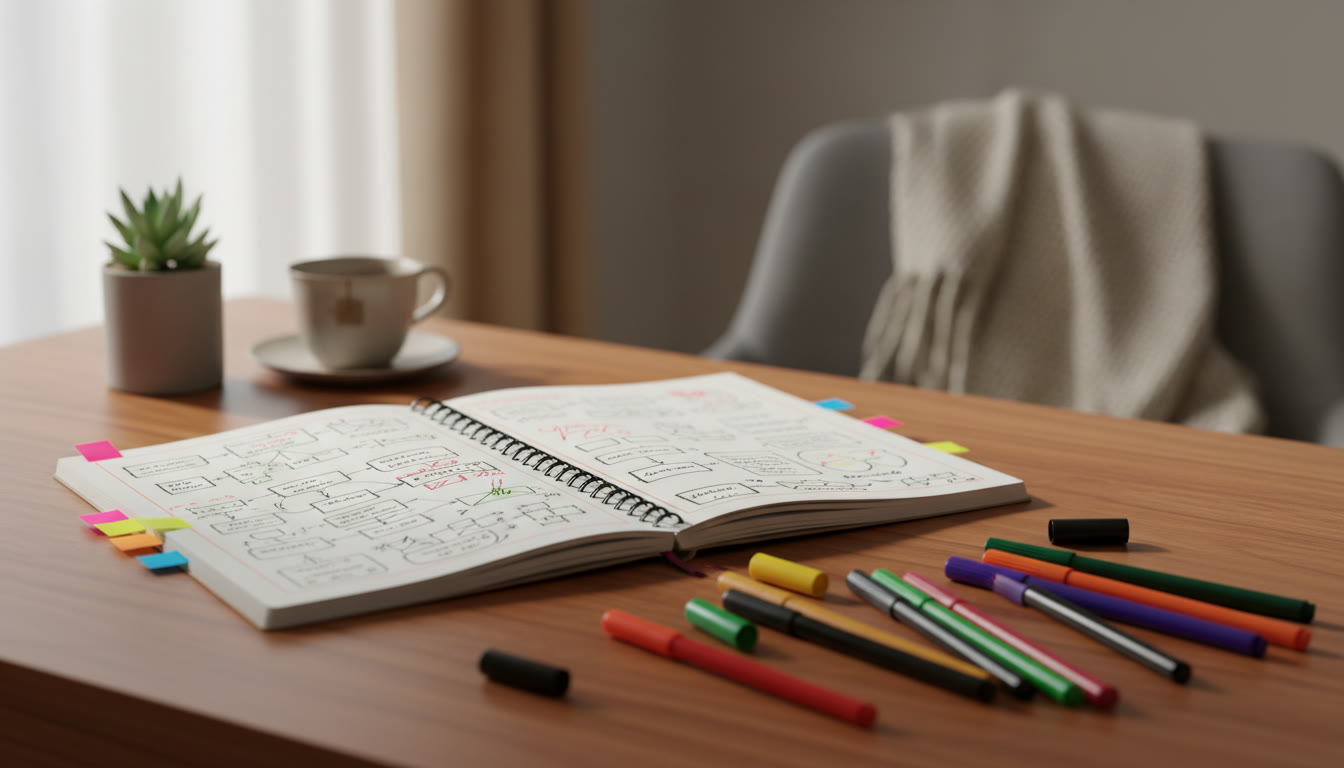
A worked example: turning a single PYQ into a mini-course
Pick one past-year question that gave you trouble. Read it twice and rewrite it in your own words in one sentence. Now create three variants: change a value, alter a boundary condition, or change the coordinate system. Solve each variant in a timed 8–12 minute slot. After each attempt, write a 2-line diagnosis: what concept carried the weight, what algebraic trick saved time, and what check would have prevented the error. Finally, create a single flashcard with the one-sentence summary on the front and the two-line diagnosis on the back. Schedule that card for active recall three days later, then again a week after. This tiny loop turns one failed attempt into a robust pattern you can apply across similar questions.
Spacing and interleaving — the small science behind retention
Human memory loves variety. Instead of blocking all calculus for three hours, alternate 30–45 minute PYQ sets across two subjects — for example, calculus and kinematics. This interleaving forces your brain to retrieve and apply different schemas and improves flexible problem selection on exam day. Use the error log to decide which pairs to interleave: pair a topic you are strong at with one you want to strengthen, and keep switching until both feel equally fluent.
When you hit a plateau
Plateaus are normal. When your weekly accuracy stalls or test scores hover despite more study, run a diagnostic. Reduce volume for a few days and focus on one high-leverage activity: either a deep concept revision, a set of micro-drills, or a comprehensive review of your top ten repeated errors. One-on-one analysis accelerates this process: targeted guidance and instant correction eliminate wasted practice cycles. If you seek guided, personalized support that blends expert tutors with analytics, consider the focused tutoring paths offered by Sparkl for tailored study plans and fast-tracked corrections.
Small daily habits that compound
Two minutes before bed: skim five flashcards derived from recent PYQs. Five minutes in the morning: solve a tiny 2–3 step numeric problem for speed. These micro-habits preserve problem fluency and keep key triggers at the frontline of memory. Combine this with weekly full-length mocks and your practice becomes durable, not brittle.
Tools and templates to keep your PYQ work sharp
Build a small toolkit you carry into every practice session. Templates remove indecision and make each minute count. Here is a simple error-log template you can recreate in a notebook or a two-column sheet.
| Question ID | Topic | Error Type | Root Cause | Fix (micro-task) | Next Review |
|---|---|---|---|---|---|
| PYQ-124 | Calculus – Mean Value | Conceptual | Unclear theorem conditions | Write one-page theorem checklist; 5 practice variants | +4 days |
| PYQ-87 | Physics – EM | Careless | Unit mismatch | Rework 3 similar problems with unit checks | +7 days |
Measuring progress: meaningful metrics
Stop measuring practice by hours or problem counts alone. Pick three metrics and track them weekly:
- Accuracy on PYQs attempted (percentage of correct attempts).
- Average time per question for each difficulty band.
- Error repeat rate — the percentage of errors that reappear after you thought they were fixed.
Those numbers tell you whether practice is getting deeper or just broader. Aim for steady improvements in accuracy and a falling error repeat rate; if time per question becomes sluggish, return to targeted speed drills.
Final practical checklist before any mock or PYQ session
- Clear objective: what chapter or skill will this session change?
- Timebox: set a fixed duration and a visible timer.
- Environment: test-like silence, no phone, and a fresh error log at hand.
- Post-mock reflection: 30–45 minutes to analyze mistakes and schedule fixes.
PYQs are not a silver bullet, but used properly they are the most efficient bridge between your current level and the performance you want. The combination of disciplined 3-hour mock practice, a surgical error-log routine, cautious negative-marking strategies, and repeated active revision converts one-off problem solving into durable exam skills.
Use each previous year question as a training microcosm: learn the framing, practice the rhythm, fix the microscopic errors, and deliberately rehearse until the solution paths become reflexive. Over time that reflex replaces panic with clarity on test day.
Consistency, structured reflection, and a focus on fixing the right mistakes are the true measures of progress.

















No Comments
Leave a comment Cancel