
Best Strategy to Crack JEE Main: A Practical Roadmap for the Upcoming Entry Cycle
Picture this: calm focus, a clear plan on your desk, and the confidence that comes from steady, deliberate progress. That’s the kind of preparation that turns nervous attempts into reliable performance. This guide is written for students who want a human, practical, and flexible strategy — not a rigid checklist. You’ll get mindset work, a phase-based schedule, subject-by-subject tactics, mock-test rhythm (including full-length three-hour practice), error-analysis technique, and revision routines you can actually follow.

Understand the exam landscape
Start by anchoring yourself in the reality of the exam you’re preparing for: JEE-style assessments are predominantly objective, with multiple-choice questions and numerical-type problems. Most cycles emphasize speed, precision, and conceptual clarity. Negative marking is a factor, so accuracy matters more than attempting every question at random. Full-length mock tests of roughly three hours are the most faithful practice — they build stamina, timing sense, and test-taking discipline.
Two practical implications: practice under timed conditions that match the real exam, and treat diagrams, derivations, and written notes as tools for learning — not as exam-answer requirements. Keep in mind the tested subjects are Physics, Chemistry, and Mathematics (PCM); tailor your strategy around those three pillars and avoid assuming descriptive/partial credit for incomplete answers.
Mindset first: small habits, big returns
Preparation is a marathon of consistency, not a sprint of last-minute intensity. A few mindset shifts matter more than 100 extra hours of noisy study:
- Adopt a growth mindset: mistakes reveal learning edges. Record them, review them, and reduce their recurrence.
- Prioritize depth before breadth: it’s better to own a core set of topics than to flit over many without consolidation.
- Set weekly, measurable goals: specific chapters, problem counts, or timed mock scores.
- Protect sleep and short breaks: mental stamina is non-negotiable for three-hour test performance.
A phase-based preparation plan (foundation → practice → polish)
Break your preparation into four sensible phases. Each has a clear primary goal so your energy is focused where it gives the most return.
| Phase | Primary goal | Key activities | Typical weekly hours (guide) |
|---|---|---|---|
| Foundation | Concept clarity | Grasp basics, clear doubts, build short notes | 18–25 |
| Consolidation | Apply concepts to problems | Chapter problems, topic-wise tests | 25–35 |
| Practice | Speed and accuracy | Full-length mocks, timed sectional practice | 30–40 |
| Revision & Polish | Retention and reliability | Active recall, quick notes, focused revision slots | 20–30 |
Adjust hours based on how far you are from your target exam window. The most important practice: regular, timed full-length mocks that mirror real test conditions (roughly three hours) and steady analysis of every mistake.
Subject-wise roadmaps
Physics: think principles, then problems
Physics rewards clear conceptual thinking. Start every chapter by anchoring core laws and physical intuition; then solve a progressive set of problems — easy, moderate, and finally advanced. When you hit a difficult problem, ask: which principle is in play? Translate the problem into equations, sketch a diagram, and simplify the system before plugging numbers.
- Make short “concept cards” for laws and typical setups (e.g., free-body diagrams, conservation conditions).
- Practice derivations until they feel natural; you don’t need to memorize every step, but know the starting assumptions and final relationships.
- Use numerical practice to build algebraic fluency and mitigates minor arithmetic errors that cost marks under negative marking.
Chemistry: three-fold approach
Chemistry splits naturally into Physical, Organic, and Inorganic. Treat each with a slightly different method:
- Physical Chemistry — practice numerical problems and understand the reasoning behind formulas; maintain a small formula-sheet and derive rather than memorize when possible.
- Organic Chemistry — try to visualize reaction mechanisms; practice pattern recognition for functional group behavior and standard reaction sequences.
- Inorganic Chemistry — build a compact set of recall notes for periodic trends, common reactions, and named facts; regular short reviews beat last-minute cramming.
Mathematics: technique, patterns, and disciplined practice
For Math, repetition is your friend. Cement fundamental methods first — algebraic manipulation, standard integrals, coordinate geometry frameworks. Then move to varied problem sets: learn to recognize patterns and the most efficient route to an answer because speed matters under time pressure.
- Maintain formula cards for quick revision, but focus study on problem-steps rather than rote formulas alone.
- Time yourself on typical problems so that you build a sense of which question types deserve more time during the exam.
Mock-test rhythm and error analysis
Mock tests are the engine of improvement; what you do after a mock matters more than the raw score. Make full-length three-hour mocks a weekly staple as you near the exam window. Alternate between sectional tests and full tests to build both stamina and focused speed.
How to analyze a mock test
- Record every mistake in an error-log (topic, reason, corrective strategy).
- Classify errors: conceptual, careless, time-driven, or misunderstanding the question.
- Make one small, concrete corrective action per mistake (e.g., rework the underlying concept, practice 10 similar problems, or slow down when transcribing answers).
- Track recurring weak topics and convert them into a short, high-frequency revision list.
On negative marking and answer discipline
Negative marking changes the calculus: a wild guess is rarely worth it. Develop a guessing policy: if you can eliminate one or two options, a calculated attempt might be justified; otherwise skip and return if time allows. In timed mocks, practice the habit of flagging questions rather than spending disproportionate time on any single item.
CBT and OMR discipline — practicing for the real interface
Although the primary mode of the exam is computer-based testing, some practice environments and earlier familiar models use OMR-style marking. You should simulate both:
- For CBT simulation: practice on a laptop or tablet, use mock interfaces that allow marking, unmarking, and navigating sections. This reduces nervousness and speeds decision-making during the real test.
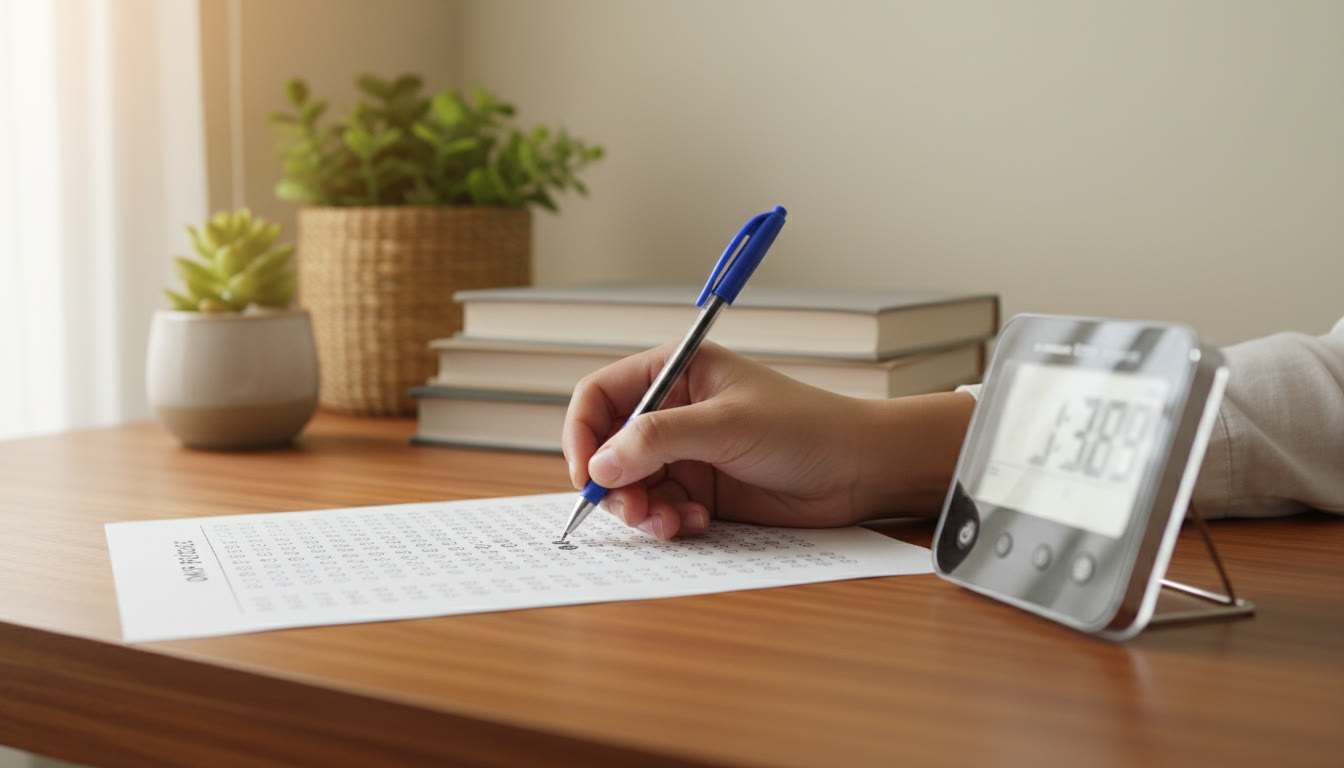
- For OMR practice: if you ever sit a paper-and-pen mock, treat answer-filling as sacred — avoid stray marks, fill bubbles fully, and practice fast, accurate shading to avoid avoidable errors.
In all cases, treat a three-hour practice as a mental endurance workout — schedule identical breaks, monitor nutrition, and simulate exam timing precisely.
Smart revision: active recall and spaced practice
Revision is not re-reading; it’s retrieving. Use quick recall techniques: flashcards for facts, closed-book problem solving, and timed mini-tests that force retrieval. Space your revisions so you revisit topics at increasing intervals — this is where retention grows without exponentially increasing time spent.
- Create one-page quick notes per chapter — these are your final-review artefacts.
- Practice problems under time constraints to maintain speed even during later revision cycles.
- Use the error-log to design 30-minute repair sessions focused only on your recurring weaknesses.
Sample weekly study schedule (example to adapt)
Below is a flexible template you can tailor: six focused study days with one lighter day to recharge. Swap hours and subjects based on your personal strengths and where you are in the phase-based plan.
| Day | Morning | Afternoon | Evening |
|---|---|---|---|
| Mon | Math – New topics (3 hrs) | Physics – Problem practice (2.5 hrs) | Chemistry – Concept review (2 hrs) |
| Tue | Chemistry – Numerical/Organic practice (3 hrs) | Math – Problem set (2.5 hrs) | Quick revision & error-log (1.5 hrs) |
| Wed | Physics – New topics (3 hrs) | Sectional timed practice (2.5 hrs) | Light review / relaxation (1.5 hrs) |
| Thu | Mock test or sectional test (3 hrs) | Mock analysis (2.5 hrs) | Targeted practice on mistakes (1.5 hrs) |
| Fri | Math – Advanced problems (3 hrs) | Chemistry – Inorganic recall (2.5 hrs) | Problem-solving drills (1.5 hrs) |
| Sat | Combined practice (2.5 hrs) | Revision of weekly highlights (2 hrs) | Plan next week & rest (1.5 hrs) |
| Sun | Light day: mental rest, short active recall sessions, exercise | ||
How targeted tutoring and tailored guidance can accelerate progress
Some students find a personalized touch accelerates learning: one-on-one guidance can diagnose the exact stumbling blocks, tailor practice volumes, and provide accountability. Sparkl‘s personalized tutoring, for example, combines tailored study plans with expert tutors and AI-driven insights to help prioritize weak spots and track improvement. If you use guided support, choose help that focuses on practice, error correction, and building independent problem-solving rather than simply delivering content.
Common pitfalls and how to avoid them
- Overdoing passive reading: replace re-reading with active problem solving and recall.
- Neglecting mocks: no single chapter-level drill fully prepares you for the rhythm of a three-hour test.
- Poor error analysis: a bad mock without correction is a confidence trap. Always fix the reasons behind mistakes.
- Unstructured last-minute cramming: rely on quick notes for late-stage revision, not wide-ranging new material.
- Ignoring health: consistent sleep, hydration, and light exercise improve focus and reduce careless errors.
Practical examples and micro-strategies
Two short examples that many students find useful:
- If you keep missing kinematics problems, spend a session converting word problems into free-body sketches and one-liners that identify which conservation or Newtonian law applies. Then practice five similar problems back-to-back.
- For organic sequences, write reaction chains on a single page and practice predicting the product before peeking at steps; this trains pattern recognition and reduces time spent reading long solution texts.
Final academic conclusion
The reliable path to top performance is clarity of concept, disciplined timed practice (including full-length three-hour mocks), targeted revision built on error analysis, and steady mental and physical care. Structure your preparation in clear phases, use mocks to refine strategy, and keep active recall at the heart of revision; together these practices transform steady work into dependable test-day performance.
















No Comments
Leave a comment Cancel