

Case Study: How Toppers Scored 99 Percentile in JEE Main
Introduction: what the 99 percentile actually feels like
There’s a certain hush around the phrase “99 percentile” — a shorthand for consistency, smart strategy, and exam temperament. But behind that number are repeatable habits, not magic. In this case study-style blog we’ll pull apart what top performers do differently: how they practice under realistic conditions, how they structure revision for Physics, Chemistry and Mathematics, and how they use timed mocks, disciplined OMR practice, and focused analysis to climb from a good score to an outstanding percentile.

Every topper’s story looks unique at first glance: one person thrives on late-night problem sets, another wins by steady morning practice. Under the surface, though, the building blocks are the same — concept clarity, calibrated practice, a strong mock-test regimen (three-hour full-length sessions that mimic exam conditions), and intelligent handling of negative marking and OMR discipline.
What 99 percentile really means — percentile vs percentage
Percentile is a relative measure: it places you among that test’s cohort, rather than reporting a raw percentage of marks obtained. A 99 percentile tells you that you scored equal to or better than 99 percent of test-takers in that session. Because paper difficulty and the candidate pool vary, toppers treat percentile as a guide to consistency, not an absolute trophy.
That distinction matters for preparation. Focusing on maximizing predictable gains (accuracy on standard topics, avoiding silly mistakes, and time management) is more effective than chasing high-difficulty outliers. Toppers prioritize predictable, repeatable scoring opportunities first — basic mechanics, high-yield topics, and routine calculations — then layer on advanced practice.
Common patterns among toppers
Daily habits that add up
- Concept-first study: Toppers spend time to understand why a method works, not just how to apply it. They use derivations and diagrams as learning tools to internalize principles.
- Micro-goals and rhythms: Small, measurable targets each study session (e.g., 10 concept checks, one timed set) make long-term progress trackable.
- Active revision: Reworking solved problems, teaching a concept to a peer, and using quick flash-recall for formulas are routines they repeat.
- Mock-test focus: Regular three-hour full-length mocks under timed conditions, with strict OMR-like discipline, mirror the exam’s mental load.
- Error logs: Every mistake is recorded with a short root-cause note: concept gap, careless error, time pressure, or interpretation issue.
- Recovery rituals: Short mental breaks, early-night sleep before mock days, and light physical activity keep stamina high.
Mindset and tempo
Toppers value steady tempo over bursts of frantic studying. They accept that consistent weekly improvements — when compounded — beat last-minute cramming. That means pacing topics, limiting distractions, and scheduling full mock tests at regular intervals to simulate exam fatigue and thinking under pressure.
Subject-wise tactics that top performers follow
Physics: build problem-pattern recognition
Physics success is about mapping problems to core principles. Toppers master a small number of problem archetypes in each chapter and practice variations until identification becomes automatic. They use diagrams liberally during revision as learning aids — not because the exam requires drawings, but because diagrams speed pattern recognition.
Chemistry: prioritize high-yield reactions and quick recalls
Chemistry is often the stabilizer in a topper’s scorecard because many questions reward fast, accurate recall rather than lengthy derivations. Toppers maintain tidy notes for reaction mechanisms and frequently practiced numerical shortcuts for physical chemistry.
Mathematics: accuracy and time-slicing
Mathematics requires both depth and speed. Top scorers are ruthless about selecting problems to practice: they move from straightforward, high-frequency Qs to tougher application problems, always timing themselves. They also keep a “go/no-go” sense on the test: if a question is taking too long, they mark and move on, returning only if time permits.
Sample subject time-allocation matrix (for a 3-hour full-length mock)
| Section | Suggested initial time (min) | Strategy focus |
|---|---|---|
| Physics | 55–70 | Quick conceptual Qs first, then calculation-heavy problems |
| Chemistry | 35–50 | Attempt organic/inorganic recall Qs first; numerical questions with care |
| Mathematics | 60–75 | Secure short problems early; mark longer derivations to revisit |
Use the table above as a starting template; toppers adapt these windows based on personal strengths. The core idea is to create a time cushion for revisiting marked questions in the final 20–30 minutes.
Mock tests: the single biggest leverage point
Why three-hour full-length mocks matter
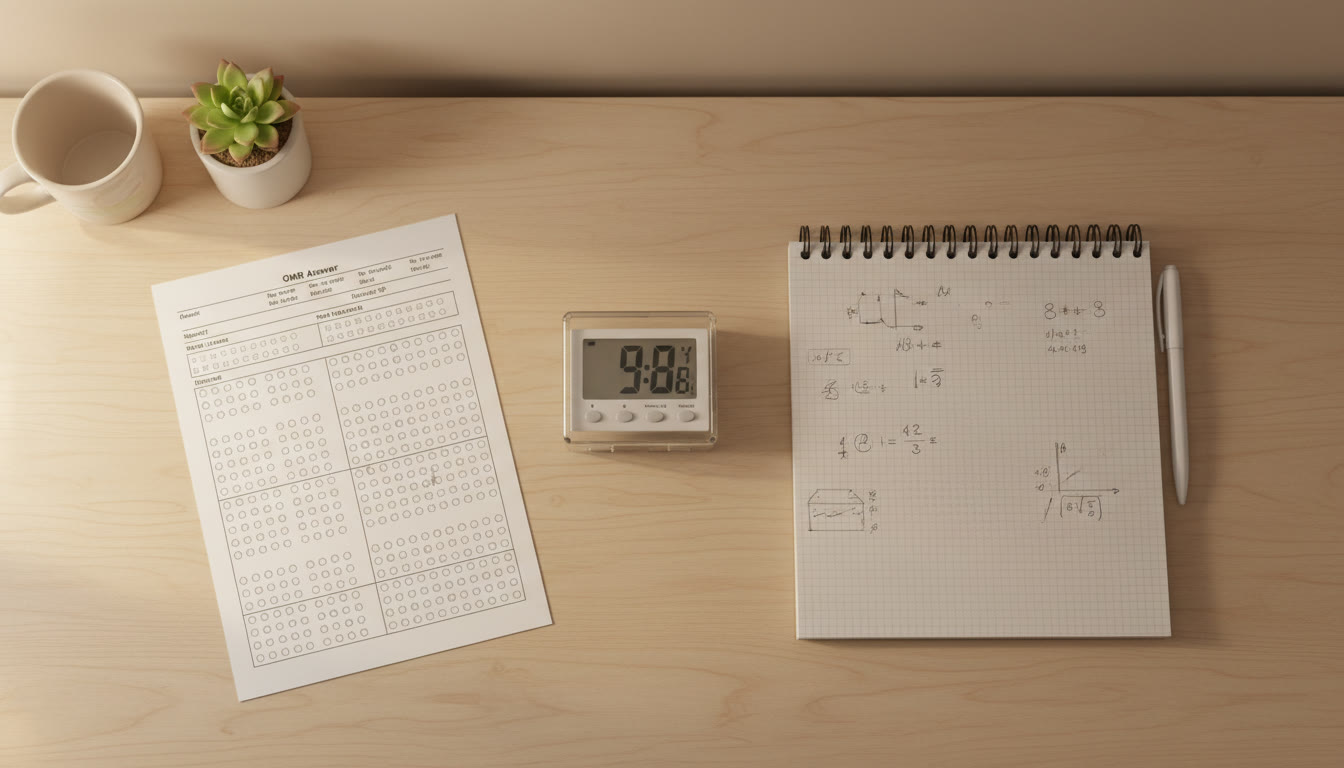
Mock tests are practice for both content and the exam experience. A three-hour full-length test recreates the fatigue, attention shifts, and time pressure of the real exam. Top performers increase the frequency of these mocks as the test date approaches, but they also make every mock count by doing disciplined post-test analysis.
How toppers analyze a mock
- First pass: Check raw score, negatives, and attempted questions.
- Error classification: Tag mistakes as conceptual, careless, calculation, misread, or time-pressure.
- Targeted drills: Turn each error into a 10–15 minute corrective exercise the same day.
- Pattern recognition: If certain topics repeat mistakes, schedule an intensive micro-week on that topic.
Importantly, toppers treat OMR discipline as part of the mock. They simulate the answer-sheet marking habit: fill answers only after confirming the final choice, use pencils or pens as per the test rules, and avoid last-minute answer switching without re-evaluating the reasoning.
Handling negative marking and OMR discipline
Smart attempt strategy under negative marking
Negative marking penalizes careless guessing. Toppers follow a calibrated guessing policy: attempt only when elimination yields a high probability of correctness, or when the risk-reward is favorable (e.g., a near-certain 2/3 chance). In practice, that means they reserve wild guesses for the end and prefer strategic skipping during the first pass.
OMR best practices
- Mark the OMR with steady strokes and confirm the question number before filling.
- Use the mock environment to practice the switching rhythm between question paper and OMR sheet — this reduces mismatches on the exam day.
- If the exam format requires on-screen marking or an OMR-like digital interface, simulate that exact interface as closely as possible in mocks.
Three composite case studies — patterns, not personalities
Case study A: The “Mock Master”
Background: Consistent mid-80s practice test percentiles, strong fundamentals but low confidence in time-pressured sections. Strategy shift: increased full-length mock frequency to one per week, followed by immediate targeted drills on the top three recurring mistakes. Result: Predictable reduction in careless errors and marked improvement in time allocation during the second half of the test.
Case study B: The “Focused Revision” student
Background: Good subject knowledge but fragmented revision schedule. Strategy shift: implemented an intense four-week focused revision per subject (one deep week per subject) while keeping two short mocks per week to prevent rust. Result: Concept retention rose sharply and the candidate converted many previously marked questions into correct first-pass attempts.
Case study C: The “Stable Pace” approach
Background: Strong scorer who burned out occasionally due to long, unstructured study days. Strategy shift: introduced micro-rest cycles, 50–60 minute focused sessions with short breaks, and scheduled light physical exercise three times a week. Result: Better retention of complex multi-step problems and more consistent mock scores across weeks.
Common mistakes that derail percentile growth
- Overemphasizing rare high-difficulty problems at the expense of consistent scoring topics.
- Ignoring OMR practice and answer-sheet discipline until the final weeks.
- Not analyzing mocks properly — treating them as score checks rather than diagnostic tools.
- Overattempting early in the test without a clear elimination strategy under negative marking.
- Neglecting physical and mental stamina training; three-hour tests require endurance conditioning.
An actionable 8-week plan to push toward 99 percentile
Weeks 1–2: Baseline and repair
Take two full-length timed mocks at the start to establish a baseline. Build an error log and categorize every mistake. Spend this phase repairing conceptual gaps in the top five recurring mistake areas, not chasing everything at once.
Weeks 3–4: Focused practice and time-slicing
Design two-week micro-sprints: one for each troublesome subject area. During these weeks, increase to two full-length mocks per week, and add short 30–45 minute timed drills daily for targeted topics.
Weeks 5–6: Consolidation and simulation
Scale mocks to three full-length mock tests per week if feasible, and practice strict OMR discipline each time. Start simulating test-day conditions: identical sleep schedule, meal pattern, and break routines. Continue drilling weak topics with practice sets and revisit any conceptual holes that resurface in mock analysis.
Weeks 7–8: Tuning and temperament
Reduce new content intake. Prioritize timed full-length mocks and quick revision notes. Practice a final set of endurance tests (two back-to-back timed sessions on consecutive days) to rehearse mental stamina. Concentrate on error-free execution and time allocation drills.
Weekly routine checklist
- At least one full-length mock under strict conditions.
- Three focused practice sessions of 60–90 minutes per subject.
- Daily 10–20 minute error-log review.
- Two short mental-rest activities (walk, breathing, light stretch).
Where personalized tutoring fits in the topper’s plan
Many successful students combine independent study with targeted, personalized guidance. One-on-one tutoring helps when you need to translate mock-test weaknesses into precise study actions quickly — for example, an expert tutor can spot persistent conceptual mis-maps, suggest efficient shortcuts for recurring problem types, or help craft a bespoke revision calendar.
If you’re using guided help, consider how it integrates: tutors should help you pinpoint the next smallest high-impact action (a 10–15 minute correction drill, a prioritized reading list, or a timed-problem template), not become a crutch for every doubt. A platform that offers tailored study plans, expert tutors, and AI-driven insights can accelerate this triage; for example, Sparkl‘s personalized tutoring models combine one-on-one guidance with data-driven recommendations so you spend fewer hours guessing and more hours practicing the right things.
Short-term tools and micro-habits that toppers swear by
- Error-first practice: Start each study day by correcting previous errors for 20 minutes.
- Two-minute recall checks: Quick flash-recall for formulas and key reactions, three times a day.
- Test-day dress rehearsal: Do a full mock with the clothes, food, and desk arrangement you plan to use on the exam day.
- Sleep and nutrition windows: Toppers treat sleep as a non-negotiable study resource; short naps after intense study blocks often help consolidation.
Final exam-day checklist
- Arrive early and settled, having rehearsed the route and timing for the test center.
- Bring permitted items only; prepare them the night before to avoid morning stress.
- Start the paper with a clear, calm first pass: pick the easy-to-medium problems to secure quick marks.
- Use marking strategy: first pass — attempt confident and quick questions; second pass — take elimination-based guesses; final pass — revisit marked problems with fresh focus.
- Keep OMR marking steady and avoid last-minute answer shifts without re-checking reasoning.
Closing thought
Achieving a 99 percentile is less about extraordinary talent and more about disciplined practice under realistic conditions: concept clarity, regular three-hour mock simulations, careful mock analysis, OMR and negative-marking strategies, and targeted short-term plans all compound into a reliable performance on exam day.
Mastery of fundamentals, disciplined timed practice, and relentless, thoughtful analysis of mistakes are the academic pillars that make a 99 percentile reproducible rather than accidental.























No Comments
Leave a comment Cancel