
Why a daily mock-test routine matters more than you think
If you’re preparing for a high-stakes, MCQ-based engineering entrance exam, mock tests are not optional practice — they are the training ground where raw knowledge becomes exam-ready performance. A daily mock-test routine doesn’t mean taking every test at full tilt forever; it means building a reliable habit that sharpens speed, reduces careless errors, and gives you honest feedback every single day.

Think of mock tests as a scientific experiment: you set a controlled condition (time, question type, exam rules), you observe results (score, accuracy, pacing), you analyze causes (careless error, unclear concept, weak formula), and you run an intervention (targeted study, revision, or a new strategy). Repeat. Over weeks, this cycle shifts you from guessing your weaknesses to correcting them systematically.
Key exam realities your mock routine must reflect
When you plan a daily mock routine, design it to mimic the actual test environment and marking rules. That means:
- MCQ-focused practice: The tests are multiple-choice or objective-type items that reward accuracy and penalize random guessing.
- Full-length time discipline: A realistic full-length simulation runs the complete allocated time for the exam (three hours for a full attempt), including strict timing per section or overall as appropriate.
- Negative marking awareness: Incorrect answers often carry a penalty, so a deliberate attempt strategy matters more than mere speed.
- Answer-entry discipline (OMR/CBT): Whether you’re filling an OMR sheet in an offline simulation or clicking answers in a computer-based mock, treat the entry step as sacrosanct — mis-clicks and mismarks cost points.
- Clear marking policy: Expect no partial credit for incomplete derivations or partial steps in objective items — correctness is binary in many questions.
- Syllabus alignment: Focus on Physics, Chemistry, and Mathematics content priorities and question styles that reflect the current cycle’s emphasis.
What a realistic daily mock-test schedule looks like (sample)
Below is a practical template you can adapt. It blends a full-length simulation with a short, focused review so the day’s practice feeds immediate learning.
| Time Window | Activity | Goal | Duration |
|---|---|---|---|
| Morning – Quick Warm-up | Concept warm-up: 2–3 short questions (mixed topics) | Activate recall; prime problem-solving muscles | 20–30 min |
| Midday – Full Mock | Full 3-hour mock (strict exam rules; replicate CBT/OMR entry) | Test endurance, pacing, and strategy under exam conditions | 180 min |
| Right after mock | Quick score and emotion reset (no deep analysis) | Capture raw performance without overthinking | 10–15 min |
| Later same day – Deep Analysis | Detailed error analysis, categorize mistakes, short corrective tasks | Turn errors into targeted study actions | 60–90 min |
| Evening – Focused Practice | Do 2–4 targeted problems in weak topics; revise one formula/note | Immediate consolidation to prevent repetition of mistakes | 30–45 min |
This is a single-day skeleton. The magic is consistency: small, deliberate corrections every day beat sporadic marathon sessions.
Before the mock: warm-ups that actually help
Skipping warm-up is like sprinting with cold muscles. A short routine prepares you mentally and practically:
- 10–15 minutes of light review: glance at a formula sheet, a tricky derivation, or one solved example each from Physics, Chemistry, and Mathematics.
- Do two quick mixed MCQs that require simple recall — nothing that strains your attention early.
- Check practicalities: charged laptop (if CBT), pens/pencils, rough sheets, stopwatch, and a quiet room; practice the same OMR marking rhythm you’ll use in a paper mock.
- Set a clear micro-goal: “Today I will reduce calculation errors” or “Today I will finish Physics in 55 minutes.” Focused goals turn a mock into a targeted experiment.
During the mock: how to turn sitting time into points
Exam time is both a resource and a pressure cooker. Tactics matter:
- First pass: rapidly scan and attempt the low-hanging fruit. Don’t get stuck on one hard problem for more than the time you’ve budgeted; flag and move on.
- Second pass: work on problems that need thinking but look solvable within your remaining time.
- Final pass: attempt last-minute shots only if time and energy permit — avoid random guessing where negative marking applies.
- OMR/CBT discipline: if your mock uses paper OMR, double-check row/column alignment before shading. For CBT, practice exact clicking flow and use navigation tools consistently to avoid accidental misplacement.
- Rough-work hygiene: keep clear margins for each problem’s rough work and transfer final answers carefully. Messy rough work is a time-sink and a source of transcription errors.
- Time checks: divide your total time into checkpoints — e.g., 60–70 minutes for the first subject block — and adjust if you’re consistently ahead or behind.
- Negative marking rule: always track the expected payoff. For typical MCQ scoring (+4 for correct, −1 for wrong in many tests), two educated guesses with reasonable elimination may be worth attempting; blind guessing is usually unwise.
Example: quick net-score thinking
Imagine 25 questions in a block. If you solve 15 correctly and get 3 wrong, with +4 and −1 marking: net = (15 × 4) − (3 × 1) = 60 − 3 = 57. This shows how each incorrect answer chips away at the gains, so strategic selection is essential. Calculate your net mentally after the test to see where time or accuracy slipped.
After the mock: analysis that actually improves scores
The critical work happens after the timer stops. Many students either celebrate or wallow — the most successful analyze. Use a four-step, repeatable method:
- Step 1 — Quick tally (10–15 minutes): Count attempted, correct, incorrect, and net marks; note time distribution roughly per section. Capture how you felt: rushed, stuck, or calm.
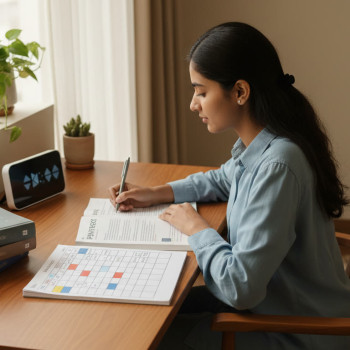
- Step 2 — Categorize mistakes (30–45 minutes): For each wrong or skipped question, tag it as careless, conceptual, formula gap, application error, or time management. Use consistent color codes in a notebook or digital log (e.g., red = concept, yellow = careless).
- Step 3 — Correct & consolidate (30–60 minutes): Re-solve each wrong question slowly. If it’s a concept gap, add a two-line note to your “concept wallet” and a single problem to practice that concept again the same day.
- Step 4 — Action plan (10–15 minutes): Decide one clear follow-up that you will do before the next mock: e.g., revise rotational dynamics formula sheet, solve five more stoichiometry MCQs, or practice algebraic manipulations for 20 minutes.
Maintaining this loop creates a feedback-driven study plan: the mock tells you precisely what to fix, not what you assume you need.
Using personalized help strategically
When you identify a stubborn pattern — say persistent calculation errors or a recurring topic like 3D geometry — targeted guidance speeds correction. A platform offering one-to-one sessions, tailored study plans, and AI-driven insights can convert the noisy data from your mocks into precise next steps. For example, after a week of daily mocks, a one-on-one discussion guided by question-level analytics can reframe your practice from “work harder” to “work smarter.”
For immediate support, consider integrating one-to-one help that reviews your error categories and suggests focused drills: Sparkl‘s personalized tutoring is designed to pair data from your mocks with tailored coaching, targeted assignments, and progress tracking.
Daily micro-actions that compound
Small, consistent fixes matter more than heroic single-day stretches. Each day after your mock, pick two micro-actions and stick to them:
- Fix one careless habit (neater rough work, always cross-check arithmetic).
- Re-learn one small concept with a worked example and write it on a single sticky note you keep by your desk.
Repeat these micro-actions daily and the improvement compounds. Use a simple mock log (date, score, top two errors, micro-actions) so you can spot trends across weeks.
Weekly and monthly cycles: balance mock frequency with deeper study
Daily mocks are powerful, but they must be balanced with deeper learning. A sample two-week rhythm might be:
- Week A: Five full mocks spread across the week, focused review sessions aligned to the daily error categories.
- Week B: Three full mocks with two days dedicated to concentrated concept building (longer revision blocks, extra problem-solving in weak areas).
Once per month, conduct a stitched-through performance review: map topic-wise accuracy (Physics chapters, Chemistry topics, Math modules), time distribution, and the ratio of careless to conceptual mistakes. Use these insights to tweak your daily mock targets for the next month.
How to track and visualize progress (simple log template)
Keep a compact mock log so your eyes can see improvement. A simple table in your notebook or spreadsheet works wonders:
| Date | Score (net) | Attempted / Correct | Top 2 Error Types | Micro-actions |
|---|---|---|---|---|
| Example | 140 | 80 / 60 | Careless arithmetic; weak integration | Neat rough work; practice 5 integrals |
How to prevent burnout: a realistic habit plan
Daily mocks are intense. Without smart recovery you will plateau. Protect your mental energy with these rules:
- Limit full mocks to a sustainable number per week if you’re also attending classes or coaching — quality of analysis matters as much as quantity of mocks.
- Take one rest or light day every 5–7 days: light revision, flashcards, or conceptual reading — no full mocks.
- Keep sleep and nutrition consistent around mock days. Performance is a brain function; treat it like an athlete would.
Use technology to amplify insight, not to replace reflection
Analytics can show which question types you miss most and how your pacing shifts during a test. These are valuable, but only if you pair them with honest reflection. After reviewing an analytics dashboard, ask yourself: did I rush? Did I lack a formula? Did I get nervous in the last hour? Combine AI-driven patterns with human decisions about what to practice next.
For instance, if analytics reveal a repeated decline in accuracy in the final 30 minutes, the human fix might be to practice stamina tests and tweak pacing — not to blindly take more mocks without changing the approach. A balanced use of personalized tutoring and analytics helps convert patterns into precise interventions; for tailored support that links analytics to action plans, Sparkl‘s one-on-one guidance and AI-driven insights can help translate mock results into a customized study sequence.
Common pitfalls and how to avoid them
- Pitfall: Taking mocks without review. Remedy: Reserve time right after the test for a short tally and later a deep analysis block the same day.
- Pitfall: Chasing only score, not process. Remedy: Track the process metrics (time per question, error type) and reward improvements there as much as raw marks.
- Pitfall: Random guessing under pressure. Remedy: Predefine a guessing rule (e.g., guess only if elimination gets options ≤2).
- Pitfall: Neglecting conceptual weak spots. Remedy: If a topic recurs in your error log for three mocks, schedule a focused study session and re-test specifically on that topic within 48–72 hours.
Small but powerful rituals to adopt
Adopt these micro-habits and you’ll reduce friction and error over time:
- Always write the question number on rough work and final answer lines to avoid transfer errors.
- For CBT practice, learn keyboard shortcuts and navigation for the test platform; practice moving between marked questions efficiently.
- Maintain one curated “formula & trick” sheet that you update weekly; read it for five minutes before each mock.
Putting it together: a simple 7-day plan to start
Day 1: Full mock + deep analysis. Day 2: Targeted practice on top two error areas. Day 3: Full mock (focused on pacing) + quick review. Day 4: Concept day (no full mock; solve 20 problems in weak topics). Day 5: Full mock + focused correction. Day 6: Light mixed practice + formula-sheet revision. Day 7: Rest or very light revision and reflection. Repeat and adjust based on your mock log trends.
Concluding academic note
A disciplined daily mock-test routine transforms uncertainty into measurable improvement. By replicating exam conditions, tracking precise metrics, analyzing errors honestly, and following through with targeted corrective practice, you convert mock-test feedback into a steady upward trend in both accuracy and speed. Consistency, thoughtful analysis, and targeted fixes are the cornerstones of turning practice into performance on the exam day.

















No Comments
Leave a comment Cancel