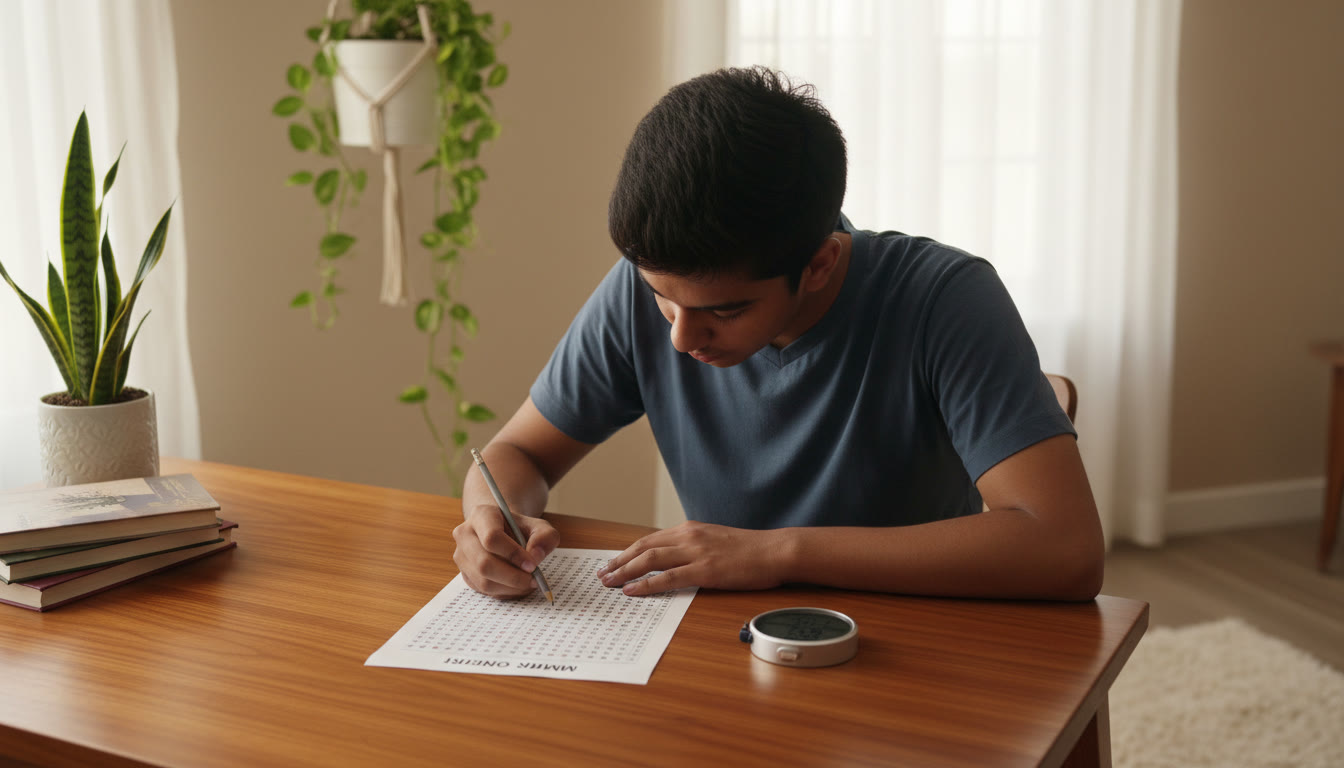

How to Balance Accuracy and Speed in JEE: A Practical Playbook
Taking a JEE mock can feel like sprinting through fog: you want to move fast, but one wrong step can cost you dearly. If you’ve ever finished a mock with good speed but poor accuracy — or the other way around — you already know the frustration. This guide is written for students who want a realistic, compassionate, and practical way to grow both skills at once. We’ll talk about mindset, mock-day tactics, measurable metrics, and concrete routines you can adopt immediately.
The JEE-style testing environment is built around MCQs, full-length 3-hour practice windows, negative marking, and strict OMR discipline. Keep that framework in mind as you read: every strategy here assumes you won’t get partial credit for descriptive shortcuts, that bubbling errors matter, and that your mock timings should mirror the real exam format. We’ll also touch on how personalized support — including tailored 1-on-1 guidance and AI-driven insights — fits into this plan, when it’s relevant to your progress.
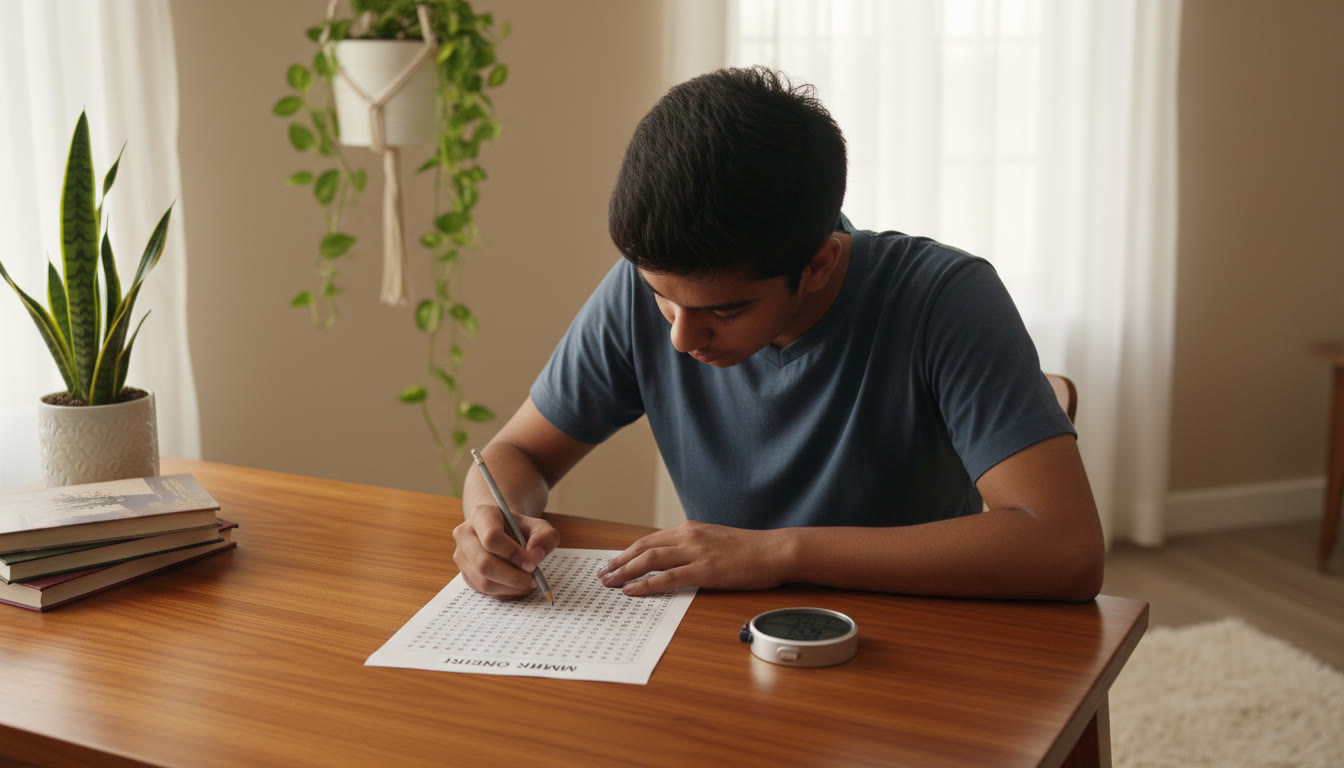
Start with the Right Mindset: Accuracy Enables Speed
The fastest test-taker is only valuable if answers are correct. Speed without a foundation of accurate technique is brittle: a small misunderstanding or careless error multiplies under time pressure. Flip the story: practice accuracy so that speed becomes reliable rather than reckless.
Small mental shifts that matter
- Read for clarity: invest 6–12 seconds to read the question properly. The time you save by skimming is often wasted in rework.
- Normalize pausing: record a short pause before answering every tricky question to check units, diagrams, and options.
- Embrace error logs: every incorrect attempt is data. Treat mistakes less like failure and more like targeted instruction.
Know the Exam Mechanics — Then Use Them
Because JEE-style tests are MCQ-based with negative marking and a 3-hour full-length structure, your practice must reflect those constraints. That means timed sections, simulated OMR filling, a realistic guessing policy, and no expectation of partial credit for descriptive work in the final answer phase.
Practical consequences of the rules
- Negative marking encourages selective attempts. Prioritize questions where you have a realistic chance of being correct rather than accumulating random guesses.
- OMR discipline matters: mis-bubbling, skipped rows, or misaligned marking can erase minutes and marks. Practice under an OMR-like routine so shading becomes a muscle memory task.
- Three hours is long. Build reserves for late-stage fatigue by training endurance and doing at least a few timed full-length mocks that mimic the exact length and break pattern.
Measure Both: Speed and Accuracy Metrics You Can Use
If it’s not measurable, it’s hard to improve. Create a simple dashboard to track where you stand on both axes: accuracy (percentage of correct answers among attempted), average time per attempted question, and error-type breakdown. Track these by subject — physics, chemistry, and biology — and by question type (conceptual, numerical, tricky options, calculation-heavy).
| Subject | Target Accuracy | Avg Time per Attempt | Weekly Attempts per Mock | Primary Action |
|---|---|---|---|---|
| Physics | 80%–90% | 3–4 min | 1 full-section mock | Concept drills + timed numericals |
| Chemistry | 85%–95% | 2–3 min | 1 full-section mock | Reaction mapping + elimination practice |
| Biology | 80%–95% | 1–2 min | 1 sectional set | Flash recall + option elimination |
Notes on the table above: numbers are target ranges to guide practice. They’re not hard thresholds — you should calibrate them to your own baseline. The central idea is to pair a time-per-question goal with a realistic accuracy band and then measure weekly.
Concrete Practice Routines That Build Both
You need micro-practice for accuracy and macro-routines for speed. Mix them intentionally in your study cycles.
Daily micro-sessions (40–60 minutes)
- 20 minutes: Focused concept clearing (one topic). Do short problems only after you can explain the concept in your own words.
- 20 minutes: Problem cluster — 8–12 short MCQs on that concept under timed conditions (1–3 minutes per question).
- 10–20 minutes: Error review and quick notes. Write down the mistake type and the corrective rule.
Weekly timed sets
- 2–3 sectional timed sets (strictly timed, OMR-like discipline).
- One full-length mock every 7–10 days during the intensive phase.
- After each set, record time used per question type and categorize errors as: careless, conceptual, calculation, or misread.
Mock schedule design
- Warm-up: 15 minutes of light conceptual Qs before a timed mock — primes accuracy.
- Mock block: full 3-hour practice, exactly matching the exam’s timing and break policy.
- Immediate review: 45–90 minutes of focused review on all mistakes; don’t postpone analysis to the next day.
Tactics During the Mock: OMR, Question Triage, and Time Banking
Day-of tactics can salvage both time and marks. Build a triage system, fix an OMR routine, and use the concept of a time bank to allocate seconds intentionally.
Question triage (a simple A–B–C system)
- A (Attempt Now): Questions you can solve reliably within the target time.
- B (Buffer Later): Questions you might solve with more time or a quick idea — mark them and return in a buffer round.
- C (Cut): Questions that look long or risky. Skip early; only attempt if time remains and you have enough cushion.
Implement this by doing a first pass where you answer all A’s, mark B’s for a second pass, and leave C’s for the final minutes. This reduces wasted time on traps and lowers risky guesses under negative marking.
OMR discipline
- Shade cleanly and fully. Practice with a pencil to mimic the pressure of shading under time.
- Sync question numbers: always check the printed question number to ensure you’re marking the corresponding OMR bubble.
- Reserve the last 10–15 minutes to cross-check shaded rows if you had format or alignment concerns.
OMR mistakes are low-variance losses: they don’t reflect your grasp of concepts but can cost marks unpredictably. Train to remove them from the error column.
Fixing Common Speed–Accuracy Tradeoffs
Here are familiar traps and immediate remedies you can practice today.
Trap: Speed-first, careless errors
Symptoms: Many small arithmetic or sign errors; repeated careless slips on identical concepts. Fix: slow down for the first 30 days. Add a brief checklist before finalizing each answer: units, sign, estimated magnitude. After the habit is formed, gradually compress time.
Trap: Accuracy-first, running out of time
Symptoms: You get nearly every question right when untimed, but mocks leave many questions unanswered. Fix: learn structured shortcuts — dimensional checks, estimation, option elimination — and practice them in timed drills to make them automatic.
Trap: Stuck in mid-problem sunk-cost fallacy
Symptoms: You spend disproportionate time on one question and lose the chance to pick up several easier ones. Fix: implement the triage system. If you’ve spent more than the allotted target time and progress is small, tag and move on.
Quick Heuristics by Subject
Physics
- Sketch first. A quick diagram often saves time and reduces errors.
- Check limiting cases or units to validate an answer quickly.
Chemistry
- Use elimination. Often 1–2 options contradict basic chemical logic (oxidation states, stability).
- Memorize reaction patterns rather than individual steps; pattern recognition speeds up answers.
Biology
- Flash recall beats derivation. Prioritize precise recall of definitions, processes, and common exceptions.
- Option matching: quickly eliminate biologically impossible choices.
Mock Analysis: The Feedback Loop That Builds Both
A mock is only as useful as the feedback you extract from it. Build a consistent post-mock routine so each practice session pushes both accuracy and speed forward.
Suggested mock-review checklist (45–90 minutes)
- Label every wrong answer with one of: careless, conceptual gap, calculation slip, misread, or time-runout.
- Create a one-line corrective action for each wrong answer: e.g., “Review projectile motion derivation” or “Practice quick oxidation number checks.”
- Record time spent on each wrong question. If time misuse is a pattern, plan targeted timed drills.
| Error Type | Immediate Fix | Practice Drill |
|---|---|---|
| Careless | Slow down; checklist before finalizing | 10-question un-timed review where you double-check answers |
| Conceptual | Re-learn concept and re-solve easier problems | Grouped conceptual sets: 12–15 Qs on one topic |
| Calculation | Use estimation or simplifying assumptions | Timed numeric drills focusing on calculation speed |
Tools and Support: When Personalized Help Speeds Progress
Self-study and disciplined mock practice will take you very far, but sometimes a targeted nudge accelerates growth. Personalized tutoring can help translate mock feedback into a custom plan, and AI-driven analytics can highlight subtle time-wasting patterns that are hard to spot alone.
If you choose guided support, look for help that offers 1-on-1 guidance, tailored study plans, expert tutors for concept gaps, and AI-driven insights that analyze where your time and accuracy leak. For many students, combining disciplined self-practice with such focused support shortens the path to consistent mock performance.
For example, a coaching structure that pairs weekly mock analysis with personalized drills and periodic OMR practice can reduce careless mistakes while improving throughput — precisely the balance we’re aiming for.
Another practical tip: use a study partner or small group to trade analysis — one person times and monitors OMR discipline while another reviews errors. Peer accountability often converts good intentions into consistent practice.
A Realistic 8-Week Mock Tuning Plan
This plan balances micro-practice with full mocks so you steadily improve accuracy while regaining speed.
| Weeks | Primary Focus | Weekly Routine | Success Marker |
|---|---|---|---|
| 1–2 | Accuracy & Concept Foundation | Daily micro-sessions; 1 sectional timed set; error log | Consistency in concept check and reduced conceptual errors |
| 3–4 | Timed Problem Speed | Timed clusters; 1 full mock every 10 days; OMR practice | Improved avg time per question by 10–20% |
| 5–6 | Mock Endurance | One full-length mock per week; focused evening review | Maintain accuracy within target while completing more questions |
| 7–8 | Polish & Mistake Minimization | Simulated exam days; OMR cross-check drills; final error fixing | Stable speed and accuracy under exam conditions |
Adjust the plan to your baseline. If your accuracy is already excellent, accelerate the timed-work phases. If you struggle with fundamentals, extend the accuracy phase and delay full-length mock frequency until you consistently clear conceptual errors.
Common Questions Students Ask — Short Answers
- How much time should I spend per question? Use target ranges but personalize them — some questions deserve 6 minutes, others 30 seconds. Track and refine.
- Should I guess? Only when your elimination method raises true probability — blind guessing under negative marking is usually costly.
- How many mocks are enough? Quality over quantity. One well-analysed mock per week beats three rushed mocks with no review.
Final Reflection: Balance Is a Skill You Can Train
Accuracy and speed are not opposing forces you must choose between; they are two skills that amplify each other when trained with intention. Measure, practice, analyze, and iterate. Build habits that eliminate sloppy errors, cultivate smart shortcuts, and keep your mock environment as close to the real one as possible. Over time, you will find that careful accuracy becomes the engine that powers reliable speed — and that steady, measurable progress in both is achievable through focused routines and honest analysis.













No Comments
Leave a comment Cancel