
JEE Main Productivity Hacks for 99 Percentile
If you’re aiming for the 99 percentile in JEE Main, you already know talent and hours matter — but neither guarantees the result. What separates a high scorer from the rest is a system: the right rhythms, surgical practice, exam-like discipline, and a relentless feedback loop. This article offers a practical, student-friendly playbook that balances deep learning with exam efficiency. It is written for the current cycle and focuses on the core realities you’ll face on test day — MCQ-based questions, a strict timed window for full-length practice, negative marking pressures, and the OMR discipline that can make or break a session.
Start with the exam architecture — know the field
Before you redesign your study plan, pin down how the exam actually tests you. JEE Main is predominantly multiple-choice and objective in nature. It rewards accuracy and speed: full-length practice runs that copy the three-hour test rhythm are non-negotiable. There is negative marking for incorrect attempts, and OMR-sheet style discipline governs how answers are recorded — that means reading instructions, timing pencil/pen fills, and avoiding last-minute rushing over answer bubbles.
Also remember the syllabus focus: Physics, Chemistry, and Mathematics are the pillars. Treat diagrams, derivations, and written notes as learning tools that build conceptual fluency and speed — not as substitutes for MCQ practice. Finally, don’t assume partial credit on objective questions; the safest approach is to make attempts when supported by confident elimination or calculation speed.
Mindset and planning: quality over blind volume
Adopt an output-first mentality
Hours are the currency of preparation, but what matters is how those hours are spent. Replace passive reading with targeted outputs: problem sets, timed quizzes, and quick concept-checks that force you to retrieve, not re-read. A good rule of thumb: every hour of passive study should produce at least 20–30 minutes of active retrieval (solving problems without looking at solutions, explaining a concept aloud, or writing a compact summary from memory).
Build a weekly blueprint, not a vague to-do list
Plan every week with clear, measurable goals: number of concept-blocks mastered, number of topic-wise timed tests, and a concrete revision target. Keep one page of living metrics — last week’s mock score, accuracy percentage, three topics to prioritize this week — and update it after each practice test.
Daily routines that scale to 99 percentile
Structure your day around focused blocks
High performers don’t study longer; they study smarter. Use concentrated blocks (60–90 minutes) with single-subject focus and short, planned breaks. Replace long, unfocused sessions with three or four deep blocks that target weak topics and one high-intensity mock or problem session later in the day.
Sample productive day (flexible to personal calendar)
| Time | Activity | Purpose |
|---|---|---|
| 06:00–07:30 | Physics: concept revision + 3 problem drills | Concept consolidation & speed |
| 08:30–10:00 | Mathematics: 90-minute problem block | Problem-solving stamina |
| 11:00–12:00 | Chemistry: formula map & selective problems | Memory accuracy & reaction time |
| 15:00–18:00 | Full-length or sectional practice (timed) | Exam simulation & OMR discipline |
| 19:00–20:00 | Review: error log + flashcards | Fixing mistakes for retention |
Notes: adapt the schedule to fit school hours. The crucial idea is a morning conceptual slot, a mid-day practice slot, an afternoon mock or problem block, and an evening review. Frequent micro-revisions and short rest breaks keep the brain efficient.
Use focused techniques inside blocks
- Pomodoro variants: 50–10 or 90–20 depending on task depth.
- Active recall: after a topic block, write three questions you think could appear and answer them without notes.
- Spaced repetition: use flashcards for quick daily checks on formulas and reaction mechanisms.
Mock tests: the engine of progress
Make every full-length test count — treat it like the real exam
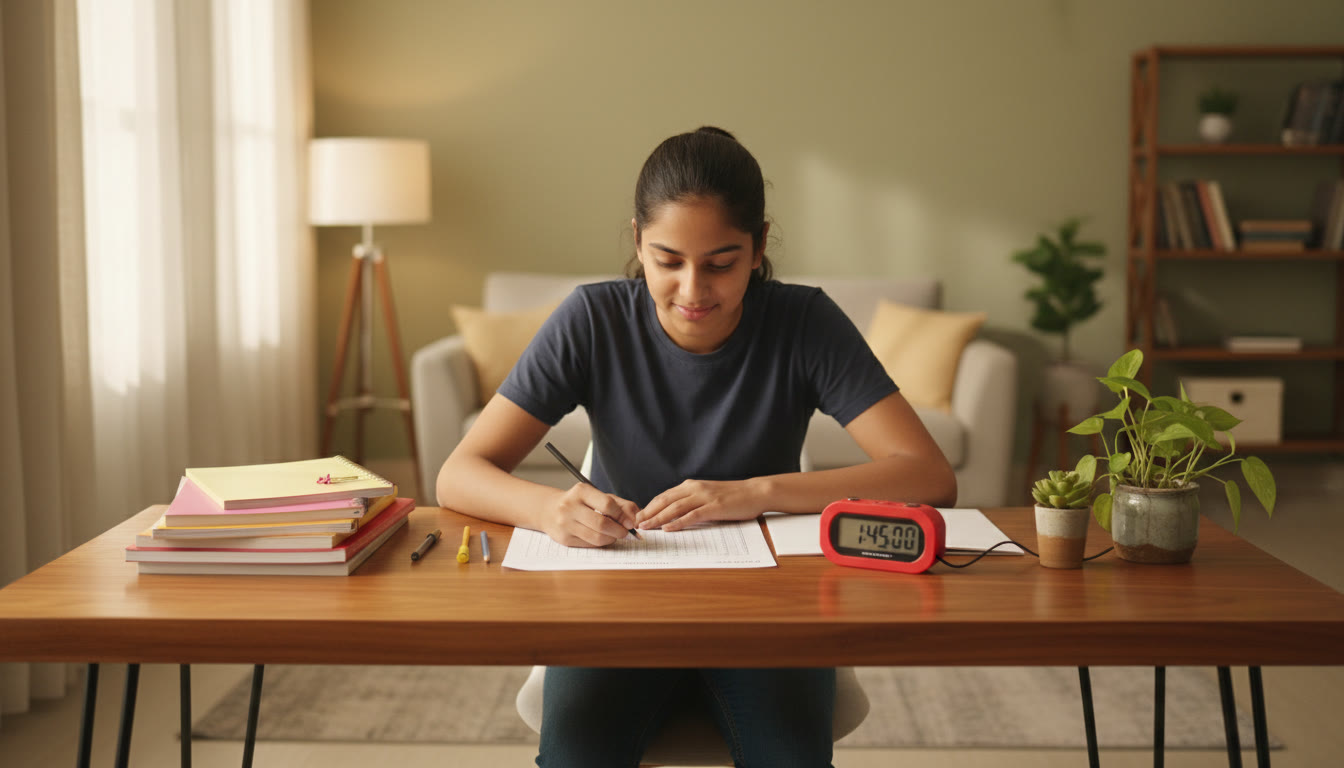
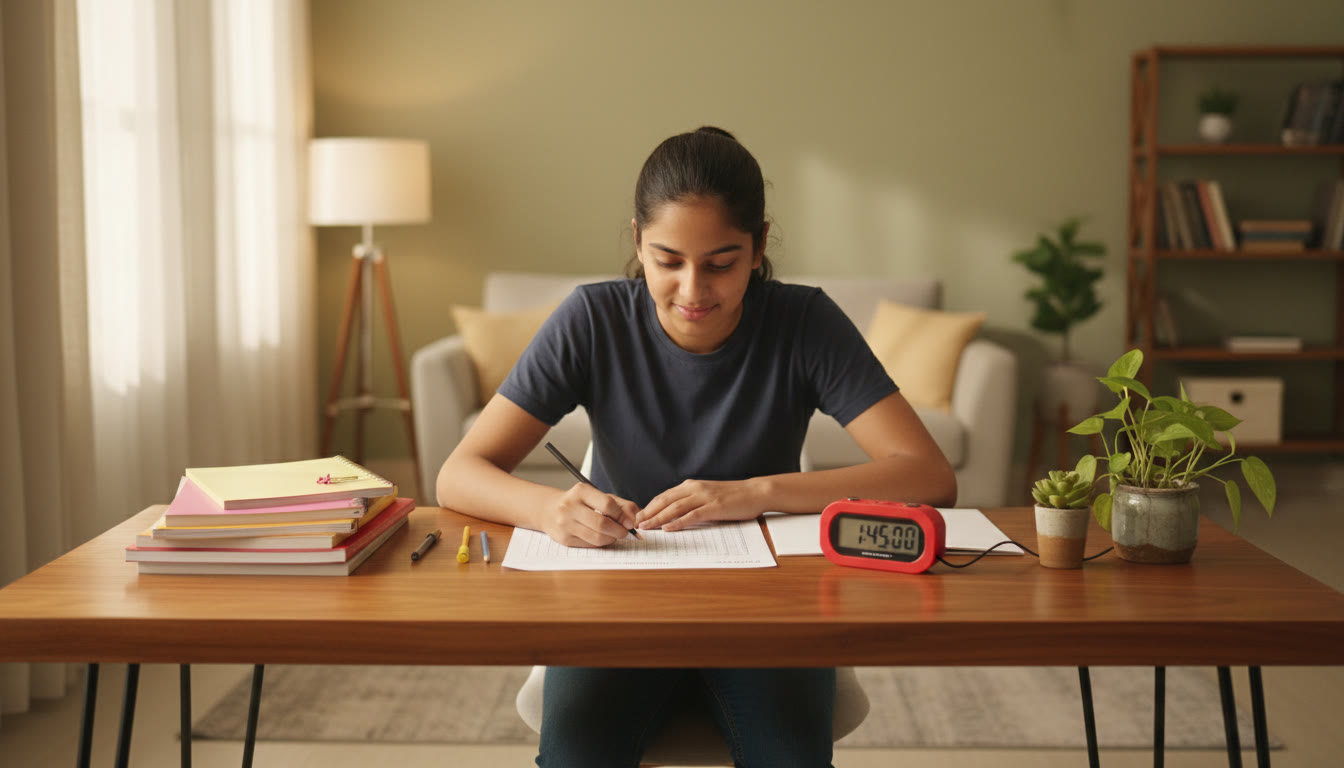
Full-length, three-hour mock tests are the single most predictive practice you can do. Simulate exam conditions strictly: same duration, timed sections if you prefer sectional practice, and OMR-style answer recording. Sit in a quiet space, use a stopwatch, and practice filling answers as you would on the day. This conditions your mind for time pressure, reduces sloppy mistakes, and trains OMR discipline — which includes reading instructions carefully and ensuring the answer sheet is filled correctly without stray marks.

What to do after a mock
Don’t rush to the next test. Spend 60–90 minutes on a structured analysis:
- Record high-level metrics: raw score, time per section, attempted vs accurate ratio.
- Make an error log: for every wrong or skipped question, note the cause — concept gap, calculation error, silly mistake, or time pressure.
- Create a 48–72 hour micro-plan: pick the top 3 recurring weaknesses from the log and schedule focused practice blocks to fix them.
Mock-test feedback table: quick diagnostic
| Test Indicator | What it means | Immediate action |
|---|---|---|
| Low accuracy, many attempts | Over-attempting under time pressure | Practice selective attempts; emphasize elimination techniques |
| High accuracy, few attempts | Too conservative; leaving scoring opportunities | Practice speed drills on high-yield topics |
| Frequent silly mistakes | Carelessness or fatigue | Implement mid-test micro-checks and stricter OMR routine |
| Sectional imbalance | Uneven preparation across subjects | Re-balance weekly blocks to shore up weak subject |
Accuracy, negative marking, and smart attempts
Make accuracy your north star
Negative marking means that blind guessing is rarely rewarded. Train a simple rule: attempt only questions where you can eliminate at least one option confidently or arrive at a solution within a time limit you set for that question type. For instance, if a particular multi-concept physics problem exceeds your timed cutoff, move on and return later — chasing one question at the cost of several easier ones is an avoidable risk.
Practical elimination techniques
- Contrast extremes: often one or two options in MCQs are physically impossible or violate dimensional logic.
- Plug-in quick checks: substitute easy numbers to test algebraic options.
- Unit/dimension sanity: if units don’t match, eliminate aggressively.
Subject-wise micro-strategies
Physics
Physics rewards conceptual anchors that generalize: kinematics templates, energy versus force comparative checks, and standard electrostatics problem shapes. Build a small “playbook” for each major topic with 5 canonical problems and one speed-trick that reduces a 15-minute derivation to a compact calculation. Practice drawing minimal diagrams under time pressure — the goal is clarity, not a full whiteboard derivation.
Chemistry
Chemistry breaks into three useful buckets: physical (problem-solving and numerical), organic (reaction patterns and mechanisms), and inorganic (facts and periodic trends). For physical chemistry, master a toolbox of formula manipulations and dimension checks. For organic, pattern-recognition beats rote memorization: group reactions into families. For inorganic, create tight memory maps and combine them with frequent flashcard reviews.
Mathematics
Mathematics requires both technique and decision-making. Identify core topics that consistently yield high-return problems and make them your “first go” areas during tests: calculus fundamentals, coordinate geometry shortcuts, algebraic identities, and standard combinatorics templates. Train yourself to spot problem type in <30 seconds and decide whether to solve, apply a trick, or skip.
Revision architecture: spacing, layering, and simulations
Layer your revision by depth
Layer 1: Daily micro-revisions — 20–30 minute recall sessions on formulas and reaction maps. Layer 2: Weekly consolidation — one full-length subject or sectional test. Layer 3: Monthly simulation — true exam-length mock with full analysis. This layering creates durable memory and reduces panic in the last lap of prep.
The 30–7–1 sprint
For the final sprint before a major test cycle: 30 days out focus on medium-complexity problems and error logs; 7 days out, intensify full-length mocks and untouchable OMR practice; 1 day out, rest, light review of flashcards, and sleep priority. Always keep the last 24 hours free of heavy cognitive load — clarity beats cramming.
Measurement: KPIs that reveal true growth
Track metrics that matter
Replace vague notions of “improvement” with concrete indicators:
- Accuracy rate per subject (correct/attempted)
- Average time per question type
- Number of repeat errors from the error log in a rolling 4-test window
- Percentage of mock tests completed under strict exam conditions
| KPI | Target (example) | Why it matters |
|---|---|---|
| Accuracy (overall) | Improve weekly by +2–4% | Shows cleaner decision-making and reduced negative marking |
| Time per question | Reduce by 5–10 seconds for typical problems | Improves ability to attempt more questions accurately |
| Error log repeats | Zero repeats in same topic over 4 tests | Indicates conceptual consolidation |
Smart help: personalize, don’t copy
When to use one-on-one support
Personalized guidance is highest-value when it fixes recurring weak-points quickly: conceptual blind spots, inconsistent test strategy, or inefficient study routines. Targeted 1-on-1 coaching can compress months of unfocused practice into weeks of guided improvement by eliminating wrong practice habits and tuning your topical priorities.
For students who combine human coaching with adaptive insights, platforms that merge tutor feedback with data-driven suggestions can accelerate the feedback loop. For example, Sparkl‘s tailored plans, expert tutors, and AI-driven insights can be used to customize your weekly blueprint and error-log remediation while preserving your unique learning pace.
Exam-day mechanics: OMR discipline and in-test habits
Before the test
- Check your kit: identification, allowed stationery, and any permitted items — organized the night before.
- Arrive early, settle, and do a 5-minute calm visualisation of the first 20 minutes of the paper.
During the test
Follow a disciplined question-selection rhythm: first pass for quick, high-confidence questions; second pass for moderate-time questions; final pass for challenging items. Use a pencil or pen practice run in the first five minutes to avoid smudges on the OMR and to align your filling pace to the answer sheet. After every 25–30 questions, perform a quick accuracy check: ensure the number of answers marked matches the questions attempted.
Well-being: sleep, nutrition, and recovery
Study recovery is not optional
High cognitive load requires structured recovery. A minimum of 7–8 hours of sleep, short physical activity breaks, and light protein-rich snacks on test day will maintain peak attention. Practice your sleep and nutrition routine during mock-test weeks so nothing on the actual test day is experimental.
Common pitfalls and how to avoid them
Top recurring mistakes
- Chasing every new trick: stick to high-yield, well-understood techniques before experimenting.
- Skipping mock analysis: the mock is an engine only if analyzed thoroughly.
- Holding onto wrong problem-solving habits: fix them immediately in the error log.
Fixing the procrastination loop
Break large topics into 25–40 minute micro-goals and attach an immediate reward (a short walk, a phone-free break) when you complete a block. Replace vague goals like “study thermodynamics” with precise ones like “solve 6 thermodynamics MCQs and summarize 3 key equations in 20 minutes.”
Final, practical checklist before a mock or exam
- Do one timed, topic-specific warm-up before a full-length test.
- Have an error-log open and commit to fixing the top three recurring issues within 48 hours.
- Simulate the entire test cycle (start-to-finish) at least once every 7–10 days in the last month of preparation.
- Maintain a compact cheat-sheet of last-minute memory anchors: formula skeletons, frequent reaction maps, and problem templates (for study use only; not during the test).
Conclusion
Reaching the 99 percentile is less about mystery and more about method: disciplined mock testing that mirrors the three-hour format, vigilant OMR habits, accuracy-first decision rules under negative marking, and a layered revision system that converts errors into durable strengths. Consistent analysis of performance metrics, targeted remediation of repeating weaknesses, and focused practice blocks produce the cognitive fluency and exam resilience required to perform at the top tier.





















No Comments
Leave a comment Cancel