

Why the order you attempt questions matters more than you think
Walk into any full-length JEE-style mock or actual test with the same question paper layout and three hours on the clock, and you’ll see a universal truth: the sequence in which you choose questions can be the difference between a calm, high-scoring finish and a frantic, error-prone scramble. The exam is MCQ-based with negative marking and typically practiced as a three-hour full-length mock. That reality shapes how you should think about selecting questions: it’s about maximizing correct attempts, minimizing risky guesses, and guarding your confidence.

Start with the rules in mind
Core exam realities that shape every decision
- MCQ format with negative marks for incorrect answers — accuracy matters as much as speed.
- Full-length practice in a three-hour window builds stamina and timing sense; simulate this in mocks.
- Even when the test delivery is computer-based, practicing OMR-like discipline (accurate answer entry, avoiding stray marks, careful selection) trains focus and reduces silly mistakes.
- Scoring is typically all-or-nothing on MCQs — there is generally no partial credit for partially worked solutions.
- Questions are distributed across three core areas: Physics, Chemistry, and Mathematics — each subject has its own patterns for quick wins.
A simple, high-impact framework: the multi-pass strategy
Instead of wrestling with each problem in order, treat the paper as a set of opportunities and use a multi-pass system. The classic two-pass or three-pass approach converts chaos into a manageable plan.
Two-pass (fast and focused) — when your first priority is accuracy
- Pass 1 (Quick-scan): Move through the paper and solve every question you can confidently finish in under 3–5 minutes. Don’t overthink anything — if it’s familiar and short, do it. Mark the solved ones clearly.
- Pass 2 (Targeted attempt): Return to the remaining questions. Tackle medium-difficulty items you can solve with some calculation or short reasoning. Reserve the last chunk of time for genuinely hard or time-consuming problems.
Three-pass (precision + time control) — when you want structure and margin for review
- Pass 1 (First 15–25 minutes): Quick-scan for low-hanging fruit — questions that require a single formula, a memory fact, or a brief plug-and-chug.
- Pass 2 (Middle 100–120 minutes): Systematically solve medium-difficulty problems and clear questions you flagged in pass 1 as “likely solvable with a couple of steps.”
- Pass 3 (Final 20–35 minutes): Attempt challenging items if time permits and use remaining minutes to review uncertain answers with a calm mind.
| Pass | Primary Goal | Typical Time Window | What to Attempt |
|---|---|---|---|
| Pass 1 | Secure quick, high-confidence marks | First 15–30 minutes | Direct recall, single-step calculations, memory-based chemistry, direct numeric physics |
| Pass 2 | Build on momentum with medium questions | Next 100–120 minutes | Multi-step math problems with clear path, moderate physics problems, calculation-heavy physical chemistry |
| Pass 3 | Try high-value, time-consuming questions only if time allows; review | Last 20–35 minutes | Hard reasoning problems, lengthy derivations, re-check flagged answers |
How to judge a question in 10–30 seconds: quick heuristics
We can’t overstate the power of a fast mental checklist — practice this so it becomes automatic during a mock or the real test.
- Recognition: Does the question map to a concept you’ve practiced recently? If yes, estimate the number of steps needed.
- Step count: Can you foresee fewer than three clean steps to the answer? If yes, that’s a green flag.
- Calculation intensity: Does the question demand long algebra, messy arithmetic, or heavy integrals? If heavy, mark and postpone.
- Memory vs derivation: Memory-based items (inorganic facts, definitions) are usually fast wins. Derivations or multi-part logic should be reserved for later passes.
- Risk vs reward: If negative marking is steep, avoid tentative guesses. Only guess when your elimination leaves you with a high-probability choice.
10-point quick checklist before you start solving any question
- Do I immediately know the main formula or concept?
- Can I estimate the final numeric range or dimension?
- Will I need long algebra or messy arithmetic?
- Is the question primarily recall, application, or synthesis?
- Is there a trick or subtle assumption that can trap me?
- How much time will I tentatively allot (in minutes)?
- Can I solve it without writing long derivations?
- Should I mark it for review instead of attempting now?
- Does it belong to a subject I am strong at today?
- If uncertain, is it worth a cautious guess (given negative marking)?
Subject-wise decision recipes
Physics: follow the clue chain
Physics questions often give clues — identify the physical principles first (kinematics, energy, electrostatics, optics) and check if the route is direct. Numeric physics with a single substitution is a fast win. If you find multiple linked conceptual steps or a messy integral, flag and proceed later.
Chemistry: order by memory, recognition, then calculation
Chemistry is friendly to this strategy: inorganic and straightforward organic reaction-recognition are quick wins; physical chemistry problems with long calculation should be slotted into the second pass; long thermodynamic derivations or multi-step mechanisms belong to the final pass unless you’re exceptionally fast in that subtopic.
Mathematics: spot the shortcut
Mathematics rewards pattern recognition and clever substitutions. Before diving into calculations, look for identities, symmetry, factorization, or substitution that collapse the problem. If the path is not clear in a handful of seconds and the algebra looks long, defer it to the second or third pass.
Practice drills to train your question-selection muscle
Decision-making under time pressure is a skill — and like any skill, it improves with deliberate practice. Make your mocks count by turning them into experiments.
- Simulate full-length three-hour tests regularly. Keep the environment close to exam conditions and practice answer-entry discipline.
- Time each question category and record how many easy, medium, and hard questions you correctly identified on the first glance.
- Run focused drills: 30-minute “quick-scan” sessions where you only attempt problems you can solve in under three minutes.
- Analyze your mock logs: how many marks did early-pass attempts yield? Which questions did you misclassify? Where did you lose time?
How tailored guidance can sharpen this process
Personalized support — one-on-one mentoring, tailored study plans, and data-driven insights — can accelerate the learning curve for question-selection skills. If you work with a mentor who reviews your mock logs and pinpoints recurring misjudgments, you will shorten the time it takes to make accurate front-of-paper decisions.
For example, Sparkl‘s personalized tutoring often focuses on refining how students spot quick-wins and on tailoring practice sets that target a student’s weak classification patterns.
Mock-test analysis: what to track and why
After each mock, do a surgical review. Your aim is to convert every mistake into a rule or a retrainable habit.
- Record the time spent per question and the pass in which you attempted it.
- Tag errors (conceptual, calculation, misread, silly) and tally them against the pass and the subject.
- Measure how many questions you identified correctly as “easy” on first scan and how many of those turned out to be traps.
- Note whether guesses helped or hurt your final score; adjust your guessing thresholds accordingly.
Common pitfalls — and how to avoid them
- Fixation: Spending too long on one question early destroys momentum. If it’s not a sure win in the first pass, mark and move on.
- Overguessing: Negative marking penalizes random guessing. Use educated elimination and only guess when probability is in your favor.
- Over-analysis: Some problems look difficult but collapse quickly with the right trick; if you can’t see that trick fast, don’t force it in the first pass.
- OMR/answer-entry errors: Always leave time to ensure answers are recorded correctly. Practicing answer-entry discipline under simulated pressure reduces such errors.
Sample timeline for a 180-minute session
| Time Window | Action | Reason |
|---|---|---|
| 0–20 minutes | Quick-scan (Pass 1) — solve clear 1–3 minute problems | Build early score, boost confidence, reduce backlog |
| 20–130 minutes | Systematic solving (Pass 2) — attempt medium problems and flagged items | Do the bulk of solvable, medium-effort questions |
| 130–160 minutes | Targeted push — try a few harder questions if you have time | High-reward attempts but careful about time cost |
| 160–180 minutes | Review and answer-entry check — re-check flagged answers and ensure all attempted answers are properly marked | Minimize silly errors and ensure data integrity of answers |
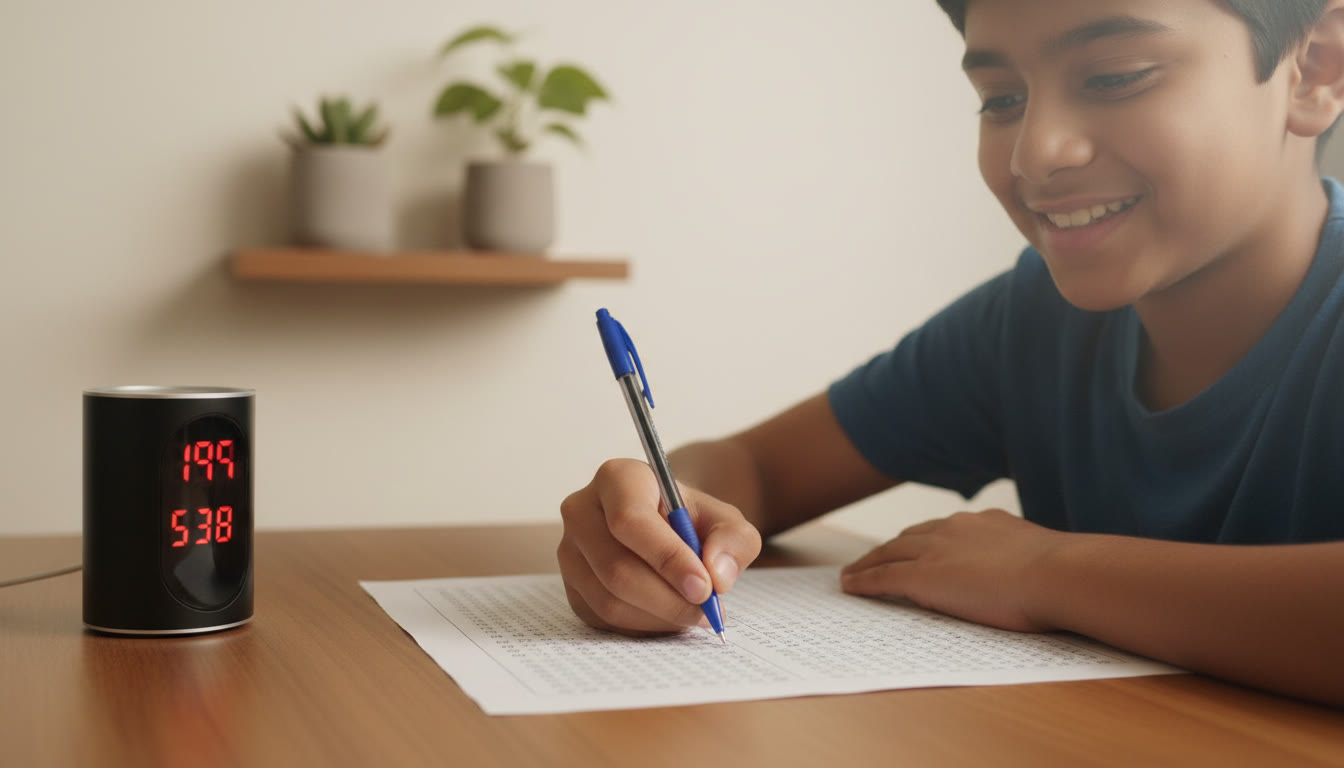
Micro-examples — choosing between two questions
Imagine two questions side-by-side: one is a memory-based chemical property you’ve revised many times, and the other is a multi-step calculus question that could take 12–15 minutes. The correct instinct in the first pass is obvious: pick the chemistry question and bank the marks. If you have extra time later, return to the calculus problem with fresh focus. Small choices like this compound into large score differences across the paper.
How to adapt the strategy on tougher papers or when you start slow
Not every mock will be a comfortable fit. On a paper that feels uniformly tough, widen your scan tolerance: if a problem looks slightly familiar and requires a recognisable trick, it might be worth a short attempt in pass 1. If you start slow or leave many blanks early, increase the pace of the quick-scan and make conservative guesses only after elimination.
Putting it all together: make the strategy yours
Practice the multi-pass approach consistently, analyze your mock logs for decision errors, and refine your heuristics. The goal is not to rigidly follow a template but to develop an instinct for quickly spotting high-probability, low-time questions while reserving mental energy for the tougher, rewarding problems. With calm execution, clear judgments, and repeated simulation under timed conditions, the process of deciding which questions to attempt first becomes intuitive and reliable.
In the exam context, the order you choose is an expression of disciplined priorities: secure what’s certain, build on momentum, and only spend precious minutes on high-value, solvable risks. Train these choices deliberately and the final result will look less like luck and more like good decision-making under pressure.
End of article.























No Comments
Leave a comment Cancel