

Thinking Like the Solver: Why Advanced Thinking Matters for JEE Ranks
Most students work hard; top scorers think differently. Advanced thinking is not a mystery talent reserved for a few — it is a set of habits and moves you can practice. For JEE, which leans heavily on objective formats such as MCQs and other fixed-answer types, the margin between ranks often comes down to how you approach unfamiliar questions, prune unnecessary work, and use time wisely during a 3-hour full-length paper. Negative marking and strict exam discipline mean that every move is a choice: try, skip, or verify.

If you want a strategy that scales, stop thinking only in terms of question counts and start training cognitive moves: pattern recognition, decomposition, estimation, and strategic risk-taking. These skills turn random practice into deliberate, rank-driven progress. Along the way, one-on-one guidance and tailored study plans can accelerate the process for students who need targeted feedback; Sparkl‘s personalized tutoring often helps by converting test data into focused action items and by providing expert tutors and AI-driven insights that keep your practice efficient.
Mindset Shift: From Repetition to Reasoning
Repetition builds comfort; reasoning builds transfer. Repetition helps you recognize types of problems, but reasoning helps you solve problems you have never seen before. Make this simple mental swap: after solving a problem, always ask “why this method works” and “what would break if one condition changed?” Those two questions teach you to generalize and to spot corner cases — both are essential for high-rank performance.
- Replace blind repetition with mini-experiments: change one parameter and re-solve.
- Keep a short “why” notebook: one to two lines on the core idea behind each solved problem.
- Prioritize depth over breadth in weak topics; a few deeply understood problems beat dozens of shallow ones.
Build a Conceptual Toolkit — Subject by Subject
Advanced thinking is built on strong conceptual scaffolding. For JEE-style exams, align your toolkit with the three pillars of the syllabus: Physics, Chemistry, and Mathematics. Below is a compact mapping of the cognitive moves that produce high-leverage improvements in each subject and realistic practice drills you can adopt weekly.
| Subject | Key Cognitive Move | Practice Drill | Weekly Target |
|---|---|---|---|
| Physics | Modeling a physical situation + dimensional sanity checks | Derive formulas from first principles; solve 2-3 problems by re-framing the scenario (e.g., change frames) | 3 deep problems |
| Chemistry | Pattern mapping (reaction mechanisms, analogies between processes) | Create reaction maps, predict outcomes on modified reagents, practice mechanism-based MCQs | 5–7 reactions/mechanisms |
| Mathematics | Abstracting structure + choosing the right representation | Transform problems into algebraic/graphical forms; re-prove a key lemma in different ways | 4 structural problems |
Treat Diagrams, Derivations, and Notes as Tools — Not Answers
When you practice, treat diagrams and stepwise derivations as cognitive scaffolds. They help you internalize relationships so you can reproduce reasoning under pressure. In the exam, you will not get partial credit for a partially correct derivation in objective formats — so your practice must focus on producing final answers reliably, while using derivations as learning devices outside test time.
Technique Library: Cognitive Moves You Can Practice Daily
Below are concrete techniques you can add to daily practice, with quick examples and how to measure progress.
- Backward reasoning: Start from the asked quantity and work backward to what you know. Useful in geometry and kinematics. Progress metric: reduce steps to solution by 20% in two weeks.
- Special-case and generalization: Test extremes and simple cases first to build intuition. Example: set variables to 0 or 1 to see structure. Progress: detect correct approach faster during timed drills.
- Dimensional checks and estimation: Before finalizing an answer, sanity-check units and order of magnitude. Progress: drop careless numeric blunders in mocks.
- Invariants and symmetry: Look for conserved quantities or symmetry to collapse complexity. Progress: apply invariant argument to at least one problem per practice session.
- Change of variables and substitution: A well-chosen substitution turns messy algebra into clean structure. Progress: re-solve algebra-heavy problems using an alternate substitution and compare elegance/time.
Worked Micro-Vignette: Backward Reasoning in Action
Suppose a question asks for the maximum range of a projectile with an unusual air-resistance term. Instead of trying to derive the full trajectory, backward reasoning asks: what condition on angle yields extremum? Translate the question to “find d(range)/d(angle) = 0”. Then test symmetry and small-angle approximations to reduce algebra. This approach often gives you a solvable path faster than plugging into long formulas.
Design Your Practice: Mock Tests, Time Management and Exam Discipline
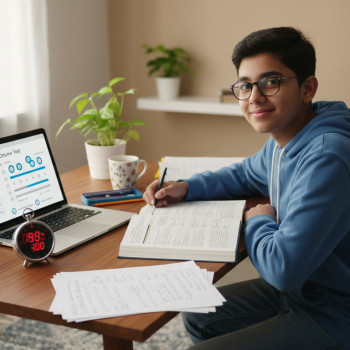
Full-length practice is non-negotiable. Treat each 3-hour mock like an official paper: same start time, identical breaks, and identical behavioural rules. Whether your test is CBT or uses OMR sheets in any cycle, you must rehearse the exact routines: logging in, question navigation, careful marking, and the discipline of review windows. Negative marking makes guessing a strategic decision, not a reflex.
Sample Mock-Test Architecture (3-hour simulation)
| Phase | Duration | Goal |
|---|---|---|
| First pass (easy & medium) | 90 minutes | Secure high-confidence marks quickly |
| Second pass (difficult & moderate) | 60 minutes | Attempt higher-value but time-consuming problems |
| Review & sanity checks | 30 minutes | Re-check calculations, revise flagged items, check OMR/answer entry |
During practice, emulate the exact marking rules: objective formats generally award marks for exact final answers and apply negative marks for incorrect responses. Because schemes can vary across cycles, practice the principle of expected-value decision-making: attempt a question only when your estimated probability of being right times the reward exceeds the expected loss from a wrong answer.
Time Allocation Heuristics
- First pass: solve 60–70% of the paper quickly — this secures your base score.
- No more than 12–15 minutes on a single complex question in first two passes; flag and move on if stuck.
- Reserve the final 20–30 minutes for calm review and OMR/answer-entry checks to avoid silly mistakes.
From Errors to Insights: A Feedback Discipline That Works
High performers don’t just record mistakes; they convert them into micro-lessons. After each mock, create a short, structured error log: the mistake type, the root cause, the corrective drill, and a one-line reminder. This converts mistakes into a study map you can revisit before subsequent mocks.
- Root-cause tagging: labeling mistakes as “conceptual”, “careless arithmetic”, “time pressure”, or “misreading the question” helps prioritize drills.
- Corrective drills: for each conceptual error, list 3 variant problems that exercise the corrected concept.
- Retention checks: revisit each corrective drill after 7 and 21 days to ensure the fix sticks.
One-on-one coaching can compress this loop. For students who need targeted adjustments, Sparkl‘s tutors help by converting mock analytics into tailored study plans and providing focused sessions that address root causes rather than surface symptoms.
Practice Habits That Build Advanced Thinking
Consistency beats intensity when training cognitive skills. Here are micro-habits that, over months, transform reasoning ability.
- Daily warm-up: 20 minutes of targeted puzzles or short conceptual proofs to activate thinking patterns.
- Active recall sessions: close the book and write the essence of a topic in 5–8 lines; then compare.
- Interleaved practice: mix topics in a session rather than doing long single-topic blocks to improve discrimination and transfer.
- Reflection log: after a problem set, write one note on what approach worked and why the wrong approaches failed.
Use Small Tests to Build Big Patterns
Micro-tests of 30–60 minutes are powerful. They teach you to warm up, focus, and shift strategies quickly — skills that mirror the compressed decision-making of an exam. Design these mini-tests around a single cognitive theme (e.g., “symmetry and invariants”) to deepen that skill in isolation.
Examples of High-Leverage Exercises
Some drills punch above their weight. Try these for a week and measure improvement.
- Reverse-solve: pick a solved problem and remove the final step; reconstruct the short chain of reasoning that leads to the final result.
- Constraint relaxation: solve a problem with a simplifying assumption, then progressively remove assumptions to test robustness.
- Analogy chain: take a concept in one subject and find an analog in another — for example, conservation in physics and invariants in math — to expand transfer ability.
When to Seek Tutoring and How to Use It Wisely
Tutoring is a multiplier when you use it to accelerate weak-point resolution, not as a crutch. Use a tutor to decode patterns in your mock performance and to get precise corrective drills. If you choose guided help, prefer short, focused interactions that aim to teach problem-class heuristics rather than just providing answers.
Sparkl‘s model of 1-on-1 guidance and tailored study plans often helps students by converting performance data into short, measurable objectives and by offering expert tutors who can demonstrate cognitive moves in live problem-solving sessions.
Measuring Progress: Metrics That Matter
Rank-focused practice needs measurable signals. Track these metrics weekly and monthly:
- Accuracy on first pass (percentage of attempted problems solved correctly in the first sweep).
- Time per problem category (easy/medium/hard) to spot creeping slowness.
- Error-type distribution to ensure conceptual mistakes are decreasing while careless errors are also addressed.
Putting It All Together: A 4-Week Cognitive Sprint
Use this template to convert ideas into practice. Each week has a theme and measurable goals; repeat cycles until patterns stick.
- Week 1 — Concept reinforcement: pick two weak topics and do deep drills; do 2 full mocks; log root causes for every mistake.
- Week 2 — Technique focus: concentrate on two cognitive moves (e.g., backward reasoning and invariants) and incorporate them into problem journaling; one mock.
- Week 3 — Speed & accuracy: timed mini-tests and one full mock; work on time allocation and rapid decision heuristics.
- Week 4 — Synthesis and review: mix topics in daily practice, simulate exam-day routine, and do one strict 3-hour full-length mock with review.
Mental Endurance and Exam-Day Routines
Mental stamina is trainable. Build it by slowly increasing focused study times and by simulating stressful conditions in mock tests. On the actual day, follow simple rules: warm up with a short review of your “why” notes, start with the paper’s easy sections to build momentum, and keep a calm pace during the final review.
- Practice calm breathing techniques to reset under pressure.
- Avoid last-minute cramming that introduces doubt; review only concise, confidence-building notes.
- During answer entry, check quickly for stray marks and mis-keyed numbers if your test uses a physical OMR sheet or an on-screen entry format.
Final Thoughts: The Long Game of Advanced Thinking
Developing advanced thinking for JEE is a gradual, measurable process. It blends a conceptual toolkit with deliberate practice, rigorous mock-test architecture, and disciplined feedback loops. Train the cognitive moves — not just the questions — and your preparation will scale: unfamiliar problems will become manageable, time pressure will feel surmountable, and rank gains will follow. The strategy is not to work harder in random directions but to practice smarter cognitive habits consistently until they become automatic.
Conclusion
Advanced thinking is a craft you can build: sharpen your conceptual foundation, practice technique-driven drills, simulate full 3-hour papers with the right exam discipline, learn from structured feedback, and steadily increase the complexity of problems you tackle. When these elements are combined and practiced with intention, they create the cognitive edge necessary for top ranks in JEE-style exams.























No Comments
Leave a comment Cancel