

How to Improve Problem Solving with Mock Tests: A Practical Playbook
Mock tests are more than just practice runs — they are the nearest thing to real exam day you can create while still having the safety net to learn from every mistake. If you treat each mock as a single experiment, rather than a verdict on your ability, you start to extract reliable data. That data tells you what to fix, how fast to fix it, and which small changes add the most points to your score.

In this guide we’ll walk through how to design, take, and analyze mock tests so your problem‑solving improves measurably. The tone is practical and hands‑on: short checklists, clear examples, and templates you can use from your next mock onward. Wherever it fits naturally, I’ll point out how personalized support—like Sparkl‘s tailored tutoring—can shorten the loop between identifying a weakness and fixing it.
Why mock tests help you get better at solving problems
There are three big advantages to mock tests that matter for problem solving:
- They force you to make choices quickly. In an MCQ environment with negative marking, timing decisions are part of the skill set.
- They create realistic stress. Practicing under stress reveals habitual errors you won’t see in calm study sessions.
- They give measurable feedback. A mock test produces numbers — accuracy by topic, time per question, patterns of careless error — and numbers are fixable.
Treat mock tests like experiments: form a hypothesis (“My weak spot is electromagnetics”), run the test, collect evidence, then iterate. Over time you convert random luck into repeatable performance.
What a real mock must replicate (and why)
To develop exam‑grade problem‑solving, a mock should mirror the exam you’re preparing for. That means:
- MCQ format and real scoring: questions should be multiple choice as on the actual test.
- Full-length duration: simulate a three‑hour full-length test to build stamina and realistic pacing.
- Negative marking: practice the discipline of selective answering; guessing strategy matters.
- OMR discipline: practice filling OMR sheets if your exam uses them — accuracy in marking saves avoidable points loss.
- Syllabus alignment: ensure questions map to the actual syllabus areas (Physics, Chemistry, Biology) so your practice is relevant to likely topics.
- No partial‑credit assumptions: treat MCQs as all‑or‑nothing unless the official scheme says otherwise; practice solving with that mindset.
When your mock environment matches test conditions, you’ll develop strategies that transfer perfectly to exam day — from time allocation to deciding which questions to attempt on first pass.
How often should you take mocks? A simple schedule
There’s no one‑size‑fits‑all frequency, but here’s a practical progression you can adapt to your study phase and energy levels. The goal is steady, evidence‑driven improvement, not burnout.
| Phase | Mock Frequency | Focus | Why it works |
|---|---|---|---|
| Foundation (early prep) | 1 every 2–3 weeks | Concept gaps, strategy basics | Gives time to patch topic gaps found in each mock |
| Build (mid prep) | 1 per week | Pacing, accuracy, focused topics | Shorter iteration cycles to solidify problem types |
| Polish (late prep) | 2 per week (including one full-length) | Stamina, full‑test rhythm, fine margins | Higher frequency keeps skills sharp and reduces surprise |
Adjust for your other commitments and energy. If you’re juggling school or board exams, shift intensity down but keep the analysis discipline high.
Before the mock: a 10‑minute checklist
- Know the rules: confirm timing, allowed materials, and marking scheme.
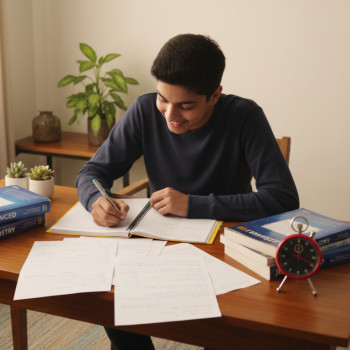
- Prepare your test station: uncluttered desk, clock visible, OMR sheet (or mock interface) ready.
- Materials ready: pencil/pen as required, rough sheets, scientific calculator only if allowed by your exam rules.
- Mindset: set a single, measurable goal for the mock (e.g., “score target: +10 over last mock in Chemistry” or “reduce silly errors by half”).
- Hydration and light snack: avoid heavy meals right before the mock; fatigue kills accuracy more than speed.
During the mock: pacing and real‑time problem‑solving tactics
How you approach the 3‑hour window dramatically affects both score and the quality of the learning you’ll get afterwards.
- First pass in 60–80% of allotted time: answer easy and medium questions quickly; mark difficult ones for review.
- Don’t chase time on a single problem: if a question is taking too long, flag it and move on.
- Intentional guessing: your strategy should reflect negative marking. If you can eliminate one or two options confidently, guessing may be advantageous; if not, leave it for the review pass.
- OMR discipline: mark answers carefully and consistently. Many students lose points by misaligning bubbles late in the test when fatigue accumulates.
- Rough work management: keep rough work organized by question number and use it to record quick elimination reasoning; this helps during review and analysis.
After the mock: a structured analysis framework (the heart of improvement)
Improvement happens in the minutes and hours after a mock, not during it. Use a fixed analysis routine so every mock yields comparable data.
Follow these steps immediately after the test:
- Step 1 — Quick debrief (within 30 minutes): note feelings while fresh — where you felt stuck, what ate time, and whether anything unexpected occurred during the test.
- Step 2 — Score and categorize every error: label each wrong answer under a cause (conceptual gap, calculation slip, misread question, OMR/marking error, time pressure).
- Step 3 — Quantify time and accuracy: compute time per attempted question and accuracy by topic (Physics: mechanics, optics; Chemistry: physical, organic; Biology: as applicable).
- Step 4 — Action plan: for each error category assign a corrective drill and a deadline (e.g., rework 10 mechanics problems, redo algebra drills, or practice OMR filling twice a day for a week).
Keep a permanent error log — a simple table you update after every mock. Over several mocks you’ll see trends rather than lucky swings.
Sample analysis table (a template you can use)
| Question # | Subject/Topic | Outcome (Right/Wrong) | Error Type | Action (Drill/Review) |
|---|---|---|---|---|
| 12 | Physics — Kinematics | Wrong | Conceptual (misapplied equation) | Re-read chapter + 8 targeted problems; discuss with tutor |
| 38 | Chemistry — Physical | Wrong | Calculation slip | Timed calculation drills (10 per day) + mental arithmetic practice |
Turning analysis into faster problem solving
Data without execution is noise. Convert patterns into practice like this:
- If careless arithmetic is a frequent error, cut down on computations by improving estimation and approximation skills. Train to check units and use quick sanity checks.
- If a topic repeatedly shows low accuracy, create a short mastery block (3–5 focused study sessions) before returning to mixed mocks.
- If time runs out regularly on a section, practice micro‑timed sets: 10 questions in 20 minutes to simulate pressure and force faster decision trees.
Micro‑mocks and drills: the multiplier effect
Not every practice session needs to be three hours. Micro‑mocks and topic drills let you focus on specific error types that full tests expose. Examples:
- 20‑minute algebra blitz to fix weak algebra fluency.
- Single‑subject 45‑minute mock focused on optics or equilibrium problems.
- Timed OMR drills to practice consistent marking under fatigue.
These short, repeated challenges reduce the cognitive load during full mocks because they turn once‑novel problems into automatic responses.
How to use trends and statistics — simple metrics that matter
Use a few simple statistics to measure progress. You don’t need fancy tools — a spreadsheet and honesty will do.
- Moving average score across the last 5 mocks: smooths out one bad day.
- Topic accuracy rate: percent correct in each chapter across the last 3 mocks.
- Time per correct answer: total time spent on correctly answered questions / number of correct attempts — a lower value means faster, more efficient solving.
Set small, achievable targets for each metric. For example, aim to reduce time per correct answer in a weaker topic by 10–15% over two weeks.
How coaching and one‑on‑one guidance speed the loop
When you’re analyzing every mock, expert feedback can accelerate correction. Personalized support is valuable for:
- Pinpointing subtle conceptual confusions you miss in self‑review.
- Designing drills tailored to your specific error profile rather than generic practice.
- Providing accountability and faster iteration: you fix an error on Monday and test the fix the next mock, rather than letting the mistake persist.
That’s why targeted help can be worth the investment. For example, Sparkl‘s approach pairs one‑on‑one guidance with tailored study plans and AI‑driven insights so every mock produces a sharper correction plan.
Common mistakes students make with mock tests
- Taking too many mocks without analyzing them properly — practice without analysis is busywork.
- Chasing raw scores instead of fixing underlying causes: a better score with the same error patterns is fragile.
- Ignoring OMR and answer‑recording practice until the last minute — small marking errors add up.
- Assuming partial credit in MCQs — treat them as all‑or‑nothing unless told otherwise.
Sample 3‑hour mock timeline (how to pace your real test)
| Time Window | Activity | Goal |
|---|---|---|
| 0–60 minutes | First pass: attempt all easy and medium questions | Secure quick points, avoid deep dives |
| 60–150 minutes | Second pass: work on flagged questions and some tougher ones | Convert flagged questions with fresh perspective |
| 150–170 minutes | Targeted time for hardest questions you can solve | Try only those with a clear path to solution |
| 170–180 minutes | Final sweep and OMR check | Correct any misalignments and fill remaining bubbles carefully |
Bringing real‑world context into problem solving
Athletes, pilots, and chess players all train under simulated pressure because skill under calm practice doesn’t always hold up in competition. The same principle applies to mock tests: train in conditions that resemble the real environment and the skill transfers. That means time pressure, decision-making under uncertainty, and disciplined procedures like OMR‑style answer recording.

Final checklist: make every mock count
- Replicate exam conditions for accuracy of measurement.
- Set one clear goal before each mock (time, accuracy, or reduction of a specific error type).
- Immediately record feelings and quick notes after the test — they are often the most honest data.
- Use a fixed analysis routine to categorize and fix errors.
- Convert analysis into short, targeted drills; then re‑test to confirm the fix.
- Consider one‑on‑one guidance to speed up diagnosis and corrective practice when you’re stuck.
Mock tests are not a scoreboard only — they are a measurement system. The students who improve most rapidly are those who treat mocks as experiments: design the experiment, run it under controlled conditions, record outcomes, identify root causes, and then run the next experiment with a refined method. Over time that scientific approach turns weak topics into strengths, reduces careless errors, and trains you to make the right decision under time pressure.
Take the data, design the drill, and let repetition do the rest.














No Comments
Leave a comment Cancel