
Why mock tests are the fastest path to a better Chemistry score
If you want a sharper Chemistry score, mock tests are not an optional extra — they are the engine. A well-designed mock shows you, in real time, where your understanding is rock-solid and where it’s paper-thin. Mock tests do more than measure: they train timing, decision-making, OMR discipline and the mental stamina you need for a 3-hour full-length mock practice that mirrors exam conditions.

Think of each mock as an experiment. You make a hypothesis about your preparation, run an experiment (the mock), collect data (scores, time per question, topic-wise errors) and then adapt. That loop — test, analyze, adapt — is what separates students who keep improving from students who repeat the same mistakes.
Understand the exam reality: format, scoring and what to assume
Chemistry in major entrance testing today is objective in nature. That means multiple-choice formats, the pressure of negative marking, and strict OMR discipline for scanned answer sheets. Because many cycles adjust specifics, treat the mock as your primary source of truth: simulate the current cycle’s pattern and rules when you practice.
- MCQ-based testing demands clear answer choices and elimination skills — not essay-style partial credit.
- Negative marking penalizes blind guessing; your mock should include the same negative-marking rule so you learn risk-aware guessing.
- OMR discipline matters: consistent, careful bubbling at speed reduces avoidable losses.
- Diagrams, derivations and rough-work are learning tools — they help you secure correct answers, but they don’t earn partial marks by themselves in objective tests.
Design a mock-test schedule that drives steady gains
Mocks have different jobs depending on your stage. Early on, they’re diagnosis tools; closer to the exam, they become simulation and stamina-building. Below is a simple, adaptable template you can tailor to your own timeline.
| Stage | Frequency (full 3-hour mocks) | Focus | Goal |
|---|---|---|---|
| Foundation | 1 every 10–14 days | Topic diagnosis + concept clarity | Map weak topics and question-types |
| Consolidation | 1 every 7 days | Time management + accuracy | Reduce silly mistakes, improve speed |
| Peak simulation | 2 per week (one full, one focused) | Full simulation + section drills | Stamina, consistent score under time |
Remember: a mock is useful only if you analyze it. A raw score without a correction plan is entertainment, not preparation.
Before the mock: a short, surgical checklist
Spend 30–60 minutes preparing before a full mock. Small moves pay big dividends:
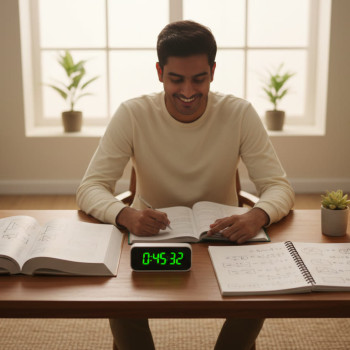
- Set up a quiet space, timer, calculator if allowed, rough paper and a comfortable chair.
- Warm up with a 15–20 minute targeted drill: a set of quick inorganic recall or 5 calculation problems in physical chemistry to get your brain in gear.
- Keep a one-page formula sheet and a one-page reaction-summary that you review the night before — not new learning on test day.
- Sleep and nutrition: a rested brain is consistently faster at problem-solving and less prone to silly slips that cost marks.
During the mock: strategy, time-splits and OMR discipline
How you use the 3 hours is more important than how many hours you spent studying overall. The test-room habits you form in mocks will be the habits you use in the actual exam.
Here is a sequencing strategy that many students find practical in mixed-subject, time-limited tests. Adapt according to your strengths:
- First pass (45–60 minutes): Rapid sweep for low-hanging fruit. Solve every chemistry question that is clearly within 60–90 seconds. Mark others for review.
- Second pass (60–75 minutes): Tackle medium-difficulty chemistry questions and time-consuming calculations. Use rough-work liberally for physical chemistry; write short mechanism bones for organic cues.
- Final pass (remaining time): Attempt the hardest or risky questions only if elimination increases your confidence to acceptable levels.
On negative marking: practice a conservative guessing rule during mocks. A common heuristic is to guess only when elimination leaves you with a probability that beats the negative-mark risk — and you must translate that into practice rather than theory. Your mock’s analytics should show whether conservative or slightly aggressive strategies work better for you.
OMR discipline is mechanical but crucial. In a mock, rehearse this exactly as in the real test: mark answers on a separate answer sheet while you solve, then bubble in the final answer in a calm, consistent flow. Avoid mid-test mass-bubbling unless it’s part of your practiced rhythm.
After the mock: a ruthless, compassionate analysis ritual
Immediate analysis is where marks are made. Do not wait days. The following ritual turns a score into improvements.
- Step 1 — Record raw metrics: total score, time taken per chemistry question (average), accuracy rate in chemistry, and number of attempted vs skipped chemistry questions.
- Step 2 — Categorize every error: conceptual gap, careless arithmetic, misreading the stem, time shortage, or OMR/bubbling error.
- Step 3 — Make a one-line remediation plan for each error type: rewrite the concept, do 10 similar questions, or create a flashcard for recall items.
- Step 4 — Schedule micro-practice sessions that fix the two most frequent error categories before the next mock.
| Metric | What to record | Action |
|---|---|---|
| Total Chemistry score | Raw marks + accuracy | Set a 5–10% improvement target by next mock |
| Topic misses | List (Physical, Organic, Inorganic) | Schedule focused drills for weakest topic |
| Mistake type | Careless / Conceptual / Calculation | Prescribe targeted practice (e.g., timed calculations for calculation errors) |
Turning mistakes into a training plan: topic-by-topic tactics
Chemistry has three broad pillars — physical, organic and inorganic — and each responds to mock-driven practice differently.
Physical Chemistry
Why mistakes happen: rushed setups, weak unit-awareness, and flubbed algebra. How to fix it:
- Convert every wrong physical question into a micro-lesson: what was the missing concept? Was it a sign error, wrong unit, or misapplied formula?
- Create a 10-problem drill for each recurring weak area (e.g., thermodynamics numericals, equilibrium problems). Time each set and aim to reduce average time by 20% over two weeks.
- Practice structured rough-work: write variables clearly, include units, and box final answers so they are easy to transfer to the OMR sheet.
Organic Chemistry
Why mistakes happen: reaction patterns not recognized, over-complicating simple MCQs, and shaky reagent recall.
- Build reaction-clusters: group reagents that behave similarly and drill recognition with flashcards or quick 5-question sets.
- For mechanism-based traps, sketch only the crucial bond changes during a mock rather than a full mechanism; it’s faster and often enough to pick the right MCQ option.
- Use mock errors to compile a one-page ‘mechanism cues’ sheet for rapid pre-test review.
Inorganic Chemistry
Why mistakes happen: poor recall and mixing up facts. How to fix it:
- Turn memory into retrieval practice: store facts as Q/A flashcards and test daily in 5–10 minute bursts.
- For coordination chemistry and periodic trends, draw quick comparison tables as you study — these become exam-ready mental maps when you’re under pressure.
- Use mock failures to identify the one inorganic sub-topic that loses you marks most often, and convert that into a 7-day focused recall sprint.
Example: converting one mistake into a measurable win
Suppose two mocks in a row show mistakes in equilibrium calculations in physical chemistry. Your plan should look like this:
- Day 1: Re-study the equilibrium concept and common pitfalls (30–45 minutes).
- Day 2–4: Do 12 targeted equilibrium problems with timers; aim to reduce time per question by 25%.
- Day 5: Take a 20-minute mixed quiz that includes 6 equilibrium problems to test retention.
- Next mock: measure whether equilibrium mistakes dropped and whether average solve time improved.
Common pitfalls and quick fixes
- Reading the question incorrectly: underline what’s asked before options — practice this in every mock.
- Careless arithmetic: write intermediate steps clearly; if a question is lengthy, mark it for review on the first pass.
- Over-reliance on memory for organic reagents: learn patterns rather than isolated facts.
- Random guessing under negative marking: practice elimination and confidence thresholds in mocks; make decisions under timed pressure during practice.
Leverage analytics, tutoring and focused feedback
Raw scores are only the start. Analytics that show topic-wise performance, time per question, and error patterns convert practice into progress. If you choose to bring in external help, prioritize personalized feedback: one-size-fits-all advice is often the reason talented students plateau.
For example, pairing targeted mock analytics with one-on-one guidance can speed up correction cycles. A blended approach that includes tailored study plans, focused 1-on-1 sessions for stubborn topics and AI-driven insights into weak patterns shortens the gap between doing a mock and improving next time. This is why some students find value in targeted tutoring; for example, Sparkl’s personalized tutoring combines guided remediation with data-backed practice plans that feed directly from mock performance.
How to measure progress meaningfully (not just score-chasing)
Tracking your raw score is natural, but the more reliable signals of improvement are consistency, reduction in repeat mistakes, and better time management. Use a simple weekly tracker that records these five items:
- Topic-wise accuracy (% correct) for Chemistry sub-sections.
- Average time per chemistry question.
- Silly-error count (questions lost to reading mistakes or OMR errors).
- Number of high-confidence guesses (and their success rate).
- Improvement actions completed (number of focused drills, flashcards reviewed).
Sample two-month improvement roadmap (compact)
| Week | Mock focus | Daily micro-work | Target |
|---|---|---|---|
| Weeks 1–2 | Diagnostic full mock + topic mapping | 30–40 minutes of focused drills (weak topic) | Map top 3 problem areas |
| Weeks 3–4 | Weekly full mock + topic drills | 40–60 minutes a day; flashcards for inorganic | Reduce silly errors by 30% |
| Weeks 5–8 | Two full mocks per week; simulate exam day routines | Mixed timed sets and revision sheets | Consistent score with lower variance |
Mindset, stamina and exam temperament
Mocks also train your emotional responses. A 3-hour mock will reveal when fatigue causes mistakes. Build stamina by gradually increasing the number of full simulations each week, and practice recovery techniques: short breathwork between sections, a 60-second reset when panic sets in, and predetermined rules for when to skip and return to a question.
Final checklist for every mock
- Simulate the full test environment for at least one mock per week (no phone, no interruptions).
- Time every question and record averages.
- Analyze immediately and make a two-point corrective plan before the next mock.
- Convert repeated mistakes into a daily micro-practice habit until they stop appearing in successive mocks.
The path to a better Chemistry score is not mysterious. It’s the steady application of realistic mocks, honest analysis, and targeted correction. Use every mock as a learning cycle: simulate honestly, analyze ruthlessly, and practice with purpose. This approach — combined with focused tools and, where helpful, personalized guidance — turns mock results into higher, more reliable scores.
Consistent test simulation, targeted remediation driven by mock analytics, and topic-specific drills for physical, organic and inorganic chemistry form the academic roadmap to improvement. Endeavor to make each mock a deliberate experiment whose results you convert into precise study actions, and your Chemistry score will reflect that disciplined progress.



















No Comments
Leave a comment Cancel