
When a low mock feels like a verdict — and why it isn’t
It stings. You sit up after the results pop up, scan the score, and feel the air go out of the room. But here’s the honest, useful truth: a low mock score is not a sentence — it’s the clearest feedback you will ever get. Mocks tell you exactly where you lost time, confidence, and marks. The difference between a student who panics and a student who improves is simple: one treats the mock like a label, the other treats it like data.

Mock-test mindset: simulation before solution
Before we dive into practical steps, adopt one non-negotiable rule: every full-length mock must be treated as the real exam. That means the same 3-hour duration, the same break habits, strict adherence to the answer-marking method you will use on exam day (OMR or CBT interface), and an environment that mimics exam pressure. If you are training your brain under real conditions, your performance in the actual exam won’t be a surprise — it will be familiar.
Quick checklist: what “real exam” simulation includes
- Full 3-hour timed test with a single, uninterrupted run (except for the controlled breaks you’d take on exam day).
- Strict answer-selection discipline: no second-guessing questions once you’ve clicked/marked them, unless you allocate time in the final review.
- Accurate marking behavior: practice the OMR or CBT clicking style you will use, because small habits with marking cause big errors.
- Note-taking only on rough sheets — don’t rewrite solutions during the mock; preserve exam conditions.
The 48-hour audit: immediate and ruthless post-mock analysis
The most valuable time after a mock is the first 48 hours. Use this window for a calm, structured audit — not a day of aimless re-solving. The goal here is to convert every disappointment into a specific fix. Don’t rewrite whole chapters; isolate problems and prescribe micro-actions.
Step-by-step audit process
- First pass (within 6–12 hours): mark every question you attempted as correct/incorrect/suspect. Don’t re-solve — record only your outcome and your immediate feeling about why it went wrong.
- Second pass (within 24–48 hours): for each incorrect/suspect question, write down the root cause in one line: conceptual gap, careless arithmetic, misread question, time-runout, wrong approach, or unfamiliar topic.
- Third pass: convert each root cause into an action: micro-lesson, 10 focused practice problems, formula flash-card, or a timed re-solve under 80% time to simulate pressure.
Post-mock analysis template (use this table as your personal log)
| Error type | Count | Root cause | Immediate fix | Target practice (minutes) |
|---|---|---|---|---|
| Careless arithmetic | 5 | Rushed final calculations | Slow final-check routine + unit checks | 30 |
| Conceptual gap | 8 | Weak in topic fundamentals | Short concept notes + 12 practice Qs | 90 |
| Time management | 3 | Poor time allocation per section | Section-timed drills | 60 |
Keep one master spreadsheet or notebook with repeated entries of this template. Over time you will see patterns (same topics, same silly mistakes) and that leads directly to efficient, targeted preparation.
Turn mistakes into micro-goals: the actionable repair plan
Big improvements are the sum of small, consistent changes. Once you have your error log, translate it into micro-goals that are measurable and repeatable. For every error type, choose a corrective action and a timing: what you will do, when, and for how long.
A practical micro-goal framework
- Conceptual Gaps: 45–90 minute focused revision sessions on core theory, followed by 10 graded practice questions (easy → medium → hard).
- Careless Errors: adopt two final-check rituals — quick sanity checks (units, dimensional analysis) and one slow re-do of the final step for any solution you marked as ‘candidate for mistake’.
- Timing Failures: replace one untimed practice session per week with a sectional sprint — e.g., 30 minutes to finish 20 questions under exam constraints.
- Question Selection Errors: practice triage — learn to recognize high-yield questions and avoid low-return traps under time pressure.
Weekly mock cycle: balance simulation, analysis, and focused practice
You need a rhythm that blends full-length simulation with deliberate practice. Here is a sustainable weekly cycle that many students find effective: one full mock, two focused practice days, one problem-synthesis day, and light revision on the rest. Keep the schedule flexible around school or board exams, but keep the cycle intact.
Sample weekly cycle (adapt to personal constraints)
| Day | Primary activity | Goal |
|---|---|---|
| Day 1 | Full-length mock (3 hours) + rough score logging | Simulate exam conditions |
| Day 2 | 48-hour audit + selective re-solve | Root-cause analysis and micro-action plan |
| Day 3 | Targeted topic practice (2 sessions) | Plug conceptual gaps identified in audit |
| Day 4 | Speed/accuracy drills (sectional timed) | Improve pacing under pressure |
| Day 5 | Mixed problem synthesis + light revision | Integrate concepts across subjects |
| Day 6 | Rest or low-intensity recall (flashcards) | Consolidate memory |
| Day 7 | Optional sectional mock or practice set | Fine-tune weak areas |
Consistency beats short-lived intensity. If you can realistically repeat this cycle for several weeks, the cumulative effect will be dramatic.
Mastering negative marking and smart attempt strategy
Mock scores often plummet because students either over-guess or under-attack. The right approach is probabilistic and disciplined: attempt questions where your expected value is positive, skip the rest, and convert near-sure opportunities with calm confidence.
Practical rules for attempts
- High-confidence questions: solve first and secure marks.
- Medium-confidence questions: mark only if you can resolve uncertainty in under 2–3 minutes during the mock’s first pass; otherwise tag and leave for the end review.
- Low-confidence or unfamiliar patterns: do not gamble unless time permits a careful second pass.
Remember, most entrance exams penalize careless guessing. Build an internal confidence meter: if you cannot justify the final answer in one clear thought, it’s safer to skip and save mental energy for higher-probability gains.
OMR/CBT discipline: tiny habits that save marks
How you mark answers is as important as how you solve questions. Many mocks go wrong in the final minutes because students forget to transfer answers properly, mis-click on the CBT, or make marking errors on an OMR. Build micro-habits to prevent this.
OMR/CBT micro-habits
- Every 30 minutes, take a 10-second check to confirm the answer sheet matches your rough-solution list.
- Reserve the last 12–15 minutes for a calm transfer and final sanity checks — do not use these minutes for last-minute solving.
- Practice on the same interface as the real test: if it’s CBT, simulate the electronic workflow; if OMR-like, run a few mock OMR transfers under time pressure.
Build accuracy with deliberate practice: from 1 error to 0
Accuracy comes from repeated, structured work on types of errors. Instead of trudging through 200 random questions, choose sets that address your specific weaknesses: calculus mistakes, kinematics, organic reaction mechanisms, or vector geometry. Focused repetition with immediate feedback rewires how you approach similar questions in future mocks.
How to structure a focused practice session
- Warm-up: 10 minutes of quick formula/flashcard review for the target topic.
- Practice block: 30–60 minutes of 12–20 graded problems (mix of easy→hard).
- Reflection: 15 minutes — record mistakes, rewrite one clear rule that would prevent each mistake, and add one practice problem to your next session.
Use data to drive decisions: metrics that matter
Don’t chase vanity metrics like raw score alone. Track the indicators that predict rank improvement: accuracy percentage, net attempts (quality attempts minus wrongs), sectional balance, and repeat error frequency on the same topics. Watch trends rather than single-test swings.
Simple progress dashboard (track weekly)
- Accuracy % (correct attempts ÷ total attempts)
- Net score trend (simulated exam metric)
- Top 3 repeat error topics (how many times the same error was repeated)
- Average time per question in each section
When personal guidance helps: one-on-one coaching and AI-driven feedback
Many students find breakthrough moments when they pair disciplined practice with tailored feedback. If you prefer focused accountability, consider a setup that offers dedicated mentoring: one-on-one guidance, a study plan crafted around your weak topics, and analytics that point to patterns you might miss alone. For example, Sparkl‘s personalized tutoring includes one-on-one guidance, tailored study plans, expert tutors, and AI-driven insights that help pinpoint recurring mistakes and suggest focused drills. Small, targeted interventions often beat generic volume-based approaches — especially when you are trying to convert a low mock into measurable rank improvement.
Practical examples: small changes, big rank moves
Here are two short, realistic examples of how specific changes translate into marks:
- Example A — Careless corrections: A student loses 8–12 marks per mock from arithmetic and sign errors. Introducing a two-step verification (unit check + sign check) at the end of each solved question reduces those errors and can immediately add 6–10 marks per mock.
- Example B — Better triage: Another student wasted 30 minutes on two medium-difficulty problems. Practicing strict triage (first pass for high-confidence questions, flag medium ones) recovered those 30 minutes for 6–10 additional question attempts, converting into steady net gains.
Common pitfalls and how to avoid them
- Over-correction: Don’t abandon wide practice for micro-fixation on a single topic. Balance targeted repair with continued broad exposure.
- Emotional decision-making: Post-mock reactivity (cramming or skipping practice) stalls progress. Stick to micro-goals and data-driven adjustments.
- Ignoring the final review: Many students spend all time solving and none reviewing. Allocate a fixed final review slot in every mock.
- Confusing volume with quality: Solving hundreds of random problems without analysis won’t fix repeat mistakes. Quality over quantity wins here.
Practical toolkit: templates and daily habits
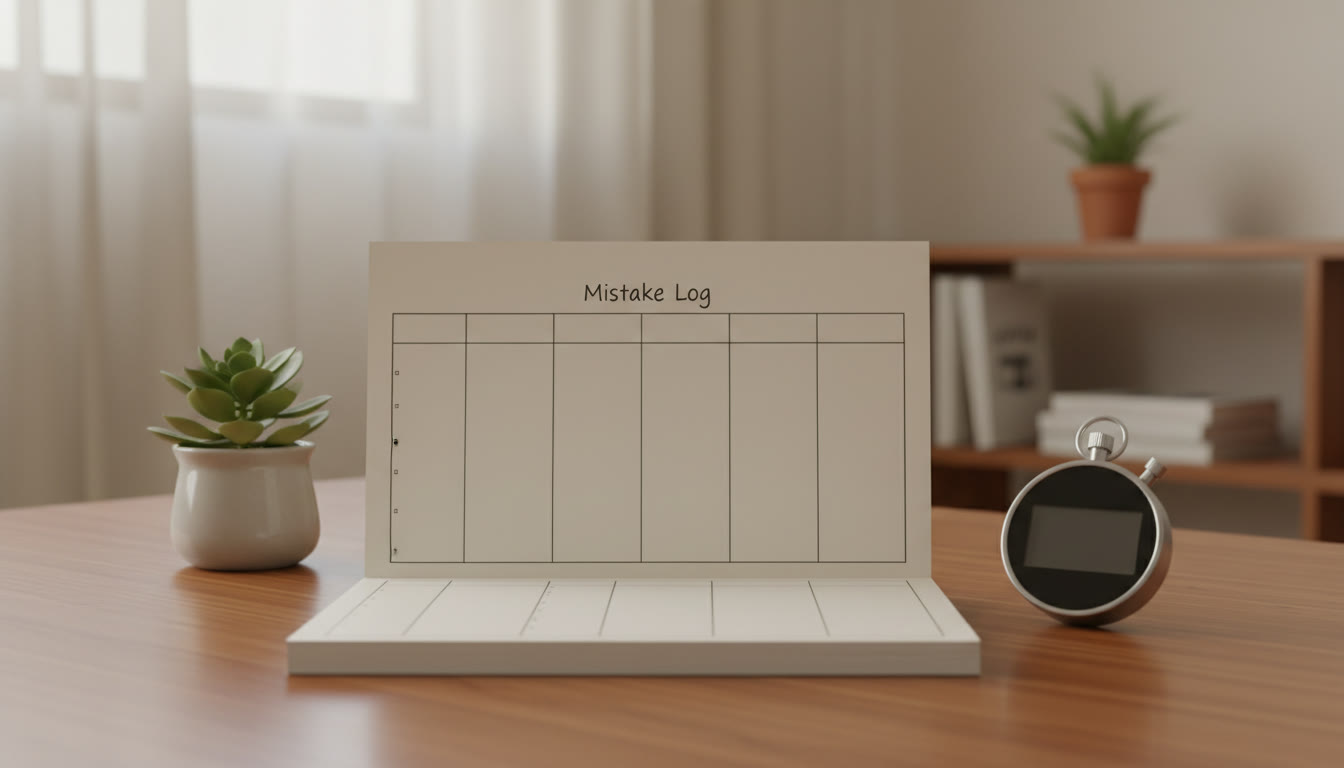
Build a small toolkit you use after every mock: a mistake log, a short formula sheet for quick review, timed sectional drills, and a one-page action plan for the next mock. After every mock, write one sentence that will change your next mock — then make it the only metric you monitor for the next week.
Daily habits that compound
- 20 minutes of formula/flashcard review each morning.
- One timed problem set focused on your weakest topic, five days a week.
- Weekly full mock followed by a 48-hour audit.
- Weekly progress check against your dashboard metrics.
Measuring success: realistic expectations
Improvement is rarely linear. Expect plateaus and occasional regressions — they’re normal. The right expectation is incremental: steady rise in accuracy, smarter attempt selection, and fewer repeat errors on core topics. If you can turn three repeated mistakes into one correct approach per mock cycle, you will see rank movement over time.
Wrapping up: a disciplined, evidence-driven path forward
Low mocks are not failures; they are precise instructions. Treat each mock as an experiment: hypothesize a fix, test it in the next mock cycle, measure results, and repeat. Build an error log, run weekly mock cycles, prioritize high-value corrections, and protect exam habits like OMR/CBT discipline and final reviews. If needed, layer in personalized guidance — a focused mentor or analytics-driven feedback — to accelerate pattern recognition. Over weeks of disciplined, reflective practice, the score plateaus give way to consistent improvements and real rank gains.
Believe in the process: systematic analysis, targeted practice, and disciplined simulation are the academic levers that convert low mock scores into high exam performance.











No Comments
Leave a comment Cancel