

How to Use PYQs for Concept Building
Why PYQs should be your concept gym — not just a shortcut
Think of previous-year questions (PYQs) as the most honest, patient tutor you’ll ever have: they repeat ideas in different disguises, reward clean thinking, and expose conceptual weak spots that textbook drills often hide. If you approach PYQs as a shortcut — memorize patterns, mimic steps — you’ll get short-term gains. If you approach them as instruments for deep learning, each PYQ becomes a compact lesson, a lab experiment for your mind.
This guide walks you through a practical, exam-aligned way to turn PYQs into robust concept anchors. It matches the realities of the current MCQ-based JEE-style testing experience: 3-hour full-length mock practice sessions, negative marking that punishes careless guessing, OMR discipline while filling responses, and the need to master Physics, Chemistry, and Mathematics from first principles rather than by rote.

Start with the right mindset and the right materials
Before you dive in, set up an environment and a mindset that encourage curious reconstruction rather than shortcut replication.
- Collect PYQs by topic, not just by year. That lets you compare how the same concept appears across cycles.
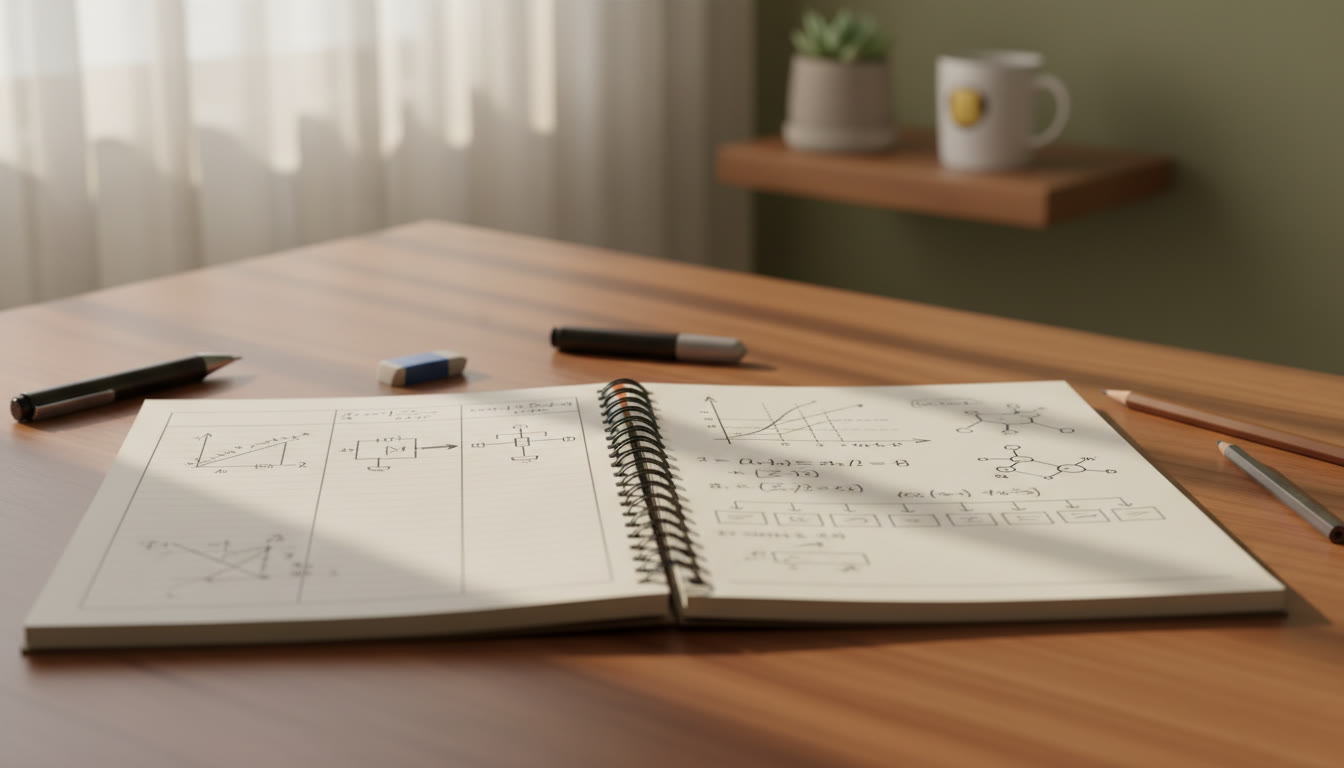
- Keep a dedicated ‘PYQ Notebook’ — a place for one clean solution, one insight, and one next-step practice idea for every question you study.
- Embrace a “why-first” attitude: ask why a certain concept is used, not just how to use it.
- Commit to regular full-length mock sessions (3-hour simulated tests) to practice pacing, stamina, and OMR discipline.
A practical 6-step method to turn PYQs into concept anchors
Use this repeatable routine with every PYQ you study. It’s simple, but consistency turns routine into progress.
- Attempt blind: Try to solve the PYQ without hints. Time it roughly according to its expected difficulty.
- Identify the kernel: After solving (or trying), write down the single core principle the question tests — e.g., conservation of energy, equilibrium condition, substitution trick, oxidation state logic.
- Re-derive the shortest route: Work backward to the minimal logical steps that connect the principle to the answer. This builds transferable reasoning.
- Vary the problem: Change one parameter (sign, limit, dimension, initial condition) and predict how the answer shifts. If you can’t predict, you haven’t internalized the concept yet.
- Write a one-line takeaway: A crisp note that captures the idea in plain words. This becomes your flashcard text later.
- Test immediately: Create a 2–3 minute micro-quiz using the variation you made. This closes the learning loop in the short term.
How to reverse-engineer a PYQ — a compact example
Say a Physics MCQ asks for the final speed of a block sliding down a frictionless incline connected to a pulley system. A rote solver might hunt for formulas. A concept-builder does this:
- Pinpoint the kernel: energy conservation or work–energy theorem.
- Draw the simplest free-body diagram and label energy states (initial PE, final KE).
- Re-derive: equate PE loss to KE gain. Check units and sign conventions.
- Vary: what if a small friction is introduced? Does the structure of the solution change (still energy-based, now with work by friction)?
- Close the loop: write a one-line takeaway: “Use energy to bypass complex acceleration equations when non-dissipative forces dominate.”
That process converts one MCQ into a reusable approach you’ll apply to many other problems — that’s the power of PYQs used well.
Subject-specific tactics: turning PYQs into subject knowledge
Physics — visualize the principle, then algebraize
In Physics, a diagram is your thought amplifier. Most PYQs hide a geometric or limiting-case insight. Train yourself to draw the minimal diagram immediately, mark signs, and test extremes (zero, infinity, 90 degrees). Use PYQs to build quick heuristics: when do you prefer energy over Newton’s laws? When is symmetry the fastest path? Each time you justify that choice, you upgrade intuition.
- Cluster PYQs by the underlying principle (conservation, equilibrium, kinematics tricks, rotational analogies).
- Practice edge cases from PYQs: small-angle approximations, high-frequency limits, steady-state vs transient.
- Keep a one-line physics “why” for each PYQ — it’s the shortest path to recall under exam pressure.
Chemistry — from facts to explanatory frameworks
Chemistry PYQs reward explanations over recall. Instead of memorizing that a reaction proceeds, build the chain: electronic structure → mechanism → energy profile → observed product. For inorganic and physical chemistry, use PYQs to map recurring trends (oxidation states, coordination preferences, rate-determining steps).
- When a PYQ tests a reagent or product, ask: what conceptual rule links reactant to product?
- Make short mechanism sketches for organic PYQs, and annotate them with the underlying electronic flow (curved arrows in notes, not in exam answers).
- For physical chemistry problems, reconstruct the derivation: does the PYQ rely on an approximation? If yes, know its applicability.
Mathematics — definitions first, then patterns
Use PYQs to identify recurring techniques: substitution tricks, inequality templates, extremum approaches, or common constructions in geometry. Instead of memorizing the trick, extract the defining property that makes the trick work — that’s transferable to novel questions.
- For algebra-based PYQs, isolate the invariants or monotonicity arguments.
- For calculus PYQs, ask which limit or continuity property is the pivot and whether a simpler inequality can replace a heavy derivation.
- Create a short “toolbox” of one-line tests (e.g., check convexity, test monotonicity) derived from PYQs and practice applying them to new problems.
Designing mock cycles with PYQs in mind
Mocks are where your concept-building pays off. Run full-length 3-hour mocks under realistic conditions: strict timing, similar question mix, and disciplined OMR practice. Use PYQs as the backbone of mock revision: pick PYQs from previous cycles as the core warm-up before the mock, and then use the mock to test synthesis.
- Before the mock: 30–45 minutes of targeted PYQs focused on the three topics you find weakest.
- During the mock: simulate OMR discipline (fill bubbles calmly, don’t over-erase, mark question numbers carefully).
- After the mock: immediate 20–30 minute review of mistakes. Use the 6-step method on missed PYQs right away to encode corrections quickly.
Practical table: a weekly PYQ-based plan (6-week cycle)
| Week | Focus | PYQ Activity | Daily Time | Expected Outcome |
|---|---|---|---|---|
| 1 | Foundations | Do 10 PYQs/topic; write one-line kernels | 2–3 hrs | Clear core principles, create flashcards |
| 2 | Application | Vary each PYQ and attempt 2 variations | 2–3 hrs | Transferable techniques |
| 3 | Integration | Mixed-topic PYQ sets; timed mini-tests | 3 hrs | Inter-topic linking |
| 4 | Error correction | Diary of mistakes; targeted rework | 2 hrs | Reduced repeat errors |
| 5 | Exam simulation | One full 3-hour mock + PYQ review | 4–5 hrs | Pacing and OMR habit |
| 6 | Synthesis | Build concept maps from PYQs | 2 hrs | Long-term recall paths |
Track progress with an error diary
Make a compact table in your notebook for every mistake: the question link, the kernel you missed, the reason (careless, concept gap, algebra), and the corrective action. Over weeks, look for clusters — if most mistakes point to one principle, prioritize that principle in the next cycle.
OMR discipline and negative-marking tactics
OMR discipline is a quiet, high-impact skill. A few simple habits protect your score:
- Fill bubbles in one direction consistently; avoid scribbles that the scanner can misread.
- If you change an answer, cross out clearly and fill the new bubble confidently — don’t leave faint marks.
- Reserve guessing for when elimination leaves you with one or two plausible options; negative marking means blind guessing is a losing strategy.
Negative marking forces you to convert uncertainty into structure: if you can identify contradictory options or show one option violates a fundamental property, you’ve created a valid basis to mark safely. A PYQ-focused study habit builds that ability: when you analyze PYQs, practice explicitly removing one distractor at a time and recording why it fails.
Common pitfalls and how to fix them
- Memorizing steps instead of ideas: Fix by re-deriving the shortest logical route from first principles every time.
- Using PYQs only for quick practice: Fix by adding the vary-and-test step after each solved PYQ.
- Ignoring edge cases: Fix by making “what if” variations mandatory — they reveal where a method breaks.
- Poor error logging: Fix by keeping one-line kernels and a habit of weekly review of your diary.
Use technology thoughtfully — where an AI coach helps and where it won’t
Digital tools can speed up diagnosis: pattern recognition, spaced repetition scheduling, and analytics that flag weak concept clusters. When you need a targeted plan or a one-on-one conversation about why a cluster of PYQs keeps tripping you up, personalized tutoring can help convert confusion into a focused plan of attack. For example, Sparkl offers 1-on-1 guidance, tailored study plans, expert tutors, and AI-driven insights that surface the exact concept clusters you should prioritize. You can use such support to accelerate the loop from error to corrected understanding, but always pair digital feedback with your handwritten re-derivations — that’s where real understanding forms.
When to switch from PYQ bootstrapping to synthesis
There’s a time to stop drilling narrowly: when you consistently explain the kernel of a PYQ in one line, predict variations correctly, and solve mixed-topic mini-tests without needing to look up basic facts, you’re ready to synthesize. Move from single-question study to integrated practice: full mocks, mixed-topic timed sets, and creative problem construction where you design new questions by combining kernels.
Quick checklist for a PYQ-focused study session
- Choose 6–10 PYQs by theme; attempt blind.
- Write the kernel and one-line derivation for each.
- Make one variation and test it immediately.
- Log any mistake and the corrective action.
- Review flashcards created from takeaways at the end of the session.
Wrapping up: how regular PYQ practice changes how you think
Studying PYQs the way described here builds a mental economy of concepts — concise kernels, predictable variations, and a habit of immediate correction. Over time, you won’t just remember solutions; you’ll recognize which conceptual tool to pull out the moment you see a question. That shift — from remembering to recognizing — is what turns mock tests into learning accelerators and makes concept-building from PYQs a sustainable, exam-proof strategy.
Use PYQs to practice clear diagrams in Physics, mechanistic frameworks in Chemistry, and definition-first problem-solving in Mathematics. Combine that with disciplined OMR habits, smart negative-marking strategies, and periodic full-length 3-hour mocks to test synthesis. With consistent application of the methods described above, PYQs will stop being a list to memorize and become, instead, the blueprint you use to build reliable, transferrable understanding.
End of article.

























No Comments
Leave a comment Cancel