
JEE Main Book Strategy for the Last 1 Month
The last month before the exam is less about discovering new chemistry tricks or learning a brand-new integration technique and more about sharpening, simplifying, and practicing with surgical precision. Think of this period as the polish phase: remove rough edges, strengthen weak points, and practice under exam-like conditions so that your reflexes — not the memory of a newly read chapter — decide how you answer on test day.

What matters in this month
In practical terms, the final month must respect the actual structure of the test you will face: a multiple-choice (MCQ)-based paper taken under strict time constraints, a single full-length session that is best practiced in a 3-hour mock format, OMR-style answer recording, and negative marking for incorrect responses. There is no partial credit for descriptive explanations in the exam; diagrams, derivations, and neat notes earn you clarity during revision, but not half-marks in the answer sheet. Keep these exam realities at the center of every decision you make about what to read, what to solve, and how to simulate the test environment.
Core principles for book use in the final month
Adopt a principle-driven plan so every hour counts. These principles will guide how you use each book and resource:
- Prioritize depth over breadth: revise a few trusted books thoroughly rather than skimming many.
- Practice under realistic constraints: always include 3-hour full-length mock practice and timed sectional drills.
- Accuracy beats blind attempts: because of negative marking, focus on solving fewer questions correctly rather than many incorrectly.
- Active learning: turn passive reading into active recall — make micro-tests from your notes or book examples.
- Consolidate, don’t cram: in the last month, aim to reinforce and connect, not to learn entire new chapters from scratch.
How to choose which books to carry into the final month
Scale down. Keep 2–3 trusted items per subject on your desk and put the rest away. A minimal, balanced set usually looks like this:
- One conceptual book for clarity and quick revision of fundamentals.
- One problem-practice book heavy on MCQs and previous-year-type questions.
- A compact compilation of previous years’ solved problems and short formula sheets/cheat-sheets you made yourself.
At this point, extra reference texts or encyclopedic volumes become distractions. The faster route to points is disciplined practice from a small, well-understood set of materials.
How to use a single book effectively: a routine
Treat each book as a laboratory. For each chapter you revisit, follow this short loop:
- 15–20 minutes: Quick conceptual revision — read the key definitions, laws, and formulae.
- 30–45 minutes: Solve 5–8 representative problems without support (timed if possible).
- 15 minutes: Check solutions, mark mistakes, and write a one-line correction or trick in your error log.
- 10 minutes: Add critical formulae or steps to your one-page cheat-sheet.
Do this loop rather than finishing chapters top-to-bottom. The loop trains recall and decision-making under pressure — exactly what MCQ exams demand.
A compact 4-week book-focused plan (table)
The following table gives a week-by-week blueprint you can adapt to your strengths and weaknesses. The goal is to cycle between focused revision, heavy practice, mock analysis, and consolidation.
| Week | Primary Focus | Daily Goal (hours) | Mocks/Week | Key Book Tasks |
|---|---|---|---|---|
| Week 1 | Core-concept sweep + identify weak pillars | 6–8 | 2 (1 full-length, 1 sectional) | Finish concept loops for high-weight chapters; build error log |
| Week 2 | Targeted problem practice + speed work | 6–8 | 2–3 (1 full-length) | Practice mixed MCQ sets and previous-year problems; refine formula sheet |
| Week 3 | Full simulation + deep analysis | 5–7 | 2–3 (2 full-length) | Take timed tests, perform full error analysis, stabilize test-taking habits |
| Week 4 | Consolidation & light practice; mental freshness | 4–6 | 1–2 (1 final full-length) | Revise error log, last-minute formula sheet, light timed quizzes |
Notes on the table
The number of hours and mocks should be adapted to your stamina and baseline preparedness. If you are already scoring consistently, focus more on accuracy and OMR discipline; if your scores are fluctuating, increase analysis and reduce raw hours.
Daily micro-plan: a sample day
Structure beats panic. A day when you follow this rhythm will produce better retention than a day spent frantically scanning random chapters.
- 06:00–07:00 — Light revision: formulas and one-page notes (low cognitive load).
- 07:30–10:30 — 3-hour full-length mock (simulate exam conditions and OMR discipline).
- 11:00–12:30 — Immediate analysis of the mock: classify errors and time sinks.
- 13:30–15:30 — Focused book loop on weak topics from the mock (concept + 6 problems).
- 16:30–18:30 — Practice set: sectional speed drills (20–30 questions timed).
- 19:30–20:30 — Revise error log and add one-line corrections; update formula sheet.
- 21:00 — Light reading: organic reaction mechanisms, physics thought experiments, or quick mental math
Mock tests, OMR discipline, and dealing with negative marking
Mocks are the primary instrument of the last month. Use them to train decision-making: when to attempt, when to skip, and how to allocate time across sections. Always sit at least one full-length mock under strict exam rules: no phone, time-boxed breaks, and mark answers on an OMR-style sheet or the test’s interface. This builds muscle memory for the rhythm of three hours.
- OMR discipline: practice filling answers cleanly and double-checking bubbles. Small physical habits — like keeping a steady pen pressure and using margins for scratch — prevent silly errors.
- Negative marking: treat wild guessing as a last resort. Use elimination to convert educated guesses into safer attempts.
- Time strategy: aim to finish the paper once with 10–12 minutes for review; use review time to re-check flagged questions, not to start long new attempts.
Analyzing a mock: the four-step review
- Classify errors: conceptual, careless, time-induced, or application mistakes.
- Isolate patterns: are errors clustered in a chapter or a technique?
- Create corrective drills: 10 focused problems addressing the weakest technique.
- Track recovery: log repeats of the same error type and mark topics as ‘stabilized’ once errors fall below 2 per 10 problems.
Subject-wise book strategy — how to spend your final weeks
Each subject has a slightly different final-month rhythm. The aim is to match book choices to the nature of the subject.
Physics
Physics rewards conceptual clarity and tidy problem setup. Keep one concept book for quick theory revision and one problem book for MCQ practice. Use worked examples to convert narrative explanations into problem-solving steps.
- Prioritize classical mechanics, electricity & magnetism, optics, and modern physics problems that commonly appear in MCQs.
- For each problem, write the ‘first principle’ used — conservation, Newton’s laws, Maxwell relations — on your scratch. That habit converts fuzzy memory into reproducible steps.
Chemistry
Chemistry is three distinct modes in one subject: conceptual recall (inorganic), mechanism recognition (organic), and numerical problem solving (physical). Tailor your book use accordingly: inorganic revision is rote-–pattern-based; organic benefits from quick mechanism sketches and practice; physical needs formula recall and varied numericals.
- Make flashcards for inorganic groups and common reactions; use short timed quizzes for organic reactions and synthesis steps.
- For physical chemistry, practice numerical sets until you can spot the approach in two minutes.
Mathematics
Mathematics is practice and pattern recognition. Your book selection should include a conceptual refresher followed by high-density MCQ practice. In the last month, focus on a handful of recurring chapters and problem types and practice them to improve speed and accuracy.
- Divide questions by type: direct formula application, multi-step reasoning, ingenuity puzzles. Triage your attempts accordingly.
- Maintain a running list of shortcuts, substitutions, and common traps you can glance at before a test.
Fixing a persistent weakness — a worked example
Suppose you repeatedly lose marks in a particular topic, like projectile problems in physics. Use this focused workflow with your book:
- Re-read the conceptual note in your concept book (10–15 minutes).
- Solve two representative examples from the book without peeking at solutions (20–30 minutes).
- Check and write a one-line correction for each mistake in the error log (10 minutes).
- Solve five more MCQs of increasing difficulty on the same topic (30–45 minutes).
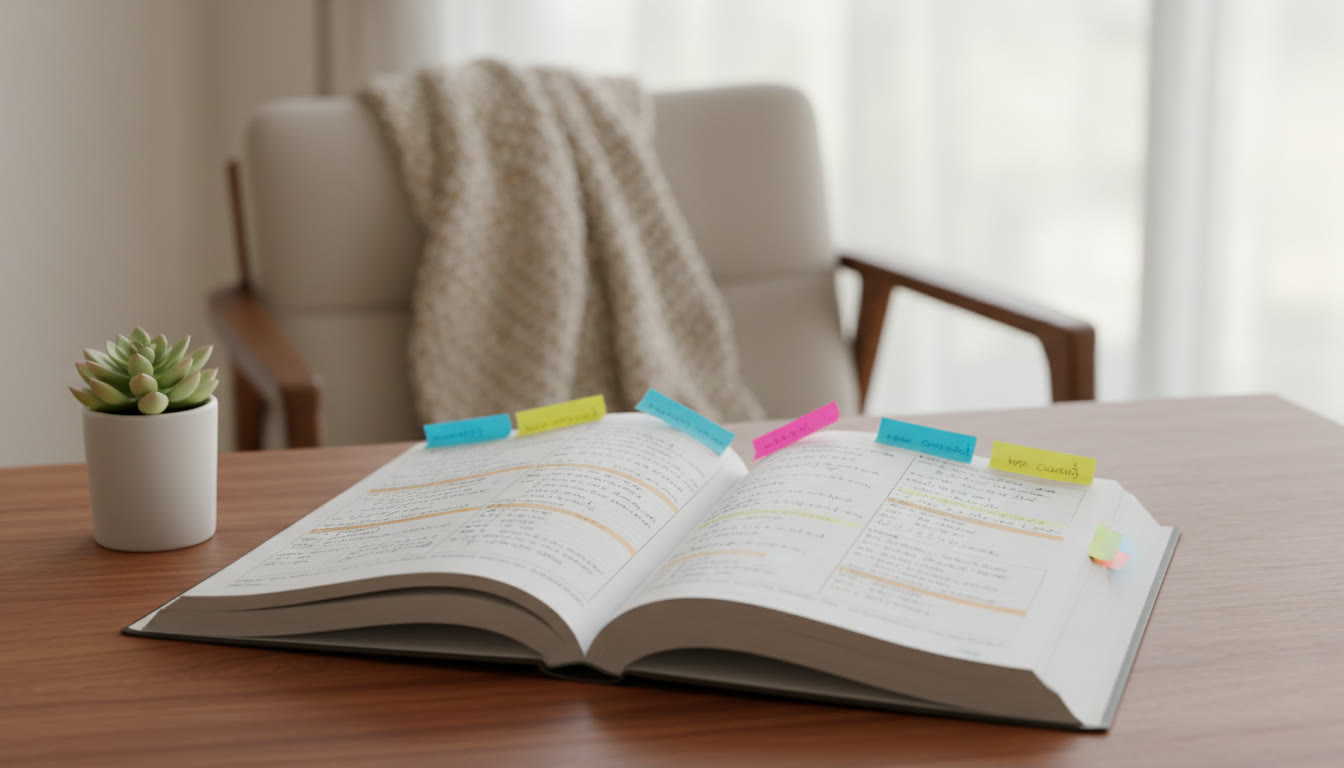
- Place a single sticky note on the book page with the core trick and add the trick to your 1-page sheet.
Repeat the cycle 2–3 times across different days. This turns a weak point into a stabilized skill instead of a forgotten patchwork fix.
Last 72 hours: calm consolidation and checklist
The final three days are for calming the mind, not for last-minute cramming. Follow a tidy checklist:
- Day —3: Take one full-length mock in the morning and do light revision of the top 10 formulas and 10 problem types in the evening.
- Day —2: Quick review of error log and one final timed practice set (60–90 minutes). Sleep early.
- Day —1: Only revisit your one-page formula sheet and run through OMR practice (no heavy study). Prepare logistics for the exam day.
- Night before: light rest, breathing exercises, and clear packing (admit card, ID, stationery, watch if allowed).
Using personalized support in the final month
If you have access to tailored help, use it very selectively. Micro-sessions with a mentor are more valuable now than long conceptual lectures because time is limited. For example, a 30–45 minute 1-on-1 session to clear a persistent doubt, practice an error pattern together, or get a personalized mock analysis can move the needle faster than a long group lecture.
If you choose to use a service, consider features that matter in this stretch: rapid one-on-one guidance for targeted weak topics, tailored study plans that re-map your last 4 weeks based on mock trends, expert tutors who can prioritize high-yield areas, and tools that give quick, AI-driven insights into recurring mistakes. Sparkl‘s personalized tutoring model, for instance, is designed around brief, focused interventions — 1-on-1 guidance, tailored study plans, expert tutors, and AI-driven insights — so each session in the last month fights the specific error patterns you keep repeating.
Mental habits, sleep, and small rituals
Books train the brain; rituals steady it. Keep three non-negotiables in the last month:
- Sleep: maintain consistent sleep hours to ensure fast consolidation of problem patterns you practice.
- Nutrition and short breaks: prevent decision fatigue with small, regular breaks and stable meals.
- Short physical movement and breathing: five minutes of deep breathing or light stretching between study blocks sharpens attention.
Final checklist for the paper
- Practice OMR discipline during mocks: fill answers carefully and double-check bubbles if you have time.
- Use elimination strategies to improve the safety of guesses.
- Follow your pre-decided time allocation and do a single, disciplined review pass with remaining minutes.
- Remember: there is no partial marking for descriptive steps — write neat scratch work but answer by selecting the correct MCQ option.
When you focus your last month on a small set of books, disciplined mocks, error logging, and brief expert interventions that target your stubborn errors, you convert panic into performance. The books become instruments — concept anchors, problem banks, and drill manuals — rather than mountains to be climbed. Work them in loops, keep the test format at the centre of practice, and protect your energy so your performance on the big day is a product of measured preparation, not stress-driven speed.
This closes the academic guidance on a pragmatic, book-driven final month plan for JEE Main preparation.















No Comments
Leave a comment Cancel