

Sharpen Your Focus: Practical Techniques to Improve JEE Main Performance
If you’re preparing for JEE Main, you already know the exam is a sprint-and-marathon mix: speed, accuracy, endurance and clarity. This blog isn’t about generic motivation posters — it’s a down-to-earth, tactical playbook you can use tonight and every week after. We’ll focus on what actually moves scores: deliberate practice, smart mocks, subject-level deep work, and mental habits that keep your momentum steady.

Know the Battlefield: Exam Structure and What Matters
Format, duration and the objective reality
JEE-style exams emphasize objective problem solving. You will face multiple-choice and numerical-answer-style questions; practice under a full-length, uninterrupted three-hour mock to build stamina and timing. Most test formats include negative marking for incorrect objective-type answers, so aim to reduce blind guessing. Whether you practice on paper or on a computer interface, treat every practice session like the real thing — discipline in marking answers and in time use is non-negotiable.
What to treat as non-negotiable
- Clear foundations in Physics, Chemistry and Mathematics — the syllabus coverage is broad, so clarity beats memorized tricks.
- Objective marking rules — there’s usually no partial credit for descriptive answers, so learn to produce correct, concise answers within the objective format.
- Mock-test simulation — full-length timed tests are the single best way to convert learning into performance.
Daily Study: Build a Habit That Scales
Quality over hours — the micro-session approach
It’s tempting to equate study hours with success. Instead, aim for focused micro-sessions: 45–90 minutes of concentrated study with specific outcomes (e.g., finish 6 problems on integration, perfect 20 ionic reactions). Short, intense sessions beat long, distracted stretches. Use a visible timer, remove phone temptations, and keep a single goal for each session.
Spacing and interleaving
Rotate subjects across the day to prevent fatigue and improve retention. For example, study Mathematics in the morning when your mind is sharp for symbolic work, Chemistry mid-day for reading and memory, and Physics later for conceptual problem solving. Interleaving — switching problem types within a subject — strengthens retrieval and helps you recognize patterns faster.
Sample weekly allocation (example)
| Day | Primary Focus | Hours | Sample Tasks |
|---|---|---|---|
| Monday | Mathematics | 4 | Practice calculus problems; revise last week’s errors |
| Tuesday | Physics | 3.5 | Mechanics problem set; conceptual revision notes |
| Wednesday | Chemistry | 3.5 | Physical chemistry numericals; organic reaction practice |
| Thursday | Mixed (All Subjects) | 4 | Short topic tests; weak-topic drill |
| Friday | Mathematics | 4 | Geometry and algebra problem set |
| Saturday | Full-length mock / Revision | 3–4 | Timed full test; detailed error analysis |
| Sunday | Light revision & rest | 2–3 | Formula revision; concept maps; active rest |
Subject-Level Deep Work: How to Practice with Purpose
Physics — build intuition before algebra
Physics rewards mental models. For every topic, write a one-paragraph summary that explains the core idea in plain language. Solve problems by sketching first: free-body diagrams, energy flow, field lines. When you’re stuck, ask: which principle applies? Then map the math. Use dimensional checks and limit cases to verify answers quickly — these tiny habits save time and mistakes during a timed test.
- Create a 3-page “go-to” sheet for each topic (mechanics, E&M, optics) that has formulas and 3 canonical problem templates.
- Practice parameter variations: how does the answer change if mass doubles, or angle halves? That builds deep familiarity.
Chemistry — balance concept, reaction patterns, and numericals
Chemistry is three skills in one: conceptual clarity (inorganic), pattern recognition (organic), and arithmetic accuracy (physical). Build short flashcards for inorganic facts but spend more time on mechanism patterns and numerical problem templates. For organic chemistry, practice reaction sequences until they feel like a small library of building blocks you can rearrange to solve synthesis questions.
- Keep a table of common reagents and their typical transformations.
- Do timed batches of stoichiometry and equilibrium problems to build speed.
Mathematics — deliberate practice on problem classes
Mathematics is pattern mastery plus rigorous practice. Identify 10 classic problems for each chapter (e.g., definite integrals, sequence limits, conic sections) and drill them until you can adapt methods fluently. When learning techniques, practice with gradually increasing difficulty and purposely make mistakes to learn recovery strategies.
- For each chapter, maintain a one-page “method map” listing typical tricks and pitfalls.
- Practice backward: look at answers and work backwards to reconstruct the path — it’s a strong diagnostic method.
Mock Tests, Analytics and Error-Driven Improvement
Why mocks are your truth serum
Mock tests expose the gaps that glad-sounding study sessions hide. Treat each full-length mock like a measurement: sit in exam-like conditions, follow the same time distribution, and practice how you’ll fill answers in the real interface. After each mock, do a structured review — not just re-solving, but analyzing error patterns.
A simple mock-test analysis framework
- Classify each wrong answer as: conceptual gap, calculation slip, careless mistake, or time-pressure error.
- For each mistake type, create a corrective action: revisit the concept, slow down calculations, add check steps, or practice time drills.
- Track how many questions you could have solved with 2 extra minutes — that reveals whether time or understanding is the limiter.
Mock test tracker (example layout)
| Mock # | Total Score (out of full) | Time per Section | Top 3 Error Types | Action Plan |
|---|---|---|---|---|
| 1 | — | Math: 70 min; Phys: 60 min; Chem: 50 min | Careless algebra, weak optics, slow equilibrium | Daily algebra drills, optics concept notes, timed equilibrium sets |
How to Convert Test Data Into Real Growth
Micro-actions after each mock
- Fix the smallest recurring error first. Tiny wins compound.
- Turn tricky questions into a 2–3 step template: when you see pattern X, do A→B→C.
- If a topic repeatedly recurs as a negative factor, schedule a one-week intensive focused only on that topic and its problem types.
Exam-Day Tactics and Answer-Entry Discipline
Time allocation and smart choices
Begin by scanning the paper quickly (or scanning section previews in a computer interface) and mark straightforward problems you can solve quickly. Aim to clear low-hanging fruit in the first pass to build confidence and bank marks. Keep track of time with mini-checkpoints (e.g., after 60 minutes, you should have attempted X good questions). Avoid spending more than 20–30 minutes on a single hard question during your first pass.
OMR/CBT discipline
Even if the official exam is computer-based, practice OMR-like discipline: never make hurried answer changes without re-evaluating the reasoning, and ensure you fill the answer only after you’re satisfied. For pen-and-paper practice, emulate OMR filling carefully: use the right pen, double-check bubbles, and maintain neat markings. For CBT practice, get comfortable with the interface: how to mark for review, how to save answers, and how the timer displays remaining time — these small skills prevent costly fumbles.
Guessing and negative marking
Because objective tests penalize incorrect answers, avoid wild guessing. Use elimination to turn a four-option MCQ into a two-option 50/50, and then decide whether the expected value favors guessing. If negative marking is explicit, do a quick expected-value calculation only when elimination has meaning.
Mindset, Recovery and Sustainable Progress
Burnout prevention and routine resilience
Consistency beats sporadic marathon sessions. Keep basic routines: sleep, short daily exercise, and regular meals. Small habits — a 20-minute walk, a 10-minute breathing break after a hard session — have outsized benefits. When motivation dips, fall back on process: your plan for the day, your mock-test results, and small wins.
Support systems: peers, mentors, and targeted help
Guidance speeds growth when it’s targeted. If you need help converting test data into a study plan or want regular 1-on-1 accountability, consider structured personalized help. For example, Sparkl‘s tailored study plans and expert tutor support can be helpful for students who need bespoke feedback loops — one-on-one guidance, tailored study schedules, and data-driven insights make it easier to translate mistakes into measurable gains.
Weekly Checklist and a 30-Day Focus Roadmap
Weekly checklist (repeat every week)
- Complete at least one full-length timed mock under exam conditions.
- Review every mock with the error-classification framework; write an explicit action plan.
- Finish core topic lists for each subject (e.g., 3 chapters per subject per week in depth).
- Do two speed drills (20 minutes each) for calculation accuracy.
- Reserve a light day for rest and consolidation.
30-day improvement roadmap (sample)
| Week | Goal | Key Actions |
|---|---|---|
| Week 1 | Solidify fundamentals | Daily focused sessions on textbook basics; 1 mock at end of week |
| Week 2 | Problem-class expansion | Target 10 high-yield problem types per subject; timed practice |
| Week 3 | Mock-driven correction | 2 full mocks; deep error analysis and targeted remediation |
| Week 4 | Consolidation & speed | Daily mixed-topic speed drills; synthesis notes for quick revision |
Common Mistakes and How to Stop Them
- Studying without a measurable goal — fix this with weekly metrics (accuracy, time per question, topics cleared).
- Blind repetition of problems — always add variation and gradually increase difficulty.
- Skipping mock review — the test without review is wasted practice.
- Late-night cramming before a mock — prioritize sleep and clarity over last-minute coverage.
Bringing It Together: Your Next 48 Hours
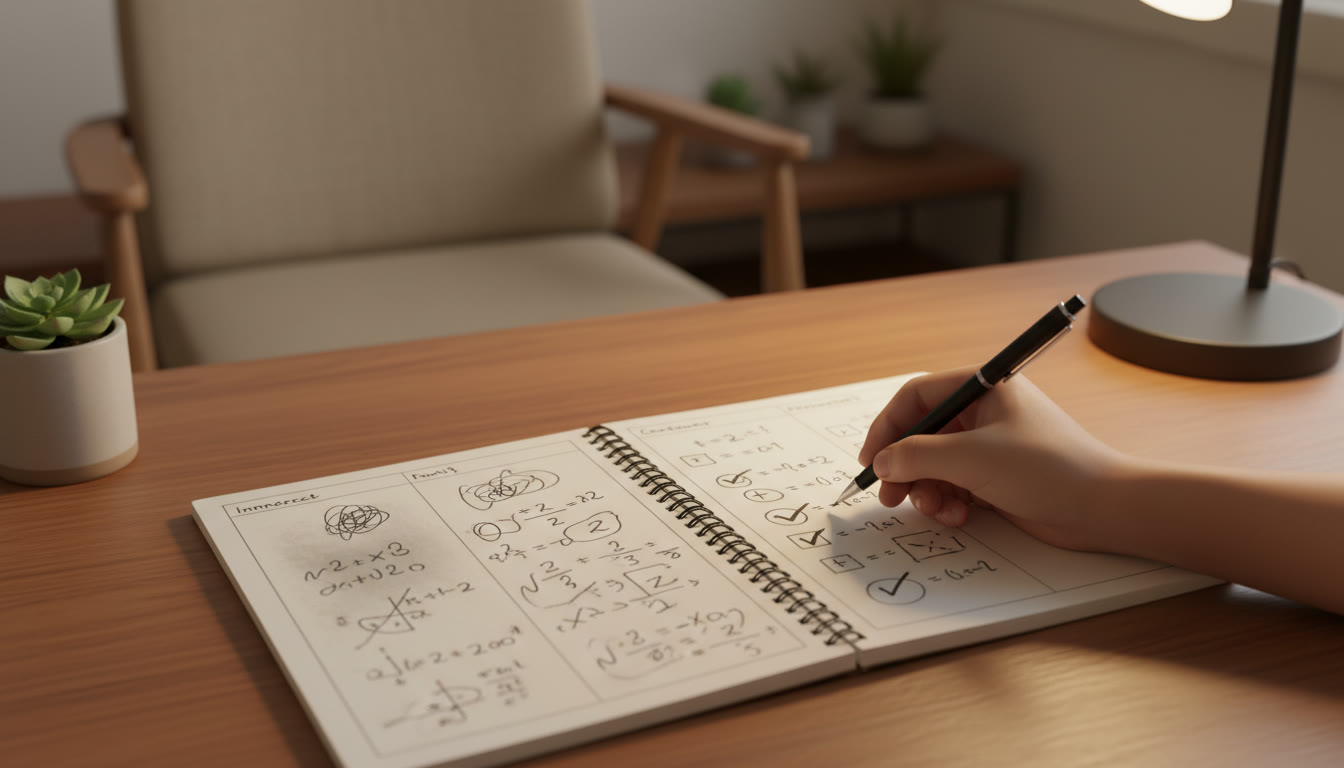
In the next two days, run a focused cycle: pick one weak topic from each subject, do two focused problem sessions on them, take a short timed test (60–90 minutes), and do an error map. That feedback loop — practice, test, analyze, correct — is the engine of steady score increase. Over time, these cycles create a reliable upward slope instead of dramatic plateaus.
Final Academic Note
Improving JEE Main performance is an iterative craft: clarity of fundamentals, strategic mock testing, corrected repetition, and disciplined exam simulation combine to produce consistent gains. Measure frequently, correct specifically, and keep the focus on small, repeatable improvements rather than dramatic last-minute expansions of the syllabus.





















No Comments
Leave a comment Cancel